Tuesday, June 30, 2026

What did Donald Trump do today?

He made his daily $5.5 million, give or take, on something even he calls a "scam."

Trump's financial disclosure forms for 2025 were released today. These documents are not even close to a comprehensive or specific accounting of Trump's wealth, and given that Trump is a convicted felon because of his willingness to lie about his finances, there's reason to doubt he's told the whole truth here. Nevertheless, they do confirm some of the broad brush strokes of how sharply Trump's wealth has increased since he returned to office, and where some of it is coming.

The topline result is that Trump's net worth increased by about $2,200,000,000 in 2025, with the majority of it, $1.4 billion, coming from cryptocurrency sales and marketing. Trump called cryptocurrency a "scam" before he was able to use his resurgent political career to get into selling it.  

Trump's crypto revenue comes from two sources. One is a novelty coin, $TRUMP, which is a kind of thing usually referred to as a "shitcoin" by crypto enthusiasts: something built from the ground up not for security or ease of use or a peg to real-world value, but purely to buy low and sell high. Virtually all of the investors in $TRUMP have lost money, as the token has lost 95% of its initial value as of today.


Even by the Wild West standards of the crypto industry, Trump's tokens come with strings attached that make them a terrible prospect for buyers. The terms mean that every transaction, no matter who is involved, generates a fee for Trump—giving him an incentive to churn the market every so often, which he's done from the White House.

The other source is the profits from World Liberty Financial, a Trump-owned company that sells other digital tokens. It appears to exist mostly as a vehicle for bribes and influence-buying. The United Arab Emirates bought a 49% stake in the company immediately on Trump's return to office, essentially gifting him about $500 million dollars. Last year, Trump pardoned a Chinese billionaire for money laundering—but only after the recipient's company agreed to take financing on an unrelated project in Trump's crypto tokens, which made Trump millions of dollars in processing fees. A different crypto mogul saw his fraud case set aside by Trump's DOJ after he bought $90 million in Trump coins.

The figures released today do not count quasi-official pass-through "gifts" by foreign countries to entities Trump controls. One example is the $400 million luxury plane Qatar gave him to use as Air Force One came with a stipulation that Trump could retain use of it through his presidential library after leaving office. Likewise, it doesn't include the multi-billion-dollar budget of the so-called "Board of Peace" he created, funded exclusively by foreign countries with authoritarian governments. The charter of that organization gives Trump himself, not the sitting President of the United States, control of it in perpetuity.

Trump's daily take from his crypto business works out to about $5.5 million, or roughly 3.5 times what the median American earns in an entire lifetime.
 

Why does this matter?

  • It's really bad that the sitting President of the United States is treating the country like a pig-butchering scam.   
  • Just because the corruption happens every day doesn't make it better.
  • It's wrong to sell pardons, for crypto tokens or real money.

Monday, June 29, 2026

What did Donald Trump do today?

He self-soothed on social media, telling himself he was popular and everyone liked his "State Fair" debacle.

Trump was up early this morning, posting to social media as he does most of the day, most days. Some of his posts concerned serious matters of state: for example, he insisted in all caps that "IRAN HAS REQUESTED A MEETING" and that it would "TAKE PLACE TOMORROW IN DOHA." Iran says that no such meeting was asked for and none is taking place: "We will not have any negotiation meetings at any level with the American side in the coming days."


Other posts dealt with the Supreme Court rulings, in particular ones he lost. He complained bitterly about a ruling saying that ballots mailed on or before Election Day must be counted in elections. (That's not a typo; that's his actual stance.) And he insisted that a ruling that he couldn't fire a member of the Federal Reserve Board for no reason didn't really mean what it said. (Trump is trying to fire Fed Governor Lisa Cook so that he can replace her himself and appoint someone who will vote for lower interest rates. That would make the present high-inflation environment much worse, but Trump would stand to make hundreds of millions or billions of dollars from bond investments and mortgage refinancing on his properties.)

He neglected to mention one other loss he suffered today, when the Supreme Court denied his final appeal of the $5 million verdict against him for defamation. A jury found that Trump lied and defamed Carroll by falsely denying that he had raped her.

But the main theme was emotional self-care. He posted that he was getting his "Highest Poll Numbers Ever." He's been insisting frequently in recent days that his "REAL POLL NUMBERS" are higher than they've ever been. Trump has a long history of declaring how universally beloved he imagines himself to be, particularly when his polls are at their worst, and the present climate is no exception. He's matched or beaten his all-time low in approval polls taken in the past week.


He also found a new crowd size to worry about. In a post at 6:27 AM, he asked this surprisingly plaintive question:

Do you think people appreciate what a fantastic job we did in building and operating the Great American State Fair at the National Mall, packed with happy people, and everybody loving it?
Trump has been reeling from a series of embarrassments over his "Great American State Fair." It started with virtually all of its musical acts cancelling after learning that they'd been hired for a partisan political event run by the pro-Trump "Freedom 250" organization, rather than an official (and politically neutral) "America 250" event. (And one of the few remaining acts, 90s novelty rap act Vanilla Ice, was rained out.)

But more recently, the GASF has attracted attention for the lack of attention it's getting. It fills up most of the National Mall, which on summer days is normally packed with tourists taking in the Capitol, the Smithsonian museums, and the various monuments. But there has been an uncanny absence of people during the GASF's run. That's been driven in part by Trump's unpopularity, in part by the lack of entertainment, and in part by the incredibly slapdash and underwhelming attractions.

There is a single Ferris wheel. There are food stands marked with pictures of food that isn't being sold there. There are tiny booths meant to showcase each state, but some are empty and some are just odd. There is a plywood and vinyl-sticker replica of the arch Trump wants to build, which is deteriorating in the rain and propped up level by scrap wood. And most of all, there is a lot of green space.

TMZ DC with perhaps the most brutal video from Trump's Great American State Fair, showing Dr. Oz on stage bragging to Dean Cain about how big the crowd is, only for the reporter to pan around and show absolutely nobody is there. Original post: x.com/i/status/207...

[image or embed]

— Justin Baragona (@justinbaragona.bsky.social) June 29, 2026 at 4:39 PM


Did the rapture happen overnight? Fox & Friends is broadcasting from a completely empty Trump state fair on the National Mall

[image or embed]

— Aaron Rupar (@atrupar.com) June 29, 2026 at 7:27 AM


my god

[image or embed]

— huck mason (@tylerhuckabee.bsky.social) June 30, 2026 at 1:48 PM

Peter Doocy claims "people are still coming out" to Trump's 250th fair -- even as the camera shot shows clearly behind him that almost nobody is there 😆

[image or embed]

— Aaron Rupar (@atrupar.com) June 28, 2026 at 10:38 AM


Don’t have to worry about fighting crowds at the Great American State Fair in D.C. One fair attendee comments: “I’ve seen bigger crowds in the waiting room for a colonoscopy”

[image or embed]

— Gwyllm Llwydd (@gwyllm.bsky.social) June 27, 2026 at 5:08 PM


Why does this matter?

  • Presidents are allowed to have emotional needs, but there is such a thing as being too emotionally unstable for the job. 

Sunday, June 28, 2026

What did Donald Trump do today?

He made golf a top presidential priority.

Trump spends almost every weekend at one of his private golf resorts. (Formerly an avid player, Trump's time at those resorts is now closed to the press, and it's not clear if his fragile health allows him to play at all.) Today, though, he visited the East Potomac Golf Links in order to promote his plan to give it—as he put it—"the ability to host Major Golf Tournaments, including The U.S. Open, The Ryder Cup, The PGA Championship, and other top PGA Tour events." 

That wouldn't be good news for the locals who actually use the course now, and who would likely be priced out of one of the few affordable DC-area courses if Trump's renovation plans go into effect.

The Trump administration is attempting to seize control of the East Potomac course from the National Links Trust, a nonprofit that had administered them on behalf of the National Parks Service. The reason that Trump gave at the time was that the Trust was in default on its lease, which it disputes. Meanwhile, East Potomac has been in the news for other reasons recently: it's where Trump dumped the construction waste from his demolition of the East Wing of the White House. Heavy metals are leaching into the soil as a result. 

This is the second time in a month that Trump has made golf course renovations a priority. Three weeks ago, he railed at the Democratic governor of Maryland for supposedly holding up improvements to courses at an Air Force base. In reality, the state hadn't done anything to stop the project.

Today's motorcade to the course, which appears to have been hastily arranged, also drove around the site where Trump plans to build what he calls a "triumphal arch." Along with the ballroom he's trying to build on the ruins of the East Wing, and his ongoing attempts to undo the damage he's done to the reflecting pool in front of the Lincoln Memorial, the arch is another pet project he's become fixated on since returning to office. He's taken to carrying around models of it to show people.

From his motorcade, Trump may have been able to see the National Mall, where a cheap plywood scale model of the planned arch was on display at his poorly-attended "National State Fair."


Why does this matter?

  • None of the things Trump is obsessing over—golf courses, arches, ballrooms, or anything else—are important in any way, much less the sort of thing a president should be spending time and energy on.

Saturday, June 27, 2026

What did Donald Trump do today?

He once again lost control of his "ceasefire."

There were escalating tit-for-tat attacks between the United States and Iran today. They began late Thursday as Iran fired on and damaged a Taiwan-flagged ship after warning vessels not to proceed through without the regime's permission. The United States launched airstrikes on Iranian targets in return, after which Iran used drones to attack targets in Bahrain. The United States responded again this evening with another wave of airstrikes.

Neither side appears to have done much serious damage, but that works to Iran's advantage. Its remaining military targets are concealed, mobile, or hardened. Commercial ships and refineries in the Gulf region, however, are inherently vulnerable to the low-cost, high-volume attacks Iran has been relying on.

The point of Iran's initial strike was to demonstrate that it can and will enforce its newfound control of the Strait of Hormuz. It's not necessary for Iran to destroy or seize vessels to make that point, and the companies that ship through the strait know it. Traffic, which had been proceeding at a fraction of its prewar levels, immediately ground to a near-halt after the attack on the first ship.

In other words, the situation has more or less regressed to—or failed to advance from—exactly where it was before the memorandum of understanding was signed. Both sides are conducting attacks without regard for the "ceasefire" Trump unilaterally declared in April, and the Strait of Hormuz remains effectively closed.

Trump is falling right back into his old habits, too, rattling his saber on social media in the apparent hope that this time it will work. He posted this at 7:13 PM this evening: 

United States aircraft just struck Iranian missile and drone storage locations, and coastal radar sites, for violating the Cease Fire Agreement, AGAIN! It is very possible that they will never learn! There may come a point when we are no longer able to be reasonable, and will be forced to militarily complete the job that we very successfully started. If that happens, the Islamic Republic of Iran will no longer exist! President DJT  

This may work emotional self-soothing on Trump's part, but as brinksmanship goes, it's a pretty empty threat. Trump has already learned the hard way that the military regime controlling the country cannot be bombed out of existence. Iran is much too large, rugged, and populous to be invaded. Trump has already tried to extricate himself from the war by promising to commit literal war crimes against Iran's civilian population—something he could at least plausibly try to do, if Congress or military leaders didn't stop him—but has always backed down from those threats, too.

Part of Iran's boldness likely has to do with the fact that, once the memorandum (generally understood to be a humiliating concession on Trump's part) was signed, he openly admitted that he was desperate to avoid the looming "economic catastrophe" that would come with the Strait of Hormuz remaining closed.
 

Why does this matter?

  • As a general rule, threats to defeat the enemy you've already tried and failed to defeat don't work.  
  • Whether or not Donald Trump is capable of admitting it to himself, his handling of this war was an unmitigated catastrophe. 

Friday, June 26, 2026

What did Donald Trump do today?

He accused his political opponents of doing what he's on tape trying to do to the 2020 elections.

Today, addressing a conservative political group, Trump said this about the Americans who conduct state elections, whom he believes are engaged in a conspiracy against him:

And you know what they do, they cheat. "How many votes do we need, how many votes?" That's why they take their time. "How many votes do we need? Okay, here they are." Honestly, it's terrible. We're a third-world country with elections.

Trump does know something about dragging out elections to determine a precise number of "votes we need." 

On January 2, 2021, Trump called Georgia's Republican secretary of state Brad Raffensberger and Ryan Germany, a lawyer representing that office. Raffensberger, as head of the state election process, had tabulated votes showing that Joe Biden had won the state by a margin of 2,473,633 votes to Trump's 2,461,854. The margin of 11,779 votes made it a close call, within a quarter of a percent of the total votes cast, but by then every vote had already been hand-recounted in accordance with state law, and all of Trump's legal appeals had been dismissed. 

During the call, which was recorded by a Raffensberger aide (transcript), Trump veered between bluster and desperate pleading. Most of it was a rehashing of absurd claims already rejected by state and federal courts. (Trump lost every election lawsuit filed on his behalf in Georgia, not counting those he voluntarily dropped for lack of evidence.)

For example, he promised Raffensberger that he would soon release alleged evidence of a "tremendous number" of fake votes cast for Biden, emphasizing the exact margin by which he trailed Biden.

Trump: Another tremendous number. We’re going to have an accurate number over the next two days with certified accountants. But an accurate number — and that’s people that went to vote and they were told they can’t vote because they’ve already been voted for. And it’s a very sad thing. They walked out complaining. But the number’s large. We’ll have it for you. But it’s much more than the number of 11,779 that’s — The current margin is only 11,779. Brad, I think you agree with that, right? That’s something I think everyone — at least that’s’ a number that everyone agrees on. 

He insisted that votes from a Biden-leaning precinct had been counted three times.

Trump: I’m telling you, “Where’s [name] ” was one of the hot items …[name] They knew her. “Where’s [name]?” So Brad, there can be no justification for that. And I you know, I give everybody the benefit of the doubt. But that was — And Brad, why did they put the votes in three times? You know, they put ‘em in three times.

Raffensperger: Mr. President, they did not put that. We did an audit of that and we proved conclusively that they were not scanned three times.

At several points, Trump demanded that Raffensberger change the vote totals because, he said, his rallies in the state had been better attended than Biden's.

Trump: We won very substantially in Georgia. You even see it by rally size, frankly. We’d be getting 25-30,000 people a rally and the competition would get less than 100 people. And it never made sense.

…And I could tell you by our rallies. I could tell you by the rally I’m having on Monday night, the place, they already have lines of people standing out front waiting. It’s just not possible to have lost Georgia. It's not possible.

He threatened Raffensberger and his office's attorney with criminal charges if they didn't do what he wanted:

Trump: And you are going to find that they are — which is totally illegal, it is more illegal for you than it is for them because, you know what they did and you’re not reporting it. That’s a criminal, that’s a criminal offense. And you can’t let that happen. That’s a big risk to you and to Ryan, your lawyer. And that’s a big risk. 

And, finally, he told Raffensberger exactly what he expected him to do:

Trump: So look. All I want to do is this. I just want to find 11,780 votes, which is one more than we have because we won the state. 

…So what are we going to do here folks? I only need 11,000 votes. Fellas, I need 11,000 votes. Give me a break.

Trump was impeached for this and other attempts to illegally overturn the results of the election, which Joe Biden won in the electoral college by 303-232, and in the popular vote by just over seven million votes. Trump was also criminally indicted in Georgia, and as the case was not brought to trial before he was elected in 2024, remains liable for prosecution there if and when he leaves office again.

Accusing other people of things he himself has done is a very, very common tactic for Trump. It's one he's used to try to distract attention away from impeachment-level scandals, like colluding with hostile foreign powers to interfere in elections, to trivial things like the embarrassing fiasco of his Reflection Pool renovations.

Why does this matter?

  • This one doesn't really need any explanation.

Thursday, June 25, 2026

What did Donald Trump do today?

He said what Americans struggling to buy a house needed was for him to make more money.

Trump was asked today about his decision to hold a popular bipartisan housing bill hostage to a quixotic attempt to get his so-called "SAVE Act" elections bill passed. But rather than answer in terms of his strategy to force Republicans to take a poison-pill vote on a bill that would make it more difficult for their own constituents to cast legal votes, Trump pivoted to the idea that affordable housing is a bad thing.

TRUMP: I said I'm not signing that housing bill, I wanna see what happens with SAVE. Look, the housing bill is — housing — I, I made billions of dollars with housing, I know housing better than anybody, maybe, anywhere. It's all about the interest rate. Lower the interest rates, you can have all the housing you want.

But you to understand, I don't wanna have — I don't wanna hurt people that own houses, too. These people for the first time in their lives have valuable houses. They've become rich. I don't wanna hurt them either. What you wanna do, what — good for everyone, get the interest rates down.  

In other words, Trump's theory is that it's better for housing prices to go up, rather than down, because it's more important for people who already own houses to be "rich" on paper than it is for houses to be affordable for more Americans.

It's hard to overstate how divorced from the financial reality of most Americans this is. Houses aren't precious collectibles that people hoard to profit from their scarcity. The vast majority of Americans who own a house own only one, and don't really benefit much from rising market prices, since the prices of houses they'd move into go up at similar rates.

What's more, lowering interest rates will raise inflation which would be a disaster for Americans already struggling to buy basic necessities, much less houses. That's why, in all likelihood, the Federal Reserve's next move will be to raise rates.

But there is one kind of person who would benefit from lowering interest rates: someone like Donald Trump, who has bought hundreds of millions of dollars in bonds since returning to office, and whose businesses own properties that are heavily mortgaged. Bond prices go up as rates go down, so a sudden drop in interest rates would create an instant windfall profit for Trump. 

Trump campaigned specifically on the issue of making housing more affordable—not less—for first-time buyers. 

Why does this matter?

  • "It's bad for houses to be affordable" is a frankly insane thing for a president to believe.    
  • Making government policy based on what's good for a politician's personal bottom line is corruption.

Wednesday, June 24, 2026

What did Donald Trump do today?

He threw a tantrum.

In an extremely rare moment of bipartisan agreement, Congress has passed a substantial piece of legislation aimed at improving Americans' ability to buy homes. A majority of both parties voted for the bill in both chambers. The shortage in housing has been a major driver of inflation. 

Trump was expected to sign the bill this afternoon. A signing ceremony for bipartisan legislation on an important topic might have provided him with an opportunity to change the subject. At the moment, most of his press is about the economic and military catastrophe of his war on Iran, or the withering mockery he's getting over his increasingly absurd attempts to shift blame for the presence of algae in the Lincoln Memorial reflecting pool.

But just before he attended a tense meeting with Senate Republicans, who have started to abandon him on key issues, he posted an ultimatum: no housing bill until his pet election bill, the so-called "SAVE" Act, is passed.

Today’s Housing News Conference and Signing is hereby cancelled until such time as we pass the desperately needed SAVE AMERICA ACT, which I consider to be a National Emergency. Thank you for your attention to this matter! President DJT 

There's a slight problem with Trump trying to block bills this way, though: his signature isn't necessary. While Congress is in session, any bill sent to him becomes law automatically after 10 days (Sundays excluded) unless he explicitly vetoes it.  


Even if Trump did veto it, the bill passed with more votes than would be needed to override Trump's veto. 

This isn't the first time Trump has tried this tactic: back in March, he swore he wouldn't sign a single bill until the SAVE Act was passed. Congress ignored his attempt at a presidential filibuster, and he signed the defense funding bill he was threatening as soon as it was passed.

The SAVE Act would instantly disenfranchise tens of millions of legitimate voters, if it were allowed by courts to go into effect—which it almost certainly wouldn't. It would require voters to show not only photo ID like a driver's license, but also "documentary proof of citizenship," which in most cases would mean either a passport or a birth certificate matching their current legal name.

That means that, for example, a married woman who took her husband's name and didn't have a passport would not only have to be able to present her original birth certificate, but also court paperwork for her name change. Many people simply don't have those documents handy, or have lost them over the years, and getting replacements can take months. Anyone in that situation would be unable to vote in the 2026 elections.  

It would also ban mail-in ballots entirely, a system that nine states use as the main method of voting, and which all fifty states use to some extent. For example, it would completely disenfranchise voters in nursing homes or hospitals, or who were away from home during the early voting period in their local district. 

Why does this matter?

  • American citizens being able to vote in American elections is not a "national emergency." 
  • A president who chooses to throw a temper tantrum rather than sign a bill he wants to become law isn't emotionally stable enough for the job.   
  • There's only one reason a politician tries to make it hard for citizens to vote.

Tuesday, June 23, 2026

What did Donald Trump do today?

He bragged about political interference in an election he probably didn't even bother actually doing.

Trump told an audience in Pennsylvania today that he had called the US Attorney in California and asked him to "take a look" at the primary election for governor in that state. "Do me a favor, take a look" Trump said he asked Bill Essayli, adding that "about an hour later" Republican Steve Hilton had "won." “Had I not made that call, Steve Hilton would be watching the election from home,” Trump claimed. 

There's really no way to know if Trump actually did make such a call. If he did, it would be a blatant abuse of his power to try to interfere in a sovereign state election where nobody actually involved—including Hilton—has suggested federal laws were being broken.

If Trump was lying, it was probably to suggest that he has the ability to influence state elections or disregard results he doesn't like. That was, in effect, what got him indicted in Georgia, when he alternately threatened and pleaded with state election officials there in a recorded phone call in early January 2021, asking them to "find" 11,780 votes for him—the number he trailed Joe Biden by. 

It's worth noting that Trump was trying to sell bizarre conspiracy theories about the California elections on the night of the primary too, even after it was quite clear that Hilton would have enough votes to finish in the top two. 

In reality, neither Trump nor the DOJ has any ability to dictate the results of California elections, or to pressure officials there to "find" that the right candidates have been selected. 

Hilton didn't "win" the primary, but he did come in second, which in California's system means he and the top vote-getter, Rep. Xavier Becerra, will advance to the general election in November. 


Why does this matter?

  • Americans don't need Donald Trump's permission to hold elections or vote for the candidates of their choice. 
  • Using state power to make sure the leader's candidates win elections is what dictators do.  

Monday, June 22, 2026

What did Donald Trump do today?

He talked tough about how Iran was "supposed" to use its war profits to buy American, then folded on sanctions.

Trump was asked today about the fact that the framework agreement he signed commits the United States to pay out hundreds of billions of dollars which could be used to rearm and rebuild its military. He responded that they weren't "supposed to be doing that," and that they were "supposed" to be buying food with it. 

To be clear, there is absolutely no doubt whatsoever that Iran will use the money it receives from the Trump administration to rebuild its military. It has willing suppliers in Russia, China, and North Korea. While its most effective weapons against the United States and its allies—as well as the critical threat it was able to levy against commercial traffic through the Strait of Hormuz—were relatively cheap drones and short-range missiles, that money will go a long way towards rearming and developing new models.

The government of Iran is effectively a military junta, one that has already been strengthened by Trump's attack, which killed the legitimate and potentially robust protest movement that had been gaining momentum before the war. Better funding for the rank-and-file will shore up the regime's control at street-level. Iran had been spending between $5 and $10 billion per year on its military in recent years, so the Trump windfall will enable massive spending not previously possible in a country otherwise wracked by economic sanctions.

Trump insisted that Iran is already buying American corn and soybeans, "exclusively from us. This is not even remotely true. Iran does not consume much in the way of corn (about 12% per capita what the United States does) and its soybean use, which is primarily for livestock feed, comes mostly from Brazil

Trump has frequently hyped "deals" with other countries in which they agree to vague and unenforceable promises to buy American goods at some point in the future, in exchange for real concessions in the present. This was a new twist: insisting that a hostile nation had agreed to buy American even as it directly contradicted him. Iran's agriculture minister made clear that his government had made no such promise and was under no obligation to abide by any restrictions Trump might put on the funds the United States will release to Iran.

A better sign of where the leverage is in these negotiations came from something Trump did today, rather than said: he ended more economic sanctions against Iran, making it easier for the regime to sell its oil.

Why does this matter?

  • Hostile foreign countries will always do what's in their own best interests, not what they're "supposed to" do to help Donald Trump politically. 
  • That's especially true when they've effectively just won a war against you.  

Sunday, June 21, 2026

What did Donald Trump do today?

He hallucinated.

Trump, or someone with access to his account, posted Father's Day greetings to his boutique social media site today. It was relatively brief and subdued by Trump's standards: he normally takes the opportunity in his holiday posts to attack his political enemies or just Americans in general. In its (relative) normalcy, it also contrasted sharply with a post he'd made the night before:


Trump's Pre-Father's Day Post About Blonde Woman Sparks Confusion: 'Great Daughter. My Honor!!!' 

The woman pictured is—pretty obviously—neither of his daughters. 

It's still not confirmed who she is, but there are some clues. The furniture strongly suggests that the setting is Camp David, the Maryland presidential retreat where Trump just happened to be last night. The blanket shows the state seal of Arkansas, and the phone and other details (like the fact that this is a scan of a print, not a native digital photograph) suggest that it was taken in the 1990s, during President Clinton's term. If so, there's a good chance that the woman is Stephanie Streett, a White House aide at the time and now director of Clinton's foundation. 

“President Clinton is proud to acknowledge our home state of Arkansas and  the many hometown communities that helped shape his vision for America.”,  -Stephanie S. Streett, executive director of the ...
Stephanie S. Streett in a much more recent photo

Others have theorized that it might be an old picture of one of Trump's billionaire donors, and that the message possibly refers to that woman's daughter, who is chair of a local Republican group in New York City.

Mistaking strangers for close friends or family members is a common symptom of dementia. Because one of the coping strategies that people experiencing cognitive decline use is to make guesses based on context, Trump may have been confused by the picture matching the very setting he was in last night, one he associates with his term in office. Seeing a picture of a woman with very light blonde hair may have been enough to convince him that she was his daughter Ivanka. 

Besides the hair color, neither Ivanka nor Tiffany otherwise closely resemble the woman pictured.

That wasn't the only bizarre and obvious misstatement Trump, who entered his ninth decade this month, made today on social media. He also claimed to have inspected the damage to the reflecting pool on the National Mall today.

Work will begin immediately on fixing the seriously vandalized Reflecting Pool. I just inspected it, and could only say to myself, and those gathered around me, WOW, who would do such a thing? SICK, DERANGED PEOPLE! We will fix it?
The question mark at the end is in the original, and given the slapdash and corrupt approach taken to putting the coating down in the first place, some doubt about whether the pool will get fixed seems appropriate.

Of course, Trump—who is followed everywhere by the White House press pool—did no such thing. He went from Camp David to Andrews AFB via helicopter, and then straight to the White House via motorcade.

The process of "remembering" events that didn't happen, especially if they involve piecing together things a person can remember—like thinking about the reflecting pool, and traveling near it—is called confabulation. It is another symptom of dementia that manifests while a patient is still able to communicate verbally.

Trump told any number of other lies today—that the economy is doing well, that the Strait of Hormuz is open—but those are, at least, lies with an obvious political motive, one that can be explained by a coherent and deliberate plan to deceive. Mistaking a stranger for one of his daughters or imagining that he was a place he wasn't are harder to explain that way.

Why does this matter?

  • It's a bad sign when a president's normal uncontrollable urge to lie and exaggerate is what passes for good news about his mental state. 
  • Under any other circumstances, Trump would be resting comfortably in a memory care unit.

Saturday, June 20, 2026

What did Donald Trump do today?

He got mad that people noticed he'd made a mistake that covered eight acres of downtown Washington.


The reflecting pool in front of the Lincoln Memorial is attracting more attention than usual, as curious sightseers take in its algae-laden, bright green water. And as of today, Trump—who has spent much of the day ranting conspiracy theories about vandals—is deploying the National Guard and police to harass them.

Took this video of a guy getting detained and a citation for putting his hand in the water an hour ago.

[image or embed]

— amanda moore 🐢 (@noturtlesoup17.bsky.social) June 20, 2026 at 5:47 PM

The reason Trump is incensed to the point of trying to have tourists put in prison for (allegedly) even touching the water is, of course, that he just finished spending tens of millions of taxpayer dollars on a slapdash, no-bid "renovation" and bragging about the beautiful "American flag blue" that the pool would be when he was done. 

When work began in May, Trump boasted that he'd put his personal "pool guys" on it, apparently on the theory that hotel swimming pools and the multi-acre granite surface of the reflecting pool were interchangeable. The White House quickly backed off of that story, given the obvious corruption of handing a no-bid contract to a Trump crony who, as it turned out, had no experience whatsoever with projects of this nature. 

It was reported earlier this week that another contractor, also owned a Trump donor and Mar-a-Lago patron, got a separate no-bid contract to install water purification systems. The owner, John J. Cafaro, is no stranger to government corruption: he was previously convicted of bribing then-Rep. James Traficant of Ohio. Amusingly, the name of that company is "Greenwater Services."

Some degree of algae was always common in the pool: it is a large, shallow, warm body of stagnant water. Algae will always grow under those conditions. But Trump's hasty and technically incompetent repairs appear to have super-charged this particular bloom. The textured sprayed-on coating, which experts are pointing out is exactly the wrong sealant to have used for a large flat surface, is an ideal growth medium for algae. And filling the whole pool at once with phosphate-rich DC tap water gave the algae plenty of nutrients.

The concentrated hydrogen peroxide that armies of workers started adding this week hasn't done much to kill the algae, although it has given the pool a an appearance reminiscent of a Mark Rothko or Ellsworth Kelly painting.


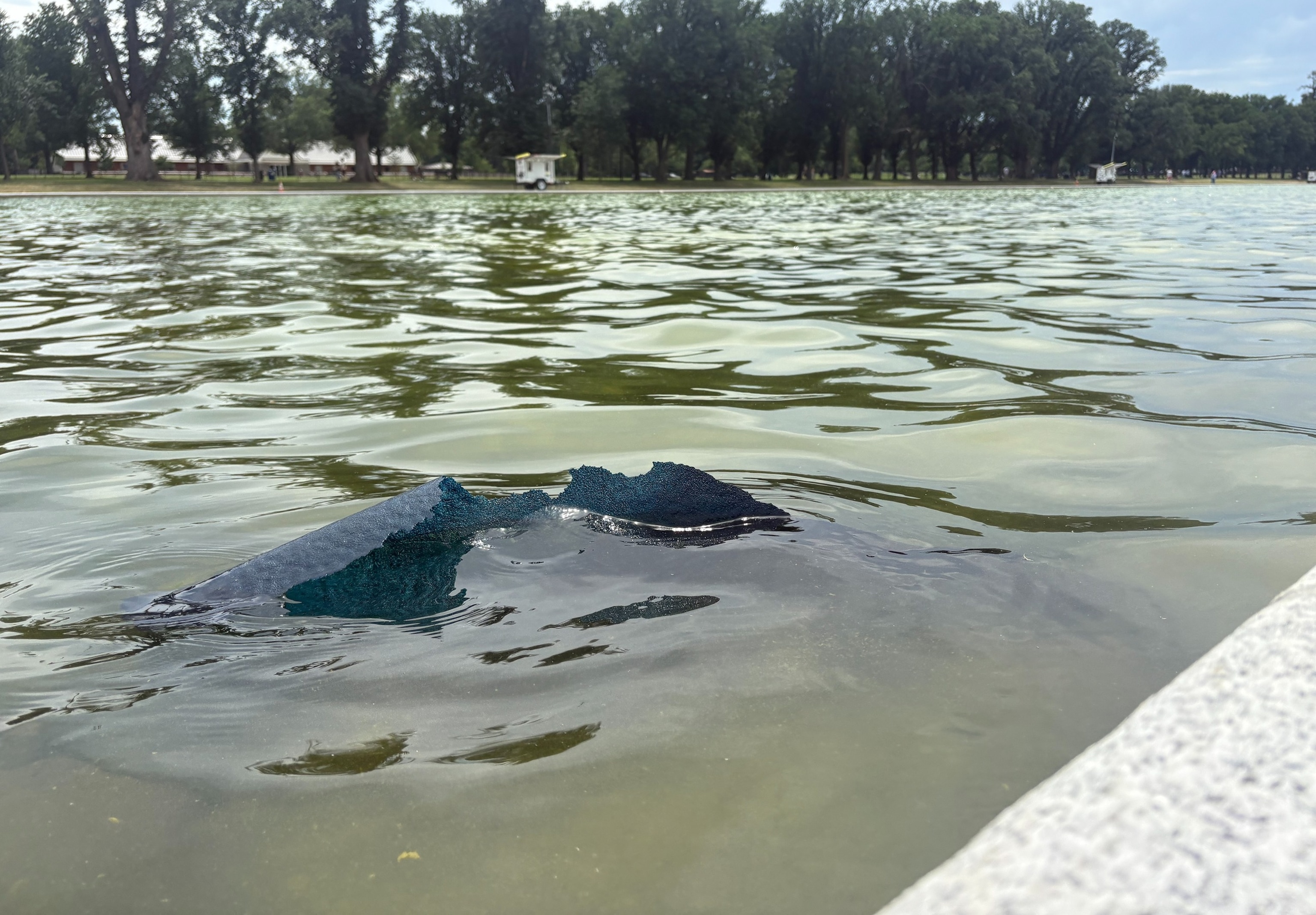
It may, however, be the reason that the coating is now peeling up so quickly around the edges, with large chunks of it floating loose. (It is touching, or seeming to touch, these bits of debris that Trump is now having people arrested for.)

Some of the Lincoln Memorial Reflecting Pool liner appears to be falling  apart - ABC News
A dark blue piece of the liner floats in murky green water within reach of the edge of the Reflecting Pool.

Trump, who reacts badly to embarrassment, has grown increasingly shrill in his posts about the pool throughout the day. By 4 PM, he was crowing about the arrests for the "serious crimes" related to "the Destruction of National Monuments," and asking "who would do such a thing? He continued posting through the evening about nonexistent "vandalism" and imaginary "250-foot" gashes in the lining, before finally admitting that the pool would have to be drained once again to fix the lining.

Trump destroyed the entire East Wing of the White House last summer, after pardoning the insurrectionist supporters who broke windows and doors to invade the Capitol Buidling and, among other things, smear their own shit all over the floor.

The East Wing of the White House is gone. Here's a look at some of the  history made there. - POLITICO 

Why does this matter?

  • It is not a federal crime to notice that Donald Trump screwed something up. 
  • It is not a crime to touch the water at the Lincoln Memorial Reflecting Pool, although it's not the most sanitary thing to do.
  • The underlying reason in this case might be comically stupid, but arresting people for embarrassing the leader is what fascist regimes do. 
  • You don't spend all day telling lies this obvious unless you're delusional, or you think the people listening are incredibly stupid. 

Friday, June 19, 2026

What did Donald Trump do today?

He fumed helplessly as his "understanding" with Iran fell apart.

The "memorandum of understanding" that Trump signed is, almost word for word, the exact same 14-point set of demands that Iran made in early May. At the time, Trump rejected it out of hand, claiming that he wasn't at all worried about the economic consequences of Iran's successful blockade of the critical Strait of Hormuz, through which 20% of the world's oil supply flows.

Six weeks later, signed memorandum in hand, Trump lashed out at "stupid" people saying he'd made a terrible deal, who he accused of not understanding that a worldwide depression was imminent if the Strait didn't reopen. 

It's generally considered a bad idea to openly admit that you're bargaining from a position of weakness. But given that global oil reserves are almost completely empty, setting up an unprecedented oil shock, he's probably right about that. As Trump put it with unusual clarity at the G7 summit on Wednesday, "You want to see bedlam? We run out of reserves in about four weeks." 

To Trump's enormous relief, Iran finally allowed a slight increase in traffic through the strait, to about 20% of the prewar daily volume.

And then today, three nations—Iran and two at least notional allies—threw the process into chaos again. Iran announced that it was once again imposing a blockade on the Strait of Hormuz, and then abruptly reversed course. (UPDATE, 6/20: as of Saturday morning, Iran announced that the Strait was closed again.) 

The reason the Iranian government gave was that Israel has continued to bomb Lebanon, and the end of that campaign was a precondition for Iran. Israel's government, which helped goad Trump into starting the war in the first place, has adamantly refused to be bound by the terms Trump accepted. That means that Iran has already started to drive a wedge between the United States and its main military ally in the Middle East.

Meanwhile, France said it would withhold its approval on the UN Security Council for any relaxation of sanctions against Iran. The end of those sanctions and UN approval is also part of Iran's demands. France's concern, likely to be echoed by the United Kingdom, which is also a Security Council member, is that Trump is acting as precipitously to escape the war at any cost as he did in unilaterally declaring it. That intervention, while probably a good thing for the United States in the long run, will mean Trump will have even less control over the peace process in the meantime.

Direct negotiations between the United States and Iran, scheduled to begin today in Switzerland, have been canceled.

Trump's response to all of the above was to retreat to the emotional safe space of declaring on social media that it was Iran, not him, who was desperate and defeated.

Why does this matter?

  • No amount of tweeting through it is going to change the situation here. 
  • Thinking an enemy nation won't fight back with every tool at its disposal is why Trump lost the war in the first place.  

Thursday, June 18, 2026

What did Donald Trump do today?

He said there were "no limits" on his power.

Trump's "peace deal" with Iran is receiving contemptuous reviews from essentially everyone not currently working for Trump. Israeli officials are calling it a "catastrophic capitulation." Republicans in Congress are saying it's Trump surrendering to Iran, not the other way around. Even Iran—which is already getting what it wants—is openly mocking Trump for agreeing to their terms, calling Trump's signature on the memorandum a "glorious defeat."

Asked what he'd learned today about the limits of his power, Trump simply responded that there aren't any. More precisely, he said, "I haven’t learned that lesson yet. I know there are [sic], but there are no limits." 

This is more or less what Trump has been saying all along: that as president, he can do whatever he wants, that he can stretch his promise to be a "dictator for a day" as far as he likes. That's not a popular position in a country that thinks of itself as a democracy, and it sparked some of the largest demonstrations in American history.

In reality—and even in practice—there are limits on Trump's power. Even during his second term, when he made a point of installing people purely for their loyalty to him above all other considerations, Trump has struggled to do nearly as much with that authority as he would have liked. (Many of them turned out to be less loyal than he thought they'd be, which is one reason that leaders who appoint people for competence rather than obedience generally get better results.) 

Iran itself is an example of one kind of limit on Trump's power: the Republican-led Congress put no real pressure on him to comply with laws governing when military force can be used, but that legal loophole didn't change the practical reality on the ground that Trump blundered into, leading to the disastrous outcome that those same Republicans are now furious about.

That sort of thing matters because, for all his bluster, Trump is very constrained by political realities. His plan to build a series of concentration camps is already being unwound as a result of public pushback. He was forced to abandon his plan to create a multi-billion-dollar slush fund to reward pro-Trump insurrectionists not by a court decision, but by the furious public reaction

The judiciary, which makes up a co-equal branch of the government that Trump is a part of, retains the ability to act as a check on Trump's power. Trump has been forced to rehire illegally fired government workers. He cannot spend money Congress hasn't appropriated, and he can't refuse to spend money that it has. Probably the most important way that courts have kept Trump from exercising the powers of a dictator has been in the criminal courts. No matter how many of his personal criminal defense attorneys Trump has appointed to key DOJ roles, they cannot create criminal liability where none exists. Judges have thrown out spurious charges selectively targeted at opposition politicians. Grand juries have refused to indict Trump's enemies for imaginary politically-motivated accusations. Trial juries have refused to convict protestors for minor, harmless acts of civil disobedience. Virtually all of Trump's campaign threats to jail Americans simply because he thinks of them as enemies have failed.

Among other things recently discussed on this site that Trump demonstrably doesn't have the ability to do—either the legal authority or the political muscle—include:

Those examples are all from one month, April 2026. 

Why does this matter?

  • Donald Trump believing he is a dictator or even a god doesn't make it true.  
  • The president is one part of the government of the United States, and is answerable to the people of the United States, whether he likes it or not. 

Wednesday, June 17, 2026

What did Donald Trump do today?

He admitted that Iran had beaten him.

While in Versailles, France today, Trump apparently signed the memorandum of understanding establishing the basis for peace talks with Iran. Also today, the United States government released the text of the MOU for the first time, effectively confirming Iran's previous readout.

There is a broad consensus across the entire American political spectrum that the MOU, even as it is only a temporary bridge towards actual negotiations, is a catastrophic humiliation for Trump and the United States. Some of the most withering criticism of Trump came from staunch Republican allies who'd initially backed the war. Fox News contributor and former Rep. Trey Gowdy (R-SC) said he thought someone was playing a practical joke on him when he saw the confirmation of the terms, correctly noting that it makes the Iranian regime many billions of dollars richer while requiring them to change nothing about their nuclear ambitions. Sen. Bill Cassidy (R-LA) said that President Reagan was "rolling over in his grave" and called the war "the worst foreign policy blunder in decades." 

Other prominent Republicans (summarized in this article by conservative columnist Howard Kurtz) used phrases like "doomed to fail" and "awful," and said that Trump's whole misadventure in Iran was characteristic of "an administration that habitually over promises and under delivers." Arch-conservative media figure Erick Erickson said flatly that "Trump has surrendered to Iran."

Pressed today on why he signed the MOU, Trump effectively admitted what he'd denied all along: that Iran's ability to choke off traffic through the Strait of Hormuz—something that had been theoretical until Trump forced their hand—had forced his hand. As he put it:

The alternative to this deal was a global recession. There are stupid people who want to see a global recession. They are just stupid people. The Strait of Hormuz would never have been opened. 

Trump had, for weeks, been insisting against all common sense and evidence that ships were transiting the strait. And he'd insisted, in extremely explicit terms, that he didn't care about the economic pain Americans were feeling as a result of the war because ending the military and nuclear threat he said Iran posed was more important.

In a sign of just how eager Trump is to run away from the conflict, he reversed himself on those points today too. In separate sets of remarks, he openly endorsed Iran's right to develop long-range missiles and nuclear reactors.

Trump endorses Iran having ballistic missiles: "I'm saying that if other countries have them, it's a little unfair for them not to have some"

[image or embed]

— Aaron Rupar (@atrupar.com) June 17, 2026 at 2:14 PM

Why does this matter?

  • This is the President of the United States admitting he lied about the war the whole way through, from why he started it to why he lost. 
  • There's defeat, and then there's whatever this is.  

Tuesday, June 16, 2026

What did Donald Trump do today?

He changed his position on Iranian nuclear bomb fuel to "why even bother?"

The contents of the "memorandum of understanding" (MOU) between the United States and Iran, scheduled to be signed on Friday, are still a secret—including to many of the Trump administration officials who were sent out to try to defend it. The reason they need to defend it is that Iran has published a detailed readout, and if that's accurate, it has the United States pledging tens if not hundreds of billions of dollars, and totally conceding Iran's control of the Strait of Hormuz.

The explanation that Trump administration officials offered today was that the text of the agreement was simply a platform for the real, "backchannel" negotiations, where Trump would supposedly drive a much harder bargain. In the meantime, those officials claimed, Iran's government needed something it could spin as a victory for its domestic political purposes.

The problem with that explanation is that Iran's government doesn't need a PR win. The country is ruled by an authoritarian clerical-military junta that is now in much firmer control of the country on a day-to-day basis than it was before the war. And unlike Trump's executive branch, that regime is not facing elections that are likely to sweep its opposition into power in five months.

Trump, who is routinely kept out of the loop by his own staff about critical mattersprobably knows what the actual text of the MOU says. And today, he offered his own hint about where things would be going, by starting to back down from the single justification he offered for the entire course of the war.


Trump is backing away from getting Iran's enriched material: "You could make the case, why even bother? It's not very valuable stuff."

[image or embed]

— Aaron Rupar (@atrupar.com) June 16, 2026 at 7:20 AM

Trump believes, or claims to believe, that all of Iran's near-bomb-grade enriched uranium was kept in a single underground storage facility, and that this has been bombed to the point where it is unrecoverable by Iran. 

That is not how physics works. Iran has construction equipment to excavate collapsed bunkers. Even if an entire mountain were brought down around the storage facility, the highly enriched uranium would still be there, and easily refined back to a usable state once it was dug up. 

The reason that enriched uranium is difficult to produce is that it takes specialized equipment to separate out the fissile uranium isotopes from raw ore, but once that's done, it stays enriched. Chemically separating it out from contamination that might have occurred during an attack would be simple. Put another way, the fuel for a nuclear weapon cannot be bombed out of existence.

Trump justified the deaths of thirteen American servicemembers by saying that it was essential to end Iran's nuclear program. He excused atrocities and threatened more by pointing to the danger that Iran might develop a weapon. He literally said that he didn't think at all about the predictable economic pain the war would inflict on American households, because stopping the supposed Iranian nuclear threat was of paramount importance. Just a few days ago, he threatened his own nuclear attack on Iran

And now, in desperate political need of an off-ramp from the war, Trump is walking back the nuclear justification. The reason, of course, is that in spite of 109 days of Trump claiming that Iran's government and military had been "ANNIHILATED," Iran will retain complete control over its nuclear stockpile, and will be able to resume using its capacity to further develop bomb-grade material as leverage.

Iran's own claims regarding the still-secret MOU are that it will voluntarily return to exactly the position it held before the war: it will "downblend" some of its highly-enriched uranium with non-fissile isotopes, and it will promise not to make a nuclear weapon. That is, roughly, the same agreement that was in place in 2018 as part of the Obama-era JCPOA, except that Trump's new agreement will not have any mechanism for enforcement or inspections.
 

Why does this matter?

  • If this goes as expected, the only thing that will change for Iran's nuclear program is that its government will understand the value of a nuclear deterrent. 
  • Even by Trump standards, blundering the United States closer to a nuclear Iran, and paying its dictatorial government tens of billions of dollars for the privilege, is a catastrophe.

Monday, June 15, 2026

What did Donald Trump do today?

He once again insisted that the extremely closed Strait of Hormuz was open.

Trump's alleged deal-to-start-talking-about-a-deal with Iran has now been pushed back for about the 41st  time, with the signing now supposedly taking place on Friday in Switzerland. 

It's still not clear what, if anything, will be signed: Trump is the only person on the US side volunteering information, and much of that is obviously false. For example, he once again insisted today that the Strait of Hormuz is already open. 

It very much is not.


Not only are ships not transiting now, but there isn't expected to be a quick return to normal operations even if and when Iran gives its blessing. Any resumption of hostilities—something that seems quite likely to occur, given how humiliating the terms Iran is offering are—would trap new ships in the Gulf.

Trump has claimed that some ships have left the Persian Gulf under cover of darkness with guidance from the US Navy. It's still not clear at all that this is true—for one thing, his own energy secretary didn't seem to know about it—but if so, it amounts to a one-way trickle out, at a tiny fraction of the normal two-way volume of traffic. Meanwhile, merchant vessels and insurers are continuing to acknowledge Iran's de facto control over the strait. 

Iran punctuated that control this morning with a stern warning against attempting any transit, directly contradicting Trump's claim that it was already cooperating. Iran also rejected Trump's claim that passage through the strait would be free—as it had been for essentially all of modern history before Trump's disastrous war—reiterating that it would be enforcing "fees" on vessels passing through.

Even if those fees aren't collected, it still leaves the military junta running Iran asserting sovereignty over a formerly international waterway of critical significance for the global economy.

Why does this matter?

  • Lies this pointless and obvious only show weakness. 
  • A war that leaves the enemy nation with more power and control than it had at the start is a war you've lost.

Sunday, June 14, 2026

What did Donald Trump do today?

He may actually have gotten Iran to the bargaining table, but at a catastrophic price.

While Trump celebrated his 80th birthday at massive taxpayer expense—and tried to turn a personal profit in the bargain—there was some real news on Iran. Unlike the previous thirty-nine separate times Trump has declared that he has reached a peace deal with Iran, it looks like there might be some substance to the one he made today. But there are three problems with it. First, it still isn't official. Second, it's not a peace treaty or an armistice—it's a "memorandum of understanding" about future talks. 

And third, if early reports of what Trump had to agree to in order to seal the alleged deal are accurate, it is an unprecedented humiliation for the United States.

Iran's government has leaked what it claims are the terms, though, and if accurate they are an absolutely brutal price for the United States to have to pay as a way of extricating Trump from the war. They include:

  • the withdrawal of the United States not only from the Persian Gulf, but the entire region
  • the end of US sanctions against Iranian oil shipments
  • unfreezing of all Iranian assets under US control
  • the end of UN sanctions within 60 days
  • $12 billion immediately
  • $12 billion within the next 60 days
  • approval by the UN security council of any terms—meaning that Trump will need to seek approval from China and Iran's ally, the Putin regime in Russia
  • Iran will not be required to put its support for Hamas, Hezbollah, or other militant groups on the table
  • Iran will be free to develop its missile program
  • the Strait of Hormuz will open, but "under Iranian arrangements"

Perhaps most humiliating of all, the terms that Iran's government are reporting would force Trump to put a $300 billion plan for rebuilding Iran on the table before any deal was finalized. Any money changing hands—even to give Iran back its own money—is a personal humiliation for Trump. He raged for years about the Obama administration unfreezing $1.7 billion dollars in Iranian funds as part of the successful multinational nuclear control deal that Trump pulled the United States out of in 2018. That $1.7 billion would be 14% the amount that Trump would have to yield back to Iran just to get the memorandum signed, if these reports are accurate.

In return, the only concession Iran's government is mentioning is the "reiteration" of its commitment not to produce nuclear weapons. That was the status quo when Trump pulled out of the JCPOA, and even after that, Iran's public posture was not that it was seeking to build nuclear weapons—only to give itself the capacity to do so as a deterrent.

Of course, Iran's government is not entirely trustworthy, other than its perfect track record of falsifying Trump's many previous claims about what it had already agreed to. It's entirely possible that Iran's readout is misinformation, or that parts of it are true but presented in a misleading context. It's even possible, as some commenters have noted, that Iran is taking advantage of Trump being distracted by the birthday party he's throwing himself to score a PR victory.

One easy way of confirming those claims would be to refer to the text of the agreement itself, but—as even normally pro-Trump commentators have noticed—Trump's team has refused to provide any information at all about the terms.

You know it’s bad when Trump’s diehards are frustrated:

[image or embed]

— Shipwreck (@shipwreck75.bsky.social) June 14, 2026 at 8:14 PM

Even so, it's very possible that nothing comes of this fortieth promise of a deal, not least because the Netanyahu regime in Israel doesn't seem to be willing to agree to dial back its attacks against Lebanon. (That's a necessary condition, according to Iran.) Israel launched another attack at Lebanon's capital Beirut this morning, infuriating Trump, which may have been the point. Netanyahu has gone to great lengths recently to demonstrate domestically and internationally that he doesn't take orders from Trump.

The more people absorb the possibility that Trump and the US might no longer be in control of the course of events the more realistic a lot of analysis would be

[image or embed]

— Alexander Clarkson (@aphclarkson.bsky.social) June 14, 2026 at 11:22 AM

Why does this matter?

  • This was not worth as-yet uncounted hundreds of billions of dollars. 
  • This was not worth a massive spike in Americans' cost of living (which will not quickly end).