Showing posts with label secrecy. Show all posts

Wednesday, August 26, 2026

What did Donald Trump do today?

He said it was no big deal that his CIA director got caught on a secret trip to Russia.

The Russian government confirmed today that CIA Director John Ratcliffe was aboard a mysterious flight that landed in Moscow yesterday. Ratcliffe's purpose, according to the Russian government, was to meet with his counterparts in Russian intelligence agencies. The meeting was not announced publicly and Ratcliffe apparently went to some trouble to conceal the fact that he was taking the trip: the Russian government initially claimed it had no idea why an American military plane had landed near Moscow.

Asked about it today, Trump insisted that it was "semi-routine" for the head of a US intelligence agency to meet with a hostile country. Trump appeared to be toeing the line set out by Russia's intelligence head, Dimitri Peskov, who characterized the meeting as a means of establishing good working relationships between the two agencies.

In reality, of course, Russia is the hostile power behind any number of intelligence operations against the United States. That's true even without addressing the question of how much direct influence the Putin regime has over Trump himself, who benefited from Russian intelligence operations to interfere in the 2016 election.

It's also not at all routine for the head of the CIA to visit Russia, or any openly hostile country. The last time it happened was in 2021, when then-Director Bill Burns went there to warn Russia that the United States was aware of its plans to invade Ukraine. That meeting was not kept a secret from the American public.

Reporting of that fact, and the contrast between Burns's and Ratcliffe's trips, seems to have convinced the Trump administration to change its story. Later today, and well after Russian state media had established the framing of the trip that Trump repeated, the official justification changed abruptly. The Trump administration's new line is that Ratcliffe was there to warn Russia not to attack NATO member states.

Trump has a long history of reaching out in secret to the Putin regime, and once tried to set up a secure private backchannel that the rest of the United States government wouldn't be able to monitor. This is also far from the first time that he's let Russian state media embarrass him by leaking news of those secret contacts to the American public before he has his story straight.

Why does this matter?

  • A president who keeps falling for the same basic trick over and over again is either too stupid or too gullible to hold office. 
  • It's a problem if the only thing Americans are allowed to know about their president's relationship with Russia is what Vladimir Putin decides to tell them.
Thursday, July 23, 2026

What did Donald Trump do today?

He lied about how many American servicemembers he's gotten killed.

A day after putting words of support for the war against Iran in the mouths of fallen American soldiers, Trump is pivoting to a new PR tactic: undercounting the number of dead servicemembers. The Pentagon, which is legally required to promptly and accurately report servicemembers killed in conflict, maintains a website listing the casualties sustained in the Iran campaign. Yesterday, it showed 18 deaths, including the four soldiers lost in Iraq and Jordan over the weekend.  

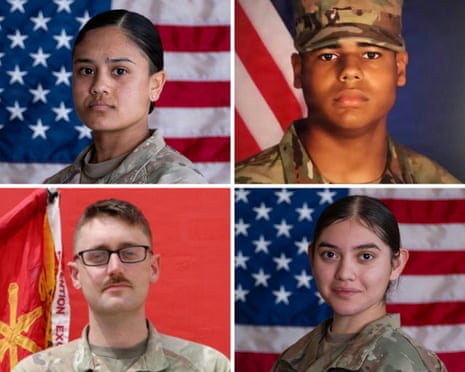
The latest US troops killed in Trump's Iran war are remembered for lives of  service | US-Israel war on Iran | The Guardian
Clockwise from upper left: Sgt. Angel Rampersad, Sgt. Michael Emmanuel Swinton, Lt. Tyler James Feehan, and Pvt. Isabella Gonzales.


Today, that website showed only 14
, with the four most recent deaths erased from the "Army" column and the total.


The justification given internally was that because Trump had declared a "ceasefire" back in April, these latest troops killed by Iranian drone and missile fire somehow didn't count. 

There are at least three ways that doesn't add up. First of all, the "ceasefire" never actually resulted in either side ceasing its attacks. Second, Trump unilaterally declared the "ceasefire" over before those four most recent servicemembers were killed. And most obviously of all, troops killed in action by enemy attacks are still casualties, regardless of whether the Trump considered the undeclared war they were fighting in to be paused or not.

It's not just troop deaths that Trump has been caught underselling. In a revival of Vietnam-era disinformation tactics, the Department of Defense kept injuries to dozens of servicemembers sustained in last week's attacks hidden as well. And Trump personally has been a geyser of fake news on the economic impacts of the war, falsely claiming that it doesn't matter if it spurs inflation (it does) or that gas prices have stayed low (they haven't). 
 

Why does this matter?

  • A president who hadn't completely botched a war he never should have started wouldn't need to lie about how badly it was going. 
  • 18 American servicemembers have lost their lives for this fiasco whether Trump is willing to admit it or not.

Monday, July 20, 2026

What did Donald Trump do today?

He threatened war crimes for the umpteenth time.

The Trump administration has been caught covering up huge numbers of injuries to American forces in recent weeks. Reports of wounded servicemembers clash with Trump's perpetual declarations that Iran's military capabilities have been utterly destroyed. Trump's war has also claimed the lives of at least two soldiers in the past week: Pvt. Isabella Gonzales, 19, and Lt. James Tyler Feehan, 25. 

This undated image provided by the U.S. Army shows Pvt. Isabella Gonzales, 19, of Carrollton, Texas. (U.S. Army via AP)
 

Trump's characteristically flippant reaction to their deaths—he used the words "very sad" before quickly adding "but"—hasn't gone over well. That may be why he tried to change his tone today on the subject of Americans dying in his war against Iran, blustering in a social media post that "Every time Iran kills an American Soldier they will pay for that killing many times over!"

The laws of armed conflict, which the United States military still acknowledges whether Trump wants it to or not, make disproportional retribution a war crime. In other words, no law or treaty has ever accepted revenge as a satisfactory justification for using more force than is necessary to achieve a military objective. That's especially true where civilian casualties are concerned

At a minimum, 1,701 Iranian civilians, including 254 children, have been killed since February 28. Trump has explicitly threatened to destroy civilian infrastructure that will lead to more deaths, which is also a war crime, even as he demands that those same civilians rise up against their government.

Why does this matter?

  • A president who hadn't dodged the Vietnam draft might understand why committing atrocities and lying about how badly the war is going isn't a winning strategy. 
  • A president who'd waged war competently wouldn't be in a position where he had to make these kinds of desperate threats.

Friday, July 10, 2026

What did Donald Trump do today?

He worried a lot about being assassinated.

Trump insisted today that he was "number one on the list" of people Iran's government wanted to kill. Israeli intelligence claims they uncovered just such a plot recently—but those claims are very likely an attempt to influence Trump to back the Netanyahu regime's more aggressive approach.

Trump, who ordered the assassination of most of the Iranian regime's previous leaders, called them "scum" for allegedly contemplating his assassination.

It's not just foreign threats that have Trump worried, though. In addition to the bunker-like "military top-secret ballroom" he still insists he must have, Trump proposed today to cordon off virtually all remaining public views of the White House behind high fences. Those fences would encircle Lafayette Square, long a notable site for both tourists and protestors.

Why does this matter?

  • It's a little late once you've decided to ignore why the United States stopped targeting world leaders for assassination to worry about the consequences of your actions. 

Sunday, July 5, 2026

What did Donald Trump do today?

He had a "businesslike and highly constructive" phone call with Vladimir Putin, according to Vladimir Putin.

Trump spent an hour and a half on the Fourth of July talking with Russian leader Vladimir Putin. The call was "businesslike and constructive" and centered on Russia's desire for a diplomatic end to the war in Ukraine, something Trump "reaffirmed his readiness" to make happen.

At least, that's what the Russian government said today. Trump had kept the call a secret.

This is a common pattern with Trump and Putin, having happened at least half a dozen times now. Needless to say, it's not common practice for American presidents to have secret peer-to-peer talks with the leaders of hostile nations, precisely because it allows the other party to control the narrative and undermine the United States.

Trump, whose demeanor towards Putin ranges from the awestruck to the submissive, doesn't seem able to break the habit. This may be because he is genuinely psychologically incapable of resisting this kind of manipulation from Putin. That's certainly the prevailing opinion on Russian state-run media, which mercilessly mocks Trump as a weak thrall to Putin

Putin's ability to command ninety minutes of Trump's time on the Fourth of July, in the middle of the 250th anniversary celebrations, certainly supports that theory.

Another factor is that Trump's history of secret backchannel communications with Russia he'd prefer the American people not know about goes back to before his first term in office. Even with his collusion with the Putin regime to influence the 2016 election a matter of public record (and certified by a Republican-led Senate committee) Trump is still politically vulnerable on the subject: he is virtually alone on the entire political spectrum in his support for Putin and the Russian objective in the war against Ukraine. 

Why does this matter?

  • A president who keeps falling for the same trick over and over again is either too stupid, too gullible, or too weak to hold office. 
  • Americans shouldn't have to rely on Russia for information about their own government. 

Thursday, July 2, 2026

What did Donald Trump do today?

He found the real victims of a terrible jobs report: himself and his children.

June's employment numbers were released today. They are grim: the entire US economy added only 57,000 jobs, far fewer than the number expected. It's also well below the number of jobs that the country needs to keep up with population growth, meaning the number of jobs per capita fell too. April and May's numbers were also revised downward.

The report had other bad news, too. The unemployment rate dropped from 4.3% to 4.2%, but only because the number of people seeking work declined. (In times of economic distress, potential workers sometimes abandon the above-board job market altogether, especially if they've been unsuccessful in finding work for a prolonged period of time.)

Worst of all, the report confirmed that wage growth is lagging well behind inflation. That means real wages—the buying power of a day's work—is down for the third month in a row.

Trump didn't comment on the jobs report, but he did talk about jobs: specifically, the ones his children have. He complained to CNBC's Joe Kernan that his sons (who are notionally running his business) were being unfairly accused of benefiting from his office and the insider information, even as he admitted that they do get insider information. Even the ultraconservative Wall Street Journal editorial page called this "graft," adding that "Americans, and especially his supporters, deserve better from this or any President."

Neither of Trump's sons have ever had jobs that were not given to them in the Trump Organization, or as the result of their influence over their father since he first became President. For example, Donald Trump Jr. is currently employed as an "advisor" to both major prediction market companies, Kalshi and Polymarket, in spite of having no relevant experience. Both companies, essentially gambling sites, are fighting state regulation with the help of Trump Sr.—which directly profits Trump Jr., who owns an investment stake in both companies.

Trump's defense of his adult children's monetization of his presidency came as analyses of his most recent financial disclosures show that he and his family made huge investments in specific areas immediately before major policy decisions that would affect the value of those investments—which Trump had previously kept secret. 
 

Why does this matter?

  • Virtually everyone in Trump's family is the heir to multiple different billion-dollar fortunes, so the idea that they're being treated unfairly is a bit much. 

Tuesday, May 26, 2026

What did Donald Trump do today?

He tried to make public servants sign the same nondisclosure agreements his ex-wives had to.

The Trump administration released a draft proposal today that would force federal employees to sign nondisclosure agreements, or NDAs, in an apparent attempt to stop embarrassing and politically damaging leaks

Of course, there are already legal means to bar the release of classified information, but most of what happens in government offices isn't classified. Stories about Trump being manipulated by junior staffers, or paying inappropriate sexual attention to them, or throwing temper tantrums when he doesn't get his way aren't matters of national security—but they are things that government employees witness, and tell Congress or the press about. They're also firsthand witnesses to incompetence, immorality, and corruption on the part of Trump's senior officials.

It's this kind of sunlight that Trump's rule would try to shut out, by giving him new ways to punish and financially ruin government employees who witnessed wrongdoing. He's tried it before in both public and private life. For example, in 2019, he threatened to sue a former White House employee who had written a tell-all book for violation of an NDA. Trump ultimately backed down, in part because without any legal authority behind it, the agreement was almost certainly unenforceable

Trump's also made extensive use of NDAs in his private life. He's forced each of his ex-wives to sign one as part of their divorce settlements, and they're a routine part of working for his businesses. But even then, they don't always have the desired effect. Trump tried unsuccessfully to use NDAs to keep the adult film actress Stormy Daniels from revealing their sexual encounter, which took place shortly after the birth of Trump's youngest son. That arrangement, signed under a pseudonym ("David Dennison"), became a key element in Trump's conviction on 34 felony counts in New York.

Whistleblower protections are baked right into federal law, and for good reason. Government officials engaging in corrupt or illegal behavior usually try to keep it secret. Bringing public scrutiny to bear on the details is sometimes the only way of rooting out that kind of corruption. Likewise, journalists who publish internal government information that sources bring them usually can't be forced to reveal those sources, or be prosecuted themselves, although it hasn't stopped Trump from trying to do just that in the past.

It was exactly this kind of protected whistleblower action that led to Trump's first impeachment. Alexander Vindman, an Army lieutenant colonel working for the National Security Council, was the first to raise alarms about the phone call in which Trump tried to strongarm Ukraine's president into ginning up a fake investigation against Joe Biden's son. Trump had correctly believed that Biden would be the Democratic nominee in 2020, and that he would need to manufacture some disqualifying scandal in order to beat Biden in the general election. But the resulting blowback, which saw many Republicans openly disgusted by Trump's abuse of an allied power in pursuit of domestic political dirty tricks, helped cost Trump the election instead.

Why does this matter?

  • The purpose of government isn't to help Donald Trump cover up his scandals.  
  • One way to stop people from sharing evidence of corruption and incompetence is to run a less corrupt and incompetent administration.

Friday, May 1, 2026

What did Donald Trump do today?

He blabbed about a top secret operation and in the same breath admitted he'd screwed it up.

Last month, Trump hinted at the existence of an otherwise secret plan to give weapons to Iran's Kurdish minority, who would in turn distribute them among opponents of Iran's ruling regime and overthrow it in the chaos caused by Trump's war.

In reality, of course, what happened is that the war made the clerical-military alliance stronger and less vulnerable to internal challenges than ever. The attacks killed a number of senior leaders on the first day, including the Supreme Leader, Ayatollah Ali Khamenei, but the nature of the regime hasn't changed. It is now led by Ali's son, Ayatollah Mojtaba Khamenei, who is one of the few surviving members of his family.

Trump has been the only member of his administration to even hint about US plans to arm Iranians, meaning that it was classified and should not have been spoken about at all. That's especially true because the United States is no more popular with anti-government Iranians than the Khamenei regime is, and having public American backing weakens the movement.

Today, he elaborated: not only had the secret plan been put into action, but it had failed. Trump apparently brought up the subject with reporters just to complain that he was "not happy with the Kurds" for keeping the weapons.

It's not clear why Trump thought that giving weapons to the relatively isolated and ethnically separatist Kurdish population would be a conduit to the urban, majority Persian protestors in a different part of the country that he had wanted to prop up. It's especially baffling given the lack of trust that he should have expected. Trump famously betrayed the Syrian Kurds who had been helping the United States campaign against ISIS. More than ten thousand of them died in that conflict, after which Trump called for their ethnic cleansing.

In an attempt to minimize the scope of the problem, Trump claimed that it had only been a "small amount" of weapons, but this is almost certainly a lie. For one thing, it was "a lot of guns" the last time Trump talked about it, not "a small amount." And for another, there wouldn't be much point in sending only a few token weapons into a country the size and population of the entire US eastern time zone. 

While there is a growing movement supporting Kurdish independence from Iran, it does not yet have autonomy in practice, and the IRGC is still in de facto control of Kurdish regions. That means that one possible outcome is that any American military hardware will simply end up in the hands of the Iranian military.

Why does this matter?

  • Donald Trump's need to blame everyone else for his mistakes doesn't justify blurting out classified information. 
  • When you rush into war on the assumption that it'll all work itself out and other people will win it for you, you get this kind of stupid and slapdash thing.  

Monday, April 6, 2026

What did Donald Trump do today?

He threatened to put a journalist in jail for reporting what his own administration leaked.

Trump held a press conference today in which he continued his pattern of whipsawing between extreme opposite positions on the Iran war. At one point, pressed on whether he could even say whether he wanted to end the war or bomb Iran "back to the stone age," he responded, "Can't tell you. I can't tell you. I don't know."

But he also took the time to threaten unnamed American journalists with jail time if they didn't give up the name of a Trump administration official who told them that an American pilot was missing after Iran shot down two jets on Friday. Trump said he was going to find out who provided reporters with that information "because we’re going to go to the media company that released it, and we’re going to say,  'National security. Give it up or go to jail.'" 

To be clear, the leak came from inside the Trump administration, and there is no way to know that it wasn't authorized. The Trump administration, like all political offices, routinely "leaks" information that it wants publicly known without having to take responsibility for answering questions about it directly.

It is not illegal for American news outlets to publish information they receive confidentially from government employees, and for the most part, journalists can't be forced to disclose their sources. Even in the rare circumstances when the federal government can meet the high threshold of an "overriding and compelling state interest," most administrations have avoided that kind of a confrontation, out of a basic respect for the value of a truly free press. Trump notoriously feels otherwise and has spent a great deal of effort trying to handpick his own press corps and escape the more difficult questions that independent reporters tend to ask.

In other words, Trump can't simply order reporters "to jail" by invoking national security, although that hasn't stopped him from threatening that or worse many, many, many, many, many, many times.
 

Why does this matter?

  • A free and independent press is essential to the functioning of democracy, which is why only dictators or people aspiring to be dictators attack it.

Saturday, February 14, 2026

What did Donald Trump do today?

Very little, even by his standards.

Trump, who likes to call other people "low energy," is famously removed from the actual work of the presidency. Even in his first term he was usually unable or unwilling to put in a full day of work in the Oval Office, and his visibly declining health and ability to control himself has removed him even further from the day-to-day operation of the White House in his second term. He's even disappeared from public view without explanation for a week at a time. The result has been that, even more often than in his first term, Trump appears to have been kept out of the loop on major decisions that "he" has supposedly made, while competing junior aides dictate policies without any real oversight.

In that sense, today was a fairly typical day in the Trump presidency, in that it was the Saturday of a three-day weekend in which he has no public events scheduled. He went to a Trump-branded golf course, although in keeping with the new normal of his second term, there was no way to know if he actually played golf. The press pool and White House photographers, who were often allowed to take pictures during his rounds, were not even allowed to verify that Trump was actually in the motorcade that went to the course today. (Trump has difficulty walking down stairs or even ramps without assistance, and while he's known to rely on a cart when he does play, even the act of getting up and down from it a hundred times or so would probably be challenging given his other symptoms.) 

Trump's afternoon schedule was similarly opaque: he supposedly had "private meetings" with unspecified visitors. It's not known who, if anyone, he met with, and likely never will be if it was anything other than a social call: Trump revoked a longstanding policy of releasing visitor logs to the public when he first took office.

But he's also been oddly silent on social media today, the one area of public life where he's normally very energetic (and sometimes hypermanic). He posted only twice to his private microblogging site the whole day. One of those posts did make headlines, because rather than a love letter to his third wife Melania, it was a Valentine's Day rant about what amounted to a bad dinner date he'd once had with the alt-conservative talk show host Bill Maher. 

Arguably, Trump complaining about not being treated gently enough by comedians wasn't the most newsworthy part of the 500-word essay that he posted: he also tried to walk back a truly deranged side comment about China's plans to cancel the Stanley Cup (that is, the NHL championship) by economically dominating Canada, which contributes seven of the NHL's 28 teams. In this morning's tirade, Trump reversed course and now claimed that he had

jokingly stated in a TRUTH that, “The first thing China will do is terminate ALL Ice Hockey being played in Canada, and permanently eliminate The Stanley Cup.” Well, he went on and on about the Hockey statement, like “What kind of a person would say such a foolish thing as this,” as though I were being serious when I said it
The post that Trump is referring to came this past Monday, and while people did call it "silly" and "deranged" and "manic," nobody—including Trump's White House staff—called it a joke. It wasn't the first time Trump has said it: a few weeks earlier, he said the same thing to reporters, who didn't take it as a joke then either.

Oh, well, if, if they do a deal with China, yeah, we'll do something very substantial, because we can't, look, I have a great relationship with China presidency, but we don't want China to take over Canada. And if they make the deal that he's looking to make, China will take over Canada. And the first thing they're gonna do, end ice hockey. 

Typically, a president caught making a ridiculous statement in writing that embarrassed him might have the option to blame a staffer, but the Trump White House has already played that card once in the past week.

Why does this matter?

  • Trump doing nothing at all might be an improvement, but a president who can't or won't rise to the burdens of the office should resign. 
  • Nothing says a president has to be funny, but it's a huge problem when nobody can tell the difference between his "jokes" and his delusions.

Thursday, January 1, 2026

What did Donald Trump do today?

He did just about everything he could to make people question his health and judgment.

At midnight Thursday morning, Trump was where he's spent most of the last two weeks: his private resort in Florida. As usual, his right hand was pasted over with makeup that doesn't match his skin tone, to cover up a bruise he claims is from shaking hands. That explanation, which the White House continues to gamely offer reporters who ask about it, doesn't explain why Trump has recently been wearing concealer on his left hand, or why he's needed adhesive bandages to cover the spot where an IV for some undisclosed infusion would go.

But today, Trump had more news about his health—none of it good. The Wall Street Journal posted a long article today detailing his various health struggles and his increasingly obvious decline in energy and cognitive fitness, as well as the effort to portray him as healthy and fit. As is typical for such stories, the reporters asked the White House for comment before publishing, and were surprised when Trump made himself available for questions. 

In the course of the impromptu interview that followed, Trump blamed his hand bruising on his aspirin regimen, saying that he takes 325mg per day in order to get "nice, thin blood pouring through my heart — does that make sense?" From a medical standpoint, it doesn't. Daily aspirin is almost never prescribed anymore for people who have not already had a cardiac incident, even people whose heart health is suspect, like Trump admits his is. And when daily aspirin is indicated, the dose is 81mg, not 325. 

In other words, Trump says he is taking aspirin explicitly against doctors' orders, and four times the dose that would be recommended even if that were a good idea.

He also tried to retroactively downgrade the mysterious MRI that reporters learned he'd undergone last fall to a CT scan. When news of the MRI broke, he claimed he didn't know what it was for—something almost impossible to believe, as MRIs are never done unless a physician is trying to confirm or rule out a specific and serious health issue. But some drug regimens, notably Alzheimers drugs like Leqembi, do require an MRI to ensure they're not causing dangerous brain swelling or fluid buildup.

As is often the case, it's not clear whether Trump was confused then or lying now, although it's worth noting that even if Trump didn't know the difference between an MRI and a CT scan, his doctors and staff would, and could have corrected the record earlier.

Trump said the lesson he'd learned from all this was, in so many words, not to tell people about future medical procedures. "In retrospect, it’s too bad I took it because it gave them a little ammunition. I would have been a lot better off if they didn’t, because the fact that I took it said, ‘Oh gee, is something wrong?’ Well, nothing’s wrong.”

Trump, who handed over control of the nation's public health and medical regulatory agencies to a devotee of pseudo-scientific conspiracy theories, is full of unusual ideas about health. When the COVID-19 epidemic broke, he publicly suggested using household cleansers and veterinary deworming agents as a drug therapy. And he unironically believes an 18th-century theory that exercise is bad for the body because it uses up the finite amount of energy a person is born with.

UPDATE, 1/2: Trump followed up early this morning with another social media post claiming that he had "just" passed his "third" dementia screening test. Trump also announced passing his third dementia screening test a month ago. It's not clear whether Trump mistakenly thought the December exam had just happened, or whether his doctors had for some reason ordered a fourth dementia test and he'd lost count, or whether he's simply making things up.

Why does this matter?

  • Presidents who can't be honest about their health (or simply can't remember what it is) aren't healthy enough to serve. 
  • Someone who gets and then ignores the best medical advice in the world on matters that might kill them is also unfit, although more on grounds of stupidity or narcissism.

Tuesday, December 23, 2025


What did Donald Trump do today?

He had the Justice Department declare him innocent of anything you might imagine he'd done.

Another tranche of Epstein investigative documents was released today, along with a social media post by the Justice Department preemptively clearing one person of any suspicion based on what they contained: Donald Trump: 

Some of these documents contain untrue and sensationalist claims made against President Trump that were submitted to the FBI right before the 2020 election. To be clear, the claims are unfounded and false. And if they had a shred of credibility, they certainly would have been weaponized against President Trump already.  

The DOJ is not supposed to act as the president's personal defense lawyer—although several of its top officials were exactly that in private life. Outside of Trump's terms in office, there has been a strict policy against giving any appearance whatsoever that the Justice Department is acting out of political motivations rather than its mission to defend the integrity of the American judicial system. President Nixon was eventually forced to resign as a direct consequence of the so-called Saturday Night Massacre, in which he fired a succession of attorneys general until he found one who would dismiss the investigation into him. And when former president Bill Clinton had a brief airport meeting with the current attorney general, Loretta Lynch, the mere suggestion that he might be trying to influence an investigation into presidential candidate Hillary Clinton was a major scandal. (Trump himself called it "so horrible.")

By contrast, the current AG, Pam Bondi, took an illegal campaign contribution from Trump's fake charity as Florida's attorney general, then dropped the state from a lawsuit against Trump's scam "university." She later became his personal defense lawyer.

The files released today do contain "sensationalist" claims involving Trump, but also more mundane details of how intimately connected Trump and a great many other wealthy and powerful people were with Epstein. That in and of itself isn't news, as even Trump's own subordinates have started to admit, but there are also documents that underscore how anxious Trump has been to try to rewrite history. One bombshell revelation is that Trump apparently misled his own DOJ during his first term about his Epstein connections, to the point where an assistant US Attorney felt compelled to warn someone in the Trump administration about how much more implicated he was.

Trump once again spent the entire day cloistered away from the public and reporters.

Why does this matter?

  • The Department of Justice is supposed to serve the American people, not protect one person from scandal at all costs. 
  • Again, Trump could not possibly be behaving more like someone with something terrible to hide than he is right now. 

Friday, December 19, 2025

What did Donald Trump do today?

He announced he wouldn't be complying with the Epstein document release law he signed a month ago.

Today is the deadline for the Trump administration to release materials the DOJ gathered during its  investigation of Trump's longtime friend Jeffrey Epstein. After fighting tooth and nail against its near-unanimous passage in Congress, Trump signed a bill into law last month that set this deadline, with a 30-day window in which to redact certain details like the identities of Epstein's victims. The law also requires that the DOJ provide a specific and explicit justification for any materials withheld from public view, in order to prevent it from simply refusing to release materials that might be embarrassing or incriminating for Trump or his political allies. 

This morning, the Trump administration announced it was not complying with the law, and issued a vague timeline for when it would supposedly produce the documents. It did release some documents, including a vast number of documents that had been entirely blacked out.

But as the normally Trump-friendly Fox News reported today, Trump's DOJ is explicitly redacting the identities of "politically exposed individuals," even though the text of the law expressly forbids that. 

Trump, who knew and was befriended by and partied with Epstein for decades, and who is mentioned thousands of times in files released by Congress from the Epstein estate, is mentioned only twice in today's document release—all but guaranteeing that he was either deliberately kept out of today's file release, or illegally redacted.

Even the law's authors admit that it's ultimately powerless to force Trump to release anything that is actually damning to him: as today's announcement demonstrates, simply breaking the law is always an option for Trump. Given the horrendous implications of some of the material regarding Trump's ties to Epstein that have already come out from other sources, that might be the correct tactical choice anyway.  

There's no smoking gun that Trump was ensnared in Epstein's blackmail web or had sex with the children that Epstein trafficked—yet. But it's almost impossible to escape the conclusion that Trump knew what Epstein was doing and kept quiet about it, at least until their friendship began to deteriorate over business conflicts. As e-mails that his estate released make clear, Epstein himself believed in 2011 that Trump had been an informant for the Palm Beach police, something he was in a position to do because he'd spent "hours" alone with one of Epstein's victims. (That person, Virginia Giuffre, had previously been employed by Trump as a Mar-a-Lago "massage therapist" despite being underage.) And in 2019, shortly before he apparently committed suicide while awaiting trial, he told a reporter that "Trump knew about the girls."

Why does this matter?

  • The American people are allowed to read something into the fact that Donald Trump could not possibly be acting any guiltier than he is.  

Wednesday, November 12, 2025

What did Donald Trump do today?

He had a very, very bad day on the Epstein front.

For Trump, one of the fringe benefits to shutting the federal government down for a record 43 days was that he was able to pressure Speaker of the House Mike Johnson (R-LA) to keep the House adjourned, and therefore to refuse to seat duly elected Rep. Adelita Grijalva (D-NM). Grijalva, who was finally sworn in today, promptly became the last signature needed on a petition to force the House to take up a bill that would require the release of the Justice Department's massive troves of information on the sex trafficking ring run by Trump's friend and confidant Jeffrey Epstein.

Trump responded by launching a furious pressure campaign against the few Republicans who have signed the petition, including dragging Rep. Lauren Boebert (R-CO) into the White House Situation Room. Most Americans are more familiar with the Situation Room as the place where then-President Obama and his cabinet observed the raid that killed Osama Bin Laden, but there was one obvious advantage for Trump to try to force Boebert to withdraw her signature there: in that high-security environment, it would have been impossible for her to record what he said.

The other major development was the release of 20,000 Epstein e-mails and text messages obtained by the House Oversight Committee. These documents are not organized, and analysis has been ongoing all day, but they are shockingly damning for Trump. In the messages—many of which predate Trump's political career—Epstein discusses, among other things:

It will probably be weeks before the full picture of Trump's involvement in Epstein's life and activities that emerges from these documents is clear. 

Virtually all of the White House's comment came from press secretary Karolina Leavitt, who gamely insisted that e-mails in which Epstein and Maxwell discussed the fact of Trump's knowledge of their operation showed only that he "did nothing wrong." 

Trump himself did wade into the fray, but only on social media, safely away from reporters who might shout questions. He once again called Epstein and Maxwell's massive sex trafficking ring, for which both were criminally convicted, a "hoax." Trump also demanded that everyone stop talking about it—or, in his words, that there be "no deflections to Epstein."

In related news, Epstein's co-conspirator Ghislaine Maxwell is reportedly planning to ask Trump to commute her sentence. After Trump sent his former defense lawyer to "interview" her about the extent of his relationship with Epstein, Maxwell was moved to a resort-style minimum security prison where she has been getting, among other perks, custom meals and access to puppies in training to become service dogs.

Trump has repeatedly refused all invitations to condemn Maxwell, who may be the only living witness who can testify to whether or how much he was involved in Epstein's trafficking ring. Instead, he has only said that he "wishes her well."

Why does this matter?

  • Victims have died because of the horrible things Jeffrey Epstein and Ghislaine Maxwell did to them. 
  • It is hard to imagine how Trump could act any guiltier. 

Monday, October 27, 2025

What did Donald Trump do today?

He accidentally revealed more about his "routine physical" than he probably meant to.

Last month, Trump visited Walter Reed National Military Medical Center. At the time, his staff insisted that the visit was "routine," even though it was the second such screening in a year, and Trump had been suffering from a variety of visible symptoms and prolonged absences from the public eye.

Speaking with reporters today aboard Air Force One, Trump confirmed that he had undergone an MRI, adding, "I gave you the full results." This is a lie: the results of the MRI—or even its existence—had not been disclosed before. Pressed for details, he called it "perfect" and insisted that his physicians told him it was "some of the best reports they've ever seen."

MRIs, or magnetic resonance imaging scans, are never, ever given as a matter of routine to healthy patients—no matter how elderly or politically important. They are only given to help diagnose specific ailments, or to rule out or confirm a diagnosis. While armchair diagnosis is hardly a science, it's been difficult for medical professionals to miss the potential symptoms of heart disease or transient ischemic attacks (better known as "mini-strokes") that Trump has displayed in recent years. MRIs can help diagnose both.

MRIs can also help identify the root causes of certain diseases affecting cognitive function like Alzheimer's. Trump, who became disoriented while trying to navigate an unfamiliar room in Japan today and needed to be personally guided around by the new Japanese Prime Minister, once again bragged about passing this dementia screening test.


Trump, and this is a direct quote, characterized it as "very hard." 

Why does this matter?

  • Presidents don't have to be in perfect health, but they do have to be willing to tell the truth about their health. 
  • Presidents who are cognitively impaired, even just some of the time, are not fit for office and should resign or be removed.

Friday, October 24, 2025

What did Donald Trump do today?

He said an anonymous "friend" was donating money for the military salaries he refuses to allow Congress to fund.

Today was the 24th day of the latest Trump shutdown, already the second-longest shutdown in American history. (The longest was Trump's, too.) Most government workers missed their first full paycheck today, including those that are required to continue working during the shutdown. 

Legally, Trump doesn't get to pick and choose which government services are shut down, or which workers get paid. The Constitution specifically requires that no money can be spent that hasn't been appropriated by Congress. But Trump has demanded that money, including salaries, continue to flow to certain programs and employees in spite of the law. This appears to be a strategy of political survival for Trump, whose approval ratings are at their lowest point in his presidency, with another massive crisis about to hit Americans' pocketbooks in just a few days.

The reason the government shuts down when appropriations bills expire is not because it doesn't have money—it does. Taxes are still being collected and bonds being sold. Rather, it's because presidents do not get to decide for themselves what the budget is. That's not just a core principle of democracy—the idea that kings shouldn't have direct and unchallenged personal control over the treasury is something that wars have been fought over in out-and-out monarchies.

That brings us to today, when Trump insisted that a story he told yesterday, about an anonymous "friend" donating $130 million to cover the salaries of military personnel, was actually true. Again, the issue is not that the federal government can't afford to pay its workers—it's that Trump has failed to get appropriations bills passed through a Congress his party controls.

There is, to say the least, a lot of skepticism that Trump's "friend" or any such donation really exists, although the Department of Defense and the White House claimed that such a gift had been accepted—and then refused further comment.

Among the questions neither Trump nor his administration would answer today:

  • whether the "friend" actually existed
  • what the name of the "friend" is
  • whether the "friend" is an American citizen 
  • whether the "friend" was donating their own money, or acting on behalf of a third party  
  • whether the payment was in the form of actual money, or the supposed dollar value of the crypto tokens Trump makes a profit from in fees every time they are traded
  • whether it was an actual irrevocable gift to the Treasury, or some kind of loan or advance tax 
  • what the "friend" expected in return 
  • whether the "friend" has a business relationship with Trump
  • how paying salaries Congress hasn't appropriated money for doesn't violate the Antideficiency Act, which explicitly forbids having private individuals pay for lapsed appropriations
  • why Trump is pressuring the Republican-controlled House to stay out of session, which keeps it from passing bills to fund the government legally
  • whether Trump's "friend" actually believed the government needed money, as opposed to an appropriations bill 

If it were legal for private individuals to sponsor military paychecks, $130 million would cover about eight hours' worth.

Why does this matter?

  • The American people don't need "gifts" from Trump's "friends" to fund their government, but they do need a president willing to govern under the law.  
  • Trump is not a king, his billionaire "friends" are not the nobility, and even if they were this would still be an insane way to run a country.

Thursday, October 16, 2025

What did Donald Trump do today?

He agreed to another summit with Vladimir Putin, possibly because of a hallucination.

Two months ago, Trump hosted Russian autocrat Vladimir Putin at a summit meeting in Alaska. That meeting that was widely regarded as an embarrassment at the time, and it only got worse in the ensuing months as Putin continued to stonewall Trump's pleas for a politically useful ceasefire in Ukraine, while escalating his aggression against NATO members

Trump has never shown any real ability to stand up to Putin, who actively interfered in American elections on Trump's behalf, and who exercises power in Russia in a way that Trump has at times been openly envious of. But he has been attempting to cajole other nations to stand up to Putin on his behalf, by threatening them with trade sanctions if they continue to buy Russian oil and natural gas.

Today, Trump announced that he had agreed to meet Putin again, this time in Hungary. The reason he gave was that he believed he'd made "great progress" in a phone call with Putin today.

The problem with Trump's optimism is that he also apparently believes that he had a good phone call with Indian Prime Minster Narendra Modi yesterday, one in which Modi promised to stop buying Russian oil. But the Indian government has confirmed that no such phone call took place, and that there was no such agreement in place.

The silver lining is that all indications are that Trump really did talk to Putin today, and that he is not imagining it. But Trump is famously secretive about his communications with Putin: he once sought to have a special private communications channel put in place that his own government couldn't monitor, and he's been paranoid about U.S. government translators knowing what he's saying to Putin, so much so that he's confiscated their notes or done without them entirely. As such there's no way of knowing what was actually said or why Trump suddenly feels so optimistic.

That is, unless Russia once again decides to embarrass Trump by sharing with the American public details of Trump-Putin diplomacy that Trump was trying to hide from them.

Why does this matter?

  • A president who is having hallucinations or is otherwise profoundly confused about what is happening around him is not fit for office. 
  • Trump is hopelessly compromised by the Putin regime even if he's fully coherent and alert.

Friday, September 5, 2025

What did Donald Trump do today?

He said he knew nothing about a botched US mission in North Korea—which, horrifyingly, may be true.

The New York Times today ran a detailed exposé of a failed American military operation on North Korea in 2019. Backed by dozens of sources, it described a risky attempt by a Navy SEAL team to plant an electronic listening device inside North Korea. The mission was aborted when the team was accidentally discovered by North Korean fishermen. Desperate to avoid alerting the North Korean military to their presence, the team opened fire and killed the fishermen, hid their bodies, and escaped.

The mission had never before been made public—or even shared with Congress, which is a major breach of law and protocol.

According to the sources in the NYT article, North Korea's military surged into the area immediately after the team withdrew, strongly suggesting that the government of North Korea knew it had been attacked, and probably why and by whom. That meant that, within days or hours of the mission being aborted, the only people Trump was keeping it a secret from were Americans.

Asked about it today, Trump replied, "I don't know anything about it. I'm hearing it now for the first time." This is, in its own way, almost as shocking as the story itself.

The best-case scenario is that Trump is simply lying: he does remember authorizing the operation, but doesn't want to take the blame for its failure or his own refusal to inform Americans' representatives in Congress. 

But this is not the only possibility. Another is that Trump, who is now 79 and was 72 at the time, genuinely cannot remember the total failure of a high-stakes military operation from his first term. Trump, whose cognitive fitness has been a concern since he first took office, frequently imagines, misremembers, forgets, or confabulates events from the past.

Another possibility, less likely but impossible to rule out, is that Trump can't remember the operation because he was never properly informed of it—even though it was about an operation that would have required a president's approval under normal circumstances. Trump is famously easily cut out of the loop by his own staff as they try to manage him. Sometimes this is for trivial reasons, as when staffers had a Navy ship named after his political enemy John McCain moved from his line of sight to head off a temper tantrum. But Trump has also let himself be sidelined on critical matters: just this year, for example, his own Secretary of Defense has twice overruled Trump's policy on military aid to Ukraine without informing him.

In related news, the Trump administration announced today that they would not be allowing Congress to learn anything about its current or future military operations against Venezuela.

Why does this matter?

  • Every single explanation for Trump claiming not to know what happened on his first watch is grounds for removal from office, either by impeachment or because he is mentally incompetent. 
  • In a democracy, presidents are not kings, and they are not military dictators either. 

Sunday, August 31, 2025

What did Donald Trump do today?

Very, very little—but he did find the energy to praise the "character" of a man fired from the NFL for racism.

Trump apparently returned to his Virginia golf club today, ostensibly to play golf with former NFL football coach Jon Gruden. Bizarrely, and just possibly significantly, neither claim could be independently verified. Press pool reports showed Trump's motorcade going to the Trump National Golf Club in Virginia, and the pool reporter did confirm a "brief glimpse" of Trump entering and exiting an SUV in his motorcade. This is the second day in a row that the pooler has not been allowed to approach Trump or do more than what reporters call "proof of life" coverage.

Gruden's presence was not visually confirmed by any independent source, only by a post to Trump's private microblogging site. And that showed only Trump from behind, sitting in a golf cart, shaking hands with Gruden—who was wearing exactly the same clothes he wore when he golfed on August 23, according to his own social media posts.

Of course, even given Trump's propensity for brazen and easily disproved lies where his health is concerned, the most likely explanation is that he and Gruden really were on the course, whether or not Trump was able to rise from the cart. But even by Trump's famously lackadaisical weekend standards, it continues to be eerily quiet on the White House beat.

In the post on Trump's blog, he (or whoever wrote it) described Gruden as "a really nice guy" with "true character." Gruden was fired as the coach of the LA Raiders in 2021 after an avalanche of revelations that he'd used homophobic, misogynist, and racist language for more than a decade to describe players, referees, staff, league officials, and anyone else who upset him. Players going back to Gruden's time as a college football coach have long confirmed those rumors and others about toxic and abusive behavior, including his famous aversion to hiring Black coaches and coordinators or putting Black players at "skill positions" like quarterback. But there's also documentary evidence, like the 2011 e-mail he wrote commenting on a Black player's intelligence and appearance in minstrel-show terms.

Confronted with such evidence at the point when he was forced to resign, Gruden insisted, "I don't have an ounce of racism in me." That's oddly similar to Trump's favorite expression when confronted with racist language he's used, or made racist assumptions about Black people he encounters in public, or his belief that African-Americans should be sent back "where they came from," or racist groups who endorse him for their belief in his racism. In those situations, Trump usually describes himself as "the least racist person ever."

Why does this matter?

  • The problem is that nobody really doubts Trump does think highly of the character of people like Jon Gruden. 
  • Under the circumstances, a president who could let reporters close enough to see him do more than sit quietly in a golf cart, probably would. 

Saturday, August 30, 2025


What did Donald Trump do today?

He returned to the land of the living with a demand for money to get him into heaven.

On Tuesday of this week, Trump sat through a cabinet meeting, occasionally but ineffectually attempting to hide from view the IV bruise that now regularly appears on his hand. (The White House has refused to say what Trump is receiving treatment for, and continues to insist the bruises are from handshaking—although lately they've started appearing on his left hand, too.)

He wasn't seen again by the public or independent press until this morning, 90 hours later, when he appeared at telephoto distance from the White House press pool while entering a Virginia golf resort. Press were not allowed to approach. It's not known whether Trump went out on the course or, as he sometimes does, simply rested in the clubhouse.


Trump's absence from public view, combined with a long history of frankly ridiculous claims about his often fragile health, led to jokes and less-than-friendly speculation online last night about whether he had died. 

He has not. But Trump and his supporters seem perversely determined lately to put the idea in people's heads themselves. Earlier this week, Vice-President JD Vance volunteered in an interview with USA Today that he was ready to assume the presidency at any moment—not the sort of thing someone in his job usually goes out of his way to mention.

And Trump—in an extremely uncharacteristic turn—has recently seemed preoccupied with his own mortality. Earlier this month, on an unscheduled call to a Fox News morning program, Trump reflected on his (failed) attempts to force Ukraine to accept Russian terms to end their war. “I want to try and get to heaven, if possible. I’m hearing I’m not doing well. I am really at the bottom of the totem pole. But if I can get to heaven, this will be one of the reasons.”

Trump is—theoretically—a member of the Presbyterian faith, which (like most Protestant Christian denominations) rejects the idea that salvation can be attained by worldly accomplishments. Normally, when Trump talks directly about religion, it's in sacrilegious terms, as when he compares himself to Jesus Christ or demands that his followers accept that he has been specially marked by God. But the seemingly abashed language about the possibility of his eternal damnation was out of character for a man who has repeatedly claimed not to confess his sins because he doesn't have any.

With the specter of his not-yet-realized mortality being joked about worldwide, today Trump put a more Trumpian spin on the same language: he sent out an e-mail to supporters reiterating his desire to go to heaven—and telling them to pay his political action committee $15 to help make it happen.

Trump, whose net worth is estimated at about $6 billion (Mt. 19:24), and who has encouraged his followers to build literal golden idols of him (Dan. 3:1-18; Exo. 32:1-35), and who has openly defied the biblical commandments against adultery and bearing false witness and covetousness and theft, and who has in thought, word, and deed spurned the teaching of Jesus to shelter the immigrant (Lk. 10:29–37Mt. 25:35-36; many others) and to share his wealth with the poor (Lk. 6:20-21; Mk. 10:21-22; many others) and to pay his taxes (Lk. 20:19-26) and to forgive his enemies (Mk. 11:25-26) and treat them gently (Mt. 5:38-39) and to make his charitable donations* in secret rather than make a show of them to appear righteous (Mt. 6:1) and to not exalt himself, lest he be humbled (Mt. 23:8-12) and to store up his treasures in heaven rather than on earth (Mt. 6:19-21) and to not despise in his worldliness those of simple faith (Mt. 18:10) and above all (save for his obligation to love God) to love his neighbors as he loves himself (Mt. 22:36-40), was not seen for the remainder of the day.

Why does this matter?

  • There is a difference between a person who falls short of their faith and one who cruelly exploits it in others. 
  • Americans are entitled to know how severe their president's health issues are.