Showing posts with label China. Show all posts

Wednesday, July 29, 2026

What did Donald Trump do today?

He was "surprised" by the news that China and Russia were selling arms to Iran and have been for decades.

Asked today about the latest reports that China is planning another arms shipment to Iran, Trump said that he would find it "surprising" if that were true, and that he'd be "disappointed."

China is planning another arms shipment to Iran

In fact, China has supplied arms to Iran for decades, although for diplomatic purposes it has usually publicly denied it. China is also a major consumer of Iranian oil (which has been under international sanctions for many years) and is Iran's largest overall trading partner.

The two countries are not close military allies, and there are no strong cultural or geopolitical ties between them, other than that neither are aligned with the United States. China, like Russia, has a vested interest in the degrading effect that Trump's war has on American military readiness and its status as a world leader. 

Trump's argument against the latest arms deal, which is sourced to US intelligence agencies, is that China's president Xi Jinping "told [him] very strongly" that no such deal would be made. He added in a social media post that "in his opinion" neither China nor Russia were selling arms to Iran.

Russia is also selling arms to Iran.
 

Why does this matter?

  • Countries always act in their own best interests, not what is best for Donald Trump.
  • There is gullible, and then there is taking the word of the dictators of hostile nations over the evidence supplied by your own intelligence agencies. 
  • Donald Trump's "disappointment" is not a threat to Xi Jinping.
Friday, May 15, 2026

What did Donald Trump do today?

He toed Xi Jinping's line on Taiwan.

One of the less talked-about consequences of Trump's disastrous war on Iran is how much it has strengthened China. Any failure of the United States to project power good for China, to say nothing of one as humiliating as Trump's inability to dictate terms to the vastly weaker Iran. But because China has influence over Iran, it now has influence over Trump as he becomes increasingly desperate to disentangle himself without admitting defeat.

President Xi Jinping said as much yesterday to Trump's face, although it's extremely unlikely Trump caught the reference. Xi said that he hoped the United States and China could avoid a "Thucydides trap," meaning a situation in which a decaying power is so threatened by the existence of a rising power that war becomes inevitable. In the original reference by Thucydides' History of the Peloponnesian War, it was waning Sparta and growing Athens, but Xi obviously meant the United States and China.

Trump may not understand classical history or foreign policy theory, but he does seem to be aware that he was going to China hat in hand, whether for Xi's intercession with Iran, or a handout for his family's businesses. That may explain why he was willing to happily repeat Beijing's talking points on the matter of greatest importance to Xi: Taiwan. Trump, following Xi, urged Taiwan to "cool down" and stop calling for independence.

But Taiwan, which could be utterly destroyed in a full-scale invasion, isn't planning to declare independence. Its overriding strategic goal is to protect its self-determination. To have the President of the United States, essentially the only real guarantor of its continued freedom, accuse it of going too far while standing next to the President of China, is an enormous concession to Beijing.

Trump didn't stop there, though. Speaking to reporters after the trip had concluded, he backed away from the once iron-clad commitment that the United States had made to sell defensive weapons to Taiwan, saying with some hesitation that he would "make a determination over the next short period." This is, to put it mildly, an abandonment of a close ally on par with his treatment of Ukraine.

It's worth noting that Trump's parroting of China's lines during his trip may have been down to confusion. Trump obviously could not recall the name of the Taiwanese president, Lai Ching-Te, saying that before he made a decision he'd have to "speak to the person who is, right now, you know, you know who he is, that's running Taiwan."

That wasn't even the only cognitive misstep Trump had on Taiwan. Asked a question about Taiwan, he meandered into an answer about Iran, and needed a reporter's help to find his way back to coherence.
 

Why does this matter?

  • The United States needs a president who is not so incredibly easy for actual strongmen to manipulate. 
  • Both Taiwan and the United States need a president who can remember all the way to the end of a single sentence what country he was supposed to be talking about.  

Wednesday, May 13, 2026

What did Donald Trump do today?

He got sued for his domestic corruption while he brought his family's private business to China.

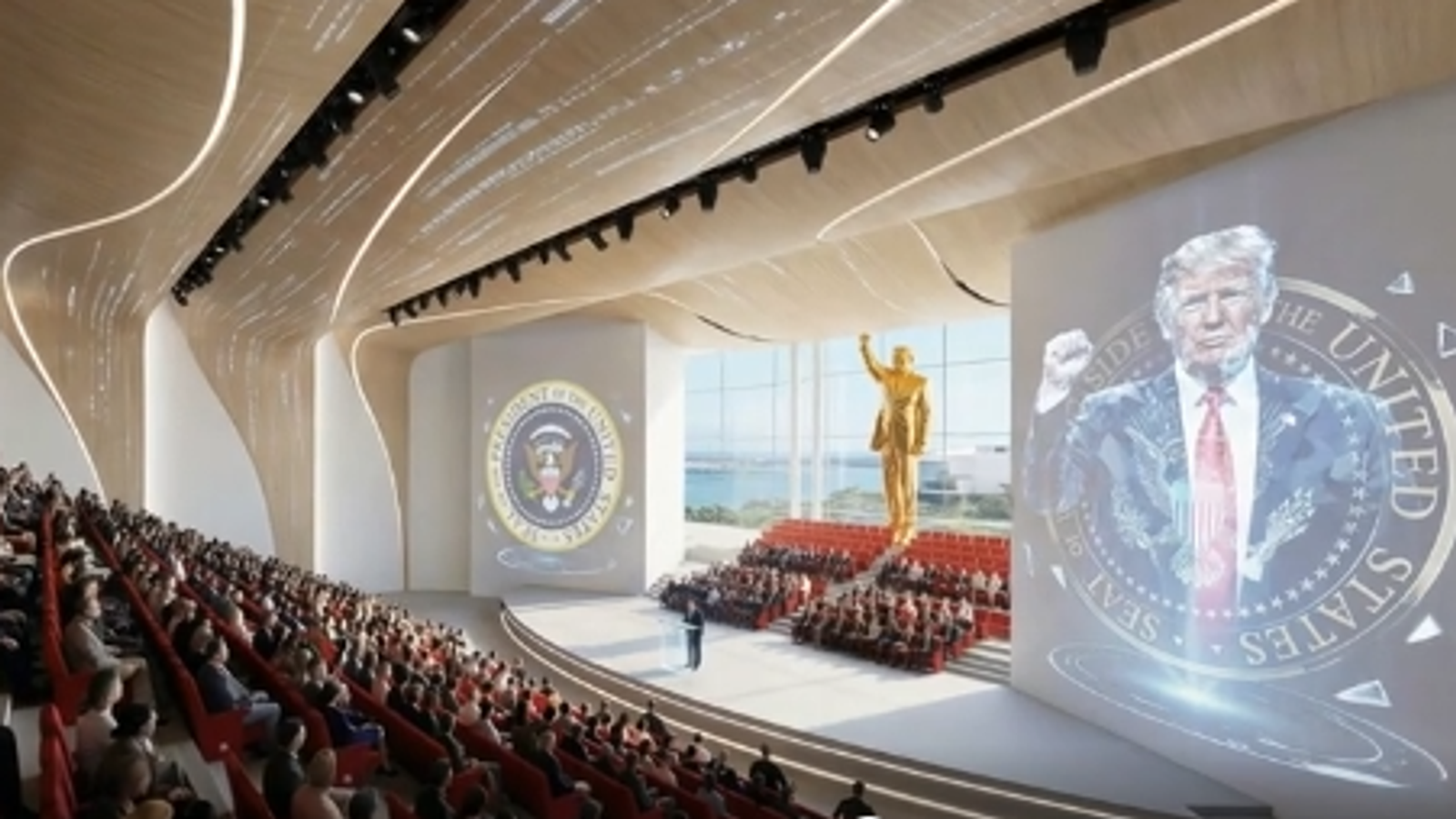
Trump has been revealing increasingly gaudy plans for his future presidential "library" in Miami, although by his own insistence, it won't actually have a library. Instead, Trump envisions it as a 50-story for-profit hotel atop a "presidential center" featuring giant golden statues of him. (These are not to be confused with the giant golden statue he's recently had installed at one of his golf courses.) 

Computer-generated image of Trump's supposed library plans, with a gallery of people staring at a giant gold Trump statue
Screenshot from AI-generated Trump video announcing the "library"

Presidential centers—that is, the bottom floors of Trump's proposed hotel—are privately-funded nonprofits. Trump, whose fraudulent New York charity was shut down and dissolved after he was caught using it for any number of illegal activities, has been using these kinds of entities as pay-for-access bribes, from his inauguration fund to the one for his pet "ballroom" project. 

But that isn't the corruption that got him sued today in Florida. Instead, it's the massive $300 million giveaway of valuable public land belonging to Miami Dade College that Trump-friendly governor Ron DeSantis and his handpicked college trustees has engineered in an apparent attempt to curry favor with him. Trump himself called it "the best block in Miami," and that's probably not far from the truth in economic terms. 

The parcel is almost certainly worth more than MDC's entire endowment. DeSantis's appointees sold it to Trump's presidential center for $10. Trump has always struggled to turn a profit with hotels, even with the help of decades of fraud to prop them up, to say nothing of his habit of forcing the US government to pay top-dollar rents to them. In spite of those illegal and gray-area advantages, he's famously bankrupted many of his hospitality properties while others strugglefra. But a hotel built on free land in a major tourist destination would have an enormous advantage over all other competition.

Trump didn't comment on the corruption lawsuit today: he was busy flying to China for a visit with its president, Xi Jinping. Traveling with him was his son Eric, a private citizen whose company is actively pursuing a deal with the Chinese government to build data centers in the United States.

Why does this matter?

  • Corruption is always bad, even when Americans have gotten used to it from Trump. 
  • When you have to buy the president's attention, only the corrupt and powerful will benefit.

Friday, March 20, 2026

What did Donald Trump do today?

He somehow managed to blunder the United States into a situation where it had to drop sanctions against Iran mid-war.

Desperate to bring oil prices down and forestall a looming collapse in the energy sector, Trump did something that may be completely without precedent in modern warfare: he dropped economic sanctions against the country the United States is currently waging war against.

To be clear, Iran was selling oil anyway—and at a brisk pace, too, since only it can safely ship oil through the Persian Gulf. But Trump's order allows countries that still respect U.S. sanctions to buy Iranian oil—and give Iran the money it needs to fight back against the United States—as opposed to having it sold exclusively to countries like China or Russia that were already ignoring the sanctions.

In other words, having inadvertently created a situation where only countries hostile to the United States can freely trade in oil, Trump is now trying to pay Iran to get in line.

Trump's actions today won't have much effect on oil prices, any more than the other stopgap measures he's tried this week. They were foreshadowed by Trump's earlier move to un-sanction Russian oil, although that at least could be explained by the personal hold the Putin regime has always had over Trump, and the fact that Trump is essentially on the opposite side of the Russia-Ukraine conflict than the rest of the United States. 

It's worth explaining why Trump is this panicked. It's not just that prices are high: normal market forces have gotten oil prices to this point before, although only rarely. And it's not just that they'll go higher, because even then, basic supply and demand pressures would mean that they would eventually come down under normal circumstances.

But in the current scenario, Trump has blundered into giving Iran a stranglehold on the entire world energy sector. The global oil market depends on a complicated mechanism that balances production, shipping, and refinery capacity. The chaotic effects of the war, exacerbated by the fact that Trump was completely unprepared for the consequences, are only just starting to be felt. It's like a bubble of air in the bloodstream: small in the grand scheme of things, but completely catastrophic in terms of its effects on the body.

That also explains why Trump now seems to be pivoting back to declaring victory and trying to go home while leaving the mess for the rest of the world to try to clean up. Today, he once again floated the idea on his private microblogging website that it was time for (unspecified) "other Nations" to take over the "easy Military Operation" of undoing Iran's stranglehold on the Persian Gulf—something that Trump himself has been completely (though predictably) unable to accomplish with the entire might of the United States military at his disposal.

So far he hasn't gotten any takers.

Why does this matter?

  • It's hard to explain what a catastrophic fuckup this is becoming because there isn't any precedent for a catastrophic fuckup of this size. 

Tuesday, February 10, 2026

What did Donald Trump do today?

He let a wealthy donor try to block an infrastructure project that's already built and cost American taxpayers nothing.

In 2012, the Obama administration struck a deal with the Republican governor of Michigan and the Conservative-led government of Canadian Prime Minister Stephen Harper to build a new bridge connecting the cities of Detroit and Windsor, Ontario. The bridge, named for Detroit Red Wings legend Gordie Howe, was paid for by the Canadian government, who also put up most of the money needed to build a customs checkpoint on the American side of the border.

undefined
The new Gordie Howe Bridge, which links I-75 and Ontario Hwy. 401 directly and is capable of handling heavy trucks.

Both the United States and Canada agreed the bridge was necessary because the only other road connection across the Detroit River, the privately-owned Ambassador Bridge, empties onto surface streets in Windsor. That makes for long traffic delays, urban blight, and increased shipping costs—when shipping is possible at all. The Ambassador Bridge has a poor maintenance history and cannot be used by large trucks.

Today, with just weeks to go before the new bridge was set to be opened, Trump demanded that the United States—which, again, did not pay for the bridge and will benefit from it economically through more efficient trade—be given a cut of the tolls.

The reason for Trump's sudden interest in the bridge is that the family that owns the Ambassador Bridge, and has been fighting unsuccessfully for twenty years to keep any competing bridge from being built, is a major Trump donor. And while the White House has not yet admitted it, the direct cause of Trump's multiple outbursts on the subject of a bridge he'd never mentioned before is a meeting between the Ambassador Bridge's owners and Trump's Commerce Secretary Howard Lutnick.

(Lutnick was also in the news today for unrelated reasons.) 

In other words, Trump is trying to metaphorically blow up a free bridge that a friendly foreign government has already paid for and built, because wealthy supporters want to maintain a local monopoly on their expensive and poorly maintained bridge.

Trump threatened to close the bridge if his demand for a cut of an investment the United States didn't make wasn't honored, which is presumably what his donors want. This would, of course, hurt the United States in the meantime while merely delaying the inevitable opening of the already-built Gordie Howe Bridge.

Trump first brought up the subject of the bridge in a social media post yesterday, although he lost his train of thought and started ranting instead about how China would take over Canada and cancel the Stanley Cup. (China is not involved with either bridge and has not made any unusually hostile moves towards the National Hockey League.)

Why does this matter?

  • Denying Americans basic government services to help political patrons is corruption, pure and simple. 
  • Not letting Americans use a free bridge that's already been built makes Trump look stupid, not tough.

Sunday, January 4, 2026

What did Donald Trump do today?

He may have figured out how badly he'd played himself in Venezuela.

Yesterday, Trump declared that he was "running" Venezuela through Delcy Rodriguez, Nicolás Maduro's vice-president and now acting president of the country. He appears to have been convinced that this was possible by Secretary of State Marco Rubio, who reportedly tried to negotiate Maduro's ouster with Venezuelan officials. This narrative was immediately demolished by Rodriguez's fiery denunciation of Maduro's abduction and the cost in Venezuelan civilian life.

As of today, Rodriguez appears to be fully in command of the Venezuelan state apparatus, and remains defiant towards Trump. The result is that Trump appears to have blundered into a situation where he's strengthened the genuinely corrupt and illegitimate Maduro regime—and further weakened the legitimate Venezuelan opposition, which also condemned the attacks—in furtherance of a corrupt bargain that existed only in his mind.

Today, as that reality seems to have become clear to him, he threatened Rodriguez's life. "If she doesn’t do what’s right, she is going to pay a very big price, probably bigger than Maduro,” he told The Atlantic. This comes less than a day after he'd bragged that Rodriguez was in effect his puppet, and that she would be "willing to do what we think is necessary to make Venezuela great again."

Rodriguez wasn't the only person Trump has had to threaten to go along with his plan. The real justification for the attack, as he explained it yesterday—seizure of the oil fields that Venezuela nationalized fifty years ago for exploitation by American oil companies—is foundering on the fact that those American companies don't see Venezuelan oil as profitable to exploit. Venezuelan crude is of low quality and requires highly specialized refineries to be turned into useful products. That would mean an enormous up-front investment in new refining capacity, which would only make economic sense on the scale of decades' worth of access to oil that neither the Rodriguez-Maduro government nor its opposition are willing to simply give to the United States as a prize.

Summarizing the last two days: Trump has tried to turn Venezuela into a client state with the explicit goal of getting oil that even American oil companies don't want, by tightening the grip on power of the very same regime he was trying to oust, in the face of massive American public opposition. At least 80 people, mostly civilians, are dead, not counting the people killed on boats when Trump was trying and failing to drum up support on the theory that his problem with the Maduro regime was drugs, not oil.

Trump also threatened to attack MexicoColombia, Cuba, and Greenland today. 

Why does this matter?

  • There's no difference between a president who isn't capable of thinking through the logical consequences of starting a war and a president who simply doesn't think he has to. 
  • There's a difference between having power and saying you have power in the hope that anyone will believe you. 

Sunday, October 26, 2025

What did Donald Trump do today?

He got very upset about a lot of things that were his fault.

Trump spent a rare Saturday away from the clubhouse of one of his resorts today, traveling to Malaysia. Ostensibly, the occasion was the biannual meeting of the Association of Southeast Asian Nations, or ASEAN. But in practice, Trump was preoccupied for much of the day with old grievances about self-inflicted wounds.

This year's ASEAN summit provided an opportunity for other nations to take stock of the chaos caused by Trump's unilateral trade war against the rest of the world—and to profit from it. Canada's Prime Minister Mark Carney, in particular, was poised and eager to move his country into the vacuum created by Trump's trade barriers, particularly where China was concerned. Carney capitalized on the chaos caused by Trump's seemingly random and tantrum-driven tariffs by reminding Asian leaders of Canada's stability and respect for international law

Trump, for his part, announced a couple more "frameworks" for future agreements, although these would only keep the prices of imported goods at their current elevated level—vastly higher than markets in other countries—and then only for as long as he keeps his word. Since Trump seems to let his famously unpredictable mood govern how high he sets trade barriers, that may not be long: he recently added 10% to the taxes American consumers pay on Canadian goods just because a television ad made him upset.

Trump's mood was generally not good today, either. He spoke today at what was supposed to be a chance to take credit for a "peace deal" between Cambodia and Indonesia. (No such deal exists; the simmering border dispute between the two countries continues.) But he broke into his prepared remarks to complain that the United Nations hadn't already resolved the dispute, which led him quickly to a conspiratorial rant about the broken escalator and teleprompter at his most recent appearance before the General Assembly. (As was widely and conclusively reported on at the time, Trump staffers were responsible for both of those minor glitches.)

Trump also fell back on what has become an emotional soothing ritual: demanding on social media that he really did win the 2020 election, and that his political enemies be prosecuted over the fact of his loss.

What’s worse, the NBA Players cheating at cards, and probably much else, or the Democrats cheating on Elections. The 2020 Presidential Election, being Rigged and Stolen, is a far bigger SCANDAL. Look what happened to our Country when a Crooked Moron became our “President!” We now know everything. I hope the DOJ pursues this with as much “gusto” as befitting the biggest SCANDAL in American history! If not, it will happen again, including the upcoming Midterms. No mail-in or “Early” Voting, Yes to Voter ID! Watch how totally dishonest the California Prop Vote is! Millions of Ballots being “shipped.” GET SMART REPUBLICANS, BEFORE IT IS TOO LATE!!! 

Trump has installed his own defense lawyers as the senior leadership of the Department of Justice, and they've shown a willingness to bring criminal charges simply because Trump demands it. (Career prosecutors who have refused to bring baseless charges have been summarily fired.) But it will be an uphill battle in this case: it is not, under the law and Constitution, illegal for Donald Trump to lose an election or for the rest of the federal and state governments to notice that he lost an election.

Why does this matter?

  • Nobody who thought his side would win a fair election would be trying to discredit elections. 
  • In a democracy, being a political enemy of the leader is not a crime. 
  • Travel can be difficult, but even with that excuse, Presidents who can't control their emotions aren't fit to serve.

Tuesday, October 14, 2025

What did Donald Trump do today?

He threatened to punish Argentinian voters if they didn't re-elect the guy he just gave a $20B bailout to. 

Last month, Trump ordered a massive bailout of the Argentinian economy in the form of a $20 billion currency swap. Argentina's president, Javier Milei, was the first foreign leader to visit Trump after his re-election, and conducted a charm offensive that has now paid off enormously well, even as Trump pleads poverty where Americans' needs are concerned. 

Of course, large economies like the United States offer economic assistance to more vulnerable ones like Argentina all the time—but only if it doesn't work against their interests. In this case, Argentina immediately repaid Trump's largesse by striking a deal with China to sell them soybeans, a crop that has been devastated in the United States after China simply stopped buying them due to Trump's tariffs. 

Worse, it's clear that Trump's staff knew this would happen. Last month, a photographer captured an image of Treasury Secretary Scott Bessent's phone as he read a text apparently from Agriculture Secretary Brooke Rollins.


It read:

Just a heads up. I am getting more intel, but this is highly unfortunate. We bailed out Argentina yesterday and in return, the Argentine’s  removed their export tariffs on grains, reducing their price to China at a time when we would normally be selling to China. Soy prices are dropping further because of it. This gives China more leverage on us.

In other words, Trump's tariffs are bankrupting American farms, and Trump's foreign bailouts are making it worse

Farmers in the United States noticed and are not happy, which may explain Trump's oddly defensive behavior today during a visit by Milei to the White House. (Milei continued to dazzle Trump with flattery today, presenting him with a gilt-framed "nomination" for the Nobel Peace Prize Trump didn't win.) Trump endorsed him in the upcoming election, declaring without evidence that "people in Argentina like me," and then immediately threatened Argentinians with economic reprisals if they failed to re-elect Milei. Asked about China's successful gambit and its effect on American farmers, he shrugged it off, saying it didn't matter.

And, as though eager to beat comedians to the punch, Trump promised that he'd punish American voters for electing the "wrong" leaders, too. 

Why does this matter?

  • Presidents are supposed to act in the best interests of the United States, not the best interests of foreign leaders they like. 
  • It shouldn't be this easy to manipulate and take advantage of a president.

Wednesday, October 1, 2025

What did Donald Trump do today?

He declared yet another bailout to fix yet another trade war farm crisis.

During his first term, Trump raised tariffs on Chinese goods to an extent that had not been seen since the Great Depression. The result was reciprocal tariffs on American farm exports to China that immediately drove farms into bankruptcy and a shocking number of farmers to literal suicide. The only way to save the agricultural sector from that self-inflicted wound was a bailout, or rather three rounds of bailouts.

Trump's second term trade war is much bigger than the first, and its consequences are already even more severe for American agriculture. (Even Trump's own Agriculture Department acknowledges how bad it has gotten.) China has completely abandoned the American soybean market, and the corresponding glut is once again killing farms. That is forcing Trump to once again promise a farm bailout, which he did on his private microblogging site today:

The Soybean Farmers of our Country are being hurt because China is, for “negotiating” reasons only, not buying. We’ve made so much money on Tariffs, that we are going to take a small portion of that money, and help our Farmers. I WILL NEVER LET OUR FARMERS DOWN! Sleepy Joe Biden didn’t enforce our Agreement with China, where they were going to purchase Billions of Dollars of our Farm Product, but Soybeans, in particular. It’s all going to work out very well. I LOVE OUR PATRIOTS, AND EVERY FARMER IS EXACTLY THAT! I’ll be meeting with President Xi, of China, in four weeks, and Soybeans will be a major topic of discussion. MAKE SOYBEANS, AND OTHER ROW CROPS, GREAT AGAIN! 

In other words, what Trump is saying is that the money from the taxes American consumers are paying on Chinese goods will be used to bail out the farms that are failing because of those same taxes. 

And this is correct—instead of American farmers selling crops to China and making a profit that way, American consumers will pay extra taxes to bail out farmers whose crops are rotting in the fields or being sold for pennies on the dollar. (That is, assuming Trump actually gets around to paying the promised bailout funds in time to do some good, something he's struggled with in the past.) Bailouts are unpopular in general, but they're extremely unpopular with farmers, who make more money and more reliably when they can actually sell their crops.

Trump is also admitting, whether he realizes it or not, that China's pressure on him is working, and that Xi Jinping can force him to give up other concessions in exchange for giving him a political win on the "major topic of discussion." Trump, who appears to genuinely believe that he is a master negotiator, frequently struggles with basic concepts like "don't tell your opponent how they can most effectively pressure you." 

He's also had difficulty with "your opponent will act in their best interests, not yours" and "don't give things away for free" and "nobody will give you anything for free" and "don't expect your opponent to help you deceive your own side."

Why does this matter?

  • A policy that costs tens of billions of taxpayer dollars to fix and cripples a major economic sector is a stupid policy. 
  • Doing it a second time, except more so, is that much stupider. 
  • Presidents who can't admit they made a mistake never learn from their mistakes, and presidents who can't learn aren't fit for office.

Sunday, September 21, 2025

What did Donald Trump do today?

He gave the Taliban a golden opportunity to score points off him.

Last Thursday, in a characteristically rambling speech during a state visit to the United Kingdom, Trump casually mentioned that he was interested in reacquiring Bagram Air Force Base in Afghanistan. He complained that "we gave it to them for nothing" and stressed that it was important for the United States to "get it back" because it was near to a Chinese nuclear weapons facility.

A few things are worth mentioning for. First, the terms of the American withdrawal were set in 2020 by Trump, who essentially endorsed the Taliban, the notoriously repressive theocratic regime that sheltered Osama bin Laden. 

Second, China has had a nuclear arsenal since 1964, and the United States has bombers that can fly 12,000 miles. In the extremely unlikely event of an American air attack on Chinese nuclear facilities, something that would probably result in a nuclear war regardless, having a runway in Afghanistan would be meaningless.

Trump had apparently bounced the idea off of aides in previous months, but it's not clear that he actually meant to announce it publicly, or if his staff had any idea that he was going to. But with the cat out of the bag either way, the Trump administration rushed to put a proposal to the Taliban. Trump suggested that the Taliban—again, one of the least free nations in the world—could earn American support and money.

Today, the Taliban gave their response, telling Trump to get real—in almost exactly those words.

The United States could, of course, simply re-invade Afghanistan and retake the base, but there are quite a few problems with that. It would all but destroy what's left of American legitimacy in world diplomacy. The cost in both dollars and American lives would be enormous, not least because of Trump's overt betrayal of Afghans who supported the United States in the previous war. 

And, perhaps most importantly to Trump, it would cast doubt on his self-proclaimed role as peacemaker. He's recently been claiming to have ended between six and ten wars since returning to office (this is not even remotely true) and just yesterday announced that he had ended the war between Cambodia and Albania.


Cambodia and Albania are approximately 5,300 miles apart and have never fought a war. Of course, it was interpreted as a slip of the tongue, but it's at least the third time in a week that Trump has been unable to remember which wars he'd supposedly ended.
 

Why does this matter?

  • It's a problem if the President of the United States can't remember why he wasn't supposed to blurt out plans to make friends with (or maybe invade) the Taliban. 
  • Trump might have genuinely warm feelings for the people running Afghanistan, but there's no reason for any other American to.

Monday, August 25, 2025

What did Donald Trump do today?

He tried and failed to beg an invite to invade Chicago.

Trump had what was, even by his standards, a bizarre day in the Oval office. It included, among a great many other things, Trump

  • said he wanted to nationalize private American businesses "as much as I can"    
  • insisted that European leaders call him "the president of Europe"
  • claimed that friends of his in Beverly Hills leave their cars unlocked so that they won't be damaged when thieves inevitably "steal the radio" [a type of theft that hasn't really been common since the early 1980s, when car radios were often expensive custom installations and crime was as common as Trump seems to think it is now] 
  • said the words "nobody needed magnets until [China] convinced everybody 20 years ago, 'let's all do magnets"  
  • complained that people still called him a racist even though he'd stopped a war in "deepest, darkest Africa" between Congo and Rwanda [Trump had nothing to do with the armistice between those two countries, which is failing anyway]  
  • claimed that Wes Moore, the Democratic governor of Maryland who he's been sniping at on social media over his plans to invade Baltimore with federal troops, privately told him, "Sir, you're the greatest president of my lifetime," and

That last comment was in regard to what he called the "killing fields" of Chicago, one of the cities he has threatened to send American military forces into, much as he has done with Washington, D.C. Supposedly, the federalized troops he has called up to mill around Metro stations are there to fight crime, but the main effect has been to turn tourists away and provoke demonstrations by Americans enraged at seeing de facto martial law declared for political reasons. 

Trump seemed to sense his weakness on the issue today, saying that he'd prefer to be asked to invade Chicago by Illinois Gov. J.B. Pritzker, a Democrat. Pritzker is considered likely to seek the Democratic nomination for president in 2028, and responded forcefully—not only rejecting Trump's "un-American" request for an invitation, but promising to prosecute any official who followed unlawful orders from Trump:

Finally, to the Trump administration officials who are complicit in this scheme, to the public servants who have forsaken their oath to the Constitution to serve the petty whims of an arrogant little man, to any federal official who would come to Chicago and try to incite my people into violence as a pretext for something darker and more dangerous: we are watching and we are taking names.

This country has survived darker periods than the one that we are going through right now, and eventually the pendulum will swing back, maybe even next year. Donald Trump has already shown himself to have little regard for the many acolytes that he has encouraged to commit crimes on his behalf.

You can delay justice for a time, but history shows you cannot prevent it from finding you eventually. If you hurt my people, nothing will stop me, not time or political circumstance, from making sure that you face justice under our constitutional rule of law.

The full text of Pritzker's remarks follows. No transcript is available for Trump's appearances today, because the White House has ended a decades-old policy of producing rush transcripts—and, therefore, a permanent written record easily accessible by the public—of what Trump says out loud at official events.


I want to speak plainly about the moment that we are in and the actual crisis, not the manufactured one, that we are facing in this city, and as a state, and as a country. If it sounds to you like I am alarmist, that is because I am ringing an alarm, one that I hope every person listening will heed, both here in Illinois and across the country.

Over the weekend, we learned from the media that Donald Trump has been planning, for quite a while now, to deploy armed military personnel to the streets of Chicago. This is exactly the type of overreach that our country's founders warned against, and it's the reason that they established a federal system with a separation of powers built on checks and balances.

What President Trump is doing is unprecedented and unwarranted. It is illegal. It is unconstitutional. It is un-American.

No one from the White House or the executive branch has reached out to me or to the mayor. No one has reached out to our staffs. No effort has been made to coordinate or to ask for our assistance in identifying any actions that might be helpful to us. Local law enforcement has not been contacted. We have made no requests for federal intervention. None.

We found out what Donald Trump was planning the same way that all of you did: We read a story in the Washington Post.

If this was really about fighting crime and making the streets safe, what possible justification could the White House have for planning such an exceptional action without any conversations or consultations with the governor, the mayor, or the police?

Let me answer that question: This is not about fighting crime. This is about Donald Trump searching for any justification to deploy the military in a blue city, in a blue state, to try and intimidate his political rivals.

This is about the president of the United States and his complicit lackey, Stephen Miller, searching for ways to lay the groundwork to circumvent our democracy, militarize our cities and end elections.

There is no emergency in Chicago that calls for armed military intervention. There is no inter- insurrection. There is no insurrection. Like every major American city in both blue and red states, we deal with crime in Chicago. Indeed, the violent crime rate is worse in red states and red cities.

Here in Chicago, our civilian police force and elected leaders work every day to combat crime and to improve public safety, and it's working.

Not one person here today will claim we have solved all crime in Chicago, nor can that be said of any major American metro area. But calling the military into a U.S. city to invade our streets and neighborhoods and disrupt the lives of everyday people is an extraordinary action, and it should require extraordinary justification.

Look around you right now. Does this look like an emergency? Look at this. Go talk to the people of Chicago who are enjoying a gorgeous afternoon in this city. Ask the families buying ice cream on the Riverwalk. Go see the students who are at the beach after school. Talk to the workers that I just met taking the water taxi to get here. Find a family who's enjoying today sitting on their front porch and ask if they want their neighborhoods turned into a war zone by a wannabe dictator. Ask if they'd like to pass through a checkpoint with unidentified officers in masks while taking their kids to school.

Crime is a reality we all face in this country. Public safety has been among our highest priorities since taking office. We have hired more police and given them more funding.

We banned assault weapons, ghost guns, bump stocks, and high-capacity magazines. We invested historic amounts into community violence intervention programs. We listened to our local communities, to the people who live and work in the places that are most affected by crime and asked them what they needed to help make their neighborhoods safer.

Those strategies have been working. Crime is dropping in Chicago. Murders are down 32% compared to last year and nearly cut in half since 2021.

Shootings are down 37% since last year, and 57% from four years ago. Robberies are down 34% year over year. Burglaries down 21%. Motor vehicle thefts down 26%.

So in case there was any doubt as to the motivation behind Trump's military occupations, take note: 13 of the top 20 cities in homicide rate have Republican governors. None of these cities is Chicago.

Eight of the top 10 states with the highest homicide rates are led by Republicans. None of those states is Illinois.

Memphis, Tennessee; Hattiesburg, Mississippi have higher crime rates than Chicago, and yet Donald Trump is sending troops here and not there? Ask yourself why.

If Donald Trump was actually serious about fighting crime in cities like Chicago, he, along with his congressional Republicans, would not be cutting over $800 million in public safety and crime prevention grants nationally, including cutting $158 million in funding to Illinois for violence prevention programs that deploy trained outreach workers to deescalate conflict on our streets. Cutting $71 million in law enforcement grants to Illinois, direct money for police departments through programs like Project Safe Neighborhoods, the state and local Antiterrorism Training Program, and the Rural Violent Crime Reduction Initiative, cutting $137 million in child protection measures in Illinois that protect our kids against abuse and neglect.

Trump is defunding the police.

To the members of the press who are assembled here today, and listening across the country, I am asking for your courage to tell it like it is.

This is not a time to pretend here that there are two sides to this story. This is not a time to fall back into the reflexive crouch that I so often see, where the authoritarian creep by this administration is ignored in favor of some horse race piece on who will be helped politically by the president's actions.

Donald Trump wants to use the military to occupy a U.S. city, punish his dissidence, and score political points. If this were happening in any other country, we would have no trouble calling it what it is: a dangerous power grab.

Look at the people assembled before you today, behind me. This is a full cross-section of Chicago's leaders from the business world, the faith community, law enforcement, education, community organizations, and more. We sometimes disagree on how to effectively solve the many challenges that our state and our city face on a daily basis. But today, we are standing here united, in public, in front of the cameras, unafraid to tell the president that his proposed actions will make our jobs harder and the lives of our residents worse.

Earlier today in the Oval Office, Donald Trump looked at the assembled cameras and asked for me personally to say, "Mr. President, can you do us the honor of protecting our city?" Instead, I say, "Mr. President, do not come to Chicago."

You are neither wanted here nor needed here. Your remarks about this effort over the last several weeks have betrayed a continuing slip in your mental faculties and are not fit for the auspicious office that you occupy.

Most alarming, you seem to lack any appropriate concern as our commander-in-chief for the members of the military that you would so callously deploy as pawns in your ever-more-alarming grabs for power.

As a governor, I've had to make the decision in the past to call up members of the National Guard into active service, and I think it's worth taking a moment to reflect on how seriously I take that responsibility, and on the many things that I consider before asking these brave men and women to leave their homes and their communities to serve in any capacity for us.

As I've said many times in the past, members of the National Guard are not trained to serve as law enforcement. They are trained for the battlefield, and they're good at it. They're not trained to arrest people and read them their Miranda rights. They did not sign up for the National Guard to fight crime. And when we call them into service, we are reaching into local communities and taking people who have jobs and families away from their neighborhoods and the people who rely upon them.

It is insulting to their integrity and to the extraordinary sacrifices that they make to serve in the Guard to use them as a political prop, where they could be put in situations where they will be at odds with their local communities, the ones that they seek to serve.

I know Donald Trump doesn't care about the well-being of the members of our military, but I do and so do all the people standing here.

So let me speak to all Illinoisans and to all Chicagoans right now.  Hopefully the president will reconsider this dangerous and misguided encroachment upon our state and our city's sovereignty. Hopefully rational voices, if there are any left inside the White House or the Pentagon, will prevail in the coming days. If not, we are going to face an unprecedented and difficult time ahead.

But I know you Chicago, and I know you are up to it. When you protest, do it peacefully. Be sure to continue Chicago's long tradition of nonviolent resistance. Remember that the members of the military and the National Guard who will be asked to walk these streets are, for the most part, here unwillingly. And remember that they can be court martialed and their lives ruined if they resist deployment. Look to the members of the faith community standing behind me today for guidance on how to mobilize.

To my fellow governors across the nation who would consider pulling your National Guards from their duties at home to come into my state against the wishes of its elected representatives and its people, you would be failing your constituents and your country. Cooperation and coordination between our states is vital to the fabric of our nation and it benefits us all. Any action undercutting that and violating the sacred sovereignty of our state to cater to the ego of a dictator will be responded to.

The State of Illinois is ready to stand against this military deployment with every peaceful tool we have. We will see the Trump administration in court. We will use every lever at our disposal to protect the people of Illinois and their rights.

Finally, to the Trump administration officials who are complicit in this scheme, to the public servants who have forsaken their oath to the Constitution to serve the petty whims of an arrogant little man, to any federal official who would come to Chicago and try to incite my people into violence as a pretext for something darker and more dangerous: we are watching and we are taking names.

This country has survived darker periods than the one that we are going through right now, and eventually the pendulum will swing back, maybe even next year. Donald Trump has already shown himself to have little regard for the many acolytes that he has encouraged to commit crimes on his behalf.

You can delay justice for a time, but history shows you cannot prevent it from finding you eventually. If you hurt my people, nothing will stop me, not time or political circumstance, from making sure that you face justice under our constitutional rule of law.

As Dr. King once said, "The arc of the moral universe is long, but it bends toward justice." Humbly I would add, it doesn't bend on its own. History tells us we often have to apply force needed to make sure that the arc gets where it needs to go. This is one of those times. 

Why does this matter?

  • The President of the United States was incoherent, confused, and emotionally unstable all day in full view of the cameras. 
  • Americans are not the enemy that the United States armed forces are meant to fight.

Friday, July 25, 2025

What did Donald Trump do today?

He appointed a white supremacist with a soft spot for authoritarians to head the United States Institute for Peace. 

When Trump ceded a broad swath of his authority to Elon Musk at the start of his second term, the United States Institute for Peace was one of Musk's so-called Department of Government Efficiency's first targets. An independent, Congressionally-chartered organization focused on diplomacy, its headquarters were occupied and vandalized by DOGE employees. A court later found that action unlawful and reversed it. 

Today, Trump announced through the State Department that he was appointing Darren Beattie, currently the Undersecretary for Public Diplomacy and Public Affairs, as its acting president. 

Beattie styles himself an academic, but has spent most of his brief working life as a right-wing political activist. He worked in the State Department during Trump's first term, until he was discovered to have attended a white nationalist conference, after which he was fired.

Beattie has praised the Chinese government for its crackdown on its Uyghur minority. He's also taken its side in its dispute with Taiwan, overtly contradicting longstanding American policy on the matter. Last year, he tweeted  that "competent white men must be in charge if you want things to work." He's also said that "low IQ trash" Americans should be forcibly sterilized.

Beattie's appointment may simply be a slap at the ever-growing number of Americans who disapprove of his dismantling of productive and valuable American institutions. But there is another possible explanation. A number of Trump administration officials now hold multiple roles simply because, as in his first term, there are very few people willing to take on prominent roles in his administration beyond those already a part of it.

Why does this matter?

  • Misogynists, eugenicist white nationalists who praise hostile foreign governments for opposing the United States shouldn't be given diplomatic roles. 
  • It's a problem if competent people aren't willing to work for the President of the United states.

Sunday, June 29, 2025

What did Donald Trump do today?

He found another thing that will happen in "two weeks."

In an interview with Fox Business that aired this morning, Trump claimed that he had found a buyer for TikTok, the social media app owned by the Chinese company ByteDance. It has been living on borrowed time, legally, after a law passed last year banning its use in the United States unless it was divested of Chinese ownership, due to security concerns.

Trump was the one who started the ball rolling on a TikTok ban, during his first term, issuing orders in 2020 in an attempt to force its divestment. He was motivated by the forthcoming launch of his own competing social media site, and the fact that much of the content on the youth-oriented site was not particularly flattering to him.  But once Congress began to move on passing a more legally sound bill to accomplish the ban—something that was deeply unpopular with young voters in an election year—Trump abruptly changed his tune, declaring "I like TikTok" and criticizing President Biden for signing the same law that Trump had campaigned for.

That law allows for the president to temporarily suspend the ban once and only once, for 90 days, which Trump did immediately on taking office. When that reprieve expired, he ordered another suspension, and then a third, which he has no legal authority to do

Trump was extremely vague on the details of the news he was breaking, saying only that "a group of very wealthy people" were interested in buying it, and that he would say more "in two weeks." If that sounds familiar, it's because it's a verbal tic Trump has come to rely heavily on to escape having to explain himself in the moment. He said earlier this month that he'd make a decision on the Iran-Israel conflict in two weeks (before launching a bombing mission a few days later that he had already ordered plans for). He used it to dodge a question in May about whether Vladimir Putin was trustworthy: Trump, who has been deeply enmeshed in the Russian president's circle for decades, wouldn't say on the day, but promised to have an opinion in two weeks. (It wasn't even the first time he'd needed a two-week reprieve where questions about where Putin were concerned.) As reporter Shawn McCreesh put it:

Tax plans, health care policies, evidence of conspiracy theories he claimed were true, the fight against ISIS, the opening of some coal mines, infrastructure plans — all were at one point or another riddles he promised to solve for the public in about two weeks.

It is a slippery thing, this two weeks — not a measurement of time so much as a placeholder. Two weeks for Mr. Trump can mean something, or nothing at all. It is both a yes and a no. It is delaying while at the same time scheduling. It is not an objective unit of time, it is a subjective unit of time. It is completely divorced from any sense of chronology. It simply means later. But later can also mean never. Sometimes. 

Of course, it's entirely possible that there is a buyer for TikTok, which is in legal limbo until Trump decides otherwise and appears to be censoring itself accordingly

It's not clear if the interviewer, Maria Bartiromo, followed up on the question, because the interview was taped and clearly edited, cutting off Trump's rambling train of thought in places. This is neither unusual nor inherently inappropriate, but Trump is currently suing the parent company of CBS for $20 billion dollars of "mental anguish" because 60 Minutes aired an edited version of an interview with Vice-President Kamala Harris during the campaign.

Why does this matter?

  • In an actual democracy, presidents don't get to ignore the parts of laws they think are inconvenient.
  • When people actually know what they're talking about, they don't generally wait two weeks to tell you about it. 

Thursday, June 26, 2025

What did Donald Trump do today? 

He imagined, or made up, a trade deal with China he'd made "yesterday."

In recent days, the Trump administration has been carefully backing away from its self-imposed July deadline to, in effect, negotiate hundreds of trade deals simultaneously with the entire world. Not only has Trump failed to make "90 deals in 90 days," even the few "deals" that have been made are small-scale or informal.

No news is good news, in this case: markets have been rising lately on the expectation that Trump will, as his detractors predicted, "chicken out" once again and revert to some relatively low baseline tax on American consumers. This will still cause unnecessary inflation and targeted attacks by foreign governments on American industries, but not to the extent originally feared.

Then today, Trump suddenly declared at an unrelated White House event that he had signed a trade agreement with China. "We just signed with China yesterday," he said, not elaborating.

Nobody—not Trump, not his administration, and not China—had said anything about a "deal" with China on trade yesterday or at any point in the recent past. 

As of this evening, the White House has refused to elaborate on whatever Chinese trade "deal" Trump was imagining.

That said, Trump does seem to have done one deal involving China recently, only as a private citizen. This week, the Trump Organization quietly walked back its claim that the overpriced and underpowered Trump-branded cell phone he's offering will be made in the United States. Or, rather, it changed the language on its website and then denied it had done so.

As pretty much everyone in the tech industry immediately noted when the phone (or a Photoshop of it) was announced, that was impossible, and for the same reason that massively high tariffs on many other foreign products won't work: the highly specialized manufacturing infrastructure needed for it doesn't exist at that scale in the United States. Not only that, it wouldn't make any business sense to spend the billions of dollars necessary to create it when it already exists elsewhere.

The Trump Organization also lowered the already bargain-bin specs on the phone, and pushed back its release date. The phone as described in its promotional materials appears to be a clone of an existing budget Chinese-made phone.

Why does this matter?

  • Past a certain point, it doesn't matter if a president is hallucinating or lying when he just makes stuff up. 
  • It's wrong to lie to people about making your products in America, even if nobody really believes you at this point. 
  • If Trump wants to get into the phone business, he should give up his day job regulating all of his potential competitors in the phone business.

Wednesday, June 11, 2025

What did Donald Trump do today?

He did a lot of tap-dancing around tariffs.

Trump began the day with a post to his boutique microblogging site falsely claiming that a court had ruled in his favor in a case challenging his authority to decree taxes on American consumers on a whim:

A Federal Appeals Court has just ruled that the United States can use TARIFFS to protect itself against other countries. A great and important win for the U.S.
In reality, what happened is that an appeals court left in place a stay of the actual ruling by the Court of International Trade pending an expedited appeal. The original court found that there was no basis in law for Trump to use a power that the Constitution gives to Congress, and that the so-called "emergency" Trump was invoking did not exist.

The extension of the stay will not have much of an effect in practice, because Trump himself rolled back most of his blanket tariffs on goods imported from the rest of the world when markets and consumers rebelled, and other countries mostly refused to negotiate.

Trump also touted a "deal" today with China in which China would "allow" a 55% tax paid by American buyers on its rare earth mineral exports, in exchange for American universities remaining open to Chinese students. No firm details were available, the Chinese government did not confirm it, and the plan was not final or official when Trump announced it. But from Trump's description the "deal" involves American companies paying higher prices for raw materials that they cannot get in sufficient numbers from any country but China.

The number of Chinese students in American universities has been declining in recent years, and as the majority of them are in science and engineering programs that are being decimated by Trump's unilateral cancellation of research contracts, it's not clear how significant Trump "allowing" them to continue enrolling will be in the years to come.

Trump has been desperate for anything that will let him seem like he is making progress on his promise to do "90 deals in 90 days." The only other "deal" is a tentative agreement on certain products with the U.K.—a country the United States already has a trade surplus with—and that "deal" has, for unspecified reasons, not yet gone into effect.

With the self-imposed July 9th deadline for "deals" looming and no real progress in sight, Trump did one other thing today on tariffs: he announced via staff that he was doing such a good job making "deals" that he would likely "pause" the re-imposition of tariffs even longer.
 

Why does this matter?

  • Presidents that are getting literally anything done could simply point to the results. 
  • American trade policy and economic security is more important than getting fake wins for Donald Trump's ego.

Saturday, April 12, 2025

What did Donald Trump do today?

He stalled for time on his tariff policy.

As he virtually always does, Trump is spending the weekend at the Florida resort and social club where he lives. Each trip costs roughly $4 million, not counting the cost to local governments to assist with his security, which is about $250,000 per day. (It's not all red ink, though: Trump himself makes money on the trips by charging his Secret Service detail top dollar for their lodgings.)

A reporter aboard Air Force One early this morning asked Trump to comment on his decision, announced late Friday night, to exempt phones, computers, and various other expensive consumer electronics items from the staggering 145% tariffs he's levied on Chinese goods. 

Not doing this would have been a political nightmare for Trump and the Republican party. Tens of millions of Americans in the market for a new smartphone—already an expensive necessity—would have seen prices skyrocket well over the $1,000 mark on average. A rapid rise in inflation is already inevitable unless Trump yet again retreats, but seeing hundreds of dollars added to the sticker price for a single item—and one with no domestic-made equivalent—would drive the point home to American consumers that much faster.

And yet, carving out a substantial exception for noticeable inflation virtually gives the game away. Trump is essentially admitting that adding astronomically high taxes to the price of consumer goods will hurt American consumers. (While polls show that this is obvious to the overwhelming majority of Americans, Trump has pretended otherwise, at least in public.)

Trump had spent the last few days unsuccessfully lobbying China's president, Xi Jinping, to "request" an audience with him. Throughout the whole second-term trade war, Trump has been eager to portray himself as a "dealmaker" with the nations of the world begging favors from him. It now seems likely that Trump was hoping he could spin a call with Xi as evidence that he'd forced China to the bargaining table, and that the exemption for phones and computers was his "reward" to them.

In reality, Xi pointedly ignored the invitation, and the Chinese government has continued to raise tariffs on American products in retaliation.

Trump, who apparently has not landed on a more appealing narrative, simply ducked the question and told the reporter on Air Force One that he'd explain it all on Monday.

Why does this matter?

  • This is one of many reasons that trade wars are not "good and easy to win," which is something Trump probably should have figured out by now.
  • Policies that make sense and accomplish good things don't need to be spun.
  • Americans deserve to know what our trade policy is now, not when Trump decides he's ready to go back to work.

Friday, April 4, 2025

What did Donald Trump do today?

He shot himself in the foot in "negotiations" with China.

Over the last two days, businesses on American stock exchanges have lost nearly $5 trillion dollars as markets price in the damage to the economy that Trump's enormous import taxes will have. Trump, who is spending the weekend playing host to a Saudi Arabian-owned golf tournament at one of his clubs, has mostly ignored the issue or claimed it doesn't really matter. When he has commented, it's been in the form of social media posts like this, in which he blames Americans or their businesses for needing the money his tariffs are sending up in smoke:


The only affirmative argument in favor of this massive tax on consumers that Trump has advanced is that other nations will be so anxious to avoid seeing their sales to American customers crater that they will make concessions. For example, he said yesterday that tariffs were key to the deal he expected to make with China over the sale of TikTok:

You have a situation with TikTok where China will probably say: "We'll approve a deal, but will you do something on the tariffs?" We could use tariffs in order to get something in return.

In reality, what happened was that a deal that was already in place fell through, because China—the United States' third-largest trading partner and the world's second-largest economy—pulled out today over the tariffs.

TikTok's operation since Trump took office has technically been illegal under a 2024 law requiring it to divested from the Chinese government's ownership stake, but Trump said he would not enforce it while negotiations were underway. Today, he was forced to extend that waiver for another 75 days.

Also today, China imposed reciprocal tariffs of 34% on the United States. These are much higher than the reciprocal tariffs of Trump's first-term trade war, which devastated American farmers and cost tens of billions of dollars in taxpayer bailouts.

Why does this matter?

  • When your "dealmaking" gets you less than you otherwise would have gotten, you are making bad deals.
  • American companies failing is a bad thing and the president should know that.
  • American consumers are not nearly as stupid as Trump thinks they are.

Thursday, March 20, 2025

What did Donald Trump do today?

He failed in an attempt to give Elon Musk unfiltered access to the most sensitive information the government collects about its citizens.

A federal judge today blocked the Trump administration's attempts to allow his political patron, Elon Musk, to continue to access the most sensitive data that the United States collects on anyone with a Social Security number. Musk has made blatantly false claims about supposed fraud in how Social Security payments are made, apparently in an attempt to justify getting access to its "crown jewel" databases. 

Had that access been granted, Musk would have been able to personally review information about effectively any and every person living or working in the United States, including
  • medical history
  • mental health treatment records
  • bank account data, including account numbers
  • work history
  • marriage and divorce records
  • tax records
  • lifetime address information
Unfettered access to this data, especially without any independent oversight by career government officials not reporting directly to Musk, represents a massive security risk. As with many other government systems that Musk has sought access to, the best case scenario is that he would gain a massive advantage for his private businesses over their competitors for the government contracts and subsidies.

A far more dangerous situation is that, accidentally or otherwise, Americans' most sensitive personal data could fall into the hands of hostile foreign governments. The source of most of Musk's wealth, his stock in Tesla, is highly dependent on maintaining the goodwill of the Chinese government. (Separately, the New York Times is reporting tonight that Trump plans to give Musk direct access to the United States' most secret military plans regarding China.)

In a 137-page ruling, Judge Ellen Lipton Hollander summarized the situation this way:

The DOGE Team is essentially engaged in a fishing expedition at SSA, in search of a fraud epidemic, based on little more than suspicion.  It has launched a search for the proverbial needle in the haystack, without any concrete knowledge that the needle is actually in the haystack. 

To facilitate the expedition, SSA provided members of the SSA DOGE Team with unbridled access to the personal and private data of millions of Americans, including but not limited to Social Security numbers, medical records, mental health records, hospitalization records, drivers’ license numbers, bank and credit card information, tax information, income history, work history, birth and marriage certificates, and home and work addresses.  

Yet, defendants, with so called experts on the DOGE Team, never identified or articulated even a single reason for which the DOGE Team needs unlimited access to SSA’s entire record systems, thereby exposing personal, confidential, sensitive, and private information that millions of Americans entrusted to their government.  Indeed, the government has not even attempted to explain why a more tailored, measured, titrated approach is not suitable to the task.  Instead, the government simply repeats its incantation of a need to modernize the system and uncover fraud.  Its method of doing so is tantamount to hitting a fly with a sledgehammer.  

As the judge noted in her ruling, there are situations where Musk is extremely concerned about privacy—specifically, in keeping the identities of the people drafted onto the DOGE team secret and unaccountable to the public. Journalists who figured out some of their names and reported on them faced immediate threats from Trump's Justice Department. That reporting on DOGE employees unearthed racist and misogynist posts on social media, lack of technical skills, security risks, and—in at least one case—someone being fired from a private sector job for leaking secret information.

Why does this matter?

  • Unelected political donors shouldn't be able to buy access to Americans' most private and sensitive information.
  • If this exact thing were happening without the compliance of the President of the United States, it would be the biggest cybercrime in history.
  • This doesn't look like the kind of thing any president would permit a subordinate to do, if he were able to stop it.

Monday, March 3, 2025

What did Donald Trump do today?

He told farmers they were planting the wrong crops.

Trump tried to spin his on-again, off-again tariffs on the United States' largest trading partners this way in a post to his boutique social media platform:


There's no real mystery as to what will happen if retaliatory tariffs deprive American farmers of the natural market for their products, because it happened already in Trump's first term. Crop prices will drop, which will cause farms to fail. Businesses that rely on farms will fail too, costing hundreds of thousands of jobs. Massive bailouts will be required to prop up the entire agriculture sector. There was even a rash of suicides as a result of farm bankruptcies the last time Trump tried this.

Trump's post implies that farmers can simply sell the same products to domestic customers. This is, to put it gently, absurd. American farmers already sell their products in the United States, but almost $200 billion worth of products are grown with the export market in mind. Trying to flood the domestic market with these crops on short notice would force farms to sell at massive losses and wreck the agricultural sector outright. American producers could try to absorb the cost of retaliatory tariffs instead, but at 25% that would still be unsurvivable for many farmers.

It's not clear if Trump understands that, for example, Americans can't really serve cattle feed at the dinner table. Changing the crops a given farm produces takes years of advance planning and infrastructure investment, if it can be done at all. 

Even worse for American farmers, foreign producers will not face the same problems. Because the United States under Trump is starting a trade war with all four of its largest trading partners at the same time, there will be trade barriers against American farmers in all directions simultaneously. But Chinese agricultural producers, for example, will only be restricted in one market, and will find it easier to reach buyers in other countries (including Canada, Mexico and the European Union). 

Likewise, American consumers will see grocery prices go up more than consumers in countries that are not inviting tariffs from all their major trade partners. (Tariffs are taxes and are ultimately paid for by consumers in the form of higher retail prices.)

In other words, Trump is telling American farmers that they have already committed to planting the wrong crops, and that it will be their fault if they can't "have fun" with the resulting chaos. 

Why does this matter?

  • When doing something once ended in disaster, it's really stupid to try it again but on an even bigger scale.
  • Voters who eat food may not want Trump screwing up the food supply chain again.