Showing posts with label Steven Mnuchin. Show all posts

Tuesday, March 17, 2020

What did Donald Trump do today?

He tried really, really hard to convince Americans he'd been taking the coronavirus seriously this whole time.

The past twenty-four hours have seen a sudden shift in Trump's tone where the coronavirus is concerned. With major American cities paralyzed by shelter-in-place orders and his own Treasury Secretary predicting 20% unemployment, Trump seems to have realized that Americans are taking the COVID-19 pandemic very seriously, and is now attempting to adjust his approach to match.

A reporter asked him about the dramatic change in tone today. Trump replied:

I didn’t feel different, I’ve always known this is a real … this is a pandemic. I thought this was a pandemic long before it was called a pandemic; all you had to do was look at other countries. I think now it’s almost 120 countries all over the world. No, I’ve always viewed it as very serious. There was no difference yesterday from days before. I feel the tone is similar, but some people said it wasn’t.

The World Health Organization officially declared the outbreak to be a pandemic last Wednesday. Prior to that, Trump said, among other things, that:


  • it would not become a pandemic (Jan. 22)
  • Americans' concern about it was a "hoax" meant to hurt him politically (Feb. 28)
  • the flu was worse (Mar. 4)
  • "It's going to disappear. One day — it's like a miracle — it will disappear." (Feb. 28)
  • the disease was "very much under control in the USA" (Feb. 24)
  • the outbreak was "getting much better in Italy" (Mar. 7)
  • a vaccine would be available within months (Mar. 2)

Trump initially refused to even ask for funding to prepare the country for the inevitable spread, apparently believing that a few travel restrictions from China—not applicable American citizens—would keep the virus out. When political pressure mounted on him to do something, he reluctantly asked Congress for $2.5 billion. 

Today, his administration proposed spending more than $1 trillion as a first attempt at limiting some of the damage.

So what?

  • You can't really tell lies this big and obvious without showing your contempt for the people you're telling them to.
  • Americans' health and safety is more important than Donald Trump's political fortunes.

Monday, October 14, 2019

What did Donald Trump do today?

He tried to sound like he was doing things with trade.

Trump made two big-sounding claims about trade today. Neither was really true.

Since Friday, Trump has been playing up a trade deal he claims he made with China as "the greatest and biggest deal ever made." He sent out surrogates today to continue the hype: Treasury Secretary Steven Mnuchin gamely told reporters about his "expectation" that a deal would still be struck, although he was visibly less enthusiastic than Trump.

But in reality, the deal doesn't exist yet, as Chinese negotiators pointedly noted. And even if it did, it would only keep the trade war with China from getting worse than it already is by suspending some planned tariff increases. (Actually, even then, other tariffs will still increase in December, inevitably leading to retaliation by China.) 

The key talking point for Trump has been a promise—again, not yet agreed to by the Chinese government—that it will buy $40 billion in agricultural products. That's a big number, but as investors noted, it's essentially meaningless. It's also unenforceable: China has never needed to buy more than $30 billion in U.S. farm products in any given year, so the promised purchases would have to be spread over a number of years, and could always be reneged on. In the meantime, though, Trump would be immediately giving up something for nothing other than the ability to claim victory.

In other trade news, Trump announced he'd be punishing Turkey for its actions in northern Syria by raising tariffs on Turkish steel by 50%. (Tariffs are taxes on foreign goods paid for by American consumers in the form of higher prices.) During the initial backlash to his still-unexplained decision to abandon the United States' Kurdish allies and permit Turkey to attack them, Trump promised to "totally destroy and obliterate the Economy of Turkey" if that country crossed any lines.

Since then, in addition to ISIS prisoners being liberated, civilians being killed, and Kurdish politicians being murdered by Turkish-backed militias, the United States has lost its only on-the-ground ally in Syria. The "punishment" Trump is promising to impose is a return to the same steel tariff levels imposed on Turkish steel in May of this year. Turkey's steel exports have been booming in recent years and the United States is a relatively small market for it.

Why does this matter?

  • Good news that doesn't exist in reality isn't good news.
  • "Punishment" that doesn't in any way hurt the country being punished is the same thing as permission—especially if you've already given permission.
  • Presidents who have accomplishments don't need to make them up to look successful.

Monday, September 23, 2019

What did Donald Trump do today?

He was surprised to learn how trade negotiations with China are going.

Trump has been visibly distracted in the past week by the ever-worsening whistleblower scandal (and by golf). This may explain why he was unaware of what his own staff was doing in the latest round of trade negotiations with China.

Appearing at a meeting of the UN General Assembly in New York, Trump was asked why a Chinese trade delegation had canceled a planned trip to tour American farms. This was a significant event: American financial markets, which have been watching the trade war for any sign it might be resolved, dropped sharply on Friday. 

Trump was visibly surprised to learn from his Treasury Secretary, Steven Mnuchin, that (at least in Mnuchin's telling) cancelling the visit had been the Trump administration's doing.

Video of the exchange makes clear Trump's surprise and annoyance. There's no way to know whether he'd been told about this and forgot, or whether his staff acted without telling him.
Q Mr. President, the Chinese delayed a trade delegation visit of farming communities, I believe in Nebraska and another state. Can you comment on that and whether you see that as a good sign, bad sign, neither? 
TRUMP: Well, they’re starting to buy a lot of our ag product. But, Steve, could you maybe — 
SECRETARY MNUCHIN: That was actually at our request they delayed that. So, we didn’t want there to be any confusion. They have started buying agriculture. They’re going to reschedule that at a different time. The timing didn’t work. But that was — that was purely at our request. 
TRUMP: Why was that our request? Just out of curiosity. 
SECRETARY MNUCHIN: We didn’t want confusion around the trade issues. 
TRUMP: Yeah, but I want them to buy farm products. 
SECRETARY MNUCHIN: There was no confusion. We want them to buy agriculture. They’ve committed to buy agriculture. And they’re doing that. 
TRUMP: They’ve committed to buy a lot of agriculture, and they’re going to start, and they’ve started. And we should get them over there as soon as possible so they can start buying.
In reality, China has not started buying American agricultural products, although Trump has been promising farmers that normal trade was about to resume almost since China began retaliating in the trade war he started more than a year and a half ago.

China is—or rather was—a major export market for American farmers. As a result of the Chinese retaliation against Trump's tariffs, farm bankruptcies have spiked. According to the Trump administration's own statistics, the trade war cost American farmers $12 billion in exports in 2018 alone from their high point in 2016—and China's retaliation only came in the second half of that year. Year-on-year agricultural exports to China were down 44% between early 2018 (before Trump's trade war) and early 2019.

The most likely explanation for the cancellation is that Mnuchin and other Trump administration officials who actually know what is happening with the trade war did not want to raise public hopes with footage of apparent progress.

Why does this matter?

  • Presidents should know about major events in their own supposed "negotiations" with major trade partners.
  • A president who can't focus on a major economic crisis (especially one of his own making) because he's dealing with scandals should resign.

Wednesday, April 10, 2019

What did Donald Trump do today?

He reprised all of his previously told lies on the subject of his taxes, and then took action to prevent any scrutiny of his taxes.

Trump briefly took questions from reporters on the White House lawn today. Among his remarks on the subject of his taxes, Trump said this:

Q: Do you believe (inaudible) law requires you to give Congress your tax returns? 
TRUMP: No, there is no law.

But there is exactly that law.

TRUMP: There’s no law whatsoever.

Yes, there is, although according to a Treasury Department memo released tonight, Trump has ordered his administration to pretend otherwise for the time being.

TRUMP: Now, I will say this: I would love to [release] them.

It's pretty clear Trump very, very much does not want this. What's less clear is exactly what he's afraid of.

TRUMP: What I have done is approximately a 104-page summary — and, really, in great detail — of assets and values.

Trump is notorious for lying about his net worth, sometimes for strategic business purposes—which can be a crime—but especially as a matter of personal vanity.

TRUMP: [F]rankly, the people don’t care.

But polling clearly shows an overwhelming majority of Americans do want Trump's taxes made public.

As investigative reporting showed last year, Trump's inheritance of almost half a billion inflation-adjusted dollars came from illegal schemes to dodge gift and estate taxes. His sister, a federal judge, was recently forced into retirement as a result of the investigation of those charges.

Why should I care about this?

  • People who "would love to" demonstrate their own innocence, usually do, unless they can't.
  • It's wrong to lie, even if it's just for purposes of vanity.
  • Presidents aren't above the law.

Sunday, January 27, 2019

What did Donald Trump do today?

He gave a gift of several hundred million dollars to one of the Russians who helped attack the election on his behalf.

Oleg Deripaska is a Russian billionaire with close political ties to the Putin regime. (Under Putin, a small group of ultra-wealthy business owners, usually called "oligarchs," are allowed to gain wealth and operate outside the law in exchange for loyalty to Putin.) In August of 2017, Congress passed a law imposing steep sanctions on many of those oligarchs. The vote was nearly unanimous (419-3 in the House, and 98-2 in the Senate), but it became law over Trump's furious objections

Deripaska was specifically targeted because of his connection to money laundering rings and organized crime, and because the U.S. government believes he ordered the murder of a rival.

But Deripaska was also the former employer of Trump's campaign chair, Paul Manafort. Manafort gave Deripaska the Trump campaign's highly sensitive voter-targeting data, which would have enabled Russia to target American voters with disinformation much more effectively. Manafort (who is now in prison for trying to cover up his Russia ties) was deeply in debt to Deripaska, and wanted to trade information about the Trump campaign to "get whole" with him. 

In short, Deripaska was a major part of the network of cooperation between Trump and the Putin regime's attack on the election during the 2016 campaign.

In December, just after sanctions against Deripaska's companies went into effect, Trump proposed lifting them. The justification for doing so, sworn to by Treasury Secretary Steven Mnuchin, was that Deripaska was divesting himself from his companies, and that keeping the sanction would punish now-innocent businesses. The Senate voted 57-42 to keep the sanctions anyway, but a 60-vote majority was required to override Trump's action.

In fact, as many suspected at the time of the vote and has now been made clear, Deripaska is actually taking advantage of the sanctions to legally escape from several hundred million dollars in debt, while selling his share to other Putin-controlled oligarchs not currently under sanction. 

In simplest terms, one of the key Russian figures in the attack on the 2016 election is not only not being punished for his actions, he is actually profiting from the attempt to impose punishment, with Trump's help.

The lifting of those sanctions took effect today.

Why should I care about this?

  • It's difficult to think of anything Trump could be doing to reward Russia for interfering in the election that he's not doing.

Monday, December 24, 2018

What did Donald Trump do today?

He found a scapegoat for the bear market that the stock markets have entered recently.

Trump hasn't said much about the stock market lately, because he took credit on the way up for its 10-year bull run, and lately it's been doing very poorly. But with major indices officially entering bear market status this month (down 20% or more from their high water mark), he may have felt he couldn't avoid the subject any longer. That led to this tweet this morning:


It would be generous to call this nonsense, but it is worth considering each part of this in turn.

The golf analogy. Trump knows about as much about golf as it is possible to know without being a pro himself, and in fact has spent much of his time since being elected on the course schmoozing with professional golfers. It is reasonable to assume that he has something specific in mind with his analogy to a golfer with a poor short game.

Unfortunately, this is where it stops making sense.

Putting all the blame on someone who isn't him. The clear advantage to Trump of blaming the Fed for market downturns is that the Fed isn't Trump—although he has appointed its chair and 80% of its governing board. Under normal circumstances, it's not really fair to give presidents much credit for stock market gains or losses, since even presidents who are actively trying to move the economy in a particular direction don't usually see the effects of their actions for years.

That said, there are exceptions. Trump's pro-trade-war stance impacts so many businesses (and so few of them positively) that it is probably the greatest single drag on the economy at the moment. And the specific cause of today's 2-3% downturns was comments by Trump's handpicked Treasury Secretary Steve Mnuchin, who tried to reassure investors today that banks had enough cash on hand to stay in business. (It's an ominous signal that Mnuchin was worried enough about another financial sector collapse to check in the first place.)

"Necessary trade wars." This is a contradiction in terms. Trade policy is necessary; trade wars—where trading partners get locked in mutual punishment and trade volume overall decreases—are not. More or less by definition, there are no "winners" in a trade war except the countries that aren't part of them. And consumers—who pay the taxes that are the only weapons in a trade war—are the losers.

Trump may or may not have figured this out, but obviously feels politically cornered by his previous cheerleading on the subject.

"Strong dollars." Trump famously cannot remember from day to day whether he wants a strong dollar or a weak one, or even who to call to help him figure it out.

"Democrat Shutdowns over borders." Setting aside the fact that Trump was claiming credit in advance for the current shutdown last week (before he realized, once again, that shutdowns are not popular with voters), the current shutdown is the least of the markets' or the country's economic worries. Shutdowns are inefficient and paradoxically expensive, but they have absolutely nothing to do with Federal Reserve monetary policy.

Who cares?

  • America's financial security is more important than any president's political standing.
  • A president who can't take responsibility for a problem can't fix it.
  • Presidents are responsible for the actions of the people they appoint to high office.

Sunday, October 21, 2018

What did Donald Trump do today?

He got so far out on a limb trying to bribe voters with tax cuts that even Steven Mnuchin couldn't bail him out.

Yesterday, en route to still yet another campaign rally, Trump told reporters that he was "looking at putting in a very major tax cut for middle-income people." Bizarrely, he followed up that vague hint with an impossible deadline: "And if we do that it’ll be sometime just prior, I would say, to November."

As Trump (hopefully) knows, changing tax laws would involve passing a bill through Congress. Congress is not in session and will not be again until November 13. Since tax policy affects every American, and is the way that the government funds itself, even minor technical changes normally take months of planning.

Pressed for comment today, Treasury Secretary Steven Mnuchin--who presumably would have been in the loop on any actual plan--had no explanation for what Trump may have meant.

It's not unheard of for politicians to try to tempt voters with the prospect of lower taxes, but Trump may want to be careful about doubling down on this particular bribe. While the 2017 tax cut package was his one and only significant legislative achievement, it has not been popular. While it has resulted in enormous windfalls for corporations and real estate tycoons, most Americans--and hence most voters--have seen no real change in their tax bills, and the ballooning budget deficit it is causing hasn't helped either.

Why should I care about this?

  • Tax policy can't (and shouldn't) be made up on the spot.
  • Past a certain point, campaign promises can be so obviously fake that it becomes insulting.
  • It's bad if we genuinely can't tell whether a president knows how a bill becomes a law.

Monday, March 26, 2018

What did Donald Trump do today?

He bragged about the stock market being down 480 points over three days.

US and international stock markets were up sharply today, with the Dow Jones rising 669 points. True to form, Trump used his Twitter bullhorn to call attention to it, as he frequently did before the stock market entered its recent correction in mid-February.

What Trump neglected to mention is that the 669-point rise came amid news that the United States would enter into trade talks with China--possibly averting the trade war that Trump seemed determined to intentionally start last week. (Even now, Trump appears to genuinely believe that a trade war can be good for the country that instigates one.)

The markets were down 1,149 points Thursday and Friday after Trump signed a memo enabling tariffs on Chinese goods, prompting an instantaneous response from China. Trump has not publicly acknowledged this or any other market downturn since taking office.

In other words, the Dow lost about 4% of its value in two days amid news that Trump was trying to provoke a trade war, and rebounded about 2% when it was revealed that US and Chinese officials were working to prevent him from doing so.

Why should I care about this?

  • A president who cannot or will not learn basic economic concepts cannot do his job.
  • You don't get to take credit for partially fixing a problem you created.

Friday, December 22, 2017

What did Donald Trump do today?

He signed a tax bill just in time to have its basic assumptions contradicted by his own government.

Trump--openly worried that the spotlight was already fading on the first significant piece of legislature passed during his presidency--abruptly decided to sign his tax bill today at a hastily arranged Oval Office ceremony. In remarks made during the event, Trump insisted that the bill was "becoming very popular." In fact, in a CNN poll taken just before its passage, voters disapproved of the bill by a margin of 35-59%. This makes Trump's tax bill, which massively reduces taxes on the wealthy but includes at least token cuts for low- and middle-income filers, less popular than several tax hikes.

Several hours after the signing ceremony, the Joint Committee on Taxation (JCT) announced in its final report that the bill would not come anywhere near to stimulating the economy enough to make up for the $1.5 trillion hole it will put in the federal budget. Quite a few independent analyses had already concluded this, but the JCT is a Republican-led congressional committee charged with analyzing the financial impact of tax legislation for the government.

The Trump administration's official position was that the tax cuts would pay for themselves, although it announced this claim in a one-page document based on extremely optimistic assumptions that one economist called "a joke."

Why should I care about this?

  • Good legislation doesn't need to be lied about.
  • Whether a president gets "credit" from media he claims to hate should be less important to him than whether he's actually doing his job.

Sunday, December 17, 2017

Sunday Week in Review

What else did Donald Trump do this week?

Voter suppression. It was revealed this week that all four Trumps who were registered to vote in the New York City mayoral election last month failed to do so legally.

Trump's son-in-law Jared Kushner simply declined to vote--which may have been the wisest course of action, given the difficulty the rest of his family had in voting legally. His wife, Ivanka, attempted to vote, but mailed her absentee ballot on Election Day, which is too late. Melania Trump failed to sign the envelope, as is required, and had her vote rejected as well. And Donald Trump submitted his signed vote in a timely fashion, but with an error that, at least in theory, should have caused it to be rejected: he misstated his birthdate.

Trump claims that the only reason he lost the popular vote was that as many as five million people voted illegally (and exclusively) for Hillary Clinton. As a face-saving gesture, one of his first acts as president was to convene a commission to investigate "election integrity." Its vice-chair, Kansas politician Kris Kobach, rejected absentee ballots in Kansas from disabled persons physically unable to sign documents. That same commission includes being on the voter rolls in multiple jurisdictions under its definition of "voter fraud"--a situation that applies to almost any American who has moved in the last few years, including his daughter Tiffany, his Treasury Secretary, and Steve Bannon.

All-white advisors. Omarosa Manigault Newman, still best known for her villainous turn on the 2004 season of The Apprentice (and subsequently on Celebrity Apprentice), either quit or was fired from her White House job. Most of the media coverage focused on the drama around her exit: Manigault Newman was reportedly unpopular with other White House staff, and nobody (including her) was sure exactly what her job was.

But whether or not she was popular or useful, as the Director of Communications for the White House Public Liaison Office, she was the only African-American person who could even conceivably be called a senior advisor to Trump.

As a private citizen, Trump has been sued for refusing to rent his properties to African-Americans (twice), and again when he broke a contractual promise to the city of Gary, Indiana to hire citizens of that majority-black city. Trump was fined in 1992 for ordering black employees off the casino floor when he visited (a practice that dates back at least as far as the 1980s), and recently assumed that black reporter April Ryan was a personal friend of the members of the Congressional Black Caucus and could set up a meeting with them.

Media meddling. Last month, Trump made headlines when he apparently leaned on his Justice Department to force the sale of CNN--the politically moderate news network he "hate-watches"--as a condition of approving a merger between AT&T and Time Warner, which owns it.

This week, he called Rupert Murdoch, the owner of 21st Century Fox, to be reassured that the sale of Fox properties to Disney did not include Fox News--the right-wing news network that makes up the bulk of his reported 4-8 hours of daily TV-watching. (Much to Trump's relief, Fox News will not be part of the sale.)

Trump's Justice Department has not raised any objections to the $52.4 billion media consolidation deal.

Why are these bad things?

  • In a functioning democracy, governments try to make it easier to vote, not harder.
  • The most likely reason that a president has no black advisors is that he does not value the opinions of black people.
  • It's bad if a president uses the powers of his office to reward friends and punish enemies.

Monday, November 20, 2017

What did Donald Trump do today?

He tried to sell his tax plan with a false claim about US tax rates.

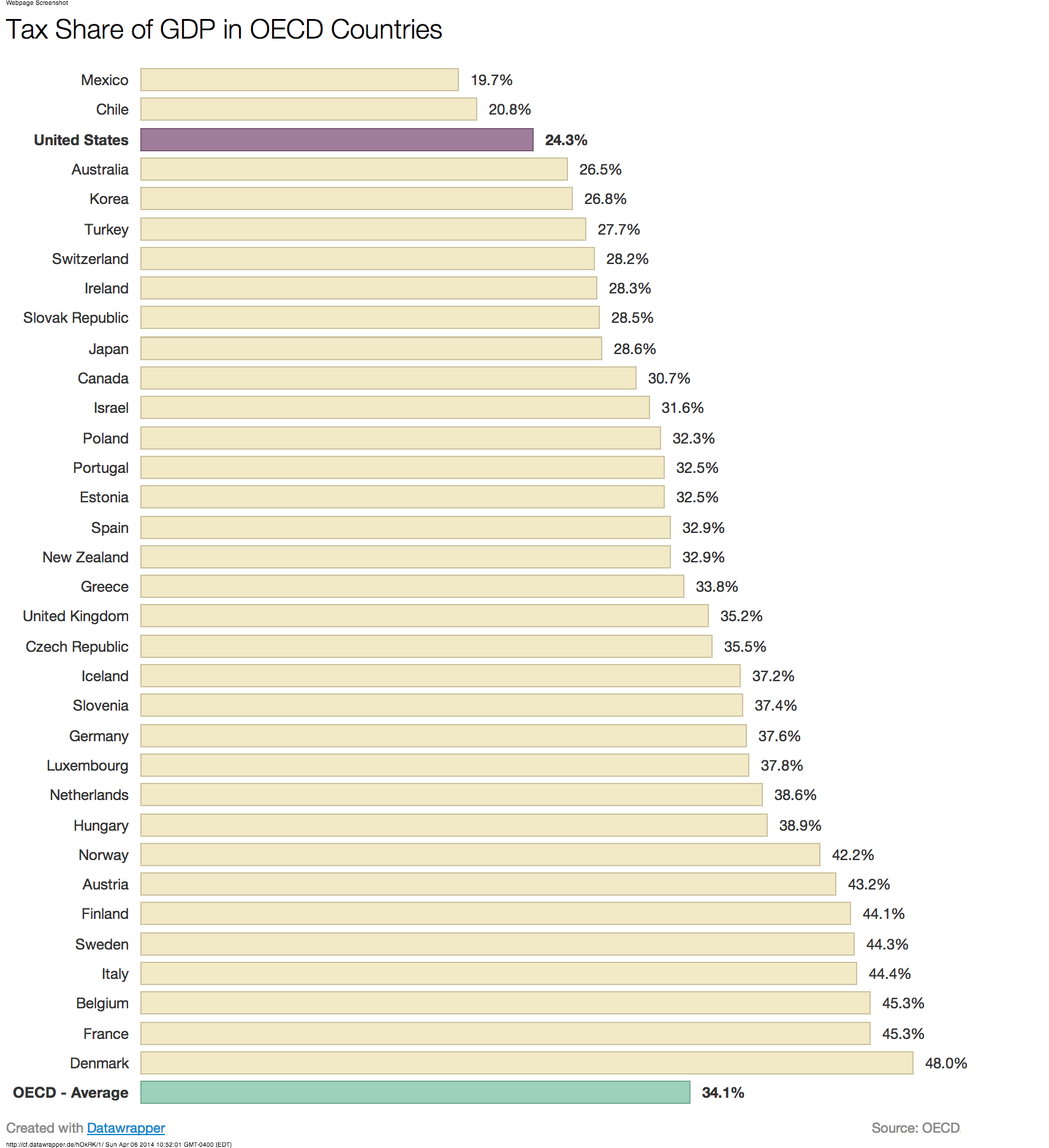
Time is running out on the Congressional calendar for Trump to pass a tax bill, which would be his first and only substantial legislation of his administration. Speaking to reporters before a Cabinet meeting today, he repeated the claim that the United States is "one of the highest taxed nations in the world."

There is no sense in which this is even remotely true. The usual way to compare taxes between nations is by looking at the ratio between GDP (the total value of things produced in a country) and tax collected. The United States is well below the world average--


--and has the one of the lowest GDP-to-tax ratios among the wealthy, democratic OECD nations:


This is hardly the most blatant deception on Trump's part with respect to the bill: for example, he recently claimed that he would see his own tax bill go up under the plan. (In fact, as even his own Treasury Secretary admits, virtually all of the tax savings will go to the wealthiest filers.)

In the one year in which Trump himself is known to have paid federal taxes, most of his bill came from the Alternative Minimum Tax (AMT), which is designed to make it more difficult for ultra-wealthy filers to take advantages of loopholes in the tax code. Trump's plan eliminates the AMT altogether.

Why should I care about this?

  • Presidents shouldn't try to mislead the public about basic facts.
  • Tax policy should be based on the needs of the country and all its citizens, rather than what will help the president.

Thursday, September 21, 2017

What did Donald Trump do today?

He tried to defuse the burgeoning charter-jet scandal in his administration by promoting the fact that his education secretary owns her own jet.

The office of Betsy DeVos, whose inherited fortune is likely to be in the billions, released a statement to the Associated Press declaring that she uses her own private jet for work-related travel, and also picks up all other travel costs at "no cost to taxpayers." 

That declaration seems to have been a deliberate response to a flurry of embarrassing travel-related stories coming out of the Trump White House lately. HHS secretary Tom Price, who came into his position under a different sort of ethical cloud, appears to have chartered at least 24 flights in the last few months, at a cost of about $300,000, ignoring vastly cheaper commercial flights operating at the same time. Treasury Secretary Steven Mnuchin and EPA administrator Scott Pruitt also appear to have abused their travel budgets for personal gain. Mnuchin appears to have used government jets to facilitate a family eclipse viewing. Pruitt--who is exploring the possibility of running for governor in his home state of Oklahoma--is under investigation by his own department for his frequent trips there in government aircraft.

Trump himself took a government plane (Air Force One) to his summer retreat, where he's expected to spend the weekend--except for a separate campaign trip to Alabama. Of course, Trump's travel isn't subject to the same rules as other government employees, but it does have costs, both for the Secret Service and local governments in the many cities Trump calls home. 

So what?

  • Presidents are responsible for the actions and ethical choices of their staff.
  • One employee not abusing her authority does not excuse several others who are.
  • Whether a cabinet employee is qualified for her job is more important than whether she is willing to spend a tiny fraction of her wealth on hotel rooms.

Sunday, August 20, 2017

Sunday Week in Review

What else did Donald Trump do this week?

Phoenix and pardons. In the wake of his initially sluggish, ultimately catastrophic response to the race-based terrorist violence in Charlottesville, Trump began publicizing his upcoming campaign rally in Phoenix. The mayor of that city has begged Trump to postpone it, citing the volatile atmosphere around Trump in the wake of Charlottesville and the likelihood of violence and disorder. 

Complicating matters is the possibility that Trump will use the event to announce a pardon for the convicted criminal Joe Arpaio, a darling of the neo-Nazi and white nationalist movements that Trump was so reluctant to offend last week. Arpaio, the former sheriff of the county Phoenix is in, was convicted of criminal contempt for his refusal to obey a federal judge's orders to halt illegal and discriminatory raids on populations Arpaio suspected of containing undocumented immigrants. While this is the first time charges have been brought against Arpaio, he is widely regarded (even by supporters) to have run a corrupt criminal enterprise from within the sheriff's department for decades. Arpaio reveled in the publicity generated by his "tough" acts like forcing county jail prisoners to wear pink underwear, but he has also used his police powers to attack and intimidate critics, reporters, other local politiciansopposing candidates for his office, and the judge presiding in his own trial.

Trump, who delights in stealing the spotlight as much as Arpaio, has been publicly musing about the possibility of a pardon.

The press conference that wasn't. On Monday, Trump was supposed to give a "big press conference," according to an announcement he made the week before. Instead, Trump read a brief statement directly from a teleprompter walking back some of his initial comments (or lack thereof) on the terrorist violence in Charlottesville. He then began to leave the room. Asked by the reporters present why they weren't having a press conference after all, Trump said "we just had one."

A press conference, by definition, includes taking questions from the press.

Tuesday. However, Trump's idea to have a press conference without the press may have had some merit. The following day, to the surprise and alarm of his staff, he did take questions from the press in the lobby of Trump Tower, walking back the previous day's walking back and defending the "very fine people" he imagined were marching in solidarity with neo-Nazis and the Ku Klux Klan.

For all the attention that Trump's remarks attracted, he did not entirely overshadow the people standing behind him. John Kelly, Trump's new chief of staff, became something of a viral sensation for his miserable body language as Trump spoke. (When Kelly was appointed on July 31, it was amid optimism that he would exert some semblance of control over Trump's most destructive impulses.)

But three other Trump administration officials were also put in awkward positions by his equation of neo-Nazis and their fictional "alt-left" counterparts. The official reason for the lobby appearance was to introduce Trump's infrastructure plan, and he was joined for that purpose by his secretary of transportation Elaine Chao, his treasury secretary Steven Mnuchin, and his chief economic advisor Gary Cohn. Chao was born in Taiwan, and Mnuchin and Cohn are Jewish. Pressed for comment, Chao and Mnuchin eventually offered tepid restatements of the White House press office's statement on Trump's remarks. Cohn has made no statement and was reportedly furious, but planned to remain in his job for fear that his departure would leave the Trump administration with no real economic policy experience at all.

Carl Icahn. Dozens of people symbolically employed by Trump for their advice resigned this week in frustration with Trump's inability to offend his white nationalist supporters, but at least one of his unpaid advisors resigned in the more traditional fashion: under a cloud of suspicion.

From the moment of his appointment, there has been suspicion that Carl Icahn, one of the few people whose advice Trump appears to actually value, would steer policy toward things that would benefit people like him--that is to say, billionaire investors. But Icahn's resignation appears to have been prompted by an article in the New Yorker spelling out his participation a much more direct form of conflict of interest. Icahn owns companies that trade in pollution credits, and appears to have used the news that he would be appointed to oversee regulations affecting those credits to drive down their price. This is significant because Icahn took the apparently unprecedented step of "shorting" those credits, meaning that he earned additional profits the lower their price went.

Manipulating the price of investments and trading on secret information are serious crimes, as is using an office of public trust for personal gain.

Why are these bad things?

  • Presidents who reluctantly read speeches denouncing white nationalists, and then speak positively about pardoning a hero to white nationalists, probably don't have much of a problem with white nationalism.
  • When presidents avoid taking questions, it's usually because they don't have good answers.
  • A president who would rather offend his staff than white supremacists is unfit for office.
  • Presidents are responsible for the ethical behavior of the people they appoint to positions of trust.

Wednesday, June 21, 2017

What did Donald Trump do today?

He said he "just doesn't want a poor person in his cabinet" because rich people have the kind of "thinking" he wants.

At another of his 2020 campaign rallies, Trump said, "I love all people -- rich or poor -- but in those particular positions, I just don't want a poor person." He added, "Somebody said, 'Why'd you appoint rich person to be in charge of the economy.' "I said, 'Because that's the kind of thinking we want.'" He was referring specifically to Treasury Secretary Steven Mnuchin, whose family fortune was made in diamonds over a century ago and who was groomed for a job with his father's firm, Goldman Sachs.

Trump is the heir to a real estate fortune and often claims to be a billionaire (which is indeed more likely to be true now that he is president) and his discomfort with people who aren't wealthy was known long before today. While there's no accurate way of assessing the wealth of his cabinet (or of Trump himself) based on information that Trump has been willing to release to the public, the minimum net worth disclosed suggests that at least seven are or are nearly billionaires. Trump also takes advice from billionaires like Carl Icahn (worth about $17B), which appears to be an excellent way for Icahn to make sure that he stays wealthy.

Because he calls himself a "populist," Trump is often thought of as having his base of support among the working poor. In fact, Hillary Clinton won a clear majority of votes below the US median income of $56,000, and Trump won the votes of wealthier Americans.

Why is this a bad thing?

  • A president who thinks that inheriting wealth gives someone the right "thinking" insults the vast majority of Americans born poorer than Steven Mnuchin.
  • Mainstream Christians who voted for Trump may be surprised to learn that he believes in the Gospel of Prosperity.

Saturday, June 10, 2017

What did Donald Trump do today?

He saw yet another of his nominees caught lying about their credentials.

Trump nominated Joseph Otting this past Tuesday to the post of Comptroller of the Currency, one of the federal government's most important bank regulators.  Otting is a friend of Treasury Secretary Steven Mnuchin, and--like Trump's failed Labor Secretary nominee--has had more professional experience defending himself for regulatory violations in his industry than enforcing them. 

Otting claims to have graduated from the School of Credit and Financial Management at Dartmouth College. Today, a spokesman for Dartmouth pointed out that not only is Otting not a graduate, but that Dartmouth has no such school.

The White House gave no indication that Otting's nomination would be withdrawn. Otting now joins a long list of Trump appointees who have lied about or fraudulently obtained credentials, including Education Secretary Betsy DeVos (who plagiarized some of the answers she provided during the Senate confirmation process), failed National Security Council nominee Monica Crowley (who plagiarized large portions of her doctoral dissertation), national security analyst Sebastian Gorka (whose doctoral degree itself is bogus). There is also the interesting case of Trump supporter David Clarke, who is under investigation by the Naval Postgraduate School for plagiarism of his 2013 master's thesis--and who may even be lying about having been offered a job in the first place, although the White House has been oddly noncommittal on the subject.

Why is this bad?

  • It matters whether nominees to be powerful regulators of the financial system are caught lying about their qualifications.
  • Presidents who appoint cronies to these positions without doing basic vetting of their resumes are essentially saying the jobs don't matter.

Wednesday, May 24, 2017

What did Donald Trump do today?

He urged Congress to increase the debt ceiling immediately--or rather, his economic advisors did.

Both Mick Mulvaney, Trump's budget director, and his Treasury Secretary Steven Mnuchin told Congressional committees that it was urgent to raise the debt ceiling before a government default occurred in October or November. Both cited lower-than-expected tax receipts as a reason for the added urgency.

Trump's subordinates are correct that a default on US government debt--which is regarded as among the safest investments in the world--would be catastrophic for the US and world economy. Raising it has no effect on the amount of money Congress can spend; it would only permit borrowing to cover appropriations that Trump has already signed into law. However, it was not clear whether Mulvaney and Mnuchin were speaking for Trump himself, given his previous statements on the subject:


Why does this matter?


  •  It's bad if a president only wants to do sensible things when it's politically convenient.

Thursday, April 27, 2017

What did Donald Trump do today?

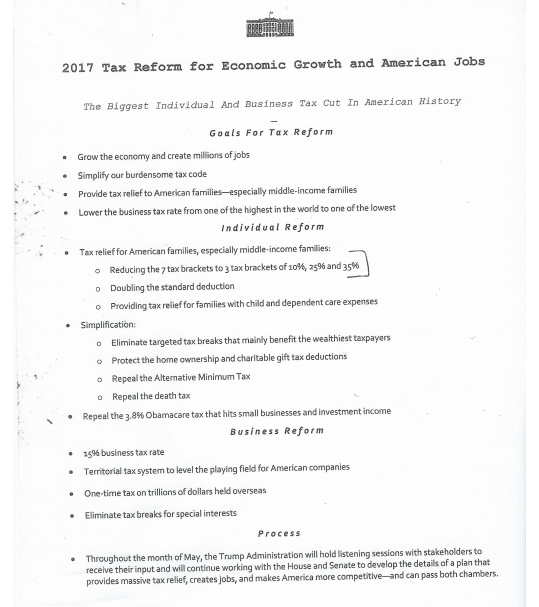
He refused to guarantee that his tax plan--hyped for years now as lowering taxes on the middle class--would lower taxes on the middle class.

Pressed for details today on whether Trump's sketch of a tax plan would mean middle-income families would see lower taxes, Treasury Secretary Steven Mnuchin would only say that "The details of taxes are very complicated." Given a specific scenario--a family of four earning $60,000--Mnuchin refused even to promise that their taxes would not go up.

For the wealthiest Americans, however, the picture is much clearer. The one-page document outlining Trump's agenda has few specifics, but there is no doubt whatsoever that it will massively reduce taxes for corporations and very wealthy individuals--in particular businesses structured the way the Trump Organization is. Assuming he pays any taxes at all at the moment, Donald Trump's personal taxes would absolutely go down under the Trump tax plan.

Trump promised during the campaign that he wanted his own taxes to go up and that he would "massively cut taxes for the middle class, the forgotten people."

So what?

  • Some middle-class voters may have believed Trump when he said he wanted to lower their taxes and raise his own, rather than the opposite.
  • It's bad to break campaign promises.

Friday, January 20, 2017

What did Donald Trump do today?

In the very first official act of his presidency, he signed an executive order that raised the cost of mortgage insurance by about $500 per household per year.

The Federal Housing Administration guarantees loans for millions of low- and middle-income American households, allowing home ownership by those with low credit scores or who cannot afford a 20% down payment. Mortgage insurance is required for all FHA loans, at rates set by the government. The Obama administration had recently taken steps to lower that rate, which in turn would have saved homeowners money.

In his inaugural address today, about an hour before signing the order, Trump said that for too long, "Washington flourished – but the people did not share in its wealth." The FHA is a government entity and will retain the surplus funds generated by the restoration of the rate increase.

Since the rate increase will make FHA loans more expensive, it is expected to decrease demand for them. Treasury Secretary-designate and former Goldman Sachs partner Steven Mnuchin (along with other Goldman Sachs alums in Trump's administration) have forcefully advocated for eliminating government support of home ownership in favor of private lending.

Why is this a bad thing?

  • If a president wants to be seen as an economic populist, it's probably a bad idea to raise government fees on low-income households at the behest of the banking industry.

Friday, December 9, 2016

What did Donald Trump do Today?

He offered a fourth Goldman Sachs executive a position in his administration.

Gary Cohn, the president and chief operating officer of Goldman Sachs, would become the director of the National Economic council. He would join other Goldman alums Steve Bannon (Trump's senior advisor), Steven Mnuchin (Treasury Secretary), and Anthony Scaramucci (transition team executive).

Trump tapped into populist outrage against the gigantic investment bank during the campaign, claiming that opponents like Ted Cruz and Hillary Clinton were its "puppets."

Because of their role in causing the housing collapse of 2008, and then profiting from the bailout, few companies are as powerful or as widely reviled as Goldman Sachs. On the campaign trail, Trump and Bernie Sanders were singing the same tune about its corrupting influence and the harm it had done to ordinary Americans.

Why should anyone care?

  • Voters may have believed Donald Trump when he said he was opposed to Goldman Sachs influencing government.