Showing posts with label revenge. Show all posts

Friday, October 2, 2026

What did Donald Trump do today?

He once again waded into an accusation of rape on the side of the accused rapists.

Thanks in large part to a recent editorial in the Cornell University student newspaper, the Cornell Sun, there has been renewed interest in the case of a woman who says she was gang-raped by members of the Chi Phi fraternity there. The woman is suing those seven members, and the university itself, over the incident. Her complaint is graphic and horrifying, and includes evidence that the event was documented on a fraternity group chat in real time as other members were invited to assault her while she was drugged and unable to resist.


The local prosecutor, Matthew van Houten, had initially dismissed the case. He hastily reopened it after the editorial drew nationwide attention to it, but New York Gov. Kathy Hochul took it out of his hands today, assigning instead it to a special prosecutor. Hochul said that the reason she was assigning it to New York state Attorney General Letitia James instead was that she had lost confidence in van Houten.

James won a civil suit for fraud against Trump and the Trump Organization in 2024, which infuriated Trump. He retaliated on his return to office, trying unsuccessfully three times to secure a federal indictment against her. (It is almost unheard of for a grand jury to refuse to return a bill of indictment even once.)

That history was enough for Trump to decide that the accused rapists wouldn't get a fair trial, because, he said today, she "is a corrupt person." He then repeated a racially derogatory nickname he first gave her when she was leading the fraud prosecution against him. (James is Black.)

But as recently as yesterday, Trump had said he didn't know much about the case, and that he trusted Cornell University to "do what's right." In reality, Cornell had already washed its hands of the incident over a year ago, when it gave the accused students temporary suspensions and, according to the lawsuit, assigned them essays. Cornell has not confirmed any more severe sanctions against the accused students.

In other words, Trump appears to be jumping in front of the spotlight here, on the side of the accused rapists and Cornell University, either because a political enemy of his is involved as the prosecutor, or simply because it's getting nationwide attention.

Trump, who a civil jury found liable for rape, has a long history of defending other men accused of rape or other abuses of women—and that's entirely setting aside the question of what he knew about his longtime friend Jeffrey Epstein's child sex trafficking ring, and the favors he's continued to do for Epstein's co-conspirator Ghislaine Maxwell. Among other men accused or convicted of serious sexual crimes, Trump has publicly defended:

  • Rep. Max Miller (R-OH), who is accused of assaulting his wife and 2-year-old daughter, and who tried to blackmail a Republican senator to cover it up. The victim, who knew Trump and his wife Melania personally, told him about it directly, but was ignored. After the scandal broke, Trump expressed sadness for what Max Miller was having to go through.
  • Conservative TV pundit Bill O'Reilly. After O'Reilly had settled lawsuits from five different women who were the targets of workplace sexual harassment by him, Trump said he didn't think a settlement was the right move, because "I don't think Bill did anything wrong." 
  • Alabama Senate candidate Roy Moore, who was so credibly accused of sexually stalking and in some cases assaulting underage girls that one of the most reliably Republican states in the country elected a Democrat, Sen. Doug Jones, rather than vote for Moore. Trump said that he was satisfied that Moore had done nothing wrong because "he totally denies it," ignoring direct testimony from the women accusing him and other witnesses. 
  • Former boxer Mike Tyson, who was convicted of raping an 18-year-old in 1991. In Trump's understanding, there was "a girl that, late in the evening, knocked on his door, was taken in, was raped perhaps, perhaps not." But Trump suggested she was lying because the young woman was "smiling" at a beauty pageant she was competing in the next day.

    (Trump presumably knows that smiling is a part of pageants: he operated a series of them himself, including "Miss Teen USA," where he was accused by contestants—including underage girls—of using his ownership of the contests to watch them undress in changing rooms. He's admitted to this, at least where adult contestants were concerned.)

  • Fox News executive Roger Ailes, whose backing of Trump helped get him elected in 2016, and who was accused of sexual harassment by at least four women, including on-air hosts Gretchen Carlson and Megyn Kelly. Trump pointed to Ailes' importance in the broadcasting industry as an excuse, adding "I'm sure it was friendly."

  • Trump campaign manager Corey Lewandowski, whose physical and sexual assault attempts include:

    • attacking a female reporter for the conservative outlet Breitbart News, for which he was arrested but not prosecuted
       
    • unwanted sexual touching of a woman performing at a Trump holiday party  

Trump refused to fire Lewandowski, and blamed his accusers for how "a man could be destroyed" over their allegations. In reality, far from having his life destroyed, Lewandowski continued to work in Trump's orbit, most recently as part of the Department of Homeland Security. He was reportedly engaged in an extramarital affair with DHS Secretary Kristi Noem. Noem was fired after reports of her using a luxury government jet to carry on the affair leaked.

  • White House Staff Secretary Rob Porter, who was accused of physical abuse by both of his ex-wives. Trump's Chief of Staff, John Kelly, forced Porter out to avoid dragging the scandal into the White House, only to have Trump say he believed Porter: "He said very strongly yesterday that he's innocent so you have to talk to him about that, but we absolutely wish him well, he did a very good job." 

Trump has been independently and credibly accused of sexual harassment or assault by at least 28 women.

Why does this matter?

  • The reason a jury of his peers found Trump to have committed massive fraud related to his business organization is that he committed massive fraud, not because Letitia James did anything wrong. 
  • The reason a jury of his peers found Trump liable for raping E. Jean Carroll is because he raped her, not because all women who accuse men of rape are liars.  
  • The last thing this tragic and horrifying story needed was Donald Trump making himself a part of it.

Friday, July 31, 2026

What did Donald Trump do today?

He sided with Iran in a cyberattack against the United States.

Earlier this week, more than 30 municipal water systems in Minnesota were targeted by a cyberattack that US intelligence officials believe came from Iran. Those agencies have been warning about the likelihood of such attacks for weeks now. No serious damage was done, but the fact that it took place on American soil represented an escalation by Iran as the war enters its sixth month, because of the implication that Iran is rising to Trump's own threats to target civilian populations.

Trump's response was to defend Iran, saying that he thought the problem—dozens of simultaneous alarms and malfunctions at independent water facilities across the state—was somehow the fault of Minnesota's government. Minnesota Gov. Tim Walz was the 2024 Democratic Vice-Presidential nominee, and Trump has been targeting the state ever since with punitive quasi-military occupations and illegal cuts to its Medicaid program.

"We heard in Minnesota there was a cyberattack and they blame it on Iran. I don't think so. I think, I blame it on Minnesota because they're grossly incompetent," Trump said during a Cabinet meeting.

Q: Can you rule out that Iran is behind the water attacks? TRUMP: I don't think so. I think that Minnesota is behind it. You know who is behind it? Minnesota. Because they're grossly incompetent. I don't think there was an Iranian cyberattack. I think Minnesota ought to get its act together.

[image or embed]

— Aaron Rupar (@atrupar.com) July 31, 2026 at 11:29 AM

Again, the "they" blaming Iran is the United States intelligence community—or what is left of it.

The federal government is primarily responsible for defending public and private infrastructure from cyberattacks. Trump's limited understanding of "the cyber" is legendary: among other things, he once seriously suggested bike messengers as a more secure means of transferring data, touted his then-10-year-old son Barron as a computer expert, and instantly agreed to an offer from Vladimir Putin to form a joint cybersecurity task force. (Russia is, of course, the main cybersecurity threat to the United States.) 

And, as Gov. Walz pointed out, Trump's DOGE attack on basic government functions severely compromised the nation's cybersecurity. Not only was some of the most sensitive data put directly into the unsupervised hands of unvetted teenagers picked for their political loyalty, but Trump deliberately slashed the budget of the main cybersecurity agency, CISA, in retaliation for its director saying that the 2020 election Trump lost was not tampered with.

Trump knows—or at least could know—more about the attack than the general public does at the moment, so it's not clear if Iran deliberately chose to target the Americans Trump thinks of as enemies to provoke exactly this reaction. But it's not that hard to believe: Iran has made trolling Trump personally a key weapon in its arsenal as it seeks to prolong the conflict on its own terms. 

Incredibly, this is not even close to the first time that Trump has defended hostile countries, including Iran, for launching attacks against the United States. He brushed off evidence that the Putin regime was helping Iran target attacks that killed four Americans earlier this month. He did the same when Putin was caught offering bounties on murdering American troops in Afghanistan. He gave Iran "permission" to launch a retaliatory attack against a US base in Qatar last year—after it was too late to do anything about it. 

Trump even defended Iran's right to develop a ballistic missile program last month, during the current war, because, he said, it wouldn't be "fair" otherwise.

UPDATE, 8/1: At least six other states have now reported the same attack. Federal officials are privately contradicting Trump and once again pointing the finger at Iran.

Why does this matter?

  • Defending an enemy you're currently fighting a war with so that you can try to score political points against Americans is about as much patriotism and love of country as you'd expect from Trump at this point.

Thursday, July 30, 2026

What did Donald Trump do today?

He pretended he didn't care that Senate Republicans are resisting installing his criminal fixer as attorney general.

Trump floated the idea of pulling his nomination of Todd Blanche to serve as attorney general on social media today, gloating over the role he played in ending the Senate careers of two Republicans, Thom Tillis (R-NC) and John Cornyn (R-TX), who oppose Blanche. The specific issue that Cornyn and Tillis cited for withholding their support was that as acting attorney general, Blanche—apparently on orders from Trump—is refusing to put in writing the promise he's made not to create a slush fund for "victims" of prosecution for political violence, including the Jan. 6th insurrection. The two senators also oppose Blanche's plan to grant Trump and his family permanent immunity from any prosecution for tax crimes.

Prior to the resignation of Trump's previous attorney general, Pam Bondi—who was also a former private Trump defense attorney—Blanche was best known for his "interview" as a deputy attorney general with convicted child sex trafficker Ghislaine Maxwell. In that meeting, Blanche gave Maxwell criminal immunity in exchange for her answers to a series of carefully worded questions, some of which were obviously designed to provide an alibi for Trump himself. Maxwell obliged by saying that she had never directly, personally witnessed Trump behaving inappropriately with children. She was then immediately, and in violation of Bureau of Prison rules, transferred to a "resort-style" minimum security prison where her privileges—unusual even for this prison—include custom meals and interaction with therapy puppies.

(Relatedly, the Senate voted unanimously yesterday in favor of a nonbinding resolution demanding that Trump not pardon Maxwell or commute her sentence. Under normal circumstances, Senate Republicans would have killed the resolution without a vote as a political stunt—but there is genuine bipartisan anxiety that Trump will actually cut a deal with Maxwell in exchange for her silence about what he knew of Epstein's child sex trafficking ring.)

The reality is that simply by refusing to nominate anyone else, Trump can keep Blanche in charge of the Department of Justice indefinitely. Blanche's authority in the acting role is not meaningfully different than it would be if it were confirmed. But the fact that it's two lame duck Republican senators with nothing left to lose politically who are standing up to Trump suggests a dangerous weakness in Trump's position. Without the full support and political cover of the Republican Party, Trump is in grave danger of losing what control he has left over his presidency and, ultimately, his ability to stay a free man if he voluntarily departs office. Gambling on the support of two new Republican senators who will be politically beholden to him may be the best option in terms of maintaining his authority with a Republican Party that is increasingly angry with how he is dragging them down in the polls.

But that only works if Tillis and Cornyn are replaced by other Republicans, and that is very doubtful. Roy Cooper, the Democratic candidate in North Carolina, is posting nearly 10-point leads over his Republican opponent. In Texas, normally a solidly red state, Democratic state senator James Talarico has a 5-point lead in the latest poll over Ken Paxton, a staunch Trump ally with a criminal record, an impeachment by the Republican-led Texas legislature, and credible allegations that he has been voting in a precinct where he doesn't live.

In a response today, Cornyn responded that he and Tillis are not the only Republicans who have said they won't vote for Blanche.

Why does this matter?

  • The only reason to refuse to promise to create a slush fund to reward people who commit political violence on your behalf is that you intend to create a slush fund to reward people who commit political violence on your behalf. 
  • The Attorney General of the United States is supposed to represent the people and government, not protect Donald Trump from them, no matter what Trump or Todd Blanche may think.  
  • Senators don't block a nominee from their own party, whom they'd voted for in a similar capacity less than two years ago, without an obvious reason.

Tuesday, July 28, 2026

What did Donald Trump do today?

He filed the latest in an endless series of appeals to avoid paying a woman he raped and defamed what a jury said he owed.

In 2023, a New York jury found that Trump had raped E. Jean Carroll in the mid-1990s, and that his public statements accusing her of lying about it for money and attention were defamatory. As a result of those defamatory statements, Carroll, 82, endured public humiliation and death threats. The result of the trial was that Trump was ordered to pay her $5.6 million in damages.

Carroll is one of about thirty women who, at various different times dating back to his first marriage, have accused Trump of sexual assault, sexual harassment, or lewd conduct towards minors. (That list does not include conduct Trump may have participated in or known about related to his friendship with Jeffrey Epstein.)

While the trial continued in the penalty phase (but after the jury's verdict) Trump repeated his defamatory comments. That resulted in a separate judgment, this time for $83.3 million. The higher damages were intended to deter Trump from continually reoffending. (They've worked: Trump no longer repeats the defamatory claims.)

Trump subsequently lost every single appeal, including one at the Supreme Court—and even an extra bite at the apple he gave himself by demanding that the Court reconsider its judgment. The original $5.6 million verdict, plus interest, was ordered paid to Carroll earlier this month. (Trump is challenging even that routine order, claiming that Carroll should not be able to invest the money in the stock market, where it might lose value, because he may someday, somehow be able to get a verdict affirmed by the highest court in the land overturned.)

Today, Trump filed an appeal of the second, $83.3 million verdict to the Supreme Court, even though it springs from identical conduct and was issued as a continuation of the same trial. 

Trump's actual argument in this appeal is that he should be immune from civil liability for defamatory statements he made while he was in office. In this case, that means that Trump is arguing that he should be allowed to call Carroll a publicity-seeking liar for saying he raped her—which a jury established as fact—because he was President at the time. This is the same argument that the Supreme Court rejected earlier, leaving a lower court's ruling intact.

He also argued, unsuccessfully, that the United States government should be allowed to replace him as the defendant, which would allow him to use taxpayer money to satisfy the verdict rather than his own.

The Department of Justice had historically declined to prosecute sitting presidents for criminal acts while they are in office, although until Trump that meant that presidents who broke the law in office could still be prosecuted after the fact. This was a custom, rather than established law, until Trump's own appointees on the court provided the majority in Trump v. United States (2024). That ruling carefully granted criminal immunity to presidents exercising unspecified "core powers" and, at least temporarily, got then-candidate Trump free from federal indictments relating to his attempts to overthrow the results of the 2020 election and stay in power illegally. (Trump could still be prosecuted for the underlying crimes under a new indictment, assuming he survives his current term and leaves office voluntarily.)

In the current case, Trump is arguing that calling his own rape victim a liar is a "core power" of the presidency.

Notably, while Trump relies on his control of the DOJ to avoid prosecution, he's succeeded in getting a criminal investigation launched against Carroll, on the theory that she committed perjury. That appears to have been a more or less empty threat: the investigation does not appear to have really commenced and even Trump diehards, like his former defense lawyer and current acting Attorney General, Todd Blanche, have distanced themselves from it.

Trump has spent much of this year trying to pay himself and supporters who committed crimes on his behalf billions of taxpayer dollars for the supposed "weaponization" of government against them.

Why does this matter? 

  • This is pretty much what you'd expect an unrepentant sexual abuser to do with the powers of the presidency.   
  • The American people are not Donald Trump's piggy bank and the Department of Justice is not his personal goon squad.  
  • Flaunting your ability to get away with horrific acts against your political enemies is what tinpot dictators do.

Friday, July 24, 2026

What did Donald Trump do today?

He admitted screwing over scientists from blue states out of revenge but said that wasn't "political."

Among the casualties of Trump's assault on federal science programs last year were 624 grants from the Department of Energy that were marked for cancellation. 284 of them were, in fact, canceled. Of those, 283 of them were from states that "had a recipient location and/or at least one place of performance in a state that awarded its electoral votes to Kamala Harris in the 2024 election and has two Democratic-caucusing Senators.” That language comes from Jeff Novak, a DoE lawyer, in a recent court filing.

In other words, the Trump administration has admitted in open court that it deliberately canceled grants on research into improved energy technologies based on whether or not the recipients were in a blue state.  

But in a comment today, Trump's Department of Energy insisted that refusing all grants from states that didn't give Trump their electoral votes somehow wasn't a political decision: "None of the termination decisions were based on political considerations."

This is just the latest in a string of episodes where Trump has openly punished the states that voted for his opponents—which, collectively, represent more than half of the nation's population and tens of millions of his own supporters. He's all but stopped signing disaster declarations in blue states, and he's trying to shut off Medicaid funding to two blue states whose governors he particularly hates. 

It's not new behavior: at the height of the COVID outbreak in 2020, he threatened to hold off on supplying urgently needed medical equipment unless blue-state governors like "the woman in Michigan" (Gov. Gretchen Whitmer) until they were appropriately "appreciative" of him in public. 

The Trump administration is currently finalizing an administrative rule that would purport to give him the power to cancel any grant that didn't "demonstrably advance the president’s policy priorities"—essentially giving Trump a personal veto over any scientific or academic research that he didn't like, regardless of what Americans' representatives in Congress had specified in appropriations bills for that funding.

Why does this matter?

  • Punishing the citizens you think of as your enemies is what dictators do.   
  • Americans deserve a president who isn't constantly looking to screw over the places where more than half of them live.

Tuesday, July 21, 2026

What did Donald Trump do today?

He used illegal Medicaid cuts to punish his political opponents in two blue states.

The Trump administration announced today that it was "pausing" Medicaid disbursements to Minnesota and California, over supposed fraud. The governors of each of those states are both political rivals to Trump: Gavin Newsom of California is a likely Democratic presidential candidate in 2028, and Minnesota's Tim Walz was the Democratic vice-presidential nominee in 2024.

Trump has made this threat before: in February, he said he'd withhold $259 million from Minnesota. He never carried it out, though. Courts have stopped Trump from politically motivated interference with healthcare programs before. In spite of the attention that Trump's HHS officials—former lawyer Robert F. Kennedy Jr. and daytime talk show host Mehmet Oz—tried to bring to the move today, it's not clear that any money has been withheld yet.

There is Medicare fraud in Minnesota and California—and in every other state, and probably almost every individual county. Committing fraud against the government for these kinds of programs is easy, but getting away with it is more difficult—as Trump, whose business was convicted of defrauding the State of New York, is well aware. (That is not to be confused with Trump's criminal conviction on 34 felony charges, which dealt with different matters.) Even if he didn't have personal experience with it, Trump has pardoned many wealthy and politically connected Medicare and Medicaid fraudsters, who collectively stole billions of dollars.

Regardless, Trump has no authority to withhold Medicaid funding for any state, or impose conditions on its release outside of what the law permits. Doing so violates Congress's constitutionally granted control over appropriation, as well as the 1974 Impoundment Control Act.

Trump has made little secret of his intention to punish states that don't support him politically at the federal level—even though, to use California as an example, that means punishing millions of people who voted for him. He's also effectively stopped approving disaster relief for blue states in his second term.

 Presidential approval rates for disaster requests from Democratic-led states and Republican-led states

Why does this matter?

  • Cutting off basic government services to punish areas the leader thinks aren't sufficiently loyal to him is what dictators do. 
  • It's beyond evil to punish poor children by withholding medical care to score political points against Americans who politically oppose you. 
  • Presidents who care about fraud generally commit less of it.

Tuesday, July 7, 2026

What did Donald Trump do today?

He threatened state election officials with prosecution, just in case he needed to.

Via the Department of Justice, which is now run in an acting capacity by one of his former criminal defense lawyers, Trump issued a veiled threat to state election officials today about the possibility that he would try to have them prosecuted after this November's elections.

The letter listed dozens of specific federal statutes regarding the conduct of elections, and emphasized that state officials could be prosecuted under those laws if Trump-appointed prosecutors weren't satisfied with their efforts to, for example, keep noncitizens from voting.

The statutes cited have not been used to prosecute state officials in decades, if ever. No official at any level of American government, down to the smallest municipality, has ever been accused of conspiring to allow noncitizens to vote, much less convicted.

The DOJ also demanded that officials "respond to this letter within five days informing us how
the state of Michigan intends to ensure it is complying with these federal laws." There is no such legal requirement. The United States Constitution gives states full authority to conduct elections.

In reality, people intentionally casting fraudulent ballots is almost completely unheard of. For example, the ultra-conservative Heritage Foundation conducted a study of reported voter fraud in past elections. In just one of the states they examined, Pennsylvania, they found 39 individual reports of voter fraud out of more than 100 million votes cast, meaning that 0.00004% of ballots cast over the course of three decades might have been illegally cast. 

Thanks in large part to Trump himself, Republicans stand a good chance of losing control of the House of Representatives in November's elections, and possibly even the Senate. 

Many things are against federal law. For example, it's a crime to use the powers of a federal office—like a federal prosecutor role—to mistreat people for unlawful purposes, like political revenge. It's also a crime to submit a false instrument—like a declaration by a slate of fraudulent electors that Trump had won their state in the 2020 election—with the intent to defraud the federal government. And, of course, it's an extremely serious federal crime to commit acts of insurrection or sedition.

Why does this matter?

  • This is not what you do if you intend to abide by the results of a free and fair election.

Tuesday, June 2, 2026

What did Donald Trump do today?

He put his political hatchet man in charge of the country's intelligence agencies.

Today, Trump named Bill Pulte as his acting Director of National Intelligence. Pulte, who will also continue in his role as head of the Federal Housing Authority, is best known in national circles for his role in ginning up spurious criminal investigations against at Trump's political enemies. (Specifically in Michigan real estate circles, he's known for being the defendant in a class action lawsuit for shoddy construction in the homes built by the company he inherited.)

In simplest terms, Pulte made a list of Trump's enemies, then used his position to go looking through the details of private financial transactions for pretexts to have criminal charges brought against them.

Among Pulte's targets for Trump's revenge were Sen. Adam Schiff (D-CA), former Rep. Eric Swalwell (D-CA), NY state Attorney General Letitia James, and Federal Reserve governor Lisa Cook. Schiff and Swalwell are outspoken critics, and James successfully prosecuted Trump's company for hundreds of millions of dollars in fraud. Cook simply refused to resign from the Federal Reserve Board so that Trump could appoint someone who would give him the massive interest rate cut he wants and would personally make tens or hundreds of millions of dollars from.

None of Pulte's criminal investigations or referrals went anywhere, and at least one was a spectacular failure by legal standards: DOJ prosecutors failed three times in a row to obtain a valid grand jury indictment of James. (Indictments at the federal level are practically a formality; failing three times in a single case may be a record.) 

In large part, Pulte's scheme failed because the supposed "wrongdoing" he accused them of—mostly, claiming different houses as primary residences on different mortgage applications—isn't illegal in the first place, unless it's part of a larger fraud scheme (like the one Trump himself was convicted of in New York state court). In the aftermath, at least three Trump cabinet officials, were revealed to have made similar mortgage claims, and Pulte's multi-millionaire father and stepmother were found to have both claimed homestead tax credits on two properties, which is likely illegal. (Pulte did not bring charges against any of them.)

When federal agents at the FNMA, which Pulte chairs, began investigating whether Pulte had improperly used his influence to target Trump's political enemies, Trump fired them.  

In his new role as DNI, Pulte would have access to all of the most sensitive information known to the United States government. That makes the fact that Pulte does not even have a security clearance now an enormous problem. There is also a legal problem with Pulte's appointment: federal law requires that a DNI have "extensive" experience in national security. Pulte, who at 38 has spent his entire career before 2025 as the heir to a real estate fortune, has none at all.

There was bipartisan disgust at the announcement today. Republican Sen. John Thune said the pick would "weaponize" the national intelligence system against Trump's enemies. The conservative editorial board of the Washington Post marveled that Trump had "managed to find someone less qualified than Tulsi Gabbard to replace her as interim director of national intelligence," and said that Pulte was a "sycophant" whose real function would be to damage the nation's intelligence agencies from within. (Trump has had a vendetta against the American intelligence community from the start, in part because they exposed his campaign's collusion with the Russian government to subvert elections on his behalf.) GOP Senator Bill Cassidy simply called Pulte incompetent.

Trump has been claiming since he took office that he, personally, is the real victim of the "weaponization" of government. 

Why does this matter?

  • Using the law to punish enemies for political crimes is basically the core of authoritarianism. 
  • The person in charge of national intelligence should know the first thing about intelligence, or at least have held a job they didn't inherit from their grandfather.
  • Playing the victim is a classic abuser strategy.

Sunday, May 31, 2026

What did Donald Trump do today?

He threatened a federal judge over his "military top-secret ballroom."

Today, Trump once again took to social media to rant about the legal obstacles he's facing in building what he has called a "military top-secret ballroom." Initially, Trump's fixation on the "ballroom" was simply for the event hosting space he was imagining. He claimed that presidents for "150 years" (so, presumably, back to the Ulysses S. Grant administration) had yearned for "a large event space on the White House complex."

But the idea that Teddy Roosevelt or Dwight Eisenhower lay awake at night dreaming of ballrooms they couldn't build didn't play well with the public, and neither did the ballroom itself, or Trump's obsession with it. Gradually, he introduced the "military" aspect to his frequent diatribes about it, recasting what he still calls a ballroom as some kind of space-age fortress with a bunker, secure communications facilities, and a hospital. (The White House already has all of these things except a hospital, which might actually be useful for a President whose "annual physicals" now occur every few months and on short notice.)

Today's emotionally overwrought post was about the "DronePort" that he claims the current litigation against the ballroom is holding up. He specifically called out the Republican-appointed judge overseeing the case, Richard Leon, and said that Leon would "be held responsible for the Death and Destruction caused to our Country."

Drawing attention to people by name in this way, in the knowledge that someone among perhaps millions of followers will try to threaten or hurt them, is called stochastic terrorism. Trump has a great deal of experience with it, including against Republicans like Judge Leon.

Trump didn't say what "Death and Destruction" he envisioned happening because the White House lacked an "ornately designed and carefully crafted space, with a seated capacity of 650 people." But he posted it from the clubhouse of one of his Virginia golf resorts, which lacks any of the White House's defensive fortifications or a drone port.

Why does this matter?

  • Laws and judicial proceedings don't cease to exist just because Donald Trump gets upset by them. 
  • Adding paranoia to a preexisting obsession doesn't make it any better.


Thursday, May 28, 2026

What did Donald Trump do today?

He lied about using the power of the state to criminally punish a woman he raped.

In 2023, a jury found that Trump had raped E. Jean Carroll and then defamed her by calling her a liar when she accused him. Trump repeated the defamatory statements after the verdict was returned, earning him a second and much larger defeat in court. Trump continues to drag the case through the appeals process, but he has lost every round in court so far.

Yesterday, news broke that the Department of Justice was investigating Carroll for the crime of perjury. Several news agencies independently confirmed the story with DOJ sources.

The substance of the investigation was a claim that Carroll, 82, made during a deposition in which she said that she was not receiving external funding for her lawsuit. That deposition took place two years after her attorneys accepted some financial support on her behalf from a Chicago nonprofit organization, and which Carroll had evidently forgotten about or was unaware of.

At Trump's attorneys' request, the trial judge held a hearing, and accepted that Carroll's statement was an innocent mistake with no bearing on the case. The jury never heard any false statement regarding the matter. 

Today, facing outrage at still yet another obvious attempt by Trump to use the power of the presidency to get revenge against his enemies, he sent a US Attorney to make a misleading statement of his own. Andrew Boutros "categorically" rejected the reporting and insisted that no such investigation into Carroll existed. His statement read:

In light of wide-spread reporting and intense media and public interest into the E. Jean Carroll matter in New York, the Chicago U.S. Attorney’s Office can confirm that it has not opened — and has never opened — a criminal investigation into E. Jean Carroll. Any claim to the contrary is categorically false. 

(Boutros has been in the news for other reasons this week, trying to do damage control after his office was found to have grossly abused the grand jury process to obtain false indictments of people protesting against Trump's immigration terror campaign.) 

But given the certainty that the investigation does exist, it appears that Boutros's statement was carefully worded to conceal that reality. Further reporting today revealed that the organization that helped fund Carroll's suit is itself under investigation—and since that would amount to a criminal conspiracy if Carroll actually had knowingly lied during her deposition, an investigation into the donor is an investigation into Carroll regardless. 

In other words: Trump's DOJ, which is led by Trump's former personal defense attorney, is targeting for criminal prosecution the woman that a jury found he raped and twice defamed for alleged false statements that her lawyers voluntarily corrected, and a judge held harmless—and then lying about it when called out. 

Trump has spent much of the last month trying to pay himself and supporters who committed crimes on his behalf billions of taxpayer dollars for the supposed "weaponization" of government against them.

Why does this matter?

  • This is pretty much what you'd expect an unrepentant sexual abuser to do with the powers of the presidency. 
  • The Department of Justice is not supposed to be Donald Trump's private goon squad.

Wednesday, February 25, 2026

What did Donald Trump do today?

He once again threatened to withhold medical care from poor children to punish the Americans he thinks are his enemies.

The day after Trump gave a long speech that left him visibly exhausted, the White House kept him out of public sight today. But the administration did send JD Vance and Mehmet Oz out to reiterate a threat Trump made last night. The two held a press event today promising to withhold $259 million in Medicaid funds to the state of Minnesota. That state's governor, Tim Walz, was Vance's opponent in the 2024 vice-presidential race. 

Minnesota is also home to the largest Somali-American communities in the nation, a group Trump has compared to animals and falsely accused of disloyalty. It's not clear how much of Trump's loathing of Americans of Somali descent comes from his personal racist beliefs and how much of it is political opportunism in the belief that other Americans can be convinced that those racist beliefs are true. Racist broadsides against immigrants were a major theme of his campaign and a sort of acid test for then-candidate Vance, who was given the job of spreading false rumors that Haitian-American immigrants in Ohio were stealing and eating household pets.

The link to Minnesota and Medicaid has its roots in a fraud investigation launched by the Walz administration before the election. Some of the targets were Somali-Americans, although most were not. That ultimately led to Walz suspending one grant program that had been a particular target for fraud, although legitimate claims were filled through other programs.

Medicaid, which is the federal government's main provider of health insurance for children and poor families, has no such alternative at the state level, meaning that Trump's threatened cuts will directly impact the ability of Minnesotans who have not committed fraud to receive necessary health care. 

There's no way to be sure whether Vance and Oz's delivery of Trump's threat will amount to anything in practice. He's made precisely this same threat before, to no real effect, because courts immediately put a stop to it. As a general rule, Trump has no legal power to punish Americans, especially Americans who are not themselves guilty of any crimes, by arbitrarily denying them government services—and certainly not as a means of political revenge against a state that doesn't vote for him.

Oz, who is Trump's Medicaid administrator, said that people who commit fraud against the program are "self-serving scoundrels." That's hard to disagree with. Among the people who have commited fraud against Medicaid and Medicare who have received pardons or commutations from Trump are:

  • Paul Walczak of Florida, who stole employee Medicare payments and used them to buy a yacht, and whose mother later gave Trump's PAC $1 million 
  • Joseph Schwartz of New Jersey, who committed fraud against Medicaid as the CEO of a chain of for-profit nursing homes, who paid lobbyists with Trump's ear $1.1 million to get the pardon 
  • Rickey Ivan Kanter, who defrauded Medicare through his orthopedic shoe business 
  • Paul Behrens, Thaddeus Bereday, Todd S. Farha, William Kale, and Peter Clay of Florida, all executives in a health insurance company that defrauded Medicare 
  • Robert Corkern of Mississippi, a hospital management company owner who bribed a public official to overpay for his services, driving up public reimbursement costs 
  • William "Ed" Henry, a former Republican member of the Alabama state legislature, who stole government property as part of a Medicare fraud scheme 
  • Ted Suhl of Arkansas, who ran a faith-based behavioral therapy clinic, and defrauded Medicaid 
  • Philip Esformes of Florida, whose chain of nursing homes billed Medicare $1.3 billion for care it never provided to patients, and who went on to commit other crimes after Trump's clemency 
  • Saloman E. Melgen of Florida, an opthalmologist who bilked Medicare for $73 million by performing unnecessary (and sometimes painful and dangerous) eye surgeries 


Why does this matter?

  • It's beyond evil to punish poor children by withholding medical care to score political points against Americans who politically oppose you. 
  • Under no circumstances does a president who pardons $1.6 billion in medical fraud, mostly from his own home state, care about medical fraud.

Thursday, February 5, 2026

What did Donald Trump do today?

He tried to put his name on at least three more things.

There are hundreds of things named for Donald Trump: buildings, hotels, bankrupted casinos, a defunct airline, discontinued commercial products from designer sneakers to frozen steaks, a fake university, and a fraudulent charity, among many other things. There are even two of his own children named after him—Donald Trump Jr., and Barron Trump, whose first name appears to be an homage to Trump's alter ego John Barron. But what almost all of them have in common is that Trump named them himself. 

But the list of public places in the United States named for Trump where other people had a say is as follows: two streets in Florida, a rural county courthouse in Nevada, and this short stretch of highway in the panhandle of Oklahoma. This compares pretty poorly with, for example, former President Obama.

President Donald J. Trump Highway in the Oklahoma Panhandle! 

Since returning to office, Trump has given up waiting for people to give him the honors he thinks he deserves, and has decreed that his name be added to the Kennedy Center (which he has shut down in anger), the United States Institute for Peace (which he first illegally seized and then vandalized), a watered-down version of the 529 Savings Plan, and a pay-to-skip-the-line scheme for permanent residency.

Today, he tried to add at least three more items to that list. The first is TrumpRx, a sort of limited version of commercial services like GoodRx that provide bulk discounts on drugs for consumers without health insurance. In fact, it is the private company GoodRx under the hood, which is why its prices aren't any lower. (In fact, a lot of them are higher than prices on the open market.) People who do have health insurance won't benefit from it, although thanks to Trump's refusal to fund the ACA in the current budget, that number is going up sharply.

He also tried to get his name put on Dulles Airport and New York's Penn Station, according to reporting today, in a deal he floated with Congressional Democrats. In exchange, he promised to release funds for a long-awaited NYC tunnel project that he shut down in an attempt to get political revenge on Sen. Chuck Schumer (D-NY). 

Trump's offer was rejected. 

Why does this matter?

Thursday, January 15, 2026

What did Donald Trump do today?

He threatened to "institute the INSURRECTION ACT," which doesn't mean what he thinks it does.

In a post to his private microblogging service today, Trump said he would "institute the INSURRECTION ACT" if the "corrupt politicians of Minnesota don’t obey the law and stop the professional agitators and insurrectionists from attacking the Patriots of I.C.E."

The Insurrection Act allows a president to use soldiers to conduct domestic law enforcement under certain narrow circumstances. Trump has publicly flirted with the idea of invoking the act many, many times, which he seems to view as a license to launch a direct military assault on his domestic political enemies and force his critics into silence. 

But in reality, the Insurrection Act does little more than give military forces police powers. It does not allow them to act against Americans with impunity, it does not allow for martial law to take the place of civilian government, and it does not suspend Americans' constitutional rights. 

It also does not permit or excuse murder, firing flashbang grenades at infants, kidnapping American citizens to try to force local governments to assist ICE. It does not require Americans to carry their papers on them at all times or be arrested, nor does it generally allow any form of "RECKONING AND RETRIBUTION" against Americans the president thinks are his enemies.

Trump also claimed that the act had been invoked "many" times before, although not since 1992 and only ten times in Trump's lifetime—and most of those were in support of American civil rights protestors who were being targeted by racist state governments. Notably, Trump decided not to invoke it during the one legitimate and serious attack on American government since reconstruction.

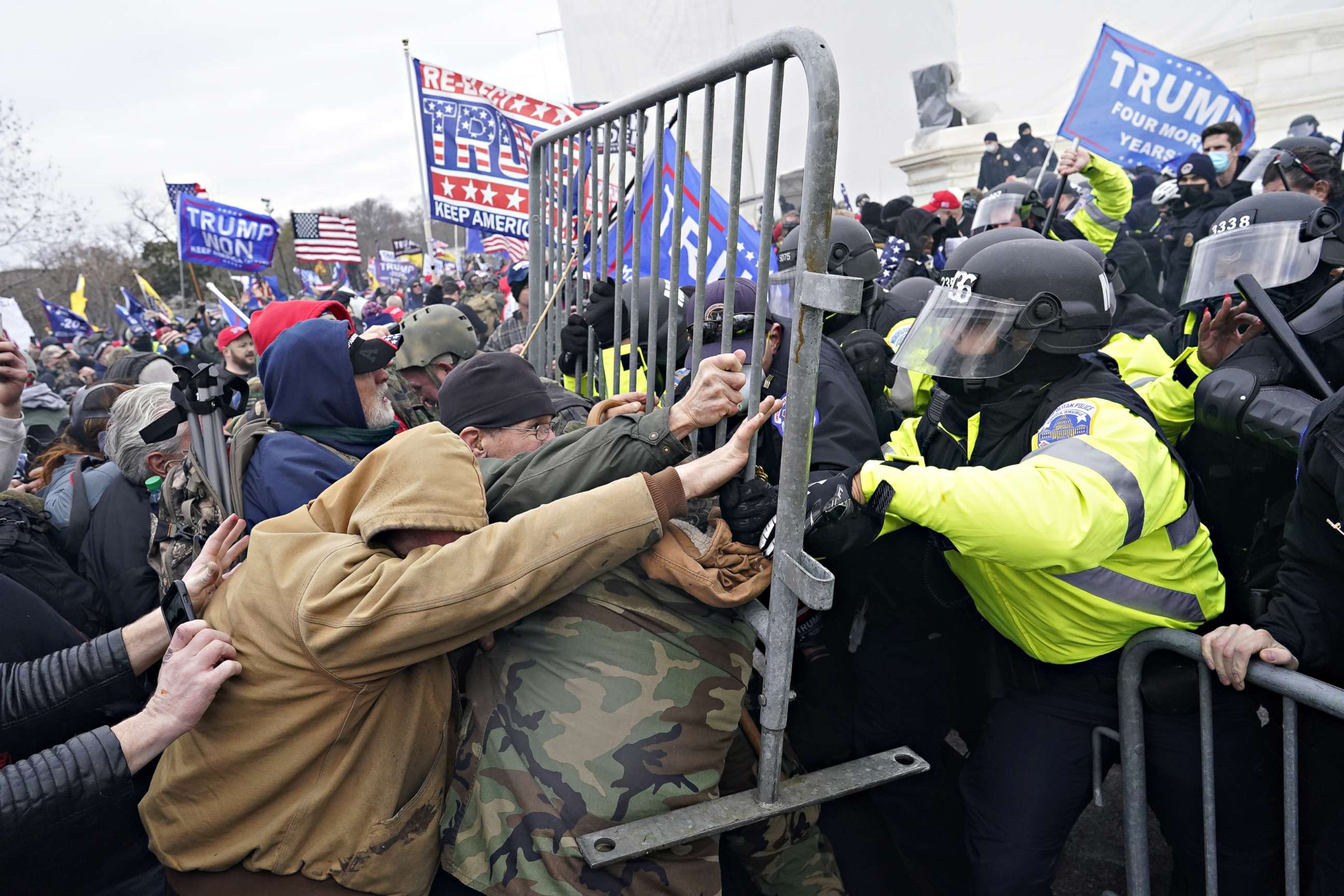
Approximately 1,000' assaults on law enforcement occurred during Capitol  attack, DOJ review finds - ABC News 

Why does this matter?

  • This is tinpot dictator shit whether or not he pretends to give it legal cover. 
  • Americans are not the enemy America's military is meant to fight.

Sunday, January 11, 2026

What did Donald Trump do today?

He imagined that his word was law.

Last week, Trump "called for" a reduction in credit card interest rates. Today, speaking to reporters as he returned from his usual three-day weekend in Florida, Trump declared that credit card companies that failed to reduce their interest rates by January 20th would be "in violation of the law."

No, they won't be. No such law exists, and Trump can't issue one by decree. 

Unfortunately, that wasn't the real financial news of the day. The New York Times broke the story on Sunday that the Trump administration has launched a criminal investigation into Jerome Powell, the chair of the Federal Reserve. Trump has been demanding that the Fed slash interest rates, something completely contradicted by basic economic principles under the current circumstances. (Trump, who owns billions of dollars in both mortgaged property and bonds, would reap an enormous financial windfall if that were to happen.)

Powell responded tonight, directly accusing Trump of extortion.

Trump claimed tonight that he was unaware of any such investigation. This is also a lie: he publicly called for it, and Trump has made a point of installing DOJ officials who will act on those posts as official orders and then confirm that they did so.

Why does this matter?

  • Trump is not a king and has no power to issue decrees with the force of law. 
  • The health of the American economy is vastly more important than Trump adding a few hundred million dollars to his billions.

Tuesday, January 6, 2026

What did Donald Trump do today?

He stopped making legally required federal aid payments for needy children to states run by Democrats.

Temporary Aid for Needy Families (TANF) is a federal cash assistance program that gives block grants to states to provide for basic welfare for poor families. The Child Care Development Fund (CCDF) underwrites child care programs so that parents in low-income families can work. Social Services Block Grants (SSBG) fund foster care programs, adoption services, and other child welfare services. All three are funded by Congressional appropriation through the Administration for Children and Families (ACF), a division of the Department of Health and Human Services.

Today, and without offering any legal justification, Trump froze all of those funds to five states: Minnesota, California, New York, Illinois, and Colorado, or about 22% of the country by population. This means that about half a million people from TANF alone will be without the food assistance American taxpayers have already funded, and federally subsidized daycares are likely to shut down abruptly.

Trump's administration claims it was because of suspected fraud, although there is no direct evidence of unusual fraud in any of those states, and an active investigation in only one of them. What they do have in common is that they are states with Democratic governors and heavily Democratic-leaning electorates.

To be clear, there is almost certainly fraud in each of these programs in every state. As a rule, it is not difficult to defraud any government. The trick, as Trump knows from extensive and bitter personal experience, is getting away with it. 

Trump has recently made Minnesotan children in particular a political target recently precisely because its government, led by 2024 vice-presidential nominee Gov. Tim Walz, had found fraud and taken action about it. Some of the fraud that Walz's government found was committed by Somali immigrants. Trump has targeted the Somali-American community, many of whom live in Minnesota, with racist attacks on their patriotism. 

Today's freeze seems to have been done in great haste in an attempt to keep Trump's version of that story in the news: identical letters requesting audit documents from Minnesota specifically went out to all five states 

It's been just over seven weeks since Trump last unlawfully stopped payments to help American children in low-income families who rely on federal subsidies for food and care. That came during the record-long shutdown at the end of last year over Trump's refusal to fund health care for 24 million Americans whose insurance comes through the Affordable Care Act.

Why does this matter?

  • Punishing poor children to hurt your political enemies is evil. 
  • No matter how many times he pretends otherwise, Donald Trump is not above the law. 
  • Fraudsters who live in glass White Houses shouldn't throw stones.

Saturday, October 11, 2025

What did Donald Trump do today?

He had to scramble yet again to rehire federal workers he fired for political purposes.

Yesterday, Trump and other members of his administration triumphantly declared that they'd fired about 4,200 federal workers from "Democrat-oriented" parts of the government, by which he appears to have meant agencies providing healthcare and disease prevention programs. Among other things, the purge is programs aimed at treating substance abuse, a problem facing millions of Americans, which Trump appears to believe he's solved by ordering airstrikes on boats in the Caribbean.

Less than a day later, his administration is now admitting that they are hastily attempting to re-hire many of the workers fired last night because they were fired by mistake.

Strictly speaking, Trump himself didn't do anything on the subject: he spent the second weekend of the shutdown as he usually does, relaxing at a golf resort he owns. (As is now customary, the pool reporter was not permitted to talk to him or determine whether he was well enough to actually go out on the golf course.) The revelation came in the form of a leak from an unnamed administration official.

Having to scramble to rehire fired essential workers is a familiar problem by now for the Trump administration. So is having to rehire those whose firings were illegal, or retroactively pay them for work never done.

Trump now faces a dilemma that was unthinkable under any other president: he is caught between his desire to punish Americans who oppose him politically by sabotaging "Democrat programs," and the need to have at least some basic functions of government continue to work. 

Almost every federal employee still employed will miss their next paycheck in four days. Trump has refused to commit to back pay for them, in spite of a law he signed clearly requiring it. 

Why does this matter?

  • The purpose of the government is to serve the American people, not be a hostage for Donald Trump to threaten until he gets his way. 
  • This is not something that would happen in a remotely competent administration, much less repeatedly.
     
  • Americans who didn't inherit their jobs know you don't fuck around with people's livelihoods like this.

Friday, September 26, 2025

What did Donald Trump do today?

He demanded that someone who'd investigated his crimes be punished, this time in the private sector.

Trump continued his vendetta against anyone who tried to hold him to account for his criminal conduct after leaving office with a threat against Microsoft, demanding that they fire a recently hired executive. Lisa Monaco, Microsoft's newly appointed president of global affairs, is a former U.S. deputy attorney general and had helped investigate Trump's theft of classified documents and his attempts to overturn the results of the 2020 election.

Trump made the demand at the instigation of Laura Loomer, who tweeted shortly after Trump's post that she was the one who told him to do it. Loomer is a ultra-right-wing conspiracy theorist and podcaster who has a direct line to Trump, to the alarm of many others in his orbit.

In a lengthy rant posted to his private microblogging website, Trump called Monaco a "menace to National Security" and insisted that she be fired. This came on the same day that he gloated over having forced the Justice Department—over the explicit objections of line prosecutors, who saw no credible case—to bring charges against former FBI Director James Comey. (Comey, whose last-minute but fruitless investigation of Hillary Clinton's handling of classified material tipped the 2016 election to Trump, was summarily fired after refusing to pledge his personal loyalty to Trump.)

Microsoft has not responded publicly, but Trump's attempt to jawbone them into firing someone he regards as an enemy is part of a bigger pattern. Trump, who inherited a vast real estate fortune just as New York City property values were skyrocketing, never had much luck in his independent business ventures. Aside from his infamous accomplishment of going bankrupt in the casino business, he lost money—his and other people's—in a variety of ill-fated acquisitions and product launches ranging from airlines to mail-order steaks. 

But forcing private companies to act at his behest gives him a chance to play CEO with a safety net, which may be the appeal. In his second term alone he's extorted the United States' only major manufacturer of computer chips for 10% of its stock, tried to get Coca-Cola to change its recipe, forced US Steel to operate a plant at a loss, prematurely celebrated getting Jimmy Kimmel fired for making fun of Trump's exploitation of a murder for political gain, and—in a move paralleling today's ultimatum to Microsoft—demanded that investment bank Goldman Sachs fire an economist who'd pointed out the basic economic fact that American consumers are the ones who pay for tariffs.

Trump has also systematically fired almost everyone in the public service who investigated or prosecuted cases related to his attempt to lead an insurrection to overturn the 2020 election results. In today's blog post, Trump referred to that insurrection, which was broadcast live as it happened and involved thousands of participants that Trump himself pardoned on returning to office, as the "January 6 hoax."

Why does this matter?

  • The government of the United States is supposed to serve the people, not settle Donald Trump's private scores. 
  • Businesses should be run by people who are not famously, provably, hilariously bad at running businesses. 
  • Trump is not a god and reality does not change itself just because he says something never happened.

Saturday, August 23, 2025

What did Donald Trump do today?

He tried to blackmail an immigrant into pleading guilty to felonies to cover up his own mistakes.

Kilmar Abrego Garcia, a Salvadoran citizen living in the United States under a protective order, became the face of Trump's second-term immigration policy when he and roughly 250 other people were unlawfully sent to a notorious Salvadoran prison camp. They were identified as members of a Venezuelan street gang, Tren de Aragua, based on shoddy evidence (or none) because of the supposed "national security threat" it posed. Trump and his newly-installed appointees at the Department of Justice ignored court orders for months, at times openly mocking the judges who issued them. 

Abrego Garcia came to particular attention because, as a Salvadoran living under a court-supervised arrangement, he was supposed to be protected from deportation back to El Salvador because of the threat of violence he faced if he returned there. The Trump administration eventually claimed that his deportation was an "administrative error" but refused to comply with court orders to have him returned, even though it was paying the Salvadoran government to imprison deportees and had full control over the situation.

Abrego Garcia and other deportees were eventually returned to the United States, but the Trump administration—having quickly burned through public goodwill on its handling of immigration—insisted he was a member of a different gang and hastily charged him with various crimes, including human trafficking. 

The allegation that he was a member of the MS-13 gang was based on the opinion of a disgraced police officer who was subsequently fired for leaking police information to a sex worker he was involved with. But in what appears to have been a serious attempt to bolster the credibility of that claim, Trump released an obviously manipulated photo showing fake "tattoos" on Abrego Garcia's fingers reading "MS-13."


No actual evidence that Abrego Garcia committed these crimes has ever been publicly released, and he has strenuously denied them. 

Today, with his pretrial release from a Tennessee jail imminent, the Trump administration announced plans to deport Abrego Garcia again, this time to the African nation of Uganda—unless he agreed to plead guilty to the felonies he is charged with. Arrangements had already been made to send him to Costa Rica instead, a vastly more suitable destination.

In other words, Trump is trying to force an immigrant whose botched deportation humiliated him into choosing between pleading guilty to politically-motivated charges, or being sent to a country on a different continent from his country of origin where he has no cultural or language fluency.

Trump has made a point of using third-party country deportations as punishment for using legal means to resist removal, such as when he sent immigrants from a variety of countries to South Sudan, a country in the middle of its own humanitarian crisis. For obvious reasons, people deported to countries where they do not speak the local language or have ties to the culture are at severe risk of endangerment. 

Why does this matter? 

  • Leaders who don't screw up this badly don't have to punish the people who embarrass them by making it clear how badly they screwed up. 
  • Ruining Abrego Garcia's life won't make Trump right, or even make him look right.

Tuesday, August 19, 2025

What did Donald Trump do today?

He lashed out at "museums" in general, but especially the Smithsonian Institution, for talking about "how bad Slavery was."


This was an actual post to his private microblogging website.   

This is not the only time in recent weeks that Trump, who explicitly aligned himself with white nationalist organizations during his first term in office, has tried to soft-pedal the horror of slavery. In place of the now-defunded Corporation for Public Broadcasting, which developed Sesame Street and countless other children's shows, Trump has promoted PragerU, a right-wing producer of "educational" videos. Among their work are AI-generated cartoons of historical figures like Christopher Columbus claim that slavery was "no big deal." They also produce a video in which a cartoon Frederick Douglass says that slavery was a worthwhile "compromise" in which enslaved Black Americans were willing to sacrifice their freedom for the good of the United States.

It's not very likely Trump cares much about the culture war he's stoking by minimizing "how bad Slavery was," his long history of overt racism aside. But his anger at the Smithsonian is almost certainly real, because it publicly acknowledged the fact that he has been impeached twice. Earlier this summer, Trump succeeded in forcing the Smithsonian to remove an exhibit in the National Museum of American History dealing with presidential impeachments (all of them, not just Trump's two). When it was replaced, the language was softened, and text related to Trump's impeachment over attempting to blackmail Ukraine into providing fake dirt on his political rival Joe Biden, and his fomenting of the attack on Congress after the 2020 election, was moved to a less visible spot.

Presenting a sanitized history of a nation's glorious past—and punishing anyone who questions it—is a core element of fascism. Presenting an image of the state as perfect makes it harder to criticize the leader. But in the case of historical evils like concentration camps, nativism, colonialism, forced labor, eugenics, racism, science denialism, religious intolerance, propaganda, or xenophobia—things virtually nobody would want to advertise as good things—a deliberate erasure of history makes it harder to tell when authoritarian governments are backsliding towards them.

Why does this matter? 

  • Even by Trump's standards, complaining about teaching that slavery was bad is some astonishingly evil shit.

Friday, August 8, 2025

What did Donald Trump do today?

He ordered still more "criminal" investigations into his political enemies.

Trump has spent his entire political career vowing to use the power of the state to get revenge against the people he thinks of as his enemies. During his first term, his efforts were at least partially thwarted by career prosecutors at the Justice Department and political appointees who refused to completely abandon the DOJ's tradition of independence and political neutrality. But purging the Justice Department ranks of anyone who had shown even the slightest bit of "disloyalty" to Trump was a top priority on his return to office, capped off by installing his personal defense lawyers in the top three roles.

Today, news broke that he has succeeded in getting the DOJ to open investigations into at least two more of the people on his enemies list. New York State Attorney General Letitia James is being "investigated" for successfully suing the Trump Organization for nearly a third of a billion dollars in fraud. Trump has also ginned up an investigation against California Sen. Adam Schiff, whose criticism of Trump seems to get under the skin more effectively than most. Schiff supposedly claimed two different residences as his "primary" one for mortgage purposes, although this is not in and of itself illegal or unethical.

There's a not-too-subtle thread connecting Trump's attacks on James and Schiff: the suit that James won was over Trump's illegal and deceptive valuation of his properties—telling banks they were worth a great deal while at the same time telling tax officials they were worth less. 

Last week, Trump demanded and got an investigation into former Special Counsel Jack Smith, who investigated and brought federal charges against Trump for his theft of highly classified documents after leaving office, and his role in inciting a violent insurrection against Congress on Jan. 6th, 2021, in a last-ditch attempt to stay in power after losing the 2020 election to Joe Biden. (Trump remains liable for prosecution on those matters if and when he leaves office.)

As legal analysts noted today, essentially everything Schiff and James has done has been a matter of public record and, in the case of James's lawsuits, already approved by multiple courts. Neither is likely to result in any prosecution, but that is probably not the endgame. As a political matter, Trump benefits from any distraction from his own overwhelming association with the Epstein scandal. Ironically, given that he and those helping him break the law while in office remain liable for prosecution if and when he leaves office, he also benefits from promoting the idea that all prosecution of political figures is based in corruption. 

Trump is a convicted felon. 

Why does this matter?

  • The leader using the justice system to settle personal scores is what happens in tinpot dictatorships. 
  • Nobody is above the law in a democracy.