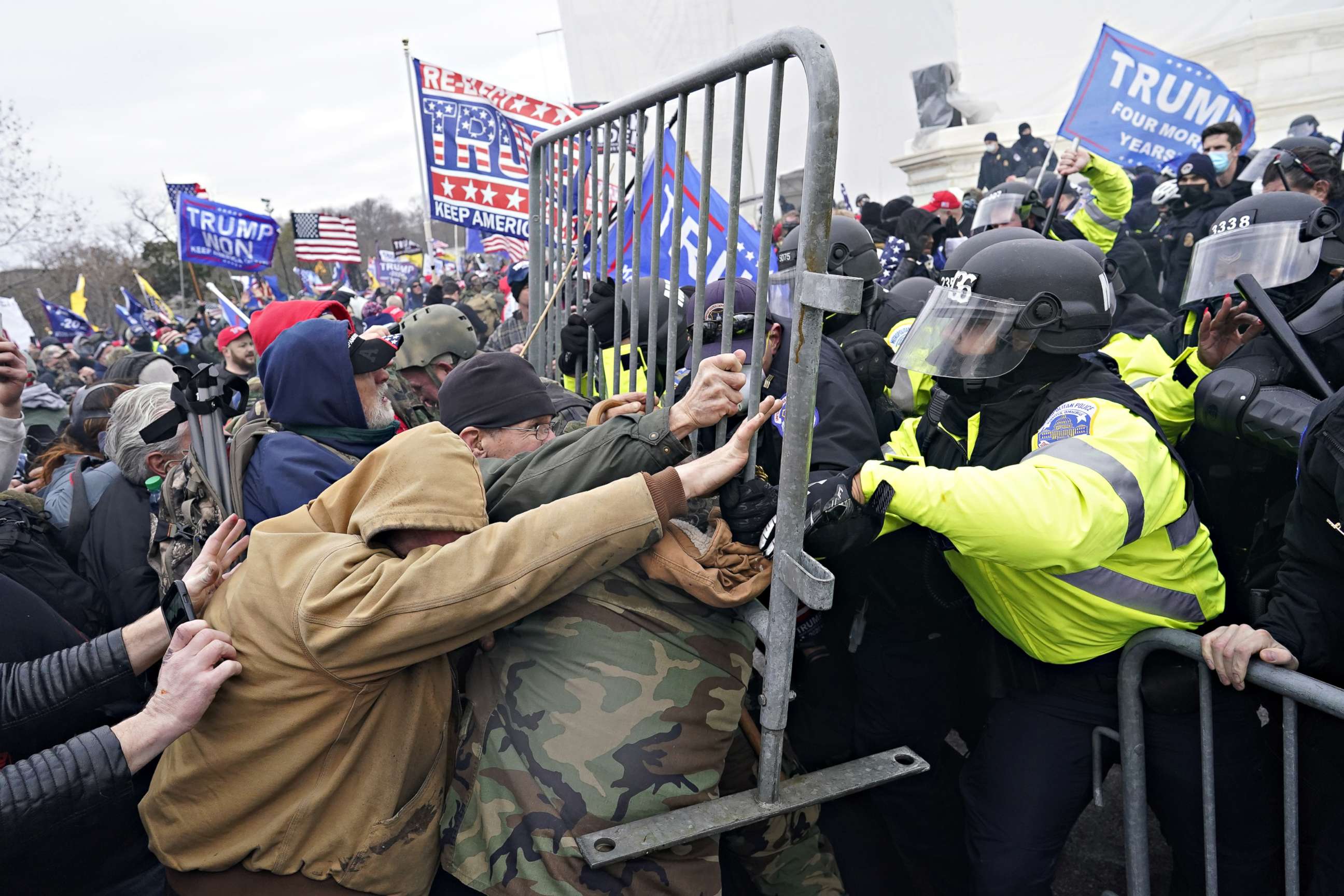
Anti-abortion protestors held a march today in Washington, attended by a number of Trump administration officials. But as was the case at his inauguration last year, the cold weather seems to have been too much for the increasingly frail Trump, who stayed indoors and delivered a brief message by recorded video.
Trump has been anxious to shore up his support with anti-choice voters. They have good reason to think he's not really serious about their pet issue: he was pro-choice most of his life before running for office, and he's gotten confused about exactly what it is he's supposed to believe now that he claims he's anti-abortion. His brief message didn't talk much about abortion, but he did make one interesting claim: that he's "bringing back God."
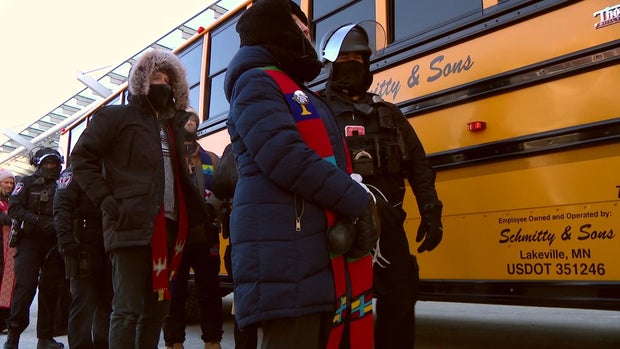
Faith leaders line up to be arrested at the Minneapolis-St. Paul Airport.
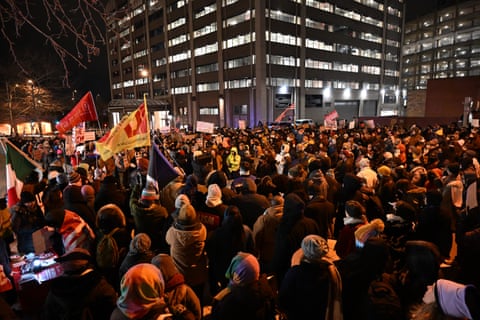
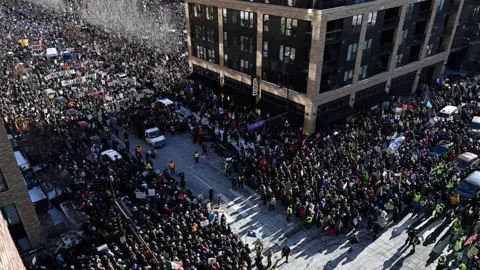
The arrested clergy were part of demonstrations all across Minnesota today. In the Twin Cities alone, tens of thousands of people took part in a march on a day when the temperature was -10°F.
Arresting clergy whose moral stances pose a danger to the establishment is what dictators do, but it has a long history in the United States too.
Thursday, January 22, 2026
What did Donald Trump do today?
He rescinded an offer for Canada to pay $1 billion to be on a "board" with dictatorships.
Canadian Prime Minister Mark Carney had sharp words for Trump in his speech to the World Economic Forum in Davos earlier this week. It got under Trump's skin, who blustered back at "Mark" and demanded that he be "grateful." (Ironically, Carney does owe Trump a debt of gratitude.
His Liberal party was widely expected to be swept out of power in last
year's elections, but when Trump returned to office and started making
insulting "51st state" remarks about Canada, it swung voters sharply
away from the Conservative party Trump backed.)
Carney returned to the fray with another speech in Quebec City today, challenging Trump by name and praising Canada for its embrace of the values Trump has abandoned—a commitment to democracy, free and fair public debate, and the strength it draws from its embrace of immigrants. "Canada doesn't live because of the United States," Carney said, throwing Trump's words back at him. "Canada thrives because we are Canadians."
That appears to have been what triggered Trump to go on social media and declare that Canada was no longer welcome to join his "Board of Peace," a sort of Potemkin village version of the United Nations with Trump's cronies and relatives in place of actual world leaders. Membership costs $1 billion, and Canada—along with virtually all of the United States' allies in developed countries—had already passed on the invitation. It was widely understood as a meaningless vanity project for Trump even before he decided to charge admission.
The billion-dollar price tag is meant to signify that a "Board of Peace" member country has demonstrated "deep commitment to peace, security, and prosperity." But the countries willing to publicly commit to joining it are among the least free countries on the planet. The charter members are:
"Belarus is an authoritarian state in which elections are openly rigged and civil liberties are severely restricted. Security forces have violently assaulted and arbitrarily detained journalists, activists, and ordinary citizens who challenge the regime. The judiciary and other institutions lack independence and provide no check on President Alyaksandr Lukashenka’s power."
Morocco
37/100 — Partly Free
Monarchy. "King Mohammed VI and his palace maintain full dominance through a combination of substantial formal powers, informal lines of influence in state and society, and ownership of crucial economic resources. Many civil liberties are constrained in practice."
Vietnam
20/100 — Not Free
"Vietnam is a one-party state, dominated for decades by the ruling Communist Party of Vietnam (CPV). Although some independent candidates are technically allowed to run in legislative elections, most opposition is banned in practice. Freedom of expression, religious freedom, and civil society activism are tightly restricted. Even by Vietnam’s authoritarian standards, in recent years, and particularly in 2024, the authorities have engaged in one of the widest-ranging crackdowns on dissent in decades."
Kazakhstan
23/100 — Not Free
"President Nursultan Nazarbayev ruled Kazakhstan from 1990 until his resignation in 2019. His hand-picked successor, Kassym-Jomart Tokayev, began a program of ostensible reform after peaceful nationwide protests turned violent in January 2022. Parliamentary and presidential elections are neither free nor fair, however, and authorities have consistently marginalized or imprisoned genuine opposition figures. The dominant media outlets are either in state hands or owned by government-friendly businessmen. Freedoms of speech and assembly remain restricted and subject to punishment, and corruption is endemic."
Hungary
65/100 — Partly Free
"Since taking power in the 2010 elections, [Trump ally] Prime Minister Viktor Orbán’s Alliance of Young Democrats–Hungarian Civic Union (Fidesz) party has pushed through constitutional and legal changes that have allowed it to consolidate control over the country’s independent institutions. The Fidesz government has passed antimigrant and anti-LGBT+ policies, as well as laws that hamper the operations of opposition groups, journalists, universities, and nongovernmental organizations (NGOs) that are critical of the ruling party or whose perspectives Fidesz otherwise finds unfavorable."
Armenia
54/100 — Partly Free
Rebounding from a period of "systemic corruption, opaque policymaking, a flawed electoral system, and weak rule of law" but its membership is part of an ongoing charm offensive directed at manipulating Trump directly. "The country has been seriously affected by military pressure from Azerbaijan in recent years. In September 2023, nearly the entire ethnic Armenian population of Nagorno-Karabakh, which had enjoyed de facto independence from Azerbaijan since 1994, fled to Armenia after the Azerbaijani military defeated local defense forces and took full control of the territory."
Egypt
13/10 — Not Free
"President Abdel Fattah al-Sisi, who first took power in a 2013 coup, has governed Egypt in an authoritarian manner. Meaningful political opposition is virtually nonexistent, as expressions of dissent can draw criminal prosecution and imprisonment. Civil liberties, including press freedom and freedom of assembly, are tightly restricted. Security forces engage in human rights abuses with impunity. Discrimination against women, LGBT+ people, and other groups remains a serious problem, as do high rates of gender-based violence."
Kosovo
60/100 — Partly Free
Plausibly fair elections but "many public institutions are undermined by corruption, though there are signs that a new generation of politicians are moving to confront corrupt practices through judicial and administrative reforms. Journalists continue to face intimidation, particularly on social media. The rule of law is inhibited by interference and dysfunction in the judiciary."
Pakistan
32/100 — Partly Free
Contested elections. "However, the military exerts enormous influence over the conduct of elections, government formation, and policies; intimidates the media; and enjoys impunity for indiscriminate or extralegal use of force. The authorities often impose selective restrictions on civil liberties. Islamist militants conduct terrorist campaigns against the state and also regularly carry out attacks on members of religious minority groups and other perceived opponents.
Paraguay
63/100 — Partly Free
Decades of entrenched one-party rule. "Corruption and organized crime remain widespread. Journalists face legal and other pressure and sometimes violence in response to their work, and many practice self-censorship. Constitutional guarantees of due process are poorly upheld. Gender-based violence is persistent. The rights of rural and Indigenous people are threatened by commercial development and associated environmental damage."
Albania
68/100 — Partly Free
"Corruption and bribery remain major problems, though the government has worked to address corruption in the judiciary."
Uzbekistan
12/100 — Not Free
"Uzbekistan remains an authoritarian state with few signs of democratization. No opposition parties operate legally. The legislature and judiciary effectively serve as instruments of the executive branch, which initiates reforms by decree, and the media are still tightly controlled by the authorities. Reports of torture and other ill-treatment persist, although highly publicized cases of abuse have resulted in dismissals and prosecutions for some officials."
Bahrain
12/100 — Not Free
"Bahrain’s Sunni-led monarchy dominates state institutions, and elections for the lower house of parliament are neither competitive nor inclusive. Since violently crushing a popular prodemocracy protest movement in 2011, the authorities have systematically eliminated a broad range of political rights and civil liberties, dismantled the political opposition, and cracked down on persistent dissent concentrated among the Shiite population."
Qatar
25/100 — Not Free
"Qatar’s hereditary emir holds all executive and legislative authority and ultimately controls the judiciary. Political parties are not permitted, and public participation in the political arena is extremely limited. While Qatari citizens are among the wealthiest in the world, most of the population consists of noncitizens with no political rights, few civil liberties, and limited access to economic opportunity." Trump is using a Qatari account to illegally hold proceeds from seized Venezuelan oil out of the reach of Congress and U.S. courts.
The country rated highest in this group on the Freedom House index, Albania, is 86th in the world overall. Canada is 4th.
Why does this matter?
Throwing a tantrum isn't the best way to promote your diplomatic initiative.
It's bad if dictatorships can buy the personal favor of the President of the United States.
This is humiliating for the United States and Donald Trump may be the only person who doesn't know it.
Wednesday, January 21, 2026
What did Donald Trump do today?
He got called out on a lie or hallucination about Greenland in real time.
In an abrupt but not particularly surprising twist, Trump appeared to back down on his threats to invade NATO ally Greenland today. More accurately, he kept up his threat that Greenland would, necessarily, become part of the United States. But he ruled out using military force, the only means by which that could happen, since both Greenland and its parent country Denmark have flatly rejected Trump's "offers" with respect to the territory.
In what may have been an attempt to square that circle, Trump posted to his private microblogging service that he'd agreed on a "framework of a future deal" with Mark Rutte, the Secretary-General of NATO. Immediately pressed for details, Trump evaded the question by saying "it's a little bit complex" but that he'd explain at some unspecified point in the future.
There are two problems with Trump's story. First, NATO has no authority to make deals on behalf of one of its member states. Rutte could no more agree to give Greenland to the United States than he could give Florida to Denmark.
Being caught in an easily disproved lie is nothing new for Trump, but it raises the question of why Trump has finally backed down, at least momentarily, from the absurd prospect of boosting the United States' "national security" by starting a war with the rest of NATO. One possibility is that he began to fear—probably correctly—that the U.S. military would simply refuse to follow any such order. While the subordination of American military forces to the President is normally absolute, there's precedent: during the lame duck period of Trump's first term, Congressional leaders sought and received assurances from the Joint Chiefs of Staff that the military would not assist him in a coup attempt or suicidal nuclear attack.
Alternatively, in the face of virtually unanimous public opinion against any such invasion and a united European front, Trump may have been trying to save face by claiming a "deal" that will never exist. If so, it doesn't seem to be working.
Finally, Trump may have said that he had a nonexistent conversation with a Dutch military bureaucrat about ceding an independent Danish territory because he genuinely believed he had. It wasn't the only time Trump got confused about which country was which: during his shambling address to the World Economic Forum today at Davos, he repeatedly confused Greenland with Iceland.
Why does this matter?
There's no practical difference between a president who won't tell the truth and who doesn't have any idea what the truth is.
Just because someone can be distracted, scared or shamed off of an incredibly stupid course of action doesn't mean it wasn't an incredibly stupid course of action to pursue in the first place.
Not only is this racism by any definition of the word, it's an open and venomous form of it that some Americans might have hoped had gone out with their great-grandparents. It didn't—but for a time, it was at least generally understood that a politician who got caught saying openly racist things, even in private conversations, was unfit for office in a country that had rejected the racial theories of slave owners.
But Trump has always been a sucker for the idea that there is something genetically perfect about himself, and by extension people he sees as being like him, and he's never much minded if that puts him in the company of other people with strong views about how immigrants and Jews and people with dark skin are "poisoning the blood" of the nation—which is a phrase that both Trump and Adolf Hitler have used on many occasions.
Trump's racism predates concerns that he is slipping further into dementia, although it's not uncommon for people to lose the ability to put a polite face on racist beliefs as they suffer cognitive decline. But on that subject, not everything Trump said to the media today was cartoonish racism. He also answered a softball question about what he hoped Congress would take up in the new year with a ramble about executive orders on drinking straws.
Why does this matter?
Racism is evil, stupid, and cowardly, and so is everyone who practices it.
Monday, January 19, 2026
What did Donald Trump do today?
He called for jailing journalists covering protests, spreading misinformation in the process.
This morning, demonstrators entered a church in St. Paul, Minnesota to protest the ongoing campaign of terror by ICE agents in the Twin Cities. For the most part, clergy have been leading anti-ICE protests—and getting shot, arrested, and gassed for their troubles—but this one was aimed at the pastor of Cities Church, David Easterwood, who is also an ICE agent.
The demonstrators had alerted media, and a number of reporters followed them in to cover the protest, including CNN's Don Lemon. Neither Lemon nor any other member of the press took part. The Trump administration responded today by calling for Lemon's prosecution as part of a "conspiracy" and said he was "on notice" for federal charges, including a violation of the Ku Klux Klan Act.
Lemon, who is Black, responded in a statement:
It’s notable that I’ve been cast as the face of a protest I was covering as a journalist — especially since I wasn’t the only reporter there. That framing is telling. What’s even more telling is the barrage of violent threats, along with homophobic and racist slurs, directed at me online by MAGA supporters and amplified by parts of the right-wing press.
If this much time and energy is going to be spent manufacturing outrage, it would be far better used investigating the tragic death of Renee Nicole Good— the very issue that brought people into the streets in the first place. I stand by my reporting.
Conspiracy, which is one of the crimes Trump is still liable to be prosecuted for when he leaves office, involves making a plan to commit a crime and then taking an action in furtherance of that plan. It is not a crime to know that a nonviolent demonstration will take place, or to see it happening.
For his part, Trump reposted a tweet by a small-time "influencer" who goes by MoniFunGirl, in which she claimed that anti-abortion protestors had gotten "40 years" for violating the same law Trump's DOJ was threatening Lemon with.
After Trump's repost, the original poster corrected herself to "40 months."
Trump's post remains up and uncorrected.
Why does this matter?
It's not a crime to protest or report on protesting.
Threatening and prosecuting reporters is what dictators do.
Presidents shouldn't spread disinformation and should care if they get caught doing it.
Sunday, January 18, 2026
What did Donald Trump do today?
He wrote a note whining about Denmark to the wrong person in the wrong country.
Trump repeated a few of the same lies about Denmark and Greenland on social media today that he has been telling for years. Specifically, he suggested that NATO (an organization he loathes and frequently becomes emotional about) had been "telling Denmark for 20 years" about the looming Russian threat.
In reality, NATO members—most especially the United States—have been closing military installations on the island precisely because they weren't needed. (The United States has a treaty right to build them back up again, but Trump doesn't seem interested in doing this, for reasons he hasn't explained.)
But today also saw reporting that Trump is mixing up his Greenland obsession with his Nobel Peace Prize obsession, in the form of a letter to Jonas Gahr Støre, the Prime Minister of Norway. Nick Schifrin, a reporter with PBS, posted the text he'd confirmed with multiple government sources today:
And most importantly, even if Trump believed Russia had designs on Greenland—and even if Trump thought that the Putin regime having its way was a bad thing—Denmark already has a robust system of defense. It is a member of NATO, whose members, including the United States, would be obliged to come to its aid if it were attacked.
Incidentally, in the 77-year history of NATO, only one country has ever invoked the portion of the charter that requires allies to come to its aid: the United States, after the September 11th attacks. As a deterrent to Soviet and later Russian aggression, it has never failed—which makes Trump attacking it from within worth far more to hostile countries like Russia than Greenland ever could be.
Why does this matter?
It doesn't really matter whether a president is doing the bidding of hostile foreign nations out of incompetence, corruption, or any other reason.
This is not how someone who is mentally stable and alert enough to be president behaves.
Saturday, January 17, 2026
What did Donald Trump do today?
He tried to use the power of the presidency to schedule a football game he goes to sometimes.
Today, Trump used his private microblogging site to issue what may be his vaguest and most toothless promise of an "order" yet: he said he would, at some point in the future, issue an executive order decreeing that no other football game could conflict with the broadcast of the annual Army-Navy game.
The game is already televised every year on CBS. It's not clear why Trump thought that other games happening at the same time would keep anyone from watching it who wanted to.
The U.S. Military Academy's Black Knights and the Naval Academy's
Midshipmen traditionally play at the end of each team's season, a
Saturday in early December. Since college football games are almost all
played on Saturdays, dozens of other games might normally conflict with
it, most of which are televised either nationally or regionally. Trump's "order" would clear out a four-hour window in the middle of all that.
To be clear: Trump has no authority as president to demand that the NCAA, the NFL, individual universities, public or private high schools, or Pop Warner leagues schedule their games according to his whim. Nor can he legally force the dozens of networks that carry sports over broadcast or cable not to air any such game. But he can signal that he will use the power of his office to corruptly punish them if they don't go along with his demands—something he's done quite a few times in his second term already.
Trump, who helped drive the short-lived USFL into the ground in the 1980s, isn't known as a football fan. But there's one reason the Army-Navy game might hold a special place in his heart: because virtually everyone in the stands is connected to the military, they can be ordered not to drown him in boos or otherwise show open signs of disrespect—which isn't the case when he appears in front of other football crowds.
Why does this matter?
Just because an illegal "order" is stupid and mostly harmless doesn't mean it's not authoritarian.
"More than one thing can be on television at the same time" is not something you need to explain to someone who is fully mentally there.
Friday, January 16, 2026
What did Donald Trump do today?
He let slip he'd pardoned a wealthy donor for fraud a second time.
Late this Friday afternoon, though, the Trump administration quietly acknowledged a pardon so overtly corrupt that even Trump didn't want to have to defend it. Earlier this week, in secret, he signed pardons for several wealthy individuals who had donated to his political causes. They included a pardon for a woman convicted in 2024 of fraud whom he had previously pardoned in 2021 for a different fraud conviction.
No White House official was willing to speak on the record today about the nearly unprecedented second pardon for Adriana Camberos, who made millions of dollars selling fake bottles of energy drinks. (Camberos will now likely escape having to pay her victims back, which was part of her criminal sentence.) The only justification given was that she and her co-conspirators were unfairly targeted after Trump's first pardon, even though she committed the second crime after receiving the first pardon.
In other words, Trump is saying that anyone he pardons is effectively immune from ever being subject to the law, even if they break the law again. Trump has already tried to get courts to stretch his pardons of the January 6th insurrectionists to cover unrelated crimes, and issued a second pardon to one insurrectionist who committed unrelated gun crimes that were discovered during his first prosecution. His DOJ has dropped federal criminal charges against dozens of other insurrectionists.
He threatened to "institute the INSURRECTION ACT," which doesn't mean what he thinks it does.
In a post to his private microblogging service today, Trump said he would "institute the INSURRECTION ACT" if the "corrupt politicians of Minnesota don’t obey the law and stop the
professional agitators and insurrectionists from attacking the Patriots
of I.C.E."
But in reality, the Insurrection Act does little more than give military forces police powers. It does not allow them to act against Americans with impunity, it does not allow for martial law to take the place of civilian government, and it does not suspend Americans' constitutional rights.
Trump also claimed that the act had been invoked "many" times before, although not since 1992 and only ten times in Trump's lifetime—and most of those were in support of American civil rights protestors who were being targeted by racist state governments. Notably, Trump decided not to invoke it during the one legitimate and serious attack on American government since reconstruction.
Why does this matter?
This is tinpot dictator shit whether or not he pretends to give it legal cover.
Americans are not the enemy America's military is meant to fight.
Wednesday, January 14, 2026
What did Donald Trump do today?
He forced NATO to take up defensive positions against an American invasion of Greenland.
In response to Trump's bizarre and increasingly serious threats to invade Greenland, European countries that are officially allies of the United States have been sending military and diplomatic delegations to the island. France recently announced it was opening a consulate in Greenland's capital city of Nuuk, and today it confirmed it would be sending military forces to participate in joint force exercises with Denmark. The UK is also sending a single officer, and Germany, Norway, and Sweden are also taking part.For their part, Denmark's armed forces have been given strict orders to actively repel any attack on Greenland.
In military theory, token detachments like this in the path of a potential invasion are called "tripwire forces." They're intended to deter aggression (because of the promise of a full-scale counterattack) without provoking unstable regimes with an escalating force. For example, the United States military presence in South Korea is not large enough to repel an invasion from North Korea, but even the notoriously chaotic North Korean government is unwilling to risk harming American troops for fear of retaliation.
In other words, the rest of NATO is beginning to treat Donald Trump the same way they do Kim Jong-un, and for the same reasons. Support for a military invasion of Greenland is nonexistent among
Americans, with a recent poll showing only 4% of Americans in favor.
The foreign ministers of Denmark and Greenland were in Washington today, meeting with JD Vance and Secretary of State Marco Rubio. Predictably, nothing was accomplished, if only because Trump preemptively declared today that "anything less than" surrender of Greenland was "unacceptable." He also flatly refused to rule out a direct military invasion of a founding member of NATO.
Trump himself did not attend the meeting. Instead, he held a signing ceremony for a bill promoting 2% milk, during which he nodded off.
Why does this matter?
Even by Trump standards, this is delusional and dishonorable.
Destroying NATO like this would be a godsend to nations hostile to the United States
Tuesday, January 13, 2026
What did Donald Trump do today?
He told an American auto worker "fuck you" for mentioning his adminstration's ongoing coverup of the Epstein files.
Trump's reaction was caught on video. He stopped, tried to draw focus on who had called him out, then pointed and said "fuck you" twice before giving the middle finger.
A spokesperson for the Trump administration (which has had to make excuses for far worse tantrums) called his reaction "appropriate."
As for the claim that Trump protects pedophiles, the numbers are on the worker's side. For the first ten months of his second term, Trump stonewalled bipartisan calls for him to make good on his campaign promise to release DOJ investigative files on Jeffrey Epstein's child sex trafficking ring. His administration "found" more than a million additional documentsafter a law was passed requiring him to release them. Trump is now almost month past the deadline set by that law and has released less than one percent of what the DOJ knows about Epstein's sex trafficking ring—and its connections to Trump and his other friends.
In fact, most of what the American people have learned about Epstein recently comes from ultra-conservative ex-Rep. Marjorie Taylor Greene, who had been a staunch defender of Trump's for her entire political career. She told the New York Times that when she pressed Trump on why he wouldn't yield to bipartisan demands for transparency on Epstein, his response was, "My friends would get hurt."
Why does this matter?
Someone who didn't want to be called a pedophile protector could simply not protect pedophiles.
Monday, January 12, 2026
What did Donald Trump do today?
He tried to shift the blame for his (probably illegal) tariffs to the Supreme Court.
The Supreme Court is likely, although not certain, to announce on Wednesday that it is allowing a lower court's ruling against most of Trump's tariffs to stand. Legal experts have been saying for months that Trump's case is weak, and
even the extremely deferential majority he's appointed to the Court is
unlikely to rule in his favor.
That would mean that the federal government would likely be required to refund the bulk of the taxes collected to the importers that paid them in the first place—although it would not help American consumers, who have been repaying those importers in the form of higher prices.
The Constitution gives Congress, not the president, the power to set tariffs. The flaw in Trump's argument is that the laws he has invoked to set the tariffs himself require there to be a "national security" justification in the form of an "unusual and extraordinary threat." But Trump has frequently and openly cited his personal anger or desire for political revenge as a reason for imposing tariffs.
Even when he hasn't done that, the Court seems unwilling to accept that national security is threatened by American consumers not paying through the nose for groceries.
Trump has apparently realized that the game is up, and is now trying to shift to blame the Court itself, saying that the country will be "SCREWED" by having to refund illegally collected taxes. He's partially right: it will be an enormous mess, and many small- and medium-sized businesses may find it too burdensome or legally costly to try to recover their losses. And, of course, many businesses didn't survive the initial shock of seeing the imports they relied on to make their own products soar in price. That's been an even bigger problem for America's farms.
But even as businesses and consumers are hurting from having to pay those taxes in the first place, the bottom line of the Treasury won't be affected very much. For all Trump's rhetoric, import taxes still account for a very small proportion of overall federal revenue: only about 3.5%, and much of those are in legally imposed tariffs that predate Trump's return to office.
Why does this matter?
It's catastrophically stupid and harmful to impose illegal taxes and even a remotely competent administration would never have done this.
Courts are not responsible for the acts of people who break the law. Lawbreakers are.
No matter how angry or surprised it makes him, Trump is not the whole of the government and he is not above its laws.
Sunday, January 11, 2026
What did Donald Trump do today?
He imagined that his word was law.
Last week, Trump "called for" a reduction in credit card interest rates. Today, speaking to reporters as he returned from his usual three-day weekend in Florida, Trump declared that credit card companies that failed to reduce their interest rates by January 20th would be "in violation of the law."
No, they won't be. No such law exists, and Trump can't issue one by decree.
Unfortunately, that wasn't the real financial news of the day. The New York Timesbroke the story on Sunday that the Trump administration has launched a criminal investigation into Jerome Powell, the chair of the Federal Reserve. Trump has been demanding that the Fed slash interest rates, something completely contradicted by basic economic principles under the current circumstances. (Trump, who owns billions of dollars in both mortgaged property and bonds, would reap an enormous financial windfall if that were to happen.)
Trump is not a king and has no power to issue decrees with the force of law.
The health of the American economy is vastly more important than Trump adding a few hundred million dollars to his billions.
Saturday, January 10, 2026
What did Donald Trump do today?
He declared victory in Venezuela, all evidence to the contrary.
Trump posted a cheery message on his private microblogging service today: "I love the Venezuelan people, and am already making Venezuela rich and safe again."
The U.S. State Department had a message about Venezuela's safety today, too, urging any Americans still there to leave immediately and to take extreme precautions in doing so. Its bulletin urged U.S. citizens to leave while international flights were still a possibility, and warned of
reports of groups of armed militias, known as colectivos, setting up roadblocks and searching vehicles for evidence of U.S. citizenship or support for the United States. U.S. citizens in Venezuela should remain vigilant and exercise caution when traveling by road.
It added that there were "severe risks to Americans, including wrongful detention, torture in detention, terrorism, kidnapping, arbitrary enforcement of local laws, crime, civil unrest, and poor health infrastructure."
As for making Venezuela rich, Trump took pains to make sure that any money derived from the sale of seized Venezuelan oil was kept in an account only he could access—and not Congress, which the Constitution gives power of the purse to. Claiming that the sale of that oil would somehow amount to a national emergency, Trump signed an executive order late Friday night declaring it, for all practical purposes, a private presidential slush fund. The order claims that this makes the proceeds immune from any "attachment, judgment, decree, lien, execution, garnishment, or other judicial process," cutting out the judicial branch too.
Trump's happy gloss on the peace and prosperity of Venezuela comes a day after yet another failed attempt to interest American oil companies in what amounts to free oil. Oil executives called Venezuela "uninvestable" precisely because there is so little guarantee that Trump will ever be able guarantee peace or prosperity while trying to run an extractive industry through an non-complaint puppet government.
Why does this matter?
Prematurely declaring victory never works.
Friday, January 9, 2026
What did Donald Trump do today?
He "called for" still yet another economic rescue he has no power to implement.
Last night, for the first time in the history of the Bureau of Labor Statistics, employment numbers were leaked in advance of this morning's official release. Trump posted a summary to his private microblogging service, apparently in the belief that they were good news. They are not: December's tiny contribution to the 2025 numbers made it the worst year for jobs outside of an outright recession since 2003.
Asked about his leak today, Trump shrugged and said, “I don’t know if they posted them. They gave me some numbers. When people give me things, I
post them.”
Notably, Trump's reaction suggests that he doesn't know what is being posted under his name or who might be doing it. And the fact that the White House is launching an internal investigation into who "gave [Trump] some numbers" to mindlessly post suggests there's more to the story, whether or not Trump is in the loop.
There's a reason that BLS jobs numbers are some of the most closely kept secrets in the economic world: they can move markets, and anyone who knows the data or knows when it might be released by surprise can make a lot of (illegal) profit overnight. That sort of free-for-all trading in government secrets for personal enrichment has been a hallmark of Trump's presidency, and especially the second term. Examples range from Elon Musk crowding out competitors to his private companies from government contracts, to someone with insider knowledge of the surprise attack on Venezuela placing huge bets on an invasion at high odds moments before it happened.
Regardless, Trump is clearly rattled by the utter lack of faith Americans have in his stewardship of the economy, and has been desperate to come up with a quick fix. This has mostly taken the form of vague, unfulfilled promises to put money in pockets at some point in the future. He's promised various bribes to lessen the damage caused by his tariffs to individual consumers. Earlier this week he said he'd direct his "agents" to manipulate the real estate finance markets to lower mortgage rates. (This immediately resulted in a huge financial windfall—for mortgage companies.) He's even tried to pitch the attack on Venezuela as some kind of financial boon to American consumers, even as he's also promised oil companies untold billions in subsidies to re-enter the Venezuelan market, and said he'll personally keep control of any money extracted from Venezuelan oil. (That is also flagrantly illegal.)
Today, he made yet another pledge in that vein: that he would "call for" a 10% cap on credit card interest rates. To put it mildly, that is not a power he has on his own, legally or otherwise, even in the unlikely event he were to actually try to follow through. Congress could pass a law that would do it, and Democrats have already introduced bills to that effect, that Trump has never supported.
There are, or rather were, ways Trump could have intervened on behalf of bank consumers in a way that would actually have helped. The Consumer Finance Protection Bureau was an Obama-era program enacted by law to help cut down on predatory lending, illegally high rates, improperly imposed fees, and dozens of other types of abuses perpetrated by finance companies. Dismantling the CFPB was one of the highest priorities for DOGE when
Trump returned to office, not least because its champion and first
director was Sen. Elizabeth Warren (D-MA), whom Trump hates. It was
absorbed into DOGE itself and functionally shut down.
In the absence of the CFPB, Trump has been busy undoing its work. For example, he recently sued to overturn a cap it had imposed on credit card late fees. This restores a massive source of real income taken from Americans' pockets for the banks that Trump is now "calling for" interest caps on.
Why does this matter?
Constantly promising things you never deliver on is another way of saying you think Americans are too stupid to notice.
A competent president wouldn't have to pretend to rescue Americans from the financial hole he'd dug for them.
Thursday, January 8, 2026
What did Donald Trump do today?
He made his dictator fetish about as clear as he possibly could.
In the last few days, Trump has attacked and blockaded Venezuela, renewed threats to annex Greenland, tried to force Ukraine to surrender to Russia, and threatened violence against a laundry list of countries including but not necessarily limited to Cuba, Canada, Mexico, Iran, Syria, Denmark, Nigeria, Nicaragua, Colombia, Panama, and NATO as a whole.
Trump made two more alarming comments in an interview released by the New York Times today. The first came when he was asked if there were any limits on his powers to invade, harass, or overthrow other nations. He responded:
Yeah, there is one thing. My own morality. My own mind. It’s the only thing that can stop me.
In reality, Trump is above neither domestic nor international law, although he can't be prosecuted while he remains in office—especially since he made a point of appointing his personal defense lawyers to run the Department of Justice.
The second alarming thing Trump said today is that he thinks that Xi Jinping, the authoritarian ruler-for-life of China, has the same rights where Taiwan is concerned, saying of Xi that "it's up to him" whether China breaks over 70 years of US-imposed stalemate and reconquers the island. This follows concerns that China, Russia, and other authoritarian regimes looking to expand their regional influence might follow Trump's lead in Venezuela.
Trump's branding for the idea that he can attack, colonize, or extort any country that isn't the special province of another authoritarian ruler is the "Donroe Doctrine." That's meant to be a play on the Monroe Doctrine from the early 1800s. There's a more accurate historical analogy, though: the 1939 Molotov-Ribbentrop pact (also known as the Hitler-Stalin Pact), in which Nazi Germany and the Soviet Union agreed to divide Europe into their respective spheres of influence.
Why does this matter?
"I am accountable to nobody on the planet except myself" is what a cartoon supervillain says, not the leader of a democracy.
The "morality" of a convicted felon, tax cheat, rapist, fraudster, and longtime close friend of Jeffrey Epstein isn't going to stop him from doing anything.
Empowering dictators is a bad idea for the United States but it is what you'd expect from a man who openlyadmires them and their tactics to the point of worshipfulness.
Wednesday, January 7, 2026
What did Donald Trump do today?
He trashed a woman murdered today by an ICE agent and her grieving widow.
Renee Nicole Good, a 37-year-old mother, was shot to death in Minneapolis by an ICE agent this morning as she was attempting to move her car out of the way of the path of an ICE vehicle. The agent, who has not yet been identified, fired several shots at her vehicle as she was moving away. Good's SUV rolled a short distance until it collided with a parked car.
Video of the event (see below) shows her SUV maneuvering slowly away from the scene. There is a clear separation between it and any law enforcement officer near it. At no point as Good tries to drive away is there ever any person in front of her SUV. The closest any person comes to the vehicle is when the agent who shot her comes up from behind the driver-side window and reaches out with his gun. As he does so, at least one other nearby law enforcement officer is recording the scene with a phone, not showing any sign of alarm.
A detailed description of the whole event, and links to video from several different angles, is available here. A frame-by-frame analysis showing that neither the shooter nor any other person was in the path of the SUV is available here.
As a senior DHS official admitted today, it is extremely dangerous to fire at vehicles, and law enforcement officers who have actually been trained know never to do it except as a last resort, especially when there are crowds of people nearby. Because the Trump administration is concealing the name of the shooter, it's not immediately clear whether he had any training at all. Trump has been trying to massively expand the size of ICE, and has been aggressively deploying it high-profile politically-motivated raids. But even with $50,000 signing bonuses and vastly lowered entry standards—much lower than for entry-level police work or even private prison guards, and with officials turning a blind eye to what background checks are turning up—recruiting has been sluggish.
The videos and still images in the link above make completely clear what happened. But within hours of Good's death, Trump was on his private social media site lying about what that video showed and saying that Good was a criminal who was killed in self-defense.
In his post, Trump claimed that the ICE agent was "violently, willfully and viciously [run] over" and that it is hard to believe he is alive." In reality, video shows the agent completely unhurt, and the video above shows he was never anywhere near being run over.
Trump also said that Good's partner was "a professional agitator" because she was screaming. In fact, she was screaming because she had witnessed Good being shot at point-blank range and was desperately trying to get her medical attention. ICE agents on the scene blocked an ambulance and turned away a physician who tried to help.
Good's killing at the hands of ICE is the only homicide Minneapolis has seen so far in the new year.
Renee Good's six-year-old daughter, whose father died in 2023, was at school during the shooting. Stuffed animals and children's toys were visible in the car.
Good's mother, Donna Ganger, said of her daughter that "she was extremely compassionate. She’s taken care of people all her
life. She was loving, forgiving and affectionate. She was an amazing
human being." Ganger also said that Good was not part of any organized groups protesting ICE.
Thousands of people in Minneapolis turned out in freezing weather tonight to hold a vigil for Good.
Why does this matter?
This kind of indifference to human life and suffering is completely depraved.
Defaming a dead woman and her grieving family for propaganda purposes is evil.
Deliberately telling obvious lies and demanding that people ignore what they can see with their own eyes is so basic to fascism that it's a plot point in 1984.
This is what unaccountable secret police deployed to stir up political trouble always do.
Tuesday, January 6, 2026
What did Donald Trump do today?
He stopped making legally required federal aid payments for needy children to states run by Democrats.
Temporary Aid for Needy Families (TANF) is a federal cash assistance program that gives block grants to states to provide for basic welfare for poor families. The Child Care Development Fund (CCDF) underwrites child care programs so that parents in low-income families can work. Social Services Block Grants (SSBG) fund foster care programs, adoption services, and other child welfare services. All three are funded by Congressional appropriation through the Administration for Children and Families (ACF), a division of the Department of Health and Human Services.
Today, and without offering any legal justification, Trump froze all of those funds to five states: Minnesota, California, New York, Illinois, and Colorado, or about 22% of the country by population. This means that about half a million people from TANF alone will be without the food assistance American taxpayers have already funded, and federally subsidized daycares are likely to shut down abruptly.
Trump's administration claims it was because of suspected fraud, although there is no direct evidence of unusual fraud in any of those states, and an active investigation in only one of them. What they do have in common is that they are states with Democratic governors and heavily Democratic-leaning electorates.
To be clear, there is almost certainly fraud in each of these programs in every state. As a rule, it is not difficult to defraud any government. The trick, as Trump knows from extensive and bitter personal experience, is getting away with it.
Trump has recently made Minnesotan children in particular a political target recently precisely because its government, led by 2024 vice-presidential nominee Gov. Tim Walz, had found fraud and taken action about it. Some of the fraud that Walz's government found was committed by Somali immigrants. Trump has targeted the Somali-American community, many of whom live in Minnesota, with racist attacks on their patriotism.
Today's freeze seems to have been done in great haste in an attempt to
keep Trump's version of that story in the news: identical letters
requesting audit documents from Minnesota specifically went out to all
five states
It's been just over seven weeks since Trump last unlawfully stopped payments to help American children in low-income families who rely on federal subsidies for food and care. That came during the
record-long shutdown at the end of last year over Trump's refusal to
fund health care for 24 million Americans whose insurance comes through the Affordable Care Act.
Why does this matter?
Punishing poor children to hurt your political enemies is evil.
No matter how many times he pretends otherwise, Donald Trump is not above the law.
Fraudsters who live in glass White Houses shouldn't throw stones.
Monday, January 5, 2026
What did Donald Trump do today?
He switched from threats to bribes in an attempt to make Venezuela make sense.
Trump's stated rationale for the attack on Venezuela was to force what was left of its government to allow American companies to take over production of its oil resources. This has quickly proven to be a massive miscalculation. He doesn't have the cooperation of the Venezuelan government, which is essential in the absence of an massive occupation by American troops. And he doesn't even have interest from the oil companies, because of the massive infrastructural investment that would be necessary to make those oil fields profitable.
Trump claimed to have met with the three major U.S. oil companies before and after the initial attack, but that is a lie, according to the companies themselves. He also claimed through a spokesperson that they were "ready and willing," which is obviously not the case. But in an apparent attempt to get them there, he floated the idea that the United States itself would reimburse those companies for the investment needed.
In other words, Trump is saying that his plan is for American taxpayers to pay oil companies to extract and refine otherwise unprofitable oil in what would be—at best—a hostile occupied country, and then pay for the oil again on the open market.
For the moment, oil production in Venezuela is down sharply following the attack, but at least some is getting out. Four tankers have run the U.S.-imposed naval blockade of Venezuela since the attack, and about a dozen since it was first imposed.
Why does this matter?
Launching a destabilizing attack on another country that nobody wanted with no plan for how to deal with the aftermath is criminally stupid.
Sunday, January 4, 2026
What did Donald Trump do today?
He may have figured out how badly he'd played himself in Venezuela.
Yesterday, Trump declared that he was "running" Venezuela through Delcy Rodriguez, Nicolás Maduro's vice-president and now acting president of the country. He appears to have been convinced that this was possible by Secretary of State Marco Rubio, who reportedly tried to negotiate Maduro's ouster with Venezuelan officials. This narrative was immediately demolished by Rodriguez's fiery denunciation of Maduro's abduction and the cost in Venezuelan civilian life.
As of today, Rodriguez appears to be fully in command of the Venezuelan state apparatus, and remains defiant towards Trump. The result is that Trump appears to have blundered into a situation where he's strengthened the genuinely corrupt and illegitimate Maduro regime—and further weakened the legitimate Venezuelan opposition, which also condemned the attacks—in furtherance of a corrupt bargain that existed only in his mind.
Today, as that reality seems to have become clear to him, he threatened Rodriguez's life. "If she doesn’t do what’s right, she is going to pay a very big price, probably bigger than Maduro,” he told The Atlantic. This comes less than a day after he'd bragged that Rodriguez was in effect his puppet, and that she would be "willing to do what we think is necessary to make Venezuela great again."
Rodriguez wasn't the only person Trump has had to threaten to go along with his plan. The real justification for the attack, as he explained it yesterday—seizure of the oil fields that Venezuela nationalized fifty years ago for exploitation by American oil companies—is foundering on the fact that those American companies don't see Venezuelan oil as profitable to exploit. Venezuelan crude is of low quality and requires highly specialized refineries to be turned into useful products. That would mean an enormous up-front investment in new refining capacity, which would only make economic sense on the scale of decades' worth of access to oil that neither the Rodriguez-Maduro government nor its opposition are willing to simply give to the United States as a prize.
Summarizing the last two days: Trump has tried to turn Venezuela into a client state with the explicit goal of getting oil that even American oil companies don't want, by tightening the grip on power of the very same regime he was trying to oust, in the face of massive American public opposition. At least 80 people, mostly civilians, are dead, not counting the people killed on boats when Trump was trying and failing to drum up support on the theory that his problem with the Maduro regime was drugs, not oil.
There's no difference between a president who isn't capable of thinking through the logical consequences of starting a war and a president who simply doesn't think he has to.
There's a difference between having power and saying you have power in the hope that anyone will believe you.
He launched an attack on Venezuela in furtherance of a plan he hasn't come up with yet.
In the early hours of Saturday morning, the United States launched an aerial attack on Caracas as an apparent distraction for the apprehension of its president, Nicolás Maduro. At least forty civilians are reported dead so far. Relatively little else is known about the attack almost a full day later.
At a press conference this morning, during which he struggled to stay awake when others were talking, Trump made perfectly clear that this his motivation was not the Maduro's supposed involvement in drug trafficking, or the questions around his legitimacy, but rather Venezuela's oil industry. (Venezuela produces a moderate amount of low-quality crude oil.) Trump claims to believe that the oil in Venezuela belongs to the United States by right, because Venezuela nationalized its oil industry fifty years ago and expelled American companies. He also claimed that those same American oil companies would participate in the takeover of the Venezuelan oil industry, saying that the United States was "in the oil business." He said, "We’re going to have our very large United States oil companies – the
biggest anywhere in the world – go in, spend billions of dollars, fix
the badly broken infrastructure and start making money for the country."
Trump also insisted that the United States would "run" Venezuela in the meantime. How this was possible was immediately unclear: there are no American troops on the ground (that Trump has acknowledged, anyway), although he didn't rule out the possibility of American forces being deployed to Venezuela, which is roughly the size of the eastern seaboard of the United States. Trump and his administration seemed to genuinely believe they would have the cooperation of Venezuela's vice-president and now acting president, Delcy Rodriguez. But Rodriguez immediately and passionately denounced the capture of Maduro as a "barbarity," calling him Venezuela's "only true president," and vowing that there would consequences for the United States.
It's not clear why Trump believed Rodriguez would support what amounts
to an external coup. She is generally regarded as an integral part of
Maduro's administration, and is under personal economic sanction by the
United States. Confusing matters even further, Trump specifically rejected the idea
that the Venezuelan opposition—widely regarded as having a legitimate
moral claim on the Venezuelan presidency after the disputed 2024 elections—could now
form a government.
In other words, based on what is known tonight, Trump launched an attack that killed at least 40 Venezuelans in order to apprehend Maduro, then confidently but wrongly claiming he had the support of the second-in-command of the same regime—the one who was supposed to allow him to "run" Venezuela.
The official justification for Maduro's apprehension was an indictment in U.S. federal court for his alleged involvement in cocaine trafficking. This is the same offense for which Trump pardoned a different former head of State, Juan Orlando Hernández.
Trump himself was indicted in two different federal districts and remains liable to prosecution—and presumably capture by the United States military—when and if he leaves office.
Why does this matter?
The skill and capability of the United States military does not make up for this kind of incompetence at the executive level.
Innocent people died today for a plan that Donald Trump hasn't bothered to think through.
The American people were overwhelmingly opposed to exactly this happening, and Trump knew it.
Friday, January 2, 2026
What did Donald Trump do today?
He changed his position on whether it's a good thing to shoot protestors.
Trump was apparently awake at 2:58 a.m. this morning, and took the opportunity to post on social media that he would "come to the rescue" of Iranian protestors if the government of Iran "shots [sic] and violently kills" them.
There are protests happening now in Iran, over the country's dire economic situation. Unlike some previous uprisings in Iran, these don't appear to be aimed at toppling the government. That was more characteristic of the 2019-2020 protests during Trump's first term, which he largely ignored as some 1,500 Iranian citizens died.
Trump didn't say how the United States would "rescue" protestors—and nobody thinks he could. A ground invasion is inconceivable and airstrikes would only endanger protestors. Even Iran's government, which routinely uses Trump's threats and bluster as a foil against its population, didn't rise to the bait.
Trump himself has threatened violence against protestors many times when his regime was the target. He made a running joke of promising to pay the legal bills of supporters who attacked protestors at his campaign rallies, although he immediately broke that promise when someone took him up on it. His own Defense Secretary, Mark Esper, said that Trump's reaction to the George Floyd protests in 2020 was to ask whether the United States military couldn't be deployed to "just shoot them in the legs or something."
This isn't the first time this week Trump has rattled the saber against Iran. Earlier, it was to warn the Iranian government of unspecified "consequences" if Iran continued to build up its nuclear program—the same nuclear program that Trump claimed six months ago was "OBLITERATED LIKE NOBODY'S EVER SEEN BEFORE" by telegraphed bombings of certain facilities. (As experts pointed out at the time, Iran was obviously capable of refining uranium almost anywhere, making the attacks on hardened underground targets mostly cosmetic.)
Why does this matter?
Empty threats like this make the United States look weak.
You either believe shooting protestors is wrong all the time, or you don't believe it at all.