Showing posts with label manipulated. Show all posts

Wednesday, October 21, 2026

What did Donald Trump do today?

He admitted he's not in control of military decisions in his own administration, or worse.

Last week, the satellite communication service provided to the Ukrainian military by Starlink was abruptly throttled. The resulting breakdown in communications forced the Ukrainian military to scrap missions.

Starlink is a subsidiary of SpaceX, which is largely owned by its CEO, Elon Musk. When asked if he was responsible for the denial of service to Ukraine, Musk shifted the blame to the White House, saying that the particular service Ukraine was using was controlled by the United States government.

Asked about the matter today, however, Trump adamantly insisted he had nothing to do with it. "I wasn’t involved," Trump said. "I don’t know who did it, but I was not involved."

Trump's categorical denial that he knew what was happening with the Starlink shutdown leaves exactly three possibilities, all of them damning.

  1. Trump is outright lying. This is the most straightforward explanation, and in some ways the least problematic, but it's also the least likely. Trump is now openly siding with the Putin regime, supporting it both financially and diplomatically in its invasion of Ukraine.

  2. Trump has been cut out of the loop by his own subordinates. According to reporting, crippling the Starlink service to Ukraine was Musk's idea, although Musk also immediately denied responsibility. But Musk, who poured hundreds of millions of dollars into the 2024 election and essentially forced himself on to Trump's campaign, has reveled in his control over Trump and Trump's agenda. Furious Trump staffers complained to reporters that Musk was acting as a "co-president" on Trump's return to the White House.

    Secretary of Defense Pete Hegseth also has a history of making decisions about Ukraine without informing Trump—in fact, he's done it more than once. Trump has been unwilling or unable to hold Hegseth accountable.

  3. Trump was kept fully informed about Musk's plan, but couldn't understand it, or has already forgotten about it. Trump is notoriously lax about doing even basic preparation for the national security aspects of the presidency, and his fragile mental and cognitive health has been a concern since his first term. On Monday, for example, he stopped before boarding a helicopter to wave at crowds and salute troops that were not there.

    It is entirely possible that Trump signed off on these and any number of other plans without understanding or bothering to take note of what he was ordering.

Why does this matter?

  • Presidents don't just get to shrug and say "it's not my fault" when something goes wrong. 
  • Having a monstrously incompetent president in charge is bad; having it be unclear who is exercising the powers of the presidency is worse. 
Wednesday, October 14, 2026

What did Donald Trump do today?

He actively joined the Putin regime in attacks on Ukrainian civilians.

Trump has spent much of the last week making what looks like a final break with Ukraine in favor of the Putin regime in Russia, to whom he is personally and financially beholden. Today, news broke on at least two fronts that he is attempting to force the United States government to switch sides mid-war, even as he tried to sell Americans on the Russian version of the war.

To be clear, Trump does not single-handedly set American foreign policy: Russia does not go from being a hostile nation under diplomatic and economic sanctions set by law to an ally simply because Trump wants, or needs, Putin's support. That's even more true when it comes to American public sentiment, which is overwhelmingly in favor of Ukraine. 

But Trump does have the power to act as a saboteur inside the American intelligence and defense sector, and that is what he appears to have started doing this week, according to two reports that came out today. 

The first has to do with Starlink, a satellite communications company owned by Elon Musk, Trump's political backer and the single wealthiest person on the planet. Ukraine reported today that Musk's company had abruptly limited its capabilities in Ukraine, crippling its functionality. Musk promptly shifted the blame to the Trump administration in a social media post, pointing out that Starlink does not make military decisions and that the relevant services were "owned and controlled" by the United States government.

The second report concerns American military intelligence sharing with Ukraine, which is an essential part of Ukrainian air defense. The Putin regime has increasingly targeted civilian residential areas for missile attacks. That information sharing stopped abruptly this week. Ukrainian officials are convinced this is a deliberate signal to both sides that Trump has, in effect, decided to stop thwarting those Russian attacks and start enabling them. 

This was Trump's attempt to reframe the Putin regime's war on Ukraine today. 

Trump makes clear that he has turned on Ukraine and Zelenskyy and want to help Russia destroy them. The technical term for this conduct in wartime is perfidy, an act of betrayal involving deceit.

[image or embed]

— Scott Horton (@robertscotthorton.bsky.social) October 14, 2026 at 3:14 PM

Virtually none of this is true, but it's hard to know what falsehoods Trump believes and what he simply thinks he can get other people to believe. Trump's version does not take note of the fact that Russia invaded Ukraine's Crimean peninsula in 2014, and in 2022 launched a massive and unprovoked attack intended to decapitate Ukraine's government and conquer the country outright. Targeting civilians and kidnapping children, which the Putin regime has done throughout the conflict, are war crimes.
 

Why does this matter?

  • Betraying allies is a humiliating stain on the national conscience no matter how many times Trump does it.
  • There is no reason for Trump to be acting like a bought and paid for Russian stooge, other than that he is one.

Tuesday, October 13, 2026

What did Donald Trump do today?

He pretended he didn't know his own ambassador to Greece, the woman who was engaged to his son for four years.

RNC 2020: Rising stars of a post-Trump Republican party take stage 

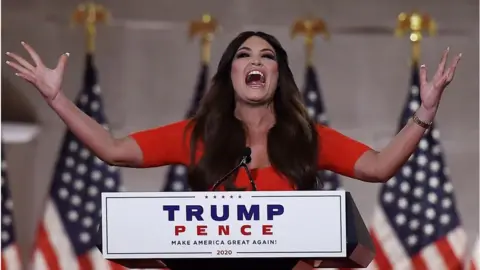
Trump's ambassador to Greece, Kimberly Guilfoyle, extorted money from a Republican congressional hopeful who wanted to buy access to Trump through her. Guilfoyle alternately wheedled and threatened the politician, one-time Congressional candidate Eric Deters, to pay off a $100,000 credit card debt through an untraceable money transfer.

The shocking and tawdry reveal in a Wall Street Journal exclusive from earlier this week had Deters calling Guilfoyle a "grifter" who was absolutely demanding a "quid pro quo" for bringing his issues to Trump. Deters also told NBC News that Guilfoyle "was so desperate for that $100,000. It was a quid pro quo. She said I could ask her for anything and everything in Trump world. There was no request too big.”

Guilfoyle resigned today. Asked about it by reporters, Trump offered tepid support for her, but insisted he didn't really know her: "She wasn’t a member of my family. She, I guess, dated my son a long time ago, but she wasn’t—no. She went to Greece. She was doing a good job."

Given Trump's precarious cognitive state, it's not impossible to believe he's forgotten that Guilfoyle was engaged to be married to his son for over four years. (Guilfoyle and Donald Trump Jr. separated in late 2024.) But if so, he's forgotten quite a lot of what's passed between the two in public, like: 

  • giving her a sexualized nickname: "Kimberly Guilfoyle has been my friend for a long time. I love calling her Kimber-lay. That's my little pet name, right?" 

  • appointing her Ambassador to Greece in the first place: "For many years, Kimberly has been a close friend and ally. Her extensive experience and leadership in law, media, and politics along with her sharp intellect make her supremely qualified to represent the United States, and safeguard its interests abroad."

  • paying her $15,000 a month off the books for a do-nothing campaign job

  • paying her $60,000 for a two-minute speech on January 6, 2021

  • giving her a prime-time speaking slot at the 2020 Republican convention…

    RNC 2020: Rising stars of a post-Trump Republican party take stage

  • …and again in 2024:

    Kimberly Guilfoyle Republican National Convention | Rev

Trump, who has not been at all shy about charging money for access to himself, added that while he thought Guilfoyle was "doing a good job" as Ambassador to Greece, he "didn't like what we were reading" in the news about her extortion scheme.

Guilfoyle was most recently in the news—in her official capacity, anyway—for threatening to overthrow the government of Greece. 

Why does this matter?

  • Trump being too senile to remember his son's ex-fiancĂ©e, who he appointed to an ambassadorship, is the charitable interpretation here.  
  • Presidents are accountable for the ethical lapses and crimes of the people they entrust with governmental authority. 
  • People try to buy access to Trump precisely because they know he can be bought.

Sunday, October 4, 2026

What did Donald Trump do today?

He lost his temper on social media, or someone did for him, and there's really no way to know.

Trump spent Saturday campaigning in Ohio. He was in rare form: he called the Senate candidate he was stumping for a "pain in the ass" who was always begging him for money. (Trump seems to regard a lot of Republicans as pains in his ass: he said the same thing about Texas Senate candidate Ken Paxton earlier in the week.) 

That visit to Ohio followed taxpayer-funded visits to deep-red Alabama and Oklahoma, where Trump urged those in attendance to vote in races where, in all likelihood, the Republican candidate will win by 40 points or more anyway. Tomorrow, he heads to Nebraska, which has become a genuine swing state. 

Today, however, he did nothing—or nothing that can be reliably attributed to him. Trump didn't even make his customary visit to a golf course this Sunday. Instead, he stayed in seclusion, resting up for his upcoming trips. 

Trump's social media accounts were active: there was a lengthy Trumpian rant at Fox News that he very well might have written himself, or at least caused to be written. (The post complained that "stupid" Fox News hadn't covered his rallies enough.) 

Trump also seemed to go on a mini-spree of what might be called "emotional support posting," ranting about old favorites like invading Greenland and the unfairness of not having the Kennedy Center renamed for him. 

However, given the influence over him that staff who post to his social media have, it's not clear whether Trump was the author or the audience.

Why does this matter?

  • It's bad if it's not clear who is actually exercising the powers of the presidency.

Wednesday, September 30, 2026

What did Donald Trump do today?

He made more extravagant, unenforceable promises to try to save a Senate seat Republicans wouldn't be losing without him.

On Monday, Trump announced a "deal" to have a steel mill built in Iowa. The actual details were underwhelming: it would create a trivial number of jobs, it wouldn't be online until the 2030s if it were ever built, and Trump is still refusing to say what the Indian conglomerate that would own it is getting in return. 

Trump's party is in danger of losing what should be a completely safe Senate seat in Iowa, and that is universally understood as the reason Trump rushed the announcement in front of the public on Monday.

Today, Trump announced another "deal" that hinges on foreign investment materializing in another deep-red state where Republicans are in serious danger of losing a Senate seat to Democrats. This time, Trump announced the possible, eventual construction of a natural gas pipeline in Alaska, supposedly financed with money from South Korean companies.

South Korea's government quickly distanced itself from Trump's announcement, saying that it had only begun to review the legal and commercial viability of the project. It explicitly refused to commit to any dollar figure: "Putting out figures, or using definitive language, goes far beyond what was agreed," a spokesperson said.

Trump has a long history of announcing "deals" in which foreign interests will supposedly invest tens of trillions of dollars in the United States. Of course, foreign investment in the United States happens regardless, but by making a "deal" with Trump those foreign companies often get tax breaks or favorable diplomatic treatment from Trump. And, as countries from Liechtenstein to Qatar, have learned, it costs nothing to tell Trump what he wants to hear about what might theoretically happen in the future.

In this case, however, it's not even a new promise. The $54 billion a gas pipeline might cost to build is part of an existing (and unfulfilled) $350 billion pledge South Korea's government made last year in order to get Trump to cancel the tariffs he imposed on their country, rather than wait for the Supreme Court to do it.

In making the announcement of the supposed pipeline today, Trump came about as close as he ever does to a moment of humility, admitting that he'd "done a very bad job of explaining" what he sees as successful stewardship of the economy. It wasn't clear why he thought that Americans were forming their opinion based on his explanation, rather than the actual prices and wages they encounter in their own lives.

Why does this matter?

  • A president who'd actually done a good job encouraging foreign investment could just point to actual accomplishments, instead of begging voters for an extension.  
  • Anyone competent to be president would know that when you lie about what other countries have agreed to, they will say that you are lying to protect their own interests.

  • "I'm sorry you don't understand how great I am" isn't an apology.

Monday, September 28, 2026

What did Donald Trump do today?

He did a live address to the nation to say he'd created jobs for .0005% of the population, 4+ years from now.

Last night, the Trump White House announced that he would give a formal presidential address to the nation from the Oval Office this afternoon at 2 P.M. Traditionally, presidents use that kind of address to speak about urgent matters, or occasions of great solemnity: the beginnings and ends of wars, or natural disasters, or in times of economic or social unrest.

In fact, Trump's address today concerned the planned construction of a steel mill in Iowa. Trump claimed it would eventually employ more than 1,700 workers, assuming it were ever built.

Iowa is the site of an unexpectedly competitive Senate race this fall. 

To put Trump's job number claims in perspective, natural population growth in the United States means that about 97,000 new jobs have to be created every month just to keep unemployment rates stable. That means that if Trump's promises of 1,700 new steelmaking jobs came true, it would replace about half a day's worth of demand for jobs.

But not until 2030 at the earliest. That was the optimistic assumption for when the plant might open.

Trump has a long history of announcing these kinds of "deals," few if any of which ever actually materialize. In 2018, Trump said that a Taiwanese tech company would open a plant in Wisconsin that would be the "eighth wonder of the world" and employ 13,000 people. State and local governments poured more than a billion dollars into infrastructure improvements for factories that were expected to make giant flat-panel video displays. Working family farms were declared "blighted" and seized by eminent domain, and homes were bulldozed. But nothing ever came of it, and the foreign company, Foxconn, repeatedly scaled down the project until virtually nothing was left beyond a few buildings rented out to other companies.

Property owners near Foxconn say they were misled. Now their homes are  gone. - Wisconsin Watch
Former residential areas near the planned Foxconn plant in Mt. Pleasant, WI, after homes were seized and destroyed for factories that were never built.

Experts and local residents disputed the economic viability of the Foxconn plant at the time Trump declared it a done deal. The question, as one resident put it, was this: "Why would you come to the United States of America, and use our workforce, when your own workforce is cheaper over there [in Taiwan]?" One answer is that giving Trump an opportunity to make gaudy promises about jobs—at U.S. taxpayer expense—paid off very well for the political connections of Foxconn executives, and those were potentially far more lucrative than making television sets.

The Iowa plant is expected to cost $18 billion to build—or, at least, that's the starting price. Trump didn't say how much taxpayer money would be used to prop up the privately owned mill, and how much would be contingent on the thing actually being built. (Most of the Foxconn money was spent in advance, and ended up costing half a million dollars per job created.)

In his remarks today, which most television networks declined to carry, Trump explicitly tied the construction of the mill to his imposition of tariffs on foreign steel: "Soon after my inauguration, I imposed powerful 50% tariffs on all foreign steel, and now our steel industry is roaring back to life." It depends on what Trump means by "our" steel industry: the company that would own the mill, Mesabi Metallics, is owned by an Indian conglomerate. 

But Trump's emphasis on the tariffs is just another way of saying that when those taxes on American consumers are removed—which is an economic and political certainty, whether or not it happens on Trump's watch—the Iowa plant will be that much less competitive, if it even gets built. 

Why does this matter?

  • At this point, Donald Trump may be the only person who believes in the "deals" he's constantly announcing.

  • It's extremely unlikely that this will change any Iowans' votes in favor of Trump's party, but it's still corrupt that he's obviously trying to make that happen this way. 

Wednesday, September 23, 2026

What did Donald Trump do today?

He clarified his position that the government SHOULD be able to punish free speech.

Last week, Trump had reporters from CNN, MS NOW, and Politico banned from the White House. His explicit justification was that he didn't like their coverage. When a reporter asked what form the ban would take, Trump had to ask her to clarify what ban she meant. After an aide mentioned Politico, he responded, "Oh, the ban on the free press?" 

Reporters from those outlets had their passes revoked shortly afterwards. They are now suing the White House to be reinstated, and they're likely to succeed. It's not unconstitutional for the government to limit press access, but it cannot be for viewpoint discrimination. In other words, the First Amendment forbids Trump or any other government official for punishing a news outlet simply because they don't like what that outlet reports.

In a late-night filing tonight, Trump seemed to go out of his way to reinforce that his motives were punitive and unconstitutional. The DOJ filed a declaration consisting of two links. One was to an MS NOW story reporting that Trump aides were discussing other historical landmarks his name could be added to, including Ford's Theater, the site of President Lincoln's assassination. 

That story provoked immediate mockery and derision of Trump online, prompting a hasty disavowal from Trump himself on social media—the second link in the DOJ filing.

In essence, Trump is arguing through the Department of Justice that the United States government should be allowed to punish news organizations that print things that the government has denied. Or, in other words, the government should be able to veto any story it doesn't like simply by issuing a denial, whether or not it's true.

It's worth noting that even incorrect reporting is covered by the First Amendment—but it's Trump's furious denial that gets the facts wrong. The MS NOW story doesn't say that Trump himself was consulted about the Ford's Theater renaming plan, or even that the idea was under serious consideration. It does say that Trump administration insiders know that flattering Trump with such plans is a good way of getting access to him. It also correctly notes that because the Department of the Interior owns the Ford's Theater site, it might be legally easier to put up signage with Trump's name on it.

The MS NOW story also cited some of the dozens of other attempts Trump has made to put his name and face on other things, ranging from the John F. Kennedy Center, to passports and National Park passes, to airports and train stations and NFL football stadiums, to the currently nonexistent $250 bill (among many other). Those have also generally provoked mockery and derision.

Why does this matter?

  • It is incredibly plausible that Donald Trump would react positively to having his name put on the site of Lincoln's assassination, at least until he realized how people would react to it.

  • The First Amendment probably wasn't written with actual temper tantrums in mind, but it still applies to presidential temper tantrums.

Saturday, August 29, 2026

What did Donald Trump do today?

We don't really know.

As is typical for a weekend day (and not uncommon for weekdays), Trump went to one of his luxury golf resorts today. The pool reporter was prevented from directly observing him, but there is at least some indirect "proof of life" because he reportedly attended a dinner for his political action committee. 

The Trump administration made no policy announcements today. There were no major developments in court cases involving Trump. If Trump signed any bills or orders, the White House hasn't told anyone about them yet.

To be clear, it was anything but a slow news day where the consequences of Trump's actions were concerned. Among other things, news broke that Trump had illegally destroyed cherry trees given as a diplomatic gift by Japan to renovate a golf course. Reports also surfaced that his supposed "deal" to give control of Venezuela's oil reserves to American companies he favored was likely to face legal and constitutional objections from, in effect, the entire political apparatus of the country. And there was more analysis of the lucrative stock trades Trump made in the oil and gas sector that just so happened to come directly before his public statements about the Iran war caused prices to change.

But in terms of events that could be directly attributed to Trump himself, the only evidence came from his social media feed—and that is no longer a reliable indicator. There were 20 posts to his microblogging website account today, including while he was supposedly golfing. But most of these were image posts—memes or the AI slop that is typical of most Trump administration comms these days. For example, there was an AI slop video of "Donald ducks"—ducks with Trump's hairpiece—carrying assault rifles to defend Lake Ontario. 

As a practical matter, it's long been clear that Trump is not personally posting most of what goes on his social media account. For one thing, it's extremely unlikely that Trump is capable of using a phone or laptop well enough to upload video or images. But recent revelations about the extent of his relationship with the aide who does much of his posting for him, Natalie Harp, strongly suggest Trump may not be aware from day to day what "he" is saying, and not just in the AI slop and memes. The emotionally raw letters that Harp sent Trump use the same idiosyncratic capitalization that appear in Trump's posts.

Harp isn't the first young junior aide that Trump has developed an emotionally intense relationship with that alarmed others close to him. Hope Hicks played a similar role during Trump's first term, as did his daughter Ivanka, both of whom were called on to help manage his outbursts of temper.

Why does this matter?

  • It's bad if it's not clear who is actually exercising the powers of the presidency.

Thursday, August 27, 2026

What did Donald Trump do today?

He threatened China with economic sanctions as softly and unconvincingly as possible. 

Trump's recent attempt to find an off-ramp from the Iran war he started has focused on economic coercion. In large part that's because he has few if any military options left: the United States military is shockingly low on missiles and defensive interceptors after six months of use against cheap, low-tech attacks from Iran.  

One problem with that approach, as many have noted, is that it's not really possible to increase sanctions on Iran any higher than they already are, or have been for most of the last 50 years. Trump's promised "Economic D-Day," which would supposedly target any country doing business with Iran, is not meaningfully different from what is already in place.

The other problem is that Iran's largest trading partner is China, and sanctioning China would be inviting retaliation from the world's largest economy. China has paid lip service to international sanctions on Iran, but is Iran's largest customer for oil. China, which supplies weapons to Iran, also benefits from the ongoing economic havoc and degradation of military readiness that Trump's war is inflicting on the United States. 

Trump was asked today about why he hadn't sanctioned the Chinese banks involved in that trade, to which he responded, "Who says I'm not?"

The answer is that Trump's Treasury Secretary, Scott Bessent, says he isn't. Bessent was asked a similar question earlier this week, about why he hadn't simply ordered sanctions immediately against countries that traded with Iran. Clearly exasperated, Bessent snapped, "Why would I want to blow up the global financial system?" 

There's another reason Trump is unlikely to cross China on this issue. President Xi Jinping is expected to visit Washington in September. Xi, along with Vladimir Putin and Kim Jong-un, is one of a number of authoritarian rulers that Trump treats with awe and respect he otherwise never shows anyone. He's openly praised Xi for engineering a lifetime dictatorship over the Chinese government. More recently, Trump went to extraordinary lengths—and taxpayer expense—to get an extremely ornate helipad constructed on White House grounds in time for Xi's visit. (Actually, he did that twice—one on an "emergency" basis, and then a second time even faster when the first attempt wasn't fancy enough for him and had to be demolished.) 

Trump's timid saber-rattling on China sanctions came on the same day that he demonstrated a more realistic example of his power to economically punish important US trading partners, by ceremonially "renaming" a lake to insult Canada.

Why does this matter?

  • Making threats everyone knows are empty only advertises your weakness, and a competent president would have learned that by now.

Wednesday, August 26, 2026

What did Donald Trump do today?

He said it was no big deal that his CIA director got caught on a secret trip to Russia.

The Russian government confirmed today that CIA Director John Ratcliffe was aboard a mysterious flight that landed in Moscow yesterday. Ratcliffe's purpose, according to the Russian government, was to meet with his counterparts in Russian intelligence agencies. The meeting was not announced publicly and Ratcliffe apparently went to some trouble to conceal the fact that he was taking the trip: the Russian government initially claimed it had no idea why an American military plane had landed near Moscow.

Asked about it today, Trump insisted that it was "semi-routine" for the head of a US intelligence agency to meet with a hostile country. Trump appeared to be toeing the line set out by Russia's intelligence head, Dimitri Peskov, who characterized the meeting as a means of establishing good working relationships between the two agencies.

In reality, of course, Russia is the hostile power behind any number of intelligence operations against the United States. That's true even without addressing the question of how much direct influence the Putin regime has over Trump himself, who benefited from Russian intelligence operations to interfere in the 2016 election.

It's also not at all routine for the head of the CIA to visit Russia, or any openly hostile country. The last time it happened was in 2021, when then-Director Bill Burns went there to warn Russia that the United States was aware of its plans to invade Ukraine. That meeting was not kept a secret from the American public.

Reporting of that fact, and the contrast between Burns's and Ratcliffe's trips, seems to have convinced the Trump administration to change its story. Later today, and well after Russian state media had established the framing of the trip that Trump repeated, the official justification changed abruptly. The Trump administration's new line is that Ratcliffe was there to warn Russia not to attack NATO member states.

Trump has a long history of reaching out in secret to the Putin regime, and once tried to set up a secure private backchannel that the rest of the United States government wouldn't be able to monitor. This is also far from the first time that he's let Russian state media embarrass him by leaking news of those secret contacts to the American public before he has his story straight.

Why does this matter?

  • A president who keeps falling for the same basic trick over and over again is either too stupid or too gullible to hold office. 
  • It's a problem if the only thing Americans are allowed to know about their president's relationship with Russia is what Vladimir Putin decides to tell them.

Monday, August 24, 2026

What did Donald Trump do today?

He tried to project strength as his personal and political problems got worse by the moment.

Trump is so incapable of admitting any kind of mistake or failure that he once told a group of evangelical Christian leaders that he'd never even asked God for forgiveness. (By Christian standards this is, to put it mildly, blasphemy.) Perhaps the only time he's ever even come close to apologizing in public was during the 2016 campaign, immediately after the infamous Access Hollywood video in which he talked about grabbing women "by the pussy" without consent—and even then, he tried to deflect blame onto others.

But over the past week, he's been uncharacteristically back on his heels. A casual reference to his aide Natalie Harp, sometimes referred to as the "human printer" for her habit of carrying around printouts of news articles meant to soothe Trump emotionally, blew up into a major scandal. Members of his own inner circle told reporters they were worried about the intensity of the hold the erratic Harp had over Trump and his agenda. Those letters showed that Harp shared Trump's unusual habit of incorrectly capitalizing random words in the middle of sentences, suggesting she was the author of far more of his social media announcements than previously suspected.  

Possibly related, Trump's wife Melania got into a public argument with him yesterday in full view of television cameras, which the White House unlawfully tried to get shut down as Melania stormed away.

Trump is also suffering defections from previously loyal constituencies as his approval rating has sunk to the low 30s—inches above where Nixon was when he was forced to resign. Congressional Republicans who can afford to are distancing themselves. One Republican voter in a swing Ohio district where Trump has backed an incumbent Congressman accused of child abuse, was asked about his message for Trump. His response: "Resign." Even beef ranchers are lashing out at Trump, furious for dropping protections on beef imports while herds recover from a screwworm infestation caused by Trump's killing a cheap eradication program.

This morning, Trump seemed to try to get back on his feet by lashing out at friends like Canada and foes like Iran in equal measure. Iran's response was predictable: mockery and threats to carry out assassination attempts in revenge for his assassination of regime leaders at the start of the war. But Canada's was much more serious. Trump had demanded that Canada "fall in line" or suffer "far worse" consequences than tariffs, an approach that couldn't possibly anger the Canadian public more than if that had been the intent. Prime Minister Mark Carney's government prepared to release details on the American industries it will attack with retaliatory tariffs, and Ontario premier Doug Ford threatened to cut off the billions of dollars worth of electricity that Canadian power plants provide to northeastern states. If that happened, it likely physically couldn't be replaced on the American side.

Trump responded by mocking Ford's dead brother. 

Why does this matter?

  • The economy would be much, much stronger right now if the President of the United States had the emotional control of a toddler. 
  • Nobody who can't keep their personal problems from affecting their work is fit to serve as president.

Sunday, August 16, 2026

What did Donald Trump do today?

He took North Korea's side against South Korea's government—and the United States'. 

Trump posted this to his private microblogging site today:

Based on my very good relationship with Kim Jong Un, of North Korea, I am not happy with the fact that the United States has, long ago, agreed to participate in Joint Military Exercises with South Korea. These exercises are not only costly, with much of these costs paid for by the United States of America (as usual!), but send a signal that is totally inappropriate and hostile, to a Country that, as long as Donald J. Trump has been President, has been unthreatening and respectful. Therefore, and based on the fact that it is too late to cancel, I have instructed Secretary of War, Pete Hegseth, to substantially reduce the Joint Military Exercises! While somewhat unrelated (?), I recently asked the President of South Korea if they would like to join us in the Denuclearization of the Islamic Republic of Iran, and they said, "No thanks!" Thank you for your attention to this matter. President DONALD J. TRUMP

To be clear, this framing—that North Korea is a well-behaved part of the international community and South Korea is making aggressive moves towards it—is exactly the stance taken by the North Korean government. Just a few days ago, the DPRK called the exercises "a rehearsal for an aggressive war." It also threatened to escalate its "deterrence" towards South Korea.

Possibly that threat is what spooked Trump, although it shouldn't have. North Korea routinely uses the US-South Korea exercises as an excuse for weapons tests, and as an opportunity to rally support for the ruling regime.

The "unthreatening and respectful" North Korea has been supplying Russia with weapons used against Ukraine, although for several obvious reasons that bothers Trump less than it does the rest of the United States government. But it's certainly true that North Korean leader Kim Jong-un enjoys a warm relationship with Trump, who—in his own words—"fell in love" with Kim during his first term.

It's also true that Trump demanded that South Korea get involved in his disastrous war with Iran, but—as with all of the United States' allies except Israel—only after the fact, and only once it was clear that he had gotten the United States stuck in a quagmire. Its government declined for the same reason that other allies did: there is no workable military solution to the problem Trump has created for the United States and the rest of the world short of a full-scale invasion, which would be a bloodbath even if it succeeded and would completely destroy any stability in the Middle East for years to come.

There's one other reason, besides his friendship with Kim Jong-un (who impressed Trump by having an dissident uncle murdered with an anti-aircraft gun), that Trump might be taking North Korea's side. South Korea impeached and then criminally convicted its former president, Yoon Suk Yeol, for illegal military actions he took in an attempt to justify a declaration of martial law that he thought would help him stay in power.

Why does this matter?

  • South Korea is an ally of the United States and North Korea is not, and no president who is confused about that is fit to serve. 
  • The leader of a democracy should not so reliably and predictably side with authoritarian regimes.

Sunday, August 9, 2026

What did Donald Trump do today?

He once again forgot that he needs to check with other countries before assuming they'll do what he hopes they'll do.

On July 30, Trump announced that his "Board of Peace" had "reached a HISTORIC agreement for the COMPLETE DISARMAMENT of Hamas and all other armed groups in Gaza." The so-called "Board of Peace" is a non-governmental agency supported by what amount to bribes from a laundry list of totalitarian dictatorships hoping to curry favor with Trump. It is headed by Trump in his capacity as a private citizen, not as President of the United States, and its charter give him permanent and irrevocable control over its membership—and therefore its budget. 

Nevertheless, the 15-point plan it outlined was more or less identical to other peace proposals for the region, and got at least tepid support in the United States and abroad. Unfortunately for Trump's premature celebration, one foreign country has rejected it: Israel. 

Prime Minister Benjamin Netanyahu, like Trump, is vulnerable to prosecution if he loses the protection of his office. He's used the war against Gaza as a political tool, even as his government failed to act on detailed and specific advance knowledge of the October 7th attacks that started the conflict, but is now in danger of being turned out in elections this fall. Netanyahu, whose best chance at staying in power is to revive the apparent threat posed by Hamas in the minds of Israeli voters, said Trump's plan relied on "fictitious" disarmament that would leave Israel vulnerable to further attack.

Trump, who was infuriated by news reports that he'd let Netanyahu goad him into war with Iran, has tried without much success over the years to get the Israeli leader to acknowledge his authority. During the 2025 Iran-Israel conflict, Trump demanded that Israel call off an attack on Iran, then watched impotently as Israeli bombers proceeded to their target anyway, even as he insisted on social media that they were merely delivering a "friendly plane wave." Trump's public demands weren't enough to stop an Israeli attack on Iran in June of this year, either, as he scrambled to get Iran to agree to the now-defunct memorandum of understanding.

Trump, who as usual spent the weekend at one of his luxury golf resorts, has not responded publicly and his staff may not have managed to get him to sit for a brief yet. 

But it wasn't all bad news from Israel on the Middle Eastern diplomatic front today for Trump. He also got bad news from Iran.

Why does this matter?

  • A president who can't understand that other countries won't just automatically do what he wants them to is too naĂŻve or stupid to be fit for office. 
  • If what happened in Gaza were important to Trump beyond giving him something to tweet about, he probably would have checked with Israel before announcing it.

Wednesday, July 29, 2026

What did Donald Trump do today?

He was "surprised" by the news that China and Russia were selling arms to Iran and have been for decades.

Asked today about the latest reports that China is planning another arms shipment to Iran, Trump said that he would find it "surprising" if that were true, and that he'd be "disappointed."

China is planning another arms shipment to Iran. 

In fact, China has supplied arms to Iran for decades, although for diplomatic purposes it has usually publicly denied it. China is also a major consumer of Iranian oil (which has been under international sanctions for many years) and is Iran's largest overall trading partner.

The two countries are not close military allies, and there are no strong cultural or geopolitical ties between them, other than that neither are aligned with the United States. China, like Russia, has a vested interest in the degrading effect that Trump's war has on American military readiness and its status as a world leader. 

Trump's argument against the latest arms deal, which is sourced to US intelligence agencies, is that China's president Xi Jinping "told [him] very strongly" that no such deal would be made. He added in a social media post that "in his opinion" neither China nor Russia were selling arms to Iran.

Russia is also selling arms to Iran.
 

Why does this matter?

  • Countries always act in their own best interests, not what is best for Donald Trump.
  • There is gullible, and then there is taking the word of the dictators of hostile nations over the evidence supplied by your own intelligence agencies. 
  • Donald Trump's "disappointment" is not a threat to Xi Jinping.

Monday, July 27, 2026

What did Donald Trump do today?

He said the deaths of four Americans in Iran "wasn't very impactful."

Trump had this exchange with reporters aboard Air Force One today:


Q: President Zelenskyy says Russia is giving Iran satellite imagery of US bases in the Gulf to help them target. What can you do about that?

TRUMP: Well, we'll find out if that's true. I'll ask Putin. We'll find out.

[crosstalk]

TRUMP: It hasn't had much impact, because we've knocked the hell out of them. …They may be giving, but—uh, if they are, it hasn't worked out, because they have no army, they have no air force, they have no navy, they have no nothing. So it hasn't worked out—I don't think, I don't think they've been doing it, certainly not at a high level. And if they have, it hasn't been very impactful.


The strikes over the past two weeks that Trump called "not very impactful" by the supposedly nonexistent Iranian military killed four American soldiers and injured dozens more.

Zelenskyy has offered proof, although there's very little doubt about the truth of the allegations. Russia is a geopolitical ally of Iran and has a particular interest in extending Trump's war on Iran as long as possible. Unlike the United States, Russia's desperately degraded economy really does rely on oil sales to stay afloat, and the higher prices caused by Iran's blockade of the Persian Gulf have helped the Putin regime enormously. 


Bogging the United States down also helps Russia in its war against Ukraine. With the United States' own supply of critical munitions getting dangerously low, there are fewer available for Ukraine. The Defense Department has already said it won't be able to supply Ukraine with weapons Congress has already authorized until a date in 2029 that, coincidentally or not, is after Trump's second term will end.

Trump is personally, financially, and politically beholden to Vladimir Putin, and is in effect on the opposite side of the Russia-Ukraine conflict from the rest of the United States. He didn't say when he'd "ask" Putin if Russia helped kill American troops, but it wouldn't be the first time Trump has excused attempts by the Putin regime to do just that. In 2020, he blew off credible intelligence reports that Russia was paying bounties on the murder of American troops in Afghanistan, and then pretended nobody had told him about them.

Why does this matter?

  • Nobody who thinks the deaths of American servicemembers isn't "impactful" is fit to command them. 
  • A president who can't stand up to a hostile power helping to kill Americans isn't fit for office.

Sunday, July 26, 2026

What did Donald Trump do today?

He gushed over his name being put on a road by a government that was clearly trying to manipulate him. 

Trump has long been obsessed with his personal brand. His fame as a real estate investor came more from his penchant for putting his name on buildings, than from any success he had as a businessman. (Even after inheriting a billion-dollar portfolio of prime New York City real estate at the beginning of a decades-long housing boom, Trump still managed to underperform the stock market for his entire "career" in real estate, and that's ignoring the businesses he ran into the ground.)

Since returning to office, one of his highest priorities has been to put his name or face on everything he possibly can, from passports to US currency (both bills and coins) to buildings to a new form of child savings account that's just a little worse than existing options in every way. He got the Florida resort town where he now lives to rename its airport after him—and made sure he got a cut of the profits in the bargain—and is trying to get Washington's Dulles Airport named for him too, as well as NYC's Penn Station.

(That is, to put it mildly, only a partial list.)

A number of countries have courted and received Trump's favor by proposing new local "Trump Towers," which doubled not only as a form of influence-buying but also money laundering. But Morocco's government hit on a simpler and much cheaper way of buying Trump's goodwill: it is naming a highway after him. 

Trump was delighted by the news, and announced it himself on social media. But there's an obvious catch: the road runs through the disputed territory of Western Sahara, which is under Moroccan occupation. Trump, unlike every other US president for the past 50 years, has been open to recognizing Morocco's claim, which is heavily disputed by residents and a number of African countries supporting independence.

In other words, this successful appeal to Trump's ego also binds the United States to a policy that favors the occupying Moroccan government.

Trump gushed that he was looking forward to traveling the entire 655-mile length. That can safely be chalked up to diplomacy: it connects small, isolated desert cities in the kind of place Trump likes to refer to as a "shithole country." Also, it's extremely unlikely that he'd be physically able to sit in a car for that long.

Satellite view of the highway Morocco's government says it is naming after Trump

Why does this matter?

  • It shouldn't be this easy for a foreign government to emotionally manipulate the President of the United States. 
  • A desperate need to force others to recognize the supernatural greatness you think you possess is called megalomania, and it's not a sign of good mental health.

Wednesday, July 22, 2026

What did Donald Trump do today?

He put words in the mouths of American soldiers he got killed.

Today, the Defense Department announced the names of another killed in the ongoing war in Iran. The body of Sgt. Angel Rampersad of Queens, New York, was brought back to American soil at Dover AFB, along with the remains of two other soldiers killed in an Iranian attack on an Army post in Jordan.

A woman in an Army uniform stares into the camera with an American flag in the background. 


Asked about the deaths today en route to the transfer ceremony, Trump put words in the mouths of the dead soldiers, claiming that "they said, and—all of them said, very strongly, 'we can't let—cannot let Iran have a nuclear weapon.'"

Trump, of course, never spoke to any of them while they were alive, and if he'd spoken with their families—a responsibility he's tried to avoid in the past—the White House hasn't mentioned it. He himself didn't settle on the nuclear justification for quite some time after the war began. Instead, Trump seems to have been pressured or manipulated by the Israeli Prime Minister, Benjamin Netanyahu, who wanted open war with Iran for his own domestic political reasons. 

Trump has outright lied about what dead servicemembers and their families have said in the past. He's also publicly picked fights with grieving family members who don't let him control the narrative. In 2017, after he'd ordered an ill-advised raid in Niger that saw four American soldiers killed, he lectured a widow on how her husband would have felt about his sacrifice, and then attacked her in the press when she told reporters what he'd said.

Trump, who dodged the draft in Vietnam by getting a tenant of his father's to write him a fake medical excuse, has often expressed contempt for people who died in military service. He once asked his former chief of staff, retired Gen. John Kelly, "What was in it for them?" and referred dead servicemembers as "suckers" and "losers." (Kelly's own son was killed in Afghanistan.) At an earlier transfer ceremony, he took the opportunity to wear a campaign baseball cap, which he did not take off in the presence of the bodies.

The American death toll in the war now stands at 18.

Why does this matter?

  • Even by Trump's standards, this is a disgusting kind of lie to tell.

Sunday, July 5, 2026

What did Donald Trump do today?

He had a "businesslike and highly constructive" phone call with Vladimir Putin, according to Vladimir Putin.

Trump spent an hour and a half on the Fourth of July talking with Russian leader Vladimir Putin. The call was "businesslike and constructive" and centered on Russia's desire for a diplomatic end to the war in Ukraine, something Trump "reaffirmed his readiness" to make happen.

At least, that's what the Russian government said today. Trump had kept the call a secret.

This is a common pattern with Trump and Putin, having happened at least half a dozen times now. Needless to say, it's not common practice for American presidents to have secret peer-to-peer talks with the leaders of hostile nations, precisely because it allows the other party to control the narrative and undermine the United States.

Trump, whose demeanor towards Putin ranges from the awestruck to the submissive, doesn't seem able to break the habit. This may be because he is genuinely psychologically incapable of resisting this kind of manipulation from Putin. That's certainly the prevailing opinion on Russian state-run media, which mercilessly mocks Trump as a weak thrall to Putin. 

Putin's ability to command ninety minutes of Trump's time on the Fourth of July, in the middle of the 250th anniversary celebrations, certainly supports that theory.

Another factor is that Trump's history of secret backchannel communications with Russia he'd prefer the American people not know about goes back to before his first term in office. Even with his collusion with the Putin regime to influence the 2016 election a matter of public record (and certified by a Republican-led Senate committee) Trump is still politically vulnerable on the subject: he is virtually alone on the entire political spectrum in his support for Putin and the Russian objective in the war against Ukraine. 

Why does this matter?

  • A president who keeps falling for the same trick over and over again is either too stupid, too gullible, or too weak to hold office. 
  • Americans shouldn't have to rely on Russia for information about their own government. 

Wednesday, July 1, 2026

What did Donald Trump do today?

He said Americans couldn't build an American plane.

Trump took his first trip on the jet that he intends to use as Air Force One. It was given to him—for his personal use, including after he leaves office—by the government of Qatar. In remarks to reporters just before departing, he said this:

So this was a gift from, uh, a country that's treated us very well, and, uh, they're an ally of us over in the Middle East, Qatar. And, uh, I went to Boeing, I said, "Who has the best one?" They said, "Qatar." There's no—there's never been a plane like this. Frankly, we couldn’t build a plane like this because we wouldn’t be willing to spend the kind of money necessary. They spent top dollars.

The plane is a custom Boeing 747-8. It was built in the United States, by Americans. 

In fact, Americans built this particular plane twice. First in its initial manufacture, and then a second time in retrofitting it with the communications and security equipment necessary for it to be used to carry a president. That process has been estimated to cost taxpayers about $1 billion. The Air Force has released lower numbers for the conversion—about $400 million—but the actual figure is classified. Trump has a long history of insisting that he is doing things at no cost to taxpayers and then hiding the bill. Most recently, reporters uncovered a secret $500 million no-bid contract for his demolition of the East Wing of the White House. 

In order to prevent corruption, the Constitution prohibits the president from accepting "any present… of any kind whatever, from… any foreign State" without Congressional approval. Trump is personally heavily invested in projects co-sponsored by the Qatari government. At the same time, the authoritarian government Qatar has received much more favorable treatment in Trump's second term than it had earned in previous administrations.

Why does this matter?

  • No president should ever, under any circumstances, say that there's anything American workers can't do. 
  • It shouldn't be this easy or this effective to bribe the President of the United States. 
  • Saying something is free and then hiding an enormous price tag with paperwork is what two-bit scammers do. 
  • If Trump's story about asking Boeing and being told this specific 14-year-old jet was the best one were true—and it obviously isn't—then he'd be confessing to soliciting a bribe as well as as receiving one.

Friday, May 15, 2026

What did Donald Trump do today?

He toed Xi Jinping's line on Taiwan.

One of the less talked-about consequences of Trump's disastrous war on Iran is how much it has strengthened China. Any failure of the United States to project power good for China, to say nothing of one as humiliating as Trump's inability to dictate terms to the vastly weaker Iran. But because China has influence over Iran, it now has influence over Trump as he becomes increasingly desperate to disentangle himself without admitting defeat.

President Xi Jinping said as much yesterday to Trump's face, although it's extremely unlikely Trump caught the reference. Xi said that he hoped the United States and China could avoid a "Thucydides trap," meaning a situation in which a decaying power is so threatened by the existence of a rising power that war becomes inevitable. In the original reference by Thucydides' History of the Peloponnesian War, it was waning Sparta and growing Athens, but Xi obviously meant the United States and China.

Trump may not understand classical history or foreign policy theory, but he does seem to be aware that he was going to China hat in hand, whether for Xi's intercession with Iran, or a handout for his family's businesses. That may explain why he was willing to happily repeat Beijing's talking points on the matter of greatest importance to Xi: Taiwan. Trump, following Xi, urged Taiwan to "cool down" and stop calling for independence.

But Taiwan, which could be utterly destroyed in a full-scale invasion, isn't planning to declare independence. Its overriding strategic goal is to protect its self-determination. To have the President of the United States, essentially the only real guarantor of its continued freedom, accuse it of going too far while standing next to the President of China, is an enormous concession to Beijing.

Trump didn't stop there, though. Speaking to reporters after the trip had concluded, he backed away from the once iron-clad commitment that the United States had made to sell defensive weapons to Taiwan, saying with some hesitation that he would "make a determination over the next short period." This is, to put it mildly, an abandonment of a close ally on par with his treatment of Ukraine.

It's worth noting that Trump's parroting of China's lines during his trip may have been down to confusion. Trump obviously could not recall the name of the Taiwanese president, Lai Ching-Te, saying that before he made a decision he'd have to "speak to the person who is, right now, you know, you know who he is, that's running Taiwan."

That wasn't even the only cognitive misstep Trump had on Taiwan. Asked a question about Taiwan, he meandered into an answer about Iran, and needed a reporter's help to find his way back to coherence.
 

Why does this matter?

  • The United States needs a president who is not so incredibly easy for actual strongmen to manipulate. 
  • Both Taiwan and the United States need a president who can remember all the way to the end of a single sentence what country he was supposed to be talking about.