Showing posts with label tax evasion. Show all posts

Tuesday, October 20, 2026

What did Donald Trump do today?

He promised to pay cash rewards for people who reported crime of the type he was criminally convicted of.

Trump announced a $25 million fund today that will supposedly reward people who give tips leading to the recovery of fraudulently awarded public funds. He also presented a right-wing YouTuber, Nick Shirley, with a check for $10,000. Shirley recorded himself going to daycare centers in the Minneapolis/St. Paul area popular with Somali-Americans, an ethnic group Trump has an especially strong history of bigotry towards.

Shirley succeeded in getting video of terrified Minneapolis daycare owners shutting their doors in his face, alarmed at a strange man asking questions about the children in their care and demanding to enter and record video of them. What he didn't do, however, is uncover any evidence of fraud. None of the fourteen daycare centers he visited were ever connected in any way to any fraud.

There was a daycare fraud ring uncovered by Minnesota state investigators. Its ringleader was Aimee Bock, who was sentenced to nearly 42 years in prison for her role. She is not Somali-American.

Woman at center of sprawling Minnesota fraud case gets nearly 42-year  prison sentence 

There is already a legal mechanism in place, known as the False Claims Act, for whistleblowers to receive a portion of money recovered from fraud schemes. The Trump administration claimed today, without evidence, that "99%" of what Trump's scheme would cover isn't dealt with by the False Claims Act.

One obvious difference is that Trump declared himself the "arbitrator" of claims submitted to him.

TRUMP: I was just thinking, when you do these things, sometimes there’s a dispute as to who turned ’em in and who didn’t turn ’em in, who’s supposed to get what and when, you know. So I am going to do something, which I think people will like, I will be the arbitrator of all of these decisions. In other words, I’ll determine whether or not the person is deserving. 

Trump's own description of the scheme caps awards at $30,000. Nevertheless, he claimed that tipsters could make "millions" by filing reports.

Trump himself has been convicted of 34 felony counts for fraudulent business practices, specifically the crime of falsifying business records for illegal gain, in New York state court. His business, the Trump Organization, was found guilty in a civil trial of massive fraud. He also benefited from tax fraud that he and his family members committed to receive most of his massive $400 million inheritance without paying taxes. Trump has been extremely generous in issuing pardons to political allies who committed Medicare fraud and other forms of benefit fraud that ran into the billions of dollars.

Why does this matter?

  • A president who cared about prosecuting fraud would stop pardoning wealthy political supporters who commit it. 
  • Nobody thinks this is about fraud.

Wednesday, August 5, 2026

What did Donald Trump do today?

He tried to hide his finances from the BBC, which he's suing over alleged damages to his finances.

Through his lawyers today, Trump demanded to be exempted from financial disclosures as part of a lawsuit he's filed against the BBC. Discovery is a routine part of any lawsuit that ensures both parties are fully disclosing all relevant information.

Just before the 2024 presidential election, the BBC released a documentary titled Trump: A Second Chance? It contained a clip of Trump speaking on January 6 to a crowd of people that included many of those who, just hours later, would be attacking a session of Congress in a desperate attempt to help Trump cling to power. In that scene, Trump's voice can be heard saying "We're going to walk down to the Capitol... and I'll be there with you. And we fight. We fight like hell."

That was actually a splice of two quotes: in the first half, Trump is encouraging the crowd to support those members of Congress who supported him. In the second, he really is winding up the crowd for the riot that eventually happened. But edits like that aren't best practices for objective reporting, and after the newly re-elected Trump complained, the BBC apologized.

Trump then sued the BBC for $10,000,000,000. 

It's extremely unlikely that Trump could win the suit because, in simplest terms, nobody is required by law to only say things about him that he approves of. Painting public figures in an unflattering light, or even outright lying about them, isn't enough by itself to generate liability. (If it were, the thousands of people Trump has lied about and insulted would all have a case against him.) What's more, the underlying message of the BBC documentary—that Trump's statements in that rally were part of the criminal conspiracy he was indicted for—is absolutely true.

Trump also claimed that the documentary was meant to "interfere in and influence the election’s outcome to President Trump’s detriment." Again, even if that were the intent, speech intended to change people's minds about the outcome of an election isn't a crime or grounds for a lawsuit—at least, not if it's not part of collusion with a hostile foreign government.  

One of Trump's claims is that the documentary cost his businesses money in lost revenue. In a predictable response, the BBC is now seeking legal discovery about his businesses' finances. In this case, to determine whether a TV show that aired in a foreign country six days before an election that has obviously made Trump's businesses suddenly more profitable, to the tune of billions of dollars, could possibly have had any effect on his bottom line. 

Other relevant information would include those businesses' tax returns, corporate structures, subsidiaries, offshore accounts, and other financial data. This is an extremely sensitive area for Trump: setting aside his tax cheating on his personal income and the 34 felony fraud charges he was convicted of in 2024, the Trump Organization has also been convicted of tax fraud and other crimes. Its CFO, Allen Weisselberg—also Trump's personal financial fixer—went to prison for his role in those crimes.

The BBC's requests were granted by the judge overseeing the trial last month. In ruling that discovery could proceed, the court noted that Trump had made broad and vague claims about the damage that the documentary did to his "brand," so discovery could be equally broad.

Of course, just because the BBC got access to Trump's financial information doesn't necessarily mean it would become public. Trump could seek an order from the judge sealing it. But pertinent information could still come out at trial, in the unlikely event Trump—who has spent most of the last 11 years stonewalling attempts to learn where his money is coming from—is willing to go forward now.

Trump also sued several American media companies for their supposed offenses against him, in what was transparently an extortion attempt, as the BBC suit may have been intended to be. Both ABC and CBS settled for token amounts rather than risk Trump openly using the powers of his office to do real harm against them.

Why does this matter?

  • Using the powers of office to extort friendly coverage for the leader from the media is what dictators do. 
  • Trump damaged his own reputation by trying to overturn the will of the American people who voted him out of office, not the people who were filming him do it. 
  • You don't get to demand $10 billion every time someone hurts your feelings.

Thursday, July 30, 2026

What did Donald Trump do today?

He pretended he didn't care that Senate Republicans are resisting installing his criminal fixer as attorney general.

Trump floated the idea of pulling his nomination of Todd Blanche to serve as attorney general on social media today, gloating over the role he played in ending the Senate careers of two Republicans, Thom Tillis (R-NC) and John Cornyn (R-TX), who oppose Blanche. The specific issue that Cornyn and Tillis cited for withholding their support was that as acting attorney general, Blanche—apparently on orders from Trump—is refusing to put in writing the promise he's made not to create a slush fund for "victims" of prosecution for political violence, including the Jan. 6th insurrection. The two senators also oppose Blanche's plan to grant Trump and his family permanent immunity from any prosecution for tax crimes.

Prior to the resignation of Trump's previous attorney general, Pam Bondi—who was also a former private Trump defense attorney—Blanche was best known for his "interview" as a deputy attorney general with convicted child sex trafficker Ghislaine Maxwell. In that meeting, Blanche gave Maxwell criminal immunity in exchange for her answers to a series of carefully worded questions, some of which were obviously designed to provide an alibi for Trump himself. Maxwell obliged by saying that she had never directly, personally witnessed Trump behaving inappropriately with children. She was then immediately, and in violation of Bureau of Prison rules, transferred to a "resort-style" minimum security prison where her privileges—unusual even for this prison—include custom meals and interaction with therapy puppies.

(Relatedly, the Senate voted unanimously yesterday in favor of a nonbinding resolution demanding that Trump not pardon Maxwell or commute her sentence. Under normal circumstances, Senate Republicans would have killed the resolution without a vote as a political stunt—but there is genuine bipartisan anxiety that Trump will actually cut a deal with Maxwell in exchange for her silence about what he knew of Epstein's child sex trafficking ring.)

The reality is that simply by refusing to nominate anyone else, Trump can keep Blanche in charge of the Department of Justice indefinitely. Blanche's authority in the acting role is not meaningfully different than it would be if it were confirmed. But the fact that it's two lame duck Republican senators with nothing left to lose politically who are standing up to Trump suggests a dangerous weakness in Trump's position. Without the full support and political cover of the Republican Party, Trump is in grave danger of losing what control he has left over his presidency and, ultimately, his ability to stay a free man if he voluntarily departs office. Gambling on the support of two new Republican senators who will be politically beholden to him may be the best option in terms of maintaining his authority with a Republican Party that is increasingly angry with how he is dragging them down in the polls.

But that only works if Tillis and Cornyn are replaced by other Republicans, and that is very doubtful. Roy Cooper, the Democratic candidate in North Carolina, is posting nearly 10-point leads over his Republican opponent. In Texas, normally a solidly red state, Democratic state senator James Talarico has a 5-point lead in the latest poll over Ken Paxton, a staunch Trump ally with a criminal record, an impeachment by the Republican-led Texas legislature, and credible allegations that he has been voting in a precinct where he doesn't live.

In a response today, Cornyn responded that he and Tillis are not the only Republicans who have said they won't vote for Blanche.

Why does this matter?

  • The only reason to refuse to promise to create a slush fund to reward people who commit political violence on your behalf is that you intend to create a slush fund to reward people who commit political violence on your behalf. 
  • The Attorney General of the United States is supposed to represent the people and government, not protect Donald Trump from them, no matter what Trump or Todd Blanche may think.  
  • Senators don't block a nominee from their own party, whom they'd voted for in a similar capacity less than two years ago, without an obvious reason.

Tuesday, May 19, 2026

What did Donald Trump do today?

He wrote himself a get-out-of-jail-for-tax-fraud-and-evasion-free card.

Contrary to popular belief, most extremely wealthy Americans do pay their taxes. The reason that many of the very richest Americans often end up paying a much lower rate than poor and middle-class citizens is that the tax code is written with loopholes only they can take advantage of. (Many of them were put there by Trump himself, and meant to benefit him primarily.)

Donald Trump, however, is the exception: he is, without question, one of the most flagrant tax cheats in American history, surpassing even his rival dabbler on the New York real estate scene, Leona Helmsley. Investigative reporting, criminal prosecutions of his businesses and his fraudulent charity, and a few tax returns that the public managed to see all tell the same story. The leaked data that formed the basis of Trump's recently settled lawsuit against the IRS for its "negligence" in letting a third party contractor see his returns during his first term didn't change that picture—it only confirmed what reporters had already learned. 

Most of this was already known in general terms during the 2016 campaign, which is why Trump—unlike every other major party candidate since Nixon—refused to release his tax returns for public inspection. But the scope was much worse than most voters had any reason to expect: if Trump had been honest about his tax returns and released them, they would have shown that he'd paid nothing at all in taxes for 10 of the previous 15 years, and only $750 in 2016. Even a part-time, minimum-wage employee would pay more than that.

Yesterday, the DOJ announced that Trump's executive branch had "agreed" to settle Trump's private lawsuit against the IRS, in exchange for a slush fund to pay off the convicted criminals who tried to help him throw out the results of the 2020 election. Today, it released another detail: it was permanently exempting Trump, his businesses, or his family members from any investigation or prosecution for tax crimes—forever.

As the memo signed by Acting Attorney General and former Trump defense attorney makes clear, that is not an exaggeration.

The United States RELEASES, WAIVES, ACQUITS, and FOREVER DISCHARGES each of the Plaintiffs from, and is hereby FOREVER BARRED and PRECLUDED from prosecuting or pursuing, any and all claims, counterclaims, causes of action, appeals, or requests for any relief, including injunctive relief, monetary relief, damages, examinations or similar or related reviews, appeals, debt relief, costs, attorney’s fees, expenses, and/or interest, whether presently known or unknown, that—as of the Effective Date of the Settlement Agreement—have been or could have been asserted by Defendants against any of the Plaintiffs or related or affiliated individuals (including, without limitation, family or others filing jointly), or parties including trusts, parent, sister, or related companies, affiliates, and subsidiaries, by reason of, with respect to, in connection with, or which arise out of (1) any matters that were raised or could have been raised in the Case or the Pending Agency Claims; (2) Lawfare and/or Weaponization; or (3) any matters currently pending or that could be pending (including tax returns filed before the Effective Date) before Defendants or other agencies or departments. 

Even ignoring the fact that Trump is writing himself a get-out-of-jail-free-card by agreeing on behalf of the government not to even begin an investigation into him as a private citizen, this document would save Trump enormous amounts of money in the future. Not only would it effectively incentivize him to commit ongoing tax fraud (which the IRS would be forbidden to take any notice of), it would save him from having to repay hundreds of millions of dollars in taxes he's already evaded.

Trump's promise not to investigate himself is not likely to be legally binding on future administrations.
 

Why does this matter?

  • There is only one reason that a government official would try to exempt themselves from criminal investigation. 
  • Even if he writes himself a note on Presidential letterhead saying that he is above the law, Donald Trump is not above the law.  

Saturday, May 9, 2026

What did Donald Trump do today?

He made money off the presidency at one of his golf courses for the second consecutive weekend.

Trump spent the day at Trump National Golf Club in Sterling, VA, watching the third round of a LIV tour event. LIV is an upstart golf tour seeking to challenge the PGA Tour's dominance. Backed by the Saudi government, with whom Trump is deeply financially entangled, it's been a lifeline for Trump's golf courses, which—like so much of the real estate empire he inherited—have often lost shocking amounts of money. As one 2021 article put it, the reason that the avid golf fan Trump can't seem to make money even on a business he ought to have some understanding of might be "incompetence, vanity, or something more sinister" like tax fraud. 

Families of September 11th victims have protested LIV events at Trump courses, correctly noting that before Trump started taking Saudi money, he had blamed the Saudi royal family for their complicity in allowing the attacks to happen. (There's no clear evidence that the Saudi government was directly involved in the 9/11 attacks, but it absolutely has committed atrocities like the kidnapping and murder of Saudi-American journalist Jamal Khashoggi—and gotten Trump to run interference for it on multiple occasions.)

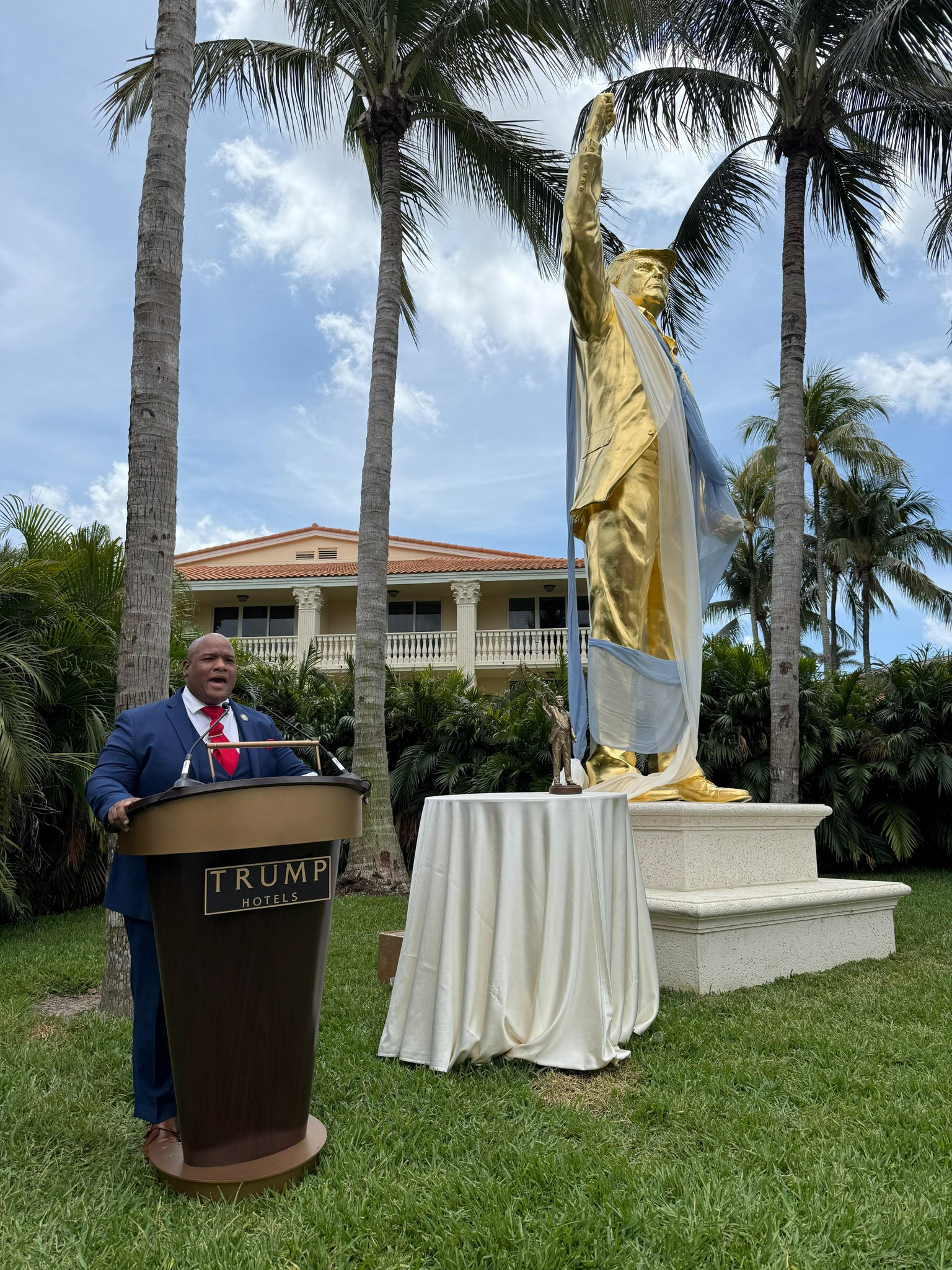
This is the second weekend in a row that Trump, who has been open about accepting thinly-disguised bribes during his second term, has made money off of a major professional golf tournament. Last week it was the PGA Tour's turn to pay the piper at Trump National Doral. That course saw the unveiling of a 15-foot golden statue of Trump this week, so reminiscent of a biblical idol that a televangelist supporter of Trump felt obliged to preemptively address the issue: "Let me say this plainly: this is not a golden calf."


Why does this matter?

  • Using the power of the state to force people to pay you money is what tinpot dictators and Russian oligarchs do. 
  • It's bad to have a president in hock to so many foreign governments, and worse that they're all dictatorships. 
  • One way to avoid people thinking you're making golden idols of yourself is not to make golden idols of yourself.

Wednesday, May 6, 2026

What did Donald Trump do today?

He tried to jump in front of the spotlight around Ted Turner's death.

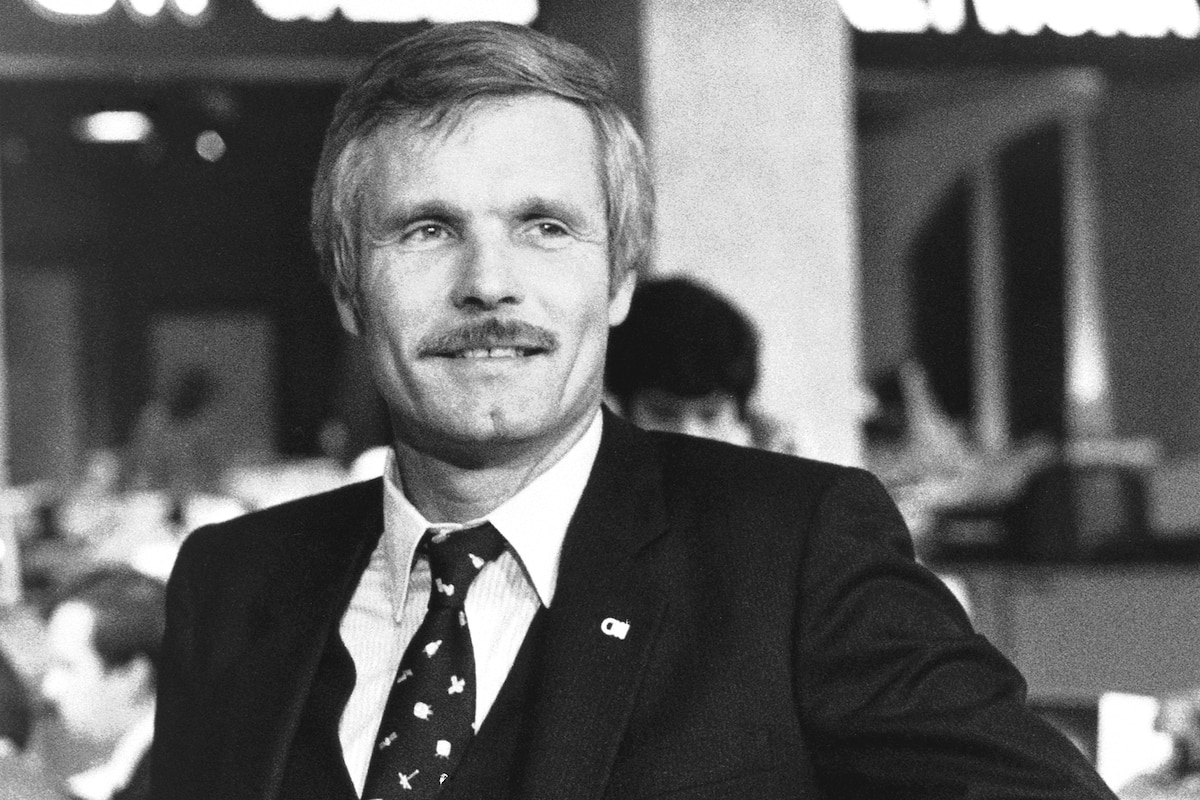
Media mogul Ted Turner died today at age 87. Turner was the founder of several early cable networks, most notably CNN and TBS. He was a connoisseur of movie history, first leading the charge to colorize black and white movies, and then—as an act of contrition to the film purists he'd outraged—creating the cable channel TCM, known for its ad-free presentation of culturally and historically significant movies. His success as a cable pioneer and as a businessman in general made him a billionaire, and he adopted a flamboyant lifestyle to match. He bought two sports teams to provide fodder for his growing cable empire: the Atlanta Hawks and the Atlanta Braves. He even appointed himself manager of the Braves for one game in 1977 (a loss to the Pittsburgh Pirates), a stunt that played to his flair for the dramatic but which is remembered surprisingly fondly by baseball's old guard.

TCM Remembers: Ted Turner 

Turner and Trump, who turns 80 next month, were superficially similar in many ways. Both were married three times and had five children, although Turner had a much warmer relationship with his wives and children. Both have courted controversy with crass remarks: Turner for making hoary jokes about Polish people, and Trump for saying that Americans who don't support him are traitors and that entire races of people are vermin with subhuman intelligence. Both owned sports teams: Turner with the occasionally good Hawks and the dynastic Braves, and Trump with the New Jersey Generals of the short-lived USFL. Trump and Turner were both billionaires, with Turner's fortune coming from a local billboard business he started and parlayed into a multimedia empire, and Trump's coming from $400 million in tax-evaded inheritance that he used to repeatedly bankrupt businesses until he began to successfully monetize the presidency during his second term through crypto scams and pay-for-access bribes. 

That may be why Trump took the unusual step of remembering Turner fondly today in a post to his boutique social media website. Normally, Trump uses the occasion of a person's death to insult them and avenge whatever grudges he may have had against them, a tactic he's deployed against everyone from celebrity filmmakers to icons of the civil rights movement to American troops killed in combat. But he called Turner "one of the Greats of Broadcast History" and claimed that he was "a friend of mine," adding, "Whenever I needed him, he was there, always willing to fight for a good cause!"

That makes it sound like Turner liked Trump or his politics. In reality, Turner explicitly endorsed Hillary Clinton in 2016, and addressed that endorsement to Trump in the first line: "From one billionaire to another, Donald, I prefer Hillary." 

On almost every political issue imaginable, Turner opposed Trump. He was an avid environmentalist and conservationist who railed against environmentally devastating coal mines, while Trump believes conspiracy theories about wind turbines causing cancer. Turner was staunchly in favor of women's rights to abortion, while Trump—at least since he started trying to get elected—has engineered the destruction of that right. 

Turner also prided himself on his philanthropy, establishing the Turner Foundation, which has given more than $400 million in grants for environmental protection projects. Trump's charity was dissolved after a trial found it to be fraudulent, used by Trump to make illegal political contributions and pay for personal expenses like oil paintings of himself and sports memorabilia. 

Why does this matter?

  • Jumping in front of the spotlight when someone famous and well-liked dies is narcissistic and needy even by Trump standards. 
  • If Ted Turner had liked and supported Donald Trump, Donald Trump wouldn't be the only person saying he did.

Friday, April 24, 2026

What did Donald Trump do today?

He got handed a legal setback in his attempt to pay himself $10 billion in taxpayer money.

Trump, a billionaire heir who routinely praises himself for not taking his $0.0004 billion salary as president, is suing the IRS for $10 billion on the grounds that it was negligent in allowing some of his tax returns to be released. The supposed "negligence" occurred during Trump's first term in office while he himself was responsible for it.

But the IRS—which is under Trump's direct control and is led by Trump appointees—has recently been signaling that it will settle the matter out of court with Trump. An actual trial that the IRS was trying to win, as it would against literally any other plaintiff besides Trump, would probably last longer than Trump's tenure as president, at which point a new administration would almost certainly start fighting back in court. A quick settlement, on the other hand, would net Trump some or all of the $10 billion at issue immediately, while he could still write the check with one hand and cash it with the other.

That may explain why Trump's legal team notified the district court handling the "lawsuit" about a potential settlement before the IRS legal team had even had a chance to formally acknowledge the suit—a pretty obvious tell that would never happen when the parties weren't colluding with one another. 

The obvious irregularity was noted today by Judge Kathleen Williams, who ordered Trump and the IRS to explain why there was any controversy between Trump the plaintiff looking to profit from the government taking orders from Trump the defendant. She noted in her order that Trump has signed executive orders requiring the Department of Justice (which would represent the IRS in this case) to follow his direct instructions.

President Trump has issued multiple executive orders which shape the relationship of the agencies of the executive branch to his presidency. For example, “[n]o employee of the executive branch acting in their official capacity may advance an interpretation of the law … that contravenes the President[’s] . . . opinion on a matter of law, including but not limited to … positions advanced in litigation[.]” 

One such employee of the executive branch, the Attorney General, has a statutory obligation to defend the IRS when it is hailed into court, but then is ostensibly required by executive mandate to adhere to the President’s opinion on a matter of law in such a case. 

The result, Judge Williams wrote, is that it's not clear "whether the Parties here are truly antagonistic to each other." Precisely to avoid sham settlements like this, courts do not consider cases where there is no actual dispute.

Williams' order does not end Trump's chances at "winning" $10 billion from taxpayers for having evidence of his obvious and already well-documented tax crimes released to the news media, but it will slow it down, and draw attention that Trump clearly doesn't want.  

Why does this matter?

  • Corruption doesn't get much more obvious than a president demanding $10 billion directly from the government branch he leads. 

  • That $10 billion will come from the pockets of Americans who don't cheat on their taxes.

Thursday, January 29, 2026

What did Donald Trump do today?

He tried to help himself to $10 billion of taxpayer money.

Trump sued the IRS for $10 billion today, claiming that the agency was negligent because a contractor in leaked his tax returns over a period of time in 2019 and 2020. Those leaks became the basis for a number of New York Times and ProPublica stories that, while damning, didn't add much to what was already known about Trump's long history of tax cheating.

These are the specific articles that the lawsuit cites:

  • Long-Concealed Records Show Trump’s Chronic Losses and Years of Tax Avoidance (NYT, Sept. 27, 2020) 
  • 18 Revelations From a Trove of Trump Tax Records (NYT, Sept. 27, 2020) 
  • Here Are the Key Numbers From Trump’s Tax Returns (NYT, Dec. 21, 2022) 
  • Trump Tax Returns Undermine His Image as a Successful Entrepreneur (NYT, Dec. 30, 2022)
  • Key Takeaways From Trump’s Tax Returns (NYT, Dec. 30, 2022)
  • Trump’s Taxes: Red Flags, Big Losses and a Windfall From His Father (NYT, Dec. 21, 2022)
  • Live Updates: I.R.S. Didn’t Audit Trump for 2 Years in Office, House Committee Says (NYT, Dec. 21, 2022) 
  • Trump Paid $750 in Federal Income Taxes in 2017. Here’s the Math. (NYT, Sept. 29, 2020) 
  • Never-Before-Seen Trump Tax Documents Show Major Inconsistencies (ProPublica, Oct. 26, 2019)
  • Meet the Shadowy Accountants Who Do Trump's Taxes and Help Him Seem Richer Than He Is (ProPublica, May 6, 2020)

Bizarrely, Trump's filing also claims that all of the above stories are false, even though they are based on leaks of his actual tax returns. 

In other words, Trump says he should be paid $10 billion dollars as a private citizen for "negligence" that happened on his watch as President, and he wants political cronies he appointed to lead the IRS and Justice Department—and whom he can fire or overrule—to decide whether he should get it.

Trump is making a lot of money during his second for himself and his political allies this way. In addition to today's lawsuit, Trump is "asking" his own Department of Justice—which his former personal defense lawyers now run—for $230 million in an administrative process because, in short, the FBI investigated his ties to Russia and his outright theft of classified documents. His DOJ also "settled" a spurious claim for $5 million by the family of Ashli Babbitt, a woman who was shot during the assault on the Capitol on January 6, 2021. 

That Trump is a tax cheat is beyond question: not only had it been exhaustively documented before the leaks described in this lawsuit, it was an element of his felony convictions in New York State. The Trump Organization was also found guilty of criminal tax fraud in 2022, and Trump's financial fixer and Trump Organization CFO Allen Weisselberg went to prison for it. That sort of thing is why Trump, who has been promising to release his tax returns since becoming a candidate in 2015, never has.
 

Why does this matter?

  • Corruption doesn't get much more obvious than a president demanding $10 billion directly from the government branch he leads. 
  • That $10 billion will come from the pockets of Americans who don't cheat on their taxes.

Monday, June 9, 2025

What did Donald Trump do today?

He had some ideas about how to make sure American children were prospering.

Today, Trump did a product rollout for a provision in his budget bill: "Trump accounts" for newborns that would come with $1,000 in seed money invested in a stock market fund. The press release said that it would help teach children the "miracle of compounded growth and set them on a course for prosperity from the very beginning."

As is the case with many provisions in that bill—most notably, the tax rate itself, which will be changed to massively benefit the wealthiest Americans—it won't actually help any family below a certain income. 

Nevertheless, the plan makes for an interesting contrast with Trump's own upbringing. He has claimed—falsely—that his father had given him only a "very small loan" of $1 million, or 1,000 times as much money with which to seek his fortune. In reality, between his actual inheritance and various tax evasion schemes, Trump had been given about $413 million by the time his father died—not counting the value of Fred Trump's real estate business itself, which was a guaranteed income stream for Donald.

Ironically, Trump himself would have benefited from a lesson in the "miracle of compounded growth" in the stock market. Even as the value of the buildings he inherited skyrocketed thanks to the New York real estate boom, his own business ventures repeatedly failed or underperformed, to the point where his own net worth would indisputably be higher if he'd just invested his 413,000 "Trump accounts" worth of inheritance in an S&P index fund and let qualified business experts it.

If the "Trump account" plan sounds similar, it's because it's a watered-down and redundant version of an existing and superior program, the 529 Savings Plan. Those are established by parents to save tax-free for children's future educational needs, and are much more flexible. Even if a child chooses not to use the accumulated funds for education, up to $35,000 can be put in a Roth IRA, which is another kind of tax-free investment account. 529s and Roth IRAs can be used with almost any form of investment (not just a single index fund), and Roth IRAs can be tapped without penalty to pay for expenses many Americans encounter, like buying a first home, tuition, or medical emergencies.

Of course, they would also contain the seed money of $1,000. That is 5.3% the average cost of giving birth in a hospital ($18,835) for a parent whose Medicaid coverage was cut, as the same budget bill calls for. 

41% of Americans rely on Medicaid to pay for the cost of each delivery (not counting prenatal checkups), and about 3.5 million babies are born in the United States each year. If only half of those parents lost their coverage due to Trump's budget bill, then the net cost to parents would be about just over ten billion dollars: 

On the other hand, "Trump accounts," would, as a matter of law, have the name "Trump" in them.

Why does this matter?

  • There are ways to build Trump's brand that don't involve taxpayer money. 
  • There are many ways to improve the financial prospects of America's children that don't involve worrying about Trump's brand.

Wednesday, May 28, 2025

What did Donald Trump do today?

He issued more pardons of the particular type he favors.

Trump has issued a spree of pardons and clemencies over the last few days. As is virtually always the case with Trump, they share a few common themes: either they are for crimes that Trump is known to have committed, or they are for people who have given Trump money, or they are for people who are or are willing to become his political allies, or they have some connection to the world of reality TV.

Todd and Julie Chrisley were convicted of fraud and tax evasion. The couple had starred for years on a reality TV show on the USA Network. Their daughter, Savannah Chrisley, is a professional conservative "influencer." Thanks to a pardon Trump signed yesterday, both were released from prison today.

John Rowland is the former Republican governor of Connecticut. He was convicted in 2004 of public corruption and tax fraud, and in a separate 2014 trial for violating campaign laws, lying to the FEC, and fraud. Trump pardoned him today.

  • In addition to the tax and fraud crimes mentioned above, Trump has been accused of any number of campaign violations, though while he was in office his own hand-picked commissioners were able to block further action against him. His 2024 conviction turned in part on the fact that his attempt to cover up his affair with porn actress Stormy Daniels by paying her $130,000 for her silence was itself a campaign finance crime: by failing to disclose it as required by law, he was in effect paying for publicity off the books.

Michael Grimm is a former Republican member of Congress from New York. He, too, was convicted of tax fraud and was investigated by the FBI for campaign finance violations. After being forced to resign from Congress, he worked in conservative media as part of the pro-Trump media ecosystem.

Jeremy Hutchinson, son of Arkansas' Republican former governor Asa Hutchinson, also committed tax fraud and accepted bribes and was convicted in 2023. The younger Hutchinson was a member of the Arkansas legislature took money in exchange for his votes to benefit a healthcare organization.  

  • Trump hasn't been formally convicted of bribery, but he has created an astonishing number of ways for people or countries to overtly or covertly funnel money to his interests, as the following example demonstrates:

Paul Walczak is another tax cheat Trump pardoned this week, although not one with the public profile of the Chrisleys or national politicians. He stole money he collected for his employees' Social Security contributions to buy a yacht—meaning that he wasn't simply stealing from the taxpayers, but hurting his workers' retirement benefits. Trump's pardon means that Walczak will profit from his crime, because he will no longer be obliged to pay the taxpayers back the $4.4 million he stole.

Earl Lamont Smith is a former Army reservist who was convicted of stealing government property. Trump pardoned him today.

Scott Jenkins is a "wonderful person" who was "dragged through hell" and "left for dead" by "radical Left monsters"—according to Trump's pardon statement for the former Culpeper County, VA sheriff, who was one of Trump's vocal supporters in the swing state.

Why does this matter?

  • "It's not illegal if it helps the Leader" is how dictatorships work.

Saturday, May 17, 2025

What did Donald Trump do today?

He got a little confused about how businesses make money.

Wal-Mart, the nation's largest retailer, announced earlier this week that they would be raising prices to cover the cost of the tariffs Trump has imposed since returning to office. Its CFO told the Associated Press that "there’s a limit to what we can bear, or any retailer for that matter."

Wal-Mart's announcement was unusual: normally, companies try not to call attention to price increases. But given that the cause was beyond their control, Wal-Mart seems to be hoping that its customers will understand it's not to blame for the spike in prices and reduced options caused by the new tariffs. 

Trump responded today by demanding that Wal-Mart and other American retailers simply absorb the costs themselves, without raising prices.

Walmart should STOP trying to blame Tariffs as the reason for raising prices throughout the chain. Walmart made BILLIONS OF DOLLARS last year, far more than expected. Between Walmart and China they should, as is said, “EAT THE TARIFFS,” and not charge valued customers ANYTHING. I’ll be watching, and so will your customers!!!

Trump, who cheated on his taxes and never really had to worry about whether he turned a profit on the real estate empire he inherited, may be a little hazy on capitalism as it's experienced by most Americans. But businesses always pass on big unexpected costs to consumers—or they go out of business. Wal-Mart is many things, but it is not a charity.

As everyone from economists to social media users were quick to note, there are a few other problems with this. For one, Trump has always claimed that foreign countries pay tariffs. This is, to put it mildly, completely false. But if Trump's version of things were true, and foreign governments or manufacturers were absorbing the costs of the tariffs through lower prices, there would be no expenses for Wal-Mart and every other retailer to pass on in the first place. 

Trump also claims, sometimes in the same breath, that tariffs will revitalize American manufacturing by making it cheaper to buy products made in the United States. That's true—because tariffs make foreign goods more expensive for consumers.

In other words, Trump is saying that Wal-Mart and other businesses should "eat" a tax that isn't even supposed to exist, and if it did (which it does), wouldn't accomplish anything unless it were passed on to consumers.

Why does this matter?

  • Even by Trump's standards, this is an embarrassing failure to understand a simple concept.

Tuesday, April 1, 2025

What did Donald Trump do today?

He did (more) mass layoffs of critical American health care workers.

In a previously unannounced move, Trump expanded his mass firings of government workers responsible for providing health and medical services to Americans today. An additional 10,000 workers at the National Institutes for Health (NIH), Centers for Disease Control (CDC), and the Food and Drug Administration (FDA).

Directors at NIH programs were fired in what appears to be a blanket purge of otherwise apolitical leadership positions—even ones who had served in the first Trump administration. Among the programs decimated by the firings are those doing research on Parkinsons and other neurodegenerative diseases, working on HIV/AIDS prevention, and approving new drugs and making sure existing ones stay safe. 

The official Trump administration rationale is that these and other firings will save taxpayers money. In reality, even as the Treasury has stopped paying out salaries to fired workers, the federal government is spending at a faster pace. This is because salaries are a tiny fraction of the cost of government, and because most of the "savings" that the so-called DOGE agency has reported are fake.

Source: NYT


Meanwhile, because Trump fired IRS workers responsible for enforcing tax laws against corporations and wealthy individuals, government revenues are expected to plummet by half a trillion dollars.

Why does this matter?

  • Shooting yourself in the foot for no reason is a bad idea.
  • Americans deserve—and the United States can afford—health care, clean food, and medical research.

Wednesday, March 26, 2025

What did Donald Trump do today?

He said that the COVID-19 pandemic never happened.

Today, Trump's Department of Health and Human Services stopped nearly $12 billion in grants to the states for disease prevention and control. Much of the money was being used to track, prevent, and control infectious diseases—such as the measles outbreak that started in Texas and is now spreading nationwide. (The Texas Health and Human Services Department is among the agencies affected.)

A statement from the department referenced the COVID-19 pandemic, a sensitive subject for Trump, and said that "HHS will no longer waste billions of taxpayer dollars responding to a non-existent pandemic that Americans moved on from years ago."

More than 1,200,000 Americans died as a result of the "non-existent" COVID-19 pandemic in just the first two years. Trump himself nearly died from it. Studies estimate that 40% of those deaths were avoidable but for Trump's policies, which treated it as a political crisis rather than a deadly infectious disease.

Trump also cut funds for state health programs that, at least in theory, he has no specific political agenda against, like mental health and substance abuse treatment. The official rationale is cost-cutting—that is, that the cost per American death or illness avoided by medical care is too high.

Trump's cuts to the IRS, also done in the name of cutting costs, are now expected to cost half a trillion dollars per year, mostly from extremely wealthy individuals and companies avoiding paying their share. That is about 42 times more than the cost of the medical services being cut today.

Why does this matter?

  • Pretending that politically inconvenient infectious diseases don't exist was a bad strategy in 2020, and it is a bad strategy in 2025.
  • Enabling tax cheats is a bad idea even when the president hasn't been repeatedly caught doing it himself.
  • It is not a waste of money to keep Americans from getting sick.

Saturday, March 1, 2025

What did Donald Trump do today?

He made a federal case out of a rant about baseball.

Today, Trump declared that he would pardon disgraced baseball star Pete Rose.

Rose's lifetime ban from baseball and exclusion from the Hall of Fame has long been a matter of legitimate debate among fans. Some feel, as Trump does, that Rose's on-field performance was too good to ignore even given that he admitted to breaking baseball's cardinal law against gambling. (Even diehard Rose supporters don't claim, as Trump did, that there was no issue with Rose betting on his own team.)

The only thing Trump can actually pardon him for are federal crimes, and Rose is known to have committed two. The first is tax evasion, for which he served several months in prison. 

The second is statutory rape, which Rose admitted to but was never charged for because his victim, who was 14 or 15 at the time Rose had sex with her, did not come forward until after the statute of limitations had expired. Rose admitted to having sex with her as a 32-year-old man, but claimed he thought she was 16 (the age of consent in Ohio) and denied her claim that they had had sex in places outside of the state of Ohio—which would make him guilty of federal child sex trafficking. 

Rose was a vocal Trump supporter, but more importantly for his posthumous pardon bid, the crimes he committed were of the sort that Trump is known or strongly suspected to have committed himself. Most of the pardons Trump issued during his first term fit that bill.

Trump has his own history with baseball, most of it fictitious. He played for his private boarding school's team. Box scores from newspaper accounts of those games give him an atrocious career batting average of .138. But his terrible performance at a small private school hasn't stopped Trump from pretending he was a major league prospect, though. He claimed to have been invited to a tryout with future Giants Hall of Famer Willie McCovey. (This is an obvious lie: McCovey is eight years older than Trump and was in the majors while Trump was still in junior high school.)
 

Why does this matter?

Wednesday, February 26, 2025

What did Donald Trump do today?

He got history wrong as well as economics.

Trump has already threatened to impose 25% tariffs on the United States' two biggest trading partners, Mexico and Canada, and an additional 10% on the third largest, China. Today, he made a similar threat against fourth largest trading partner, the European Union.

In explaining the move, Trump insisted that "the European Union was formed to screw the United States—that's the purpose of it and they've done a good job of it."

In reality, the European Union was formed in the late 1940s at the behest of the United States to "screw" the Soviet Union, which was forming its own equivalent economic union in Warsaw Pact countries. Its original organization, the OECC, was stood up with Marshall Plan funds from the United States. One of its primary purposes was to strengthen the coal and steel production of US-allied nations, because those industries were critical for defense purposes.

Unlike every other Democratic and Republican president since Harry Truman, Trump is not particularly interested in defending European allies, and few Americans with any political power have ever been as favorably disposed towards the Putin regime. 

This is not the only historical error Trump has made on tariffs recently. Trump has been increasingly insistent that tariffs could fund the government, which would solve the awkward political problem of how much his proposed tax cuts for the wealthiest Americans would cost. He's cited the example of the federal government in the 1890s, when the taxes American consumers paid on imported goods really did account for a substantial fraction of government income. Tariffs are less than 2% of total revenues now.

As economists—and, increasingly, nervous investors—have pointed out, there are just a few problems with assuming that Gilded Age economics will work today. Trump, for his part, appears to genuinely believe that the country was "at its richest" at a time of widespread food insecurity and desperate, grinding poverty for tens of millions of Americans. That may be because tariffs are a consumption tax, meaning that people spending every penny of their income on food and necessities were being taxed on 100% of their income, while those few at the other extreme of wealth paid almost no tax at all—something Trump can deeply relate to.

Why does this matter?

  • Presidents who can't tell allies from enemies aren't fit to serve.
  • Neither are presidents who can't or won't understand basic economic concepts like "tariffs are taxes paid by American consumers."

Thursday, February 20, 2025

What did Donald Trump do today?

He made sure it would be easier to cheat on taxes on his watch.

Today, Trump—or someone using his authority as President—began firing as many as 7,000 IRS employees. He used the same loophole he's used to get around civil service job protections at other agencies, including the FAA, the National Parks Service, and the agency that builds and maintains the United States nuclear weapons stockpile.

The firings are expected to have two main effects. First, it will delay refunds and limit filing assistance for the vast majority of Americans who follow the law and file their taxes. Second, it will cost the federal government money as tax cheats—especially individuals at the very top of the income ladder—will be more likely to avoid paying their fair share, and more likely to try to hide assets.

Trump has claimed that the reason he wants to decimate the federal workforce is to save taxpayer money. The IRS, of course, generates taxpayer money—particularly when it enforces the law on people like Trump.

It's difficult to summarize all the various ways that Trump himself has bent or broken tax laws, before and during his presidency. He is known to have used tax-dodging schemes to illegally take about $413 million from his father. His company, the Trump Organization, was convicted of tax fraud in 2022. He famously refused to release his tax returns during his 2016 campaign, a usually routine step. When they were finally released to the public over Trump's objections after he'd left office, it was revealed that he'd lied about being under IRS audit during his term. (The IRS is required to audit presidents every year, and always has, with the specific exception of the years Donald Trump was president.) For ten out of 15 years ending in 2015, the self-described billionaire paid no income tax at all, and in 2016 and 2017 he paid $750—apparently so that he could say he paid taxes without technically lying. But he hasn't always shied away from his ability to pay less tax than a part-time minimum-wage worker: in a 2016 presidential debate, he boasted that not paying his taxes "means I'm smart." He has "paid" family members like his daughter Ivanka lavish "consulting fees" for unspecified business work, allowing him to deduct the amount from his business taxes while avoiding gift taxes. His fraudulent "charity," the Trump Foundation, was shut down by the state of New York in part because he used its tax-exempt status to hide wealth he controlled. He also deducted $70,000 in haircuts, claimed (and received) $72.9 million in refunds he wasn't entitled to, and paid hundreds of millions of dollars less than someone of his supposed wealth typically would.

The IRS is also a frontline agency for national security aims Trump might approve of (like disrupting the flow of money to Hamas and ISIL) and those he certainly would't (like enforcing sanctions against Russian oligarchs).

Why does this matter?

  • Americans who don't cheat on their taxes don't usually like people who do.
  • Donald Trump is not above the law, including the law that says he has to pay a tiny amount of his wealth as his fair share of taxes.
  • A president who cared about efficiency or the budget deficit would make it easier for the government to collect the money it's legally owed, not more difficult.

Saturday, October 24, 2020

EARLY VOTING IS NOW UNDERWAY IN ALL STATES THAT ALLOW IT, except Maryland (begins Oct. 26), Washington D.C. (Oct. 27), and Oklahoma (Oct. 29).

What did Donald Trump do today?

He voted, as literally only he can.

Trump voted today in his new home state of Florida. A library in Palm Beach that serves as an early voting location had to be shut down for several hours in order to make it secure so that Trump alone could vote. 

Trump normally votes by mail, but he's been trying to convince voters (without evidence) that mail-in voting is subject to fraud. With the uncontrolled COVID-19 epidemic in the United States once again setting daily records, voting without going to crowded indoor polling places is appealing to many Americans.

Trump said today that voting in-person is "much more secure than when you send in a ballot," which is a lie—but this year, for the first time in the history of absentee balloting, there are concerns that his admitted attempts to slow down mail delivery will disqualify ballots.

Trump's vote today was legally valid, but he committed at least two potential crimes in registering. One was that he claimed Washington, D.C. as his official residence while trying to register in Florida, His staff later changed the paperwork, calling it an innocent mistake—although that kind of mistake has sent other Americans to prison.

The other is that his supposed address in Florida—his luxury Mar-a-Lago resort—is not legally a residence. This doesn't automatically mean that Trump can't claim it as his place of residence for voting purposes, but it may mean that he's cheating on a tax agreement with local governments. Voters have faced extremely serious consequences for claiming to live at addresses that aren't proper residences, including a prosecution in Palm Beach.

So what?

  • It's wrong to try to keep Americans from exercising their right to vote.
  • It's a bad sign when a president can't even register to vote without potentially committing crimes.

Monday, September 28, 2020

EARLY VOTING IS NOW UNDERWAY IN THE FOLLOWING STATES:
Illinois, Michigan, Minnesota, New Jersey, Pennsylvania, South Dakota, Vermont, Virginia, and Wyoming

What did Donald Trump do today? 

He tried to defuse the tax story without saying anything.

Trump made two public appearances today: once at a swing-state factory making electric trucks, and once at a coronavirus briefing. At the first, he reflexively began to answer when a reporter shouted a question, but turned and abruptly left after it became clear she was asking about the shocking revelations about his tax returns.

Q: Mr. President, are you looking forward to the debate?

TRUMP:  Yeah, I am.  I do.  I’m really —

Q: Mr. President, you tweeted about releasing a financial statement.  When will you release that?

TRUMP:  — I am looking — I am looking very forward to the debate.  Thank you, everybody.


At the second, he simply stalked away from the podium as reporters shouted questions.

Trump's strategy yesterday was to insist that, somehow, the 18 years of tax returns obtained by the New York Times were "fake news." He also insisted that unofficial financial disclosure forms would be a much better way to learn about his finances.

Today, in a tweet, he backtracked from even that, saying that he "may" release a self-reported financial statement. This hypothetical future statement—Trump didn't say when he might release it—would supposedly show that Trump had a healthy debt-to-cash ratio, and that it would be "IMPRESSIVE."

Of course, even without releasing his own copies of tax returns, Trump could easily disprove any false statements in the NYT article. He could also simply say who some of the unknown parties or countries are who own his debt, which may total $1.1 billion or more. Because the use of financial leverage is a common way of recruiting spies, far less debt than the NYT story uncovered would permanently disqualify Trump from getting even a basic security clearance, if he weren't president. 

He could also, if possible, explain why so much of what is revealed in the NYT returns looks so much like common (and illegal) tax evasion schemes. For example, Trump paid his daughter Ivanka, an employee of the Trump Organization, a separate fee as a "consultant." This allowed him to write off the amount as a business expense, but it's illegal to pay sham fees to avoid income or gift taxes.

Who cares?

  • The only reason to keep something like this secret is that the truth is even more damning than keeping silent.
  • It shouldn't be possible for anyone to have this much leverage over the President of the United States—much less any number of anonymous entities whose identity is protected by the president himself.
  • Running away from reporters doesn't make questions go away.

Sunday, September 27, 2020

EARLY VOTING IS NOW UNDERWAY IN THE FOLLOWING STATES:
Illinois, Michigan, Minnesota, New Jersey, Pennsylvania, South Dakota, Vermont, Virginia, and Wyoming

What did Donald Trump do today?

He tried his best to fend off the inevitable catastrophe of his tax returns finally seeing the light of day.

Late this afternoon, the New York Times published a 30,000-word article that can be summarized this way: the paper has acquired Trump's tax returns for the last 18 years, and in most of them, he paid virtually no income taxes. 

Trump has tried desperately to prevent this information from coming out—although every other presidential candidate since Richard Nixon has released them—and it's now clear why. He paid either zero dollars in income taxes, or a token $750 amount (apparently so that he could say he was paying taxes at all), in 13 of the last 18 years.

The story (which the NYT summarizes in a separate article) makes the following revelations.

  • Trump is personally in debt to the tune of $421 million, and those loans are coming due during what he hopes will be his next term in office. This means that the people holding those notes—in many cases, foreign interests—have and have always had enormous direct leverage over Trump.
  • His business empire was in shambles for much of that time. Ironically, the only reliable source of income was his personal "brand"—which centered on the idea that he was a savvy and successful businessman.

  • Trump's tax avoidance was astonishing even by the standards of the 0.001%—the group his supposed net worth puts him in. He paid $400 million less in taxes than the average member of that group.

  • Among the "business expenses" used to zero out his tax bill were $70,000 in haircuts.
  • He is fighting with the IRS—which reports to him—over an apparently invalid $72.9 million refund.
  • The famous NYC Trump Tower, one of his few profitable real estate holdings, has a mortgage bill of over $100 million coming due in 2022, and he has made no payments on it.

Trump held a press conference today, supposedly to continue his remarks on the Supreme Court nomination he made yesterday, and gave this response when asked about it:

Q: [T]here’s a New York Times story that came out about an hour ago that says that, when you came to the White House, you were paying about $750 a year in federal income tax.

They are not releasing what — they’re not publishing the tax returns. They’re not showing that out there. They’re saying — to protect their sources. In your tax returns, sir, does that sound right, that you were paying a couple hundred dollars a year in federal income taxes?

TRUMP: No. No. It’s fake news. It’s totally fake news. Made up. Fake. We went through the same stories. You could have asked me the same questions four years ago. I had to litigate this and talk about it. Totally fake news. No.

Actually, I paid tax, but — and you’ll see that as soon as my tax returns — it’s under audit. They’ve been under audit for a long time. The IRS does not treat me well. They treat me like the Tea Party — like they treated the Tea Party. And they don’t treat me well. They treat me very badly.

You have people in the IRS — they’re very — they treat me very, very badly. But they’re under audit. And when they’re not, I would be proud to show you. But that’s just fake news. The New York Times tried it — the same thing. They want to create a little bit of a story, a little bit of — they’re doing anything they can.

Not only — that’s the least of it. I mean, the stories that I read are so fake. They’re so phony.

Q: Did they tell you this was going to come out today?

TRUMP: No, I didn’t know anything about it. I don’t know anything about it. I think somebody said they were going to do a negative — they always do — they only do negative stories.

It's a minor point, but Trump is definitely lying about knowing that the story was coming out. In fact, the press conference was clearly scheduled just so that Trump would be able to give an instant reaction. The White House was contacted for comment immediately before the story broke, and the press conference was only announced at 1:39 P.M. today, while Trump was still at the golf course.

The fact that Trump is under audit—as every president is, by law—has no bearing on his years-long attempts to keep the returns secret. He was always free to release them.

The larger problem for Trump, though, is that the NYT story cannot be "fake news," unless they literally manufactured 18 years of fictitious tax returns—which Trump could easily prove even without releasing his own copies.

So what?

  • Voters may think that someone who constantly brags about his wealth should pay more in taxes than a part-time worker earning minimum wage.
  • Nobody with financial problems this complicated has the time or energy to be president.
  • It's bad if the president keeps secret all the different people who can threaten him with financial ruin.
  • It's wrong to lie to the American people, even if the truth is humiliating.

Monday, September 21, 2020

EARLY VOTING IS NOW UNDERWAY IN THE FOLLOWING STATES:
Michigan, Minnesota, New Jersey, Pennsylvania, South Dakota, Vermont, Virginia, and Wyoming


What did Donald Trump do today?

He issued an empty threat to defund "anarchist" cities.

The Department of Justice, headed by Trump ultra-loyalist William Barr, designated three cities as "anarchist jurisdictions" according to a September 2nd memo issued by Trump. 

The cities—Seattle, Portland, and New York—are all places that Trump tried to make the focus of a summertime culture war about police violence and systemic racism. They're also safe political targets, since Trump stands no chance of winning any electoral votes from the affected states.

According to the memo, Trump's definition of an "anarchist jurisdiction" is one that refused to let him "help" fight protestors with federal forces—like the anonymous, unbadged, and largely untrained squads that he deployed to attack and in some cases kidnap demonstrators in Washington, D.C. and Portland this summer.

Trump claims that he will now have the authority to withhold federal funds from these cities. In reality, he has no such authority, unless Congress explicitly gives it to him in a spending bill. 

As residents of the "anarchist jurisdictions" immediately pointed out, there's not much anarchy to be found. In fact, the New York district attorney's office announced in a court filing today that it had grounds to conduct far more law enforcement than Trump is likely to be comfortable with on the subject of tax fraud he's likely to have committed in their jurisdiction.

Why does this matter?

  • Conservative voters may not like being told that state and local governments have no authority to handle their own affairs.
  • It's un-American to try to pit Americans against each other.
  • Punishing places that don't punish the leader's political opponents is what dictators do.
  • Strong leaders don't make empty threats.