Showing posts with label labor. Show all posts

Thursday, July 2, 2026

What did Donald Trump do today?

He found the real victims of a terrible jobs report: himself and his children.

June's employment numbers were released today. They are grim: the entire US economy added only 57,000 jobs, far fewer than the number expected. It's also well below the number of jobs that the country needs to keep up with population growth, meaning the number of jobs per capita fell too. April and May's numbers were also revised downward.

The report had other bad news, too. The unemployment rate dropped from 4.3% to 4.2%, but only because the number of people seeking work declined. (In times of economic distress, potential workers sometimes abandon the above-board job market altogether, especially if they've been unsuccessful in finding work for a prolonged period of time.)

Worst of all, the report confirmed that wage growth is lagging well behind inflation. That means real wages—the buying power of a day's work—is down for the third month in a row.

Trump didn't comment on the jobs report, but he did talk about jobs: specifically, the ones his children have. He complained to CNBC's Joe Kernan that his sons (who are notionally running his business) were being unfairly accused of benefiting from his office and the insider information, even as he admitted that they do get insider information. Even the ultraconservative Wall Street Journal editorial page called this "graft," adding that "Americans, and especially his supporters, deserve better from this or any President."

Neither of Trump's sons have ever had jobs that were not given to them in the Trump Organization, or as the result of their influence over their father since he first became President. For example, Donald Trump Jr. is currently employed as an "advisor" to both major prediction market companies, Kalshi and Polymarket, in spite of having no relevant experience. Both companies, essentially gambling sites, are fighting state regulation with the help of Trump Sr.—which directly profits Trump Jr., who owns an investment stake in both companies.

Trump's defense of his adult children's monetization of his presidency came as analyses of his most recent financial disclosures show that he and his family made huge investments in specific areas immediately before major policy decisions that would affect the value of those investments—which Trump had previously kept secret. 
 

Why does this matter?

  • Virtually everyone in Trump's family is the heir to multiple different billion-dollar fortunes, so the idea that they're being treated unfairly is a bit much. 
Saturday, May 16, 2026

What did Donald Trump do today?

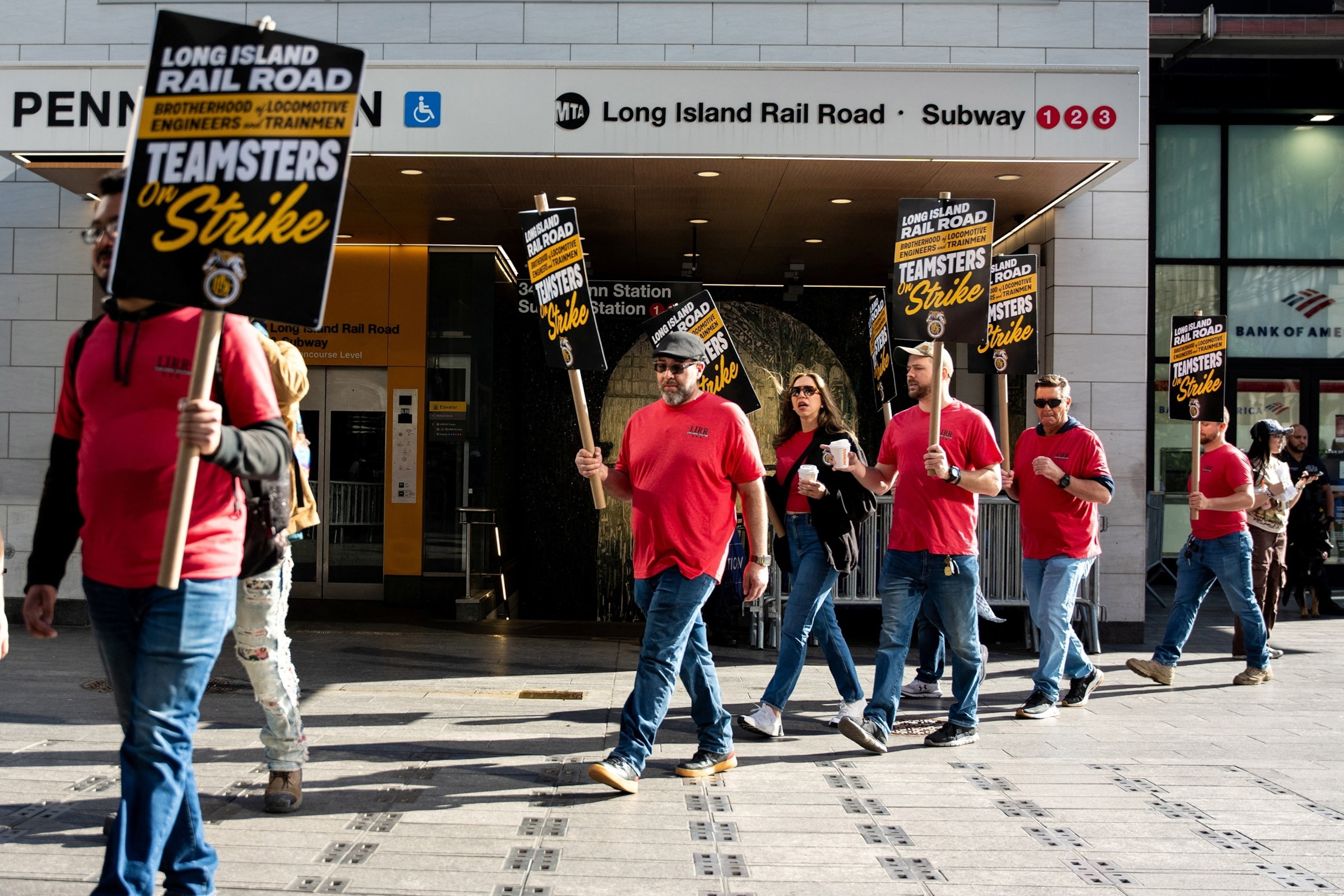
He bragged about not knowing about what was happening with a major transit strike.

3,500 employees of the Long Island Railroad (LIRR) went on strike today. The striking workers have not received a raise in three years, meaning they've taken a de facto pay cut amid sharply rising inflation. Talks with the Metropolitan Transit Authority (MTA) have been stalled for years.

LIRR workers go on strike after negotiations with MTA fail - ABC News 

New York's Democratic governor, Kathy Hochul, opposes the strike and supports only a 3% raise—almost certainly not enough to outpace this year's rising prices—but in a statement she made almost nine months ago, she also criticized Trump and his appointees to the board that helps mediate labor disputes in the railroad industry. She reiterated that today, saying that the strike was the "direct result of reckless actions by the Trump Administration to cut mediation short and push these negotiations toward a strike."

Trump responded not by disputing her claim, exactly, but by bragging about how he'd never even heard about any LIRR strike:

Failed New York State Governor Kathy Hochul, a Dumacrat, just blamed ME for her Long Island Railroad STRIKE, when she knows, full well, that I have NOTHING TO DO WITH IT - never even heard about it until this morning.
To be clear, Trump is almost certainly telling the truth, because a president admitting they had no clue about a major railroad strike is incredibly damning. Railroads, both commuter and freight, are considered so essential to the proper functioning of government that they have an entire separate legal apparatus designed specifically to avoid strikes. Presidents can legally order striking railroad workers back on the job under certain circumstances, as President Biden did in 2022. 

But railroad workers also have special protections and benefits unique to them, including recourse the National Mediation Board whose members were supposed to prevent this or any other transit strike from happening in the first place. Trump appointed the current chair and fired one of the Biden appointees, quite probably illegally, essentially paralyzing the two remaining members from taking any action. 

Three members, the original two Biden appointees and one Trump appointee, would have been able to take valid legal action to avert the strike.

270,000 people use the LIRR on a daily basis.

Why does this matter?

  • It's bad if a president doesn't have the first clue about major events his administration is supposed to be working on.  
  • It's worse if he thinks that's a good thing.

Tuesday, November 11, 2025

What did Donald Trump do today?

He celebrated Veterans Day by threatening to send US troops into Chicago to fight a real estate bubble.

Just before 1 A.M. on Veterans Day, Trump posted this to his private microblogging website:

First of all, there is no "Miracle Mile Shopping Center." Well, actually, there are four, but none of them are in Chicago. (This is a common error in Trump world, which once held a press conference at a landscaping business because it had gotten it confused with Philadelphia's Four Seasons Hotel.) 


Trump probably meant the "Magnificent Mile," which is not a shopping center, but the part of Michigan Avenue between E. Lake Shore Dr. and the river best known for its upscale shopping and dining.

More to the point, violent crime is extremely low in that area, which is heavily patrolled by the Chicago PD. 

The real reason that there are high vacancy rates is that rents on commercial real estate is sky-high, as landlords try to maximize profit. For example, one of the business that have moved out of their Michigan Avenue digs recently is the H&M clothing store—but it moved to a smaller location two blocks away, still on the Magnificent Mile, because its new landlords refused to renew the lease. H&M moved into the space vacated by an Apple store, which itself moved to another Michigan Avenue location just a few blocks away.

Trump regularly lies about crime in the United States, which is still historically low and has been declining in recent years. But he's also wrong about the business trajectory of the Magnificent Mile: its vacancy rate is already dropping as market forces (and a gloomy economic outlook) drop rents into a range businesses are willing to pay.

In other words, Trump—who owns a hotel several hundred feet from the Magnificent Mile—is proposing to once again deploy American troops against American citizens, but this time because a real estate bubble that would affect him personally might be about to deflate.

It's not clear who Trump was demanding to "CALL IN THE TROOPS, FAST," because he is the only person who could order that. But he couldn't do so legally unless there was an actual rebellion or insurrection, and businesses choosing not to pay too much for a lease probably doesn't count.

Why does this matter?

  • A president who had even the slightest bit of respect for Americans or the Americans who serve in the military wouldn't try to pit them against each other.   

Wednesday, August 27, 2025

What did Donald Trump do today?

He tried and failed to quietly fire his CDC Director for not going along with his administration's attack on the COVID-19 vaccine.

For a man whose game show catchphrase was "you're fired," Trump is quite squeamish about actually firing people, and has gone to extraordinary lengths to avoid having to do it himself. He prefers to act through intermediaries or via social media—even when the person in question works in the same building as him. In his second term, at least where his inner circle is concerned, he's all but abandoned the concept, preferring instead to "promote" staff who offend or underperform in some way to diplomatic jobs.

With regular federal employees—the ones with no personal connection to Trump—it's a different story. Trump has fired hundreds of thousands of workers, including many he had no legal right to fire, forcing them to take legal action just to be temporarily reinstated. The full scope of Trump's decimation of the federal workforce is becoming clear: just shy of 200,000 government employees have lost their jobs, with another 100,000 expected this year. 

The damage done by those firings is far greater than the immediate loss of the workers' livelihoods. The job market itself has virtually shut down over the last few months, and unemployed former government workers are now competing with new entrants to what's left of the private sector market. Meanwhile, federal agencies are unable to staff critical positions because skilled workers are resigning too, either out of fear for the uncertainty of working under Trump or disgust at his treatment of workers.

All of these tendencies were on display today, as Trump unofficially and indirectly fired the head of the CDC, Dr. Susan Monarez—the person he'd appointed to the role just weeks ago. But while the firing was announced on the CDC's own social media site, as of late this evening, it had not actually been done, apparently in the hope that Monarez would resign of her own accord. 

Through her attorneys, Monarez posted this response to Trump's attempts to get her to fall on her sword:

Throughout the day, both CDC and White House spokespeople insisted that Monarez had been fired, but Trump himself must order it done, and whether through inability or unwillingness, he had not yet made any such order as of midnight Thursday.

Meanwhile, three other senior CDC officials resigned in protest tonight. Like Monarez, they cited the dangerous and anti-scientific orders from HHS Secretary Robert F. Kennedy Jr., who today announced restrictions on who would be eligible to receive this winter's updated COVID-19 vaccine. Kennedy, a former talk show host and lawyer with no experience in health care, is a vaccine conspiracy theorist. The officials who resigned cited Kennedy's censorship of medical research to fit his personal political agenda, his purging of scientists who wouldn't promise to issue the findings he wanted, and the Trump administration's belief in the discredited science of eugenics.

Under today's orders, which appear to have set off the firings and resignations, Americans will no longer be able to simply choose to receive a vaccine at a convenient location like a pharmacy. Instead, they s will have to schedule a visit with their doctor first. This will add expense and inconvenience even for those whose access to health care won't be affected by Medicaid cuts in Trump's budget bill. 

Studies vary, but the COVID-19 vaccine is generally credited with saving 20,000,000 lives worldwide in its first year of availability alone.  

Full text of the resignation letters

Why does this matter?

  • Americans' health and safety literally depends on letting competent public health officials do their jobs.  

Tuesday, August 5, 2025

What did Donald Trump do today?

He said that undocumented immigrants were "naturally" bred to do farm labor.

To hear Trump tell it, there is plenty of labor available to harvest crops on American farms, because he has implemented an elaborate process by which undocumented workers are arrested, detained, deported, somehow given "schooling and learning," and then brought back into the United States as guest workers. 

No such process exists, although Trump has been claiming that it already does. It's not clear whether he understands that this isn't true.

In reality, thanks to ICE crackdowns that specifically targeted agricultural workers, combined with the sudden domestic oversupply thanks to other countries' retaliatory tariffs, crops are rotting in the fields for lack of harvesters even as prices are crashing through the floor. The result is a spiraling debt crisis for American farms that rivals the one from Trump's first term, which required a massive taxpayer bailout.

Trump addressed the subject again today in an interview on CNBC, and he had this to say about the largely Latino population of farmworkers that he is simultaneously trying to drive out of the country and anxious to have work:

TRUMP: We can't let our [farm owners] not have anybody, uhh — you know, these are very, uhh — these people, they're, they're — you can't replace them very easily. You know, people that live in the inner city are not doing that work, they're just not doing that work. And They've tried, we've tried, everybody tried. Uh, They don't do it. These people do it naturally. Naturally. I said what happens if they get into — a farmer, the other day, what happens if they get a bad back. He said, "They don't get a bad back, sir, because if they get a bad back, they die." I said, "that's interesting, isn't it?"


Trump has never really tried to hide his belief that people are "naturally" suited to one kind of life or another based on their race: Jews as "Shylocks" and accountants, Latinos as farm workers and hotel housekeepers and rapists, and so on. 

 As journalist Ashton Pittman and others noted, this is exactly the same kind of racist taxonomy that was used to justify enslaving Africans and their Black American descendants: the idea that the whole race had been built specifically to bear up under brutal labor:

Confederate States of America - Mississippi SecessionA Declaration of the Immediate Causes which Induce and Justify the Secession of the State of Mississippi from the Federal Union.In the momentous step which our State has taken of dissolving its connection with the government of which we so long formed a part, it is but just that we should declare the prominent reasons which have induced our course.Our position is thoroughly identified with the institution of slavery-- the greatest material interest of the world. Its labor supplies the product which constitutes by far the largest and most important portions of commerce of the earth. These products are peculiar to the climate verging on the tropical regions, and by an imperious law of nature, none but the black race can bear exposure to the tropical sun. These products have become necessities of the world, and a blow at slavery is a blow at commerce and civilization. That blow has been long aimed at the institution, and was at the point of reaching its consummation. There was no choice left us but submission to the mandates of abolition, or a dissolution of the Union, whose principles had been subverted to work out our ruin.That we do not overstate the dangers to our institution. a reference to a few facts will

Trump is right about one thing, though: farm labor is physically demanding, dangerous, and brutally hard on bodies of any race. Undocumented workers contribute tens of billions of dollars to Social Security and Medicare every year in the form of payroll taxes, but cannot receive any benefits from them.

Why does this matter?

  • Even by Trump standards, this is some racist shit. 
  • A U.S. President who sounds exactly like a Confederate Presidency is unfit for office in the 21st century.  

Wednesday, March 12, 2025

What did Donald Trump do today?

He slandered fired federal workers.

Asked today if he took responsibility for the massive job losses his indiscriminate firing of federal employees has caused, Trump retorted that the American workers he fired weren't really workers. "Many of them don’t work at all. Many of them never showed up to work." He added that he was "keeping the best people" in what remained of the federal workforce.

To be clear: the charge that federal workers weren't working is a lie. Some were working remotely because they had no offices to return to after Trump canceled leases and tried to sell off government buildings. 

In fact, Trump is not firing people based on performance at all, but simply who lacks civil service protection by virtue of being in a new job within the civil service. These "probationary" jobs are not just for employees who entered the federal workforce for the first time in the past few years, but also include people with decades of experience who had recently been promoted to senior leadership roles.

The firings have been so chaotic and, in many cases, so unlawful that either the courts or the Trump administration itself have been forced to scramble to try to undo firings to avoid catastrophe. A small portion of the federal workers who were summarily fired and then rushed back to work include those responsible for keeping the U.S. nuclear arsenal safe, calibrating x-ray machines and other medical devices, containing the current bird flu epidemic, and handing benefits for first responders with chronic health conditions because of their service after September 11th.

Trump, whose lackluster management of the billion-dollar real estate fortune he inherited meant that his business underperformed the overall economy during the biggest real estate boom in the history of New York City, addressed reporters after taking his sixth golf vacation in seven weeks on the taxpayer dime.
 

Why does this matter?

  • A billionaire trust-fund baby saying that Americans in civil service jobs don't do work is beyond the pale even for Trump.

Tuesday, March 4, 2025

UPDATE, March 5: Less than a day later, all 443 properties had been pulled from the site. Bloomberg News notes that one of the properties mentioned was "a northern Virginia campus that doesn’t appear in federal property records but has long been associated with the Central Intelligence Agency."

The Trump administration continues to refuse to comment, either on the notice or the retraction.


What did Donald Trump do today?

He put more than 443 federal properties, some of them irreplaceable, on the market.

Today, the General Services Administration put 443 federal properties up for sale, including the Washington headquarters of the FBI and the Department of Justice, but also other purpose-built facilities across the country. They range from enormous office buildings to specialized facilities like a functionally irreplaceable nuclear waste treatment plant. 

It's not clear how much money the properties could raise, assuming they could be sold at all, but it's telling that the Trump administration cited "$430 million in [annual] operating costs." This is not a lot of money: the federal government takes in that much revenue about every 51 minutes.

Neither Trump nor anyone in his administration has offered any explanation for the move, to include where the employees who use those buildings would go. The Trump administration's return-to-office mandate has already produced some absurd results, with workers hired remotely "returning" to offices with no desks or electricity, and in some cases, no office left to return to.

If there is a plan, it's most likely that Trump intends to enter into a leaseback scheme, where private investors buy the buildings at pennies on the dollar and then lease them back to the federal government. This would, in effect, turn buildings that were costing the federal government nothing into a giant perpetual drain on the federal budget.

It's common for struggling, cash-poor businesses to enter into this kind of arrangement as a way to create cash flow and stave off bankruptcy. Troubled restaurant chains like Red Lobster and Olive Garden, and the now-bankrupt Sears chain of department stores are familiar examples. That logic doesn't apply to the federal government.

This isn't the first time that Trump, who has owned many buildings but made money on very few of them, has used government real estate for his own profit. In 2012, the General Services Administration approved a plan to relocate the FBI to new custom facility while turning the site of the current J. Edgar Hoover Building into newly-built mixed commercial and residential space. But that would have brought competition to what was then the Trump International Hotel—which occupied the Old Post Office Building, of which Trump was simultaneously the tenant and landlord. Trump personally intervened to kill the project.

Why does this matter?

  • One way to make government more "efficient" is to not hold a fire sale for the buildings where government employees work.
  • A president who was familiar with how real estate markets work would probably try to avoid flooding the market with hundreds of properties all at once, driving down prices.
  • It's bad to loot the government for the sake of private interests.
  • Accidentally outing your secret CIA facility like this is pretty embarrassing.

Saturday, February 22, 2025

What did Donald Trump do today?

He spammed the federal government.

Today, government employees across a wide range of agencies—including some that are not in any way part of the executive branch—received an e-mail from hr@opm.gov. It read:

SUBJECT: What did you do last week?

Please reply to this email with approx. 5 bullets of what you accomplished last week and cc your manager.

Please do not send any classified information, links, or attachments.

Deadline is this Monday at 11:59pmEST.

The e-mail apparently came at the behest of Trump's financial backer Elon Musk, to whom he has delegated an apparently unlimited suite of presidential powers. Musk tweeted about them shortly before workers started getting them, and threatened (in the tweet) that any employee that failed to respond would be deemed to have resigned.

Resignations don't work that way, but as Josh Marshall reported tonight, even Trump's own agencies are specifically instructing their employees to ignore the message. These include the Defense Department, the FBI, the State Department, the Veterans' Administration, and the Department of the Navy. Labor unions were recommending the same.

It's not clear what Musk hoped to accomplish. All federal employees (except Musk himself) already report to supervisors. Many who received the e-mail are on paid leave, as the "efficiency" office Musk is notionally in charge of seems to have no clear idea of who it can actually get fired and what portions of the government it can or should shut down. Others—for example, postal workers—have jobs where giving an explanation like "delivered the mail" seems ridiculous. 

Musk has tried to portray himself as an omniscient micromanager before. After buying Twitter, he famously demanded, to the amusement of people who knew anything about software, that its engineers screenshot the code they had worked on over the past six months and send it to him—a process a little like asking auto mechanics to make an oil painting of each part of a transmission to prove that they'd replaced it. 

Even so, it's not clear who this was meant to impress. Musk is even less popular these days than Trump, while Trump himself often seems to find out what Musk is doing only when reporters ask him about it. 

Musk himself is a federal employee. During the week ending Saturday, he:
  • successfully dodged the question of on exactly what authority he was doing anything in government, and

Why does this matter?

  • Wasting workers' time like this isn't exactly a stirring example of "government efficiency."
  • Presidents are responsible for the actions of entire executive branch, even if they don't seem to know what's happening in it or why.

Monday, February 17, 2025

What did Donald Trump do today?

He sent employees of a private company owned by Elon Musk to "help" gut the agency that regulates them, while firing its workers.

Over the weekend, Trump extended his purge of federal employees to include FAA workers charged with keeping the country's aviation infrastructure working. As with other purges, Trump is not firing FAA workers based on poor performance or redundancy, but simply because of loopholes in the law that make it easier to fire any employees who have been hired or promoted in the last few years.

Nobody, including the Trump administration, seems entirely sure how many aviation safety workers were just fired, but the number appears to be at least several hundred. The FAA was already understaffed prior to Trump taking office, something exacerbated by a hiring freeze Trump instituted on his second day in office with an executive order titled "Keeping Americans Safe in Aviation."

Employees of SpaceX, a company owned by Trump's patron Elon Musk, visited FAA headquarters today on orders from Musk and Trump. It's not clear whether they they were going as official government employees, or whether any of them had any experience in aviation or the relevant computer systems. But a press release from Trump's transportation secretary, former reality TV contestant Sean Duffy, suggested that they would be going to "get a firsthand look at the current system" and "learn" how it might be improved.

Musk is the CEO of SpaceX, but has no experience in aviation except as a passenger. However, the FAA did temporarily ground his rockets after one of them blew up over commercial airspace. Musk retaliated by having Trump force the resignation of the previous FAA director. The federal government is SpaceX's main source of income.

Why does this matter?

  • The FAA needs its own experienced workers more than it needs "help" from a company owned by a private citizen who hates it.
  • Even if it's legal, firing workers in critical safety roles at random is stupid.
  • The FAA's mission is to keep American skies safe, not maximize Elon Musk's profits.

Monday, February 10, 2025

What did Donald Trump do today?

He said, via a surrogate, that he wants Americans to feel they can't afford to buy the things they want.

In an interview this morning on CNBC, White House economic advisor Kevin Hassett said that Trump's plan to fight inflation was to "increase supply [of labor] and reduce aggregate demand."

There are a few things to note here. First, Trump is beginning his term having inherited very low inflation, in spite of his campaign claims that inflation was out of control. His trade policies are inflationary—Americans will spend more money for foreign goods once Trump's taxes are added in to the price—but for the moment there isn't really very much excess inflation to fight.

Hassett said that Trump's plan to "increase the supply of labor" would come by slashing the payroll taxes that pay for Social Security. This would save money for employers and theoretically encourage them to hire more workers—although they could also simply take it as profit. Trump has claimed, falsely, that Social Security is insolvent—but shutting down the money it takes in from existing workers really would mean that it would go bust in the near term. 

"Reducing aggregate demand" for goods and services is even harder to sugar-coat. Virtually by definition, that means deliberately causing a recession. This really would lower inflation—prices come down when fewer people can afford what they need. 

Large companies tend to do relatively well during recessions, as they have the resources to weather it, and to buy up smaller competitors who can't. The same is true for wealthy individuals. But for the vast majority of Americans, "reducing aggregate demand" would mean trading a situation where they can buy the goods and services they want at 3% inflation for one where they didn't have the money they needed at 2% inflation.

Hassett did not elaborate on why Trump thought businesses would increase hiring while demand for their goods dropped.

Why does this matter?

  • "Let's intentionally cause a recession" is a Bond villain plan, not what a president should be saying.
  • The government should focus on fixing problems that exist rather than ones that don't.

Tuesday, July 9, 2019

What did Donald Trump do today?

He tried to cut himself free from the unfolding Jeffrey Epstein child sex trafficking scandal.

Trump was forced to address his and his administration's connections to Jeffrey Epstein, the hedge fund manager who was given a notoriously lenient sentence for sex crimes against children, and who now faces new charges for child sex trafficking. He expressed sympathy for his labor secretary, Alex Acosta, whose as a prosecutor signed off on an extremely light sentence, and then illegally tried to hide the details of that deal from Epstein's victims. Trump also claimed he'd had a "falling out" with Epstein and that he "wasn't a fan."

Trump made no mention at all of Epstein's dozens of known victims.

Asked about his confidence in Acosta, Trump said, "I feel very badly, actually, for Secretary Acosta because I’ve known him as being somebody that works so hard and has done such a good job." He also floated the idea that Acosta wasn't really responsible: "I do hear that there were a lot of people involved in that decision, not just him."

As for his relationship with Epstein, Trump explained it this way:

Well, I knew him like everybody in Palm Beach knew him. I mean, people in Palm Beach knew him. He was a fixture in Palm Beach. I had a falling out with him a long time ago. I don’t think I’ve spoken to him for 15 years. I wasn’t a fan. I was not — yeah, a long time ago. I’d say maybe 15 years. I was not a fan of his, that I can tell you. I was not a fan of his.

This is either a lie or a convenient mis-remembering. Trump was a fan of Epstein's, at least for a while. In New York magazine's 2002 profile on Epstein, Trump told a reporter, "I’ve known Jeff for fifteen years. Terrific guy. He’s a lot of fun to be with. It is even said that he likes beautiful women as much as I do, and many of them are on the younger side. No doubt about it – Jeffrey enjoys his social life.”

Trump is not directly implicated in Epstein's alleged child sex trafficking, although he has openly admitted to behavior with girls and young women that ranges from creepy to criminal.

However, Trump is acting very worried by the unfolding Epstein drama. Probably the most important sign of how seriously Trump is taking the potential for scandal is the behavior of his famously Trump-protective attorney general, William Barr. Yesterday, Barr recused himself from the Epstein case, as he had promised senators he would at his confirmation hearing. Barr has several connections to Epstein that would normally prevent him from being involved: he was a partner at the law firm that defended Epstein, and Barr's father gave Epstein (then a college dropout) a job at a private school in New York.

Today, Barr "unrecused" himself.

Why should I care about this?

  • The attorney general is not the president's personal "fixer."
  • Presidents are responsible for appointing people who the public can trust with power.
  • Reality doesn't change just because the president wants to remember it differently.

Thursday, May 16, 2019

What did Donald Trump do today?

He announced an immigration "plan" that would have excluded the many immigrants he is related to.

In a speech today, Trump unveiled an immigration plan put together by his son-in-law and senior advisor Jared Kushner. (Kushner, who failed the normal background check needed to get a White House security clearance, is the heir to a real estate fortune whose work experience is limited to jobs given him by companies bought with family money.)

It wasn't well received—particularly by Republicans.

White House policy proposals like this aren't usually intended to be adopted verbatim as laws, although the "plan" was remarkable even by those standards for what it leaves out. For example, it makes no mention of DACA, the overwhelmingly popular program that protects children brought to the United States illegally from arbitrary deportation. 

Its centerpiece is a so-called "merit-based" system for evaluating immigration applications, and a limitation on the number of family members that can be included as part of an application. As many people noted, it's unlikely that either of the immigrants Trump has married would have passed a "merit" test based on their job prospects and financial support at the time they came to the United States—unless someone pulled strings. And both Trump's mother and paternal grandfather—and his current wife's elderly parents—benefited from what Trump now calls "chain migration," using connections to family members who had previously emigrated to establish themselves.

Trump's personal priorities where immigration are concerned have also made news recently. More undocumented workers, known to be ineligible to work in the United States when they were hired, came forward to reveal wage theft by Trump businesses. A number of Trump businesses are being investigated for their use and abuse of illegal labor. And as a Washington Post article revealed today, employees are telling reporters about his obsessive "micromanaging" of designs for his border fence.

The bollards, or “slats,” as he prefers to call them, should be painted “flat black,” a dark hue that would absorb heat in the summer, making the metal too hot for climbers to scale, Trump has recently told White House aides, Homeland Security officials and military engineers. 
And the tips of the bollards should be pointed, not round, the president insists, describing in graphic terms the potential injuries that border crossers might receive.

So what?


  • Policy affecting immigration, national security, and security for American workers should be crafted by people who know something about those things.
  • It's wrong to apply one standard to yourself and your family, and another to everyone else.
  • Obsessive fixation on violent images isn't a sign of good mental health.

Wednesday, May 1, 2019

What did Donald Trump do today?

He spent even more time than usual on Twitter.

For better or for worse, Trump's lackadaisical work habits are common knowledge now. He typically spends three days a week at one of his vacation homes, often has weekdays with no real work schedule, and famously spends hours in the middle of the business day in "executive time"—a euphemism for binge-tweeting, watching cable news programs, and other forms of self-care unique to Trump.

Today was unusual even by Trump's standards. He spent an hour doing nothing but retweeting comments from people attacking a firefighter's union for endorsing Democratic presidential candidate Joe Biden. (Trump, whose chances of staying out of jail are increased the longer he remains protected by the DOJ policy against indicting a sitting president, is more afraid of Biden's candidacy than he is of any other Democrat's, according to people who have spoken about it with him.)

All told, Trump spent over an hour manually retweeting 58 people claiming to be firefighters outraged by the International Association of Fire Fighters' endorsement of Biden in the Democratic primary. The IAFF based its endorsement on a poll of its members showing that, of the 60% of its members who were Democrats or independents, Biden was overwhelmingly the first or second choice of most respondents.

Trump's 81 total tweets today appear to be a record for his presidency. Trump also managed to fit a single meeting and a public dinner into his busy day.

Not all of the 58 retweets remain in place. For example, one of Trump's "supporters" immediately changed their Twitter name—which displayed in the retweet—to "Fuck Donald Trump." It was eventually taken down.


Part of Trump's early-morning rage comes from fear that Biden connects better with working-class voters than he does. Trump also melted down last month when Biden was cheered at a speech he gave to an electrical workers' union.

This may be because Trump actually believes his own press about appealing to poor and working-class Americans. In reality, his base of support in the 2016 election was wealthier voters. Trump, who has tried to bust unions in his own businesses, lost union households decisively to Hillary Clinton—herself no favorite of unions.

Why should I care about this?

  • It's not great to have an elderly president awake before dawn and obsessively attacking political rivals.
  • In a democracy, presidents owe loyalty to voters, not the other way around.

Sunday, August 12, 2018

What did Donald Trump do today?

He encouraged a boycott of an American company because it opposed his trade war.

When he's been able to tear himself away from the golf course, Trump has spent most of his extended "working" vacation doing photo ops and fundraising, like his "Bikers for Trump" event yesterday. (That's a bit of poetic license--lots of bikers don't have such high opinions of him.) Yesterday's soirée may have encouraged a tweet today in which he attacked Harley-Davidson for moving some of its production overseas to avoid retaliation against Trump's tariffs.
Harley-Davidson is based in Wisconsin, in Speaker of the House Paul Ryan's political backyard, and their products have been specifically targeted by retaliatory sanctions. In simplest terms, the company has a choice between producing motorcycles intended for foreign markets overseas, or not at all. (Bikes meant for the U.S. market will still be made domestically.) 

Trump uses the presidency as a way of rewarding or punishing Americans based on their personal loyalty to him, so this reaction isn't surprising. It wasn't that long ago that Harley-Davidson, whose executives made a pilgrimage to him at the start of his term, were getting praise from Trump rather than attacks.

Trump's boycott call originated with the so-called "Bikers for Trump," who share with him a general aversion to American-made products. The Trump t-shirts that some of the well-heeled "bikers" wore to Trump's luxury golf course yesterday were made in Haiti. The organizer, Chris Cox, explained it this way:

Why does this matter?

  • Making businesses choose political loyalty to the regime over their own best interests is what authoritarians do.
  • American clothing companies aren't "gouging" people by not trying to compete on price with companies that pay textile workers in the poorest country in the hemisphere about $5 a day, and the President of the United States should know that.
  • The responsibility for jobs lost to Trump's trade war lies with him, not the victims of it.

Wednesday, April 4, 2018

What did Donald Trump do today?

He shrugged off the consequences of his trade war with China.

As expected, China retaliated against Trump's imposition of tariffs with $50 billion worth of its own, targeting American soybean farmers and automobile workers, among others. 

Trump responded with this tweet:

(Trump apparently continues to believe that money the US spends on foreign goods is somehow lost to the United States forever.)

Later in the day, press secretary Sarah Huckabee Sanders picked up the theme, saying that Trump wasn't concerned about "a little bit of short-term pain" as a result of China's inevitable retaliation.

The chief economist at Moody's Analytics, Mark Zandi, estimated that this round of tariffs alone will cost the United States about 190,000 jobs, and about 6% of the total gains in GDP from last year. Even though the tariffs have not gone into effect, they are already costing American farmers money as futures prices for targeted crops plummeted.

What's the problem here?

  • A president who can't be bothered by the loss of hundreds of thousands of American jobs is unfit to serve.
  • It's bad if the president can't understand the most basic facts about international trade.

Tuesday, January 2, 2018

What did Donald Trump do today?

He bragged about preventing airliner crashes.

Trump began what is likely (though not yet certain) to be his first golf-free day since Christmas with a tweet in which he announced that because he was "very strict," there had been zero commercial air travel fatalities in 2017. He also claimed that this was a record.

There has not been a commercial airliner death in the United States since February 12, 2009. The last commercial plane crash of any kind occurred in Hawaii in 2013 and resulted in no deaths.

The Trump administration has done effectively nothing with commercial air safety other than to inherit a working system and not succeed in dismantling it. His administration did sign on to a proposal to privatize the air traffic control system, but it's not clear if Trump was actually made aware of this plan, and in any event it went nowhere in Congress.

Trump's successful deregulatory attack on mine safety provides a useful point of comparison. After an (actual) record-safe year for coal miners in 2016, with 8 work-related accidental deaths, that number nearly doubled in Trump's first year to 15. The increased deaths happened in spite of declining coal production on Trump's watch so far.

Why does this matter?

  • It's wrong to take credit for things you had nothing to do with.
  • Bragging about this means that either Trump is stupid, or he thinks his audience is.
  • Deregulation is neither good nor bad in and of itself, but deregulation that kills workers and reduces production is always bad.

Monday, December 25, 2017

What did Donald Trump do today?

He forgot the rest of the country doesn't work on the Trump schedule.

This afternoon, Trump tweeted his Christmas greetings, then reminded the nation that "tomorrow it’s back to work in order to Make America Great Again!"

Many Americans will indeed be going back to work tomorrow--assuming they had today off--but Trump is in the middle of a 10-day stay at Mar-a-Lago, his vacation resort and the de facto Winter White House. His public schedule is blank, meaning that his communications staff has abandoned even the pretense of a work day.

Even Trump cannot fully escape all the responsibilities of the presidency while away from the (official) White House, but he usually tries his best, and this extended vacation is no different: as usual, he's been spending it golfing. 

So what?

  • It's fine for a president to vacation, but he doesn't have to taunt Americans who actually do have to go to work.
  • It's not great if it doesn't even occur to the president of the United States that some people really do work on holidays.

Tuesday, September 5, 2017

What did Donald Trump do today?

He formally nominated a head of the Mine Safety and Health Administration who has a great deal of experience with that agency's regulations... as a violator of them.

David G. Zatezelo's name was officially sent to the Senate today for confirmation as the Assistant Secretary of Labor for Mine Safety and Health, along with 45 other appointments. The MSHA, as its name suggests, is in charge of enforcing regulations related to worker safety in underground and surface mining in the United States. 

Zatezelo, the former CEO of coal company Rhino Resources, was recommended for the job by major Trump donor Bob Murray, the CEO of Murray Energy. That company operated the Crandall Canyon mine, where in 2007 six miners and three rescue workers were killed in a mine collapse following a series of violations and failures to disclose mining plans to MSHA. (Murray himself participated in a cover-up related to those failures to disclose.)

Under Zatezelo's watch, Rhino subsidiaries engaged in surveillance of MSHA inspectors so that they would have enough warning to hide violations. Nevertheless, the agency found so many violations that it issued rare "pattern of violations" letters in two consecutive years. It also fined the company for the death of one of its workers during a collapse. 

Why is this a bad thing?

  • Breaking laws is still not good job experience for enforcing those laws.
  • "Regulatory capture" shouldn't be something a president deliberately tries to make happen.


WTDT will address the DACA issue in the coming Sunday Week In Review post. As a reminder, this site does not take sides on policy issues, only with how Trump handles them--or fails to.


In the meantime, if you have found this site valuable, please remember to share it with your friends on Facebook, or follow it on Twitter.

Monday, September 4, 2017

What did Donald Trump do today?

He fit what appears to be his entire Labor Day message into 115 characters.

Trump is the first president since Herbert Hoover (and possibly earlier) to fail to issue a Labor Day message, unless his tweet from this morning counts. In it, he claimed that "We are building our future with American hands, American labor, American iron, aluminum and steel."

Trump's own relationship with labor--American and otherwise--means his relative silence will probably be better received than any statement would, but even so the tweet steps on its own message. The reference to aluminum and steel is probably meant to remind people that Trump has made noises about imposing tariffs on imports of those materials. That plan, which Trump may not intend to ever put into effect, is notable for the breadth of opposition it has attracted from within the US political spectrum. Trump's proposed steel tariff would likely benefit the country's 140,000 steelworkers--and endanger the jobs of 6,500,000 workers in industries that use steel.

The tweet also featured a picture of Trump and his wife, Melania, who was wearing a $2,255 dress created by a Greek designer and made in Italy. Trump's own wardrobe is a bit less distinctive, but if his suit, shirt, or tie was from his his own signature line, it was made in China or Bangladesh.

Why does this matter?

  • Providing Americans with jobs is the sort of thing where a sitting president should lead by example. 
  • A president who claims to be worth $10,000,000,000 can probably afford to clothe himself and his family in American-made clothes one day of the year.
  • America's workers probably deserve a little more attention on Labor Day than a single tweet.

Friday, May 26, 2017

What did Donald Trump do today?

He partially walked back remarks calling Germans "bad, very bad," but not the untrue example he gave of the badness of Germany.

In a meeting with European Union officials yesterday, Trump said that "the Germans are bad, very bad." The larger context of the remarks had to do with trade surpluses, so economic advisor Gary Cohn was dispatched to reassure allies that Trump "said they're very bad on trade but he doesn't have a problem with Germany."

However, Trump followed up the "very bad" remark by saying, "See the millions of cars they are selling in the U.S.? Terrible. We will stop this.”

Trump apparently didn't know he can't "stop" anything with Germany specifically, as EU member nations negotiate trade treaties as a bloc. But more to the point, most German cars sold in the United States are made in the United States--and US-made German cars are a significant portion of cars exported from the United States. Reducing those numbers would hurt American consumers by decreasing free market competition, and American workers in the predominantly Southern states where German factories are located.

Why should anyone care?

  • It's bad if a president can't express a view on something as important as international trade without being both insulting and factually wrong.
  • As a rule, presidents should not adopt trade positions that would both raise prices for American consumers and threaten American manufacturing jobs.