Showing posts with label Social Security. Show all posts

Friday, July 4, 2025

What did Donald Trump do today?

He lied about his budget bill.

Trump signed his budget bill into law today as part of a White House Independence Day ceremony. According to nonpartisan experts including the Congressional Budget Office, the bill is expected to add $3 or $4 trillion to the national debt, cause 17 million Americans to lose their health coverage, and make permanent Trump's 2017 tax cuts that exclusively benefit the very wealthiest Americans while cutting services for everyone else. It will also massively expand the size of ICE, ballooning its budget overnight into something bigger than the entire military spending of some of the world's largest nations.

None of these things are popular. In fact, Trump's budget bill is the second most unpopular piece of legislation in the last 35 years, topped only by his failed attempt to repeal the Affordable Care Act in 2017.

Republicans in both chambers—including some who voted for the billwarned their colleagues that the clear public opposition to the bill was political suicide for the midterm elections. That may explain why Trump said this today:

It's the most popular bill ever signed in the history of our country. Whether you're military or anybody else, this is the most—single most popular bill ever signed.

As is often the case with these kinds of bizarre denials of reality from Trump, it's not clear whether he's deliberately lying or has no idea what he's talking about. He appeared genuinely confused earlier this week about whether the bill had anything to do with Medicaid. (It cuts Medicaid by one trillion dollars, almost precisely the amount needed to offset the tax breaks for the ultra-wealthy.)

Trump also repeated a lie about Social Security, claiming that his bill ended taxation of its benefits. In fact, it has no effect at all. Most seniors don't pay income tax as it is, but those who do will still see that income taxed. The Trump Administration sent an e-mail overnight repeating this lie directly from the Trump-appointed head of the Social Security Administration, praising Trump by name for fulfilling his "promise."

Trump did campaign on that still-unfulfilled promise to end taxation of Social Security benefits, something that would have been far more popular than most of the actual provisions in the bill and faced little opposition in Congress—if he had bothered to put it in.

Why does this matter?

  • Reality doesn't change just because Donald Trump tells it to. 
  • Presidents who pass genuinely popular legislation don't have to demand that people pretend it was popular. 
  • If Trump wasn't lying, then he's incapable of understanding that he's being systematically lied to, and is unfit for office on those grounds.
Friday, April 25, 2025

What did Donald Trump do today?

He tacitly admitted he'd made a mistake in trying to deport thousands of valid student visa holders.

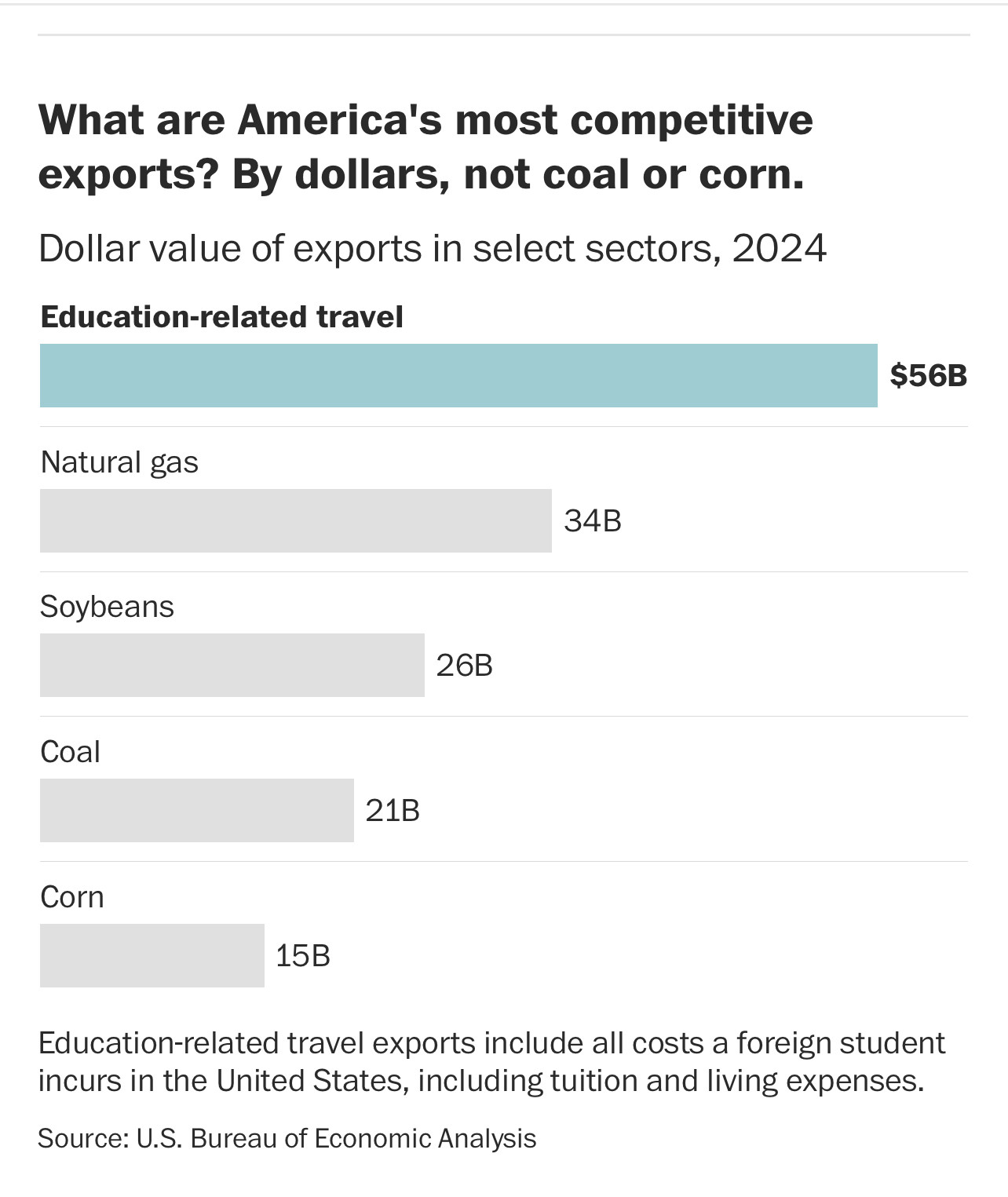
International students are a major component of American universities' financial health—and for that matter, the economic health of the nation as a whole

What are America's most competitive exports? By dollars, not coal or corn.Dollar value of exports in select sectors, 2024Education-related travelTrump is killing one of our strongest exportsThe president wants to balance U.S. trade deficits? He can’t do it without this industry he hates.Colleges and universities are among America’s most competitive international exporters. In dollar terms, last year, the United States sold more educational services to the rest of the world than it sold in natural gas and coal combined.

The ability to attract the best students from around the world gives the United States a major competitive advantage. But such students are subject to strict visa rules, even ignoring Trump's legally bankrupt claim that he can deport anyone at anytime for any reason.

Trump has attempted to deport thousands of non-citizen students since taking office. In some cases, it has been for overtly political reasons—for example, a Turkish student who remains in ICE custody for the "offense" of co-signing a letter to her school paper encouraging its administration to take anti-genocide protests seriously. But most of his attempted student deportations have come from the results of criminal background checks run against the SEVIS database which tracks international students.

The problem, as dozens of court orders since have noted, is that the "hits" on such background checks were frequently for incidents in which no crimes whatsoever were committed or even suspected. Students have found themselves at risk of deportation for minor traffic offenses or being involved in non-criminal academic governance proceedings.

Today, after losing virtually every decision in nearly a hundred separate lawsuits seeking protective orders, the Trump administration quietly rescinded the deportation orders for an unknown number of students, suspected to be in the thousands.

The announcement did not say how the erroneous results were generated—and the Trump administration has provided no explanation, even to universities. But a leading theory is that they applied the now infamous "DOGE methodology" of running deliberately naïve database queries that generated spurious results, immediately on a predetermined course of action, and then claiming "administrative error" after being caught. This has led to any number of absurd and at times catastrophic mistakes, ranging from firing employees responsible for securing the nation's nuclear weapon stockpile, to disappearing people living legally in the United States under protective court orders, to freezing billions of dollars in grants for medical research, to (deliberately) declaring living people dead in Social Security records.

Why does this matter?

  • An administration that makes this many "errors" is too incompetent to govern.
  • Deporting students who bring enormous amounts of money and value to the American educational system for speeding tickets or attending protests would be absurd even if it were intentional.
  • Thinking that this population of immigrants is somehow a threat to the United States is a shamefully un-American level of cowardice.

Thursday, March 20, 2025

What did Donald Trump do today?

He failed in an attempt to give Elon Musk unfiltered access to the most sensitive information the government collects about its citizens.

A federal judge today blocked the Trump administration's attempts to allow his political patron, Elon Musk, to continue to access the most sensitive data that the United States collects on anyone with a Social Security number. Musk has made blatantly false claims about supposed fraud in how Social Security payments are made, apparently in an attempt to justify getting access to its "crown jewel" databases. 

Had that access been granted, Musk would have been able to personally review information about effectively any and every person living or working in the United States, including
  • medical history
  • mental health treatment records
  • bank account data, including account numbers
  • work history
  • marriage and divorce records
  • tax records
  • lifetime address information
Unfettered access to this data, especially without any independent oversight by career government officials not reporting directly to Musk, represents a massive security risk. As with many other government systems that Musk has sought access to, the best case scenario is that he would gain a massive advantage for his private businesses over their competitors for the government contracts and subsidies.

A far more dangerous situation is that, accidentally or otherwise, Americans' most sensitive personal data could fall into the hands of hostile foreign governments. The source of most of Musk's wealth, his stock in Tesla, is highly dependent on maintaining the goodwill of the Chinese government. (Separately, the New York Times is reporting tonight that Trump plans to give Musk direct access to the United States' most secret military plans regarding China.)

In a 137-page ruling, Judge Ellen Lipton Hollander summarized the situation this way:

The DOGE Team is essentially engaged in a fishing expedition at SSA, in search of a fraud epidemic, based on little more than suspicion.  It has launched a search for the proverbial needle in the haystack, without any concrete knowledge that the needle is actually in the haystack. 

To facilitate the expedition, SSA provided members of the SSA DOGE Team with unbridled access to the personal and private data of millions of Americans, including but not limited to Social Security numbers, medical records, mental health records, hospitalization records, drivers’ license numbers, bank and credit card information, tax information, income history, work history, birth and marriage certificates, and home and work addresses.  

Yet, defendants, with so called experts on the DOGE Team, never identified or articulated even a single reason for which the DOGE Team needs unlimited access to SSA’s entire record systems, thereby exposing personal, confidential, sensitive, and private information that millions of Americans entrusted to their government.  Indeed, the government has not even attempted to explain why a more tailored, measured, titrated approach is not suitable to the task.  Instead, the government simply repeats its incantation of a need to modernize the system and uncover fraud.  Its method of doing so is tantamount to hitting a fly with a sledgehammer.  

As the judge noted in her ruling, there are situations where Musk is extremely concerned about privacy—specifically, in keeping the identities of the people drafted onto the DOGE team secret and unaccountable to the public. Journalists who figured out some of their names and reported on them faced immediate threats from Trump's Justice Department. That reporting on DOGE employees unearthed racist and misogynist posts on social media, lack of technical skills, security risks, and—in at least one case—someone being fired from a private sector job for leaking secret information.

Why does this matter?

  • Unelected political donors shouldn't be able to buy access to Americans' most private and sensitive information.
  • If this exact thing were happening without the compliance of the President of the United States, it would be the biggest cybercrime in history.
  • This doesn't look like the kind of thing any president would permit a subordinate to do, if he were able to stop it.

Monday, February 10, 2025

What did Donald Trump do today?

He said, via a surrogate, that he wants Americans to feel they can't afford to buy the things they want.

In an interview this morning on CNBC, White House economic advisor Kevin Hassett said that Trump's plan to fight inflation was to "increase supply [of labor] and reduce aggregate demand."

There are a few things to note here. First, Trump is beginning his term having inherited very low inflation, in spite of his campaign claims that inflation was out of control. His trade policies are inflationary—Americans will spend more money for foreign goods once Trump's taxes are added in to the price—but for the moment there isn't really very much excess inflation to fight.

Hassett said that Trump's plan to "increase the supply of labor" would come by slashing the payroll taxes that pay for Social Security. This would save money for employers and theoretically encourage them to hire more workers—although they could also simply take it as profit. Trump has claimed, falsely, that Social Security is insolvent—but shutting down the money it takes in from existing workers really would mean that it would go bust in the near term. 

"Reducing aggregate demand" for goods and services is even harder to sugar-coat. Virtually by definition, that means deliberately causing a recession. This really would lower inflation—prices come down when fewer people can afford what they need. 

Large companies tend to do relatively well during recessions, as they have the resources to weather it, and to buy up smaller competitors who can't. The same is true for wealthy individuals. But for the vast majority of Americans, "reducing aggregate demand" would mean trading a situation where they can buy the goods and services they want at 3% inflation for one where they didn't have the money they needed at 2% inflation.

Hassett did not elaborate on why Trump thought businesses would increase hiring while demand for their goods dropped.

Why does this matter?

  • "Let's intentionally cause a recession" is a Bond villain plan, not what a president should be saying.
  • The government should focus on fixing problems that exist rather than ones that don't.

Sunday, September 22, 2019

What did Donald Trump do today?

He reminded Indian-American voters that he'd never treat them the way he treats the undocumented workers at his golf courses.

Trump appeared today at an event celebrating the Indian diaspora with its guest of honor, Indian prime minister Narendra Modi. Trump was in campaign mode, trying to appeal to an audience that included many American citizens of Indian descent—one of the few relatively large racial minorities in the country that he hasn't directly insulted while in office. 

His speech included most of the usual false and debunked talking points that Trump gives at rallies. Trump made a special point of contrasting Indian-Americans with "illegals" who he said were "pouring into our country" for free health care.

In reality, most undocumented workers who are illegally hired in the United States pay taxes and into Social Security and already cannot receive most public benefits. For example, this would include the dozens of undocumented workers hired by just one of Trump's luxury golf resorts. Trump businesses have only just now started using the government E-Verify system, after the sheer size of their illegally hired workforce started coming to light. Not using the E-Verify makes it easier to hire workers with fake credentials—and hiring workers that a company knows are undocumented makes it easier to steal wages from them, as Trump's businesses have.

It's hard to say if any Indian-American voters in the crowd were impressed by his bashing of other immigrant populations, but Trump had almost nothing to lose with them: he only won about 16% of their votes in 2016.

Why should I care about this?

  • Praising one racial minority doesn't make it okay to attack another.
  • If undocumented workers are such a problem, Trump could always make sure his businesses stop hiring them.

Monday, March 11, 2019

What did Donald Trump do today?

He proposed to cut Medicare, Medicaid, and Social Security.

Trump's official 2020 budget proposal, released today, calls for $845 billion in cuts to Medicare. Trump is also proposing $241 billion in cuts to Medicaid, and $26 billion from Social Security.

There's nothing inherently wrong with proposing such cuts, which have no chance of becoming law, regardless of which party controls Congress. But Trump distinguished himself from other Republicans during the primary by accusing them of wanting to cut those programs, while swearing that he himself never would. 

For example, in a May 2015 interview with a conservative website, Trump said, "I’m not going to cut Social Security like every other Republican, and I’m not going to cut Medicare or Medicaid."

A few days later, he gave a speech in which he made the same claim—and then quoted himself in a tweet.


He said the same thing in his formal campaign announcement the following month: "Save Medicare, Medicaid and Social Security without cuts. Have to do it."

In 2017, the Washington Post put together a video compilation that captured some, but not all, of Trump's subsequent promises to leave those entitlement programs untouched.


Trump subsequently accused Hillary Clinton of attending a "secret Wall Street meeting" where she "admitted that she wants to cut Medicare and Social Security." (This was a lie.) He also said that Democrats running in the 2018 midterm elections "want to destroy Medicare."

Why does this matter?

  • People who heard Trump promise not to cut Medicare, Medicaid, and Social Security may have thought he wouldn't try to cut Medicare, Medicaid, and Social Security.
  • Accusing other people of wanting to do the things you are doing doesn't change the fact that you are doing them.

Tuesday, May 23, 2017

What did Donald Trump do today?

He explained that his promise not to cut Social Security and Medicaid did not mean he wouldn't cut Social Security and Medicaid.

Trump released another budget plan today, consistent in its overall extreme austerity (except for defense spending) with the previous attempt that went ignored by Congress. In his inaugural campaign speech in 2015, Trump promised to "save Medicare, Medicaid and Social Security without cuts." But his current proposal would slash the Social Security Disability Insurance program by 28%. About 10,000,000 Americans currently receive disability assistance through the program. Asked to explain this discrepancy, Budget Director Mick Mulvaney claimed that the Social Security Disability Insurance program was not really a part of Social Security.

It really is.

Candidate Trump also promised not to cut Medicaid, but his budget today calls for $600 billion in cuts to the program (on top of an estimated $839 billion in cuts built into his health care bill). Roughly one-quarter of Americans are enrolled in Medicaid and would be affected by those cuts. Mulvaney explained that Trump's promise not to cut Medicaid had been "overridden" by his promise to repeal the Affordable Care Act.

So what?

  • Voters who heard Trump promise not to cut Social Security and Medicaid may have believed that he was not planning to cut Social Security and Medicaid.
  • Breaking a promise you didn't intend to keep isn't excused by making a conflicting promise you can't keep.