Showing posts with label Robert F. Kennedy Jr.. Show all posts

Tuesday, July 21, 2026

What did Donald Trump do today?

He used illegal Medicaid cuts to punish his political opponents in two blue states.

The Trump administration announced today that it was "pausing" Medicaid disbursements to Minnesota and California, over supposed fraud. The governors of each of those states are both political rivals to Trump: Gavin Newsom of California is a likely Democratic presidential candidate in 2028, and Minnesota's Tim Walz was the Democratic vice-presidential nominee in 2024.

Trump has made this threat before: in February, he said he'd withhold $259 million from Minnesota. He never carried it out, though. Courts have stopped Trump from politically motivated interference with healthcare programs before. In spite of the attention that Trump's HHS officials—former lawyer Robert F. Kennedy Jr. and daytime talk show host Mehmet Oz—tried to bring to the move today, it's not clear that any money has been withheld yet.

There is Medicare fraud in Minnesota and California—and in every other state, and probably almost every individual county. Committing fraud against the government for these kinds of programs is easy, but getting away with it is more difficult—as Trump, whose business was convicted of defrauding the State of New York, is well aware. (That is not to be confused with Trump's criminal conviction on 34 felony charges, which dealt with different matters.) Even if he didn't have personal experience with it, Trump has pardoned many wealthy and politically connected Medicare and Medicaid fraudsters, who collectively stole billions of dollars.

Regardless, Trump has no authority to withhold Medicaid funding for any state, or impose conditions on its release outside of what the law permits. Doing so violates Congress's constitutionally granted control over appropriation, as well as the 1974 Impoundment Control Act.

Trump has made little secret of his intention to punish states that don't support him politically at the federal level—even though, to use California as an example, that means punishing millions of people who voted for him. He's also effectively stopped approving disaster relief for blue states in his second term.

 Presidential approval rates for disaster requests from Democratic-led states and Republican-led states

Why does this matter?

  • Cutting off basic government services to punish areas the leader thinks aren't sufficiently loyal to him is what dictators do. 
  • It's beyond evil to punish poor children by withholding medical care to score political points against Americans who politically oppose you. 
  • Presidents who care about fraud generally commit less of it.

Saturday, April 18, 2026

What did Donald Trump do today?

He let a comedy podcaster write prescription drug rules for the FDA.

Trump spent a rare Saturday in the White House today, with only one event on his schedule: he signed an executive order speeding up review of two psychedelic drugs. He did this at the behest of podcaster Joe Rogan (who shares with Trump the distinction of having hosted a reality game show on NBC) and his Secretary of Health and Human Services, Robert Kennedy Jr.  Perhaps even more influential for Trump, right-wing tech billionaire and Trump patron Peter Thiel has also advocated for the legalization and commercialization of these drugs, and owns a company that will profit if they are made legal for prescription.

Trump signs psychedelic drug executive order with Joe Rogan 

Trump's remarks made clear that he was skipping past the normal scientific procedures for assessment and study as a favor to Rogan personally, who let Trump use his popular platform late in the election to reach young male voters. As Rogan described it, he sent Trump a text message mentioning the possibility, and Trump responded with "Sounds great. Do you want FDA approval? Let's do it."

By the standards of some medical theories Trump has advanced, ibogaine and psilocybin are probably relatively harmless. Taking controlled, small amounts of psilocybin (the active ingredient in hallucinogenic mushrooms) under medical supervision is absolutely safer than injecting bleach or household cleaners, which Trump famously mused aloud about as a potential COVID-19 cure during a press conference. And ibogaine, while known to have certain dangerous side effects, is safer on balance than taking massive doses of the veterinary antiparasitic drug Ivermectin, which Trump also touted as a cure for COVID. (Some Americans followed his "advice" and suffered serious illnesses or death as a result.)

Kennedy, for his part, has used his tenure as HHS head to slash funding for cancer research, and medical research in general. He's an advocate for several discredited and unscientific health practices, including fad diets and using over-the-counter medicines to treat serious infectious diseases. He's expressed skepticism about the basic germ theory of disease, campaigned against vaccinations, and in one case personally sparked a fatal measles epidemic. A recovering heroin addict, Kennedy's mental health and cognitive stability have been called into question almost as much as Trump's, most notably by his own family. He's most recently been in the news amid fresh reports of his bizarre habit of picking up roadkill for later study or consumption: Kennedy has, by his own admission, made off with the carcasses of bears, whales, and—as revealed this week—a raccoon's penis.

For the most part, because most data comes from reports of recreational use, the effects of ibogaine and psilocybin aren't well understood—including how severe the established negative effects and toxicity are. Under normal circumstances, the FDA would grant permission for small-scale lab studies, then escalate to a larger scale if the evidence pointed to a clear and statistically meaningful benefit that outweighed any risks that were discovered. Final approval for use as legally prescribed medicines would come after a series of carefully designed clinical trials in human patients, with specific safeguards built in based on earlier data. 

Trump's order, done on the say-so of a podcaster, short-circuits that process and orders the FDA to jump in blind.

Why does this matter?

  • Decisions about how the United States government helps Americans get and stay healthy shouldn't come from comedy podcasters the president owes a favor to. 

Sunday, November 2, 2025

What did Donald Trump do today?

He rushed to help exactly one American, a wealthy political supporter, get the health care they needed.

Scott Adams, the conservative culture warrior and creator of the comic strip Dilbert, announced earlier this year that he has been diagnosed with aggressive prostate cancer and is not expected to live long. Adams, who recently said that Black Americans were a "hate group" and that whites should "get the hell away" from them, has been a vocal Trump supporter since 2015. 

That relationship may be why Adams publicly begged Trump to intervene in what he described as the botched administration of a last-chance drug that might extend his life. It is also probably why Trump immediately responded, via HHS Secretary Robert F. Kennedy Jr., who told Adams that Trump "wants to help" and would be contacting him.


Where less well-connected Americans are concerned, Trump and Kennedy have slashed funding for cancer research, and medical research in general. Adams, whose net worth is estimated to be in the tens of millions of dollars, probably isn't having financial issues related to his treatment, but 45 million Americans are facing sharp increases in health care premiums due to Trump's refusal to fund ACA subsidies.

Adams described his problem as a logistical issue, not a question of money or access. But this wouldn't be the first time Trump has pulled strings to get someone access to medicines other people can't have: he did it for himself when he nearly died of COVID-19 in 2020. Clinical trials often make exceptions for patients who are truly without hope, but in the case of the brand-new experimental monoclonal antibody therapy Trump helped himself to, it did mean he took a dose that would have gone to someone else. About 60,000 Americans died of COVID before that therapy became available to the general public.

Pluvicto, the drug Adams is seeking access to, was developed at Purdue University from research funded by the National Cancer Institute. Trump's budget, passed this summer, cut the NCI's budget by almost 40%.

Why does this matter?

  • Americans have a right to health care whether or not they're wealthy campaign surrogates for the current president. 
  • There's cronyism, and then there's picking one person out of tens of millions to have the government help.

Monday, September 22, 2025

What did Donald Trump do today?

He regurgitated a mess of conspiracy theories about vaccines, autism, and Tylenol.

In a rambling press appearance today with Robert Kennedy Jr., Trump made a number of dangerous and medically illiterate claims about vaccines, autism, and the over-the-counter pain medicine Tylenol, based on his "feelings" and—to all appearances—conspiracy theories of the kind that Kennedy believes.

Trump appears to have swallowed the totally unfounded theory that Tylenol use during pregnancy, also known as acetaminophen, is connected to autism. Kennedy, who is more or less open in his embrace of eugenics and seems to regard people on the autism spectrum with a mixture of pity and contempt, has seized on this drug that almost every American has taken at one time as the root cause of the fantastically complex range of behaviors that fall under the autism spectrum. In reality, there is no known cause of autism spectrum disorders, and there is almost certainly no one cause.

Trump, who struggled to pronounce the word "acetaminophen" and seemed to be seeing it for the first time as he read it from a notecard, nevertheless felt confident telling pregnant women that "taking Tylenol is, uh, not good." It's not clear if Trump knows that acetaminophen is the one of the only over-the-counter pain medicine that is approved for use during pregnancy: actual studies have shown that it is much safer for developing fetuses than naproxen sodium (Aleve) and aspirin, which have been linked to lower birth weights (though not to autism). But he did seem to believe that pain is just something that pregnant women should just have to endure: "If you can't tough it out, if you can't do it—that's what you're gonna have to do."

Medical organizations all over the world immediately denounced Trump's statements

He also listed his objection to the current vaccine schedule for infants: that "eighty" shots are given at once, or perhaps eighty vaccines in one shot—it wasn't clear. In his own words:

I think it has—I think it's very bad. They're pumping, it looks like they're pumping into a horse. You have a little child, a little fragile child, and you get a, a vat of 80 different vaccines, I guess. 80 different blends. And they pump it in. Uh, so ideally, a woman won't take Tylenol, and uh, on the vaccines, it would be good, instead of one visit where they pump the baby, you load it up with stuff, uh, you do it over a period of four times or five times.

Trump seemed mostly to be talking about the MMR vaccine, which protects against measles, mumps and rubella (although Trump seemed unable to remember what the R stood for). All three can cause death or serious lifelong complications in children. This is what an infant getting vaccinated actually looks like:

There's a particularly strong whiff of hypocrisy for Trump on the issue of what drugs people should be allowed to take at what stage of clinical certainty. He nearly died of COVID-19 in early October 2020. It's very likely that what saved his life was a highly experimental therapy called a monoclonal antibody cocktail—one that had barely begun human trials, and that he was able to receive only because he effectively gave himself special permission: the FDA, which answered to Trump, has to approve each such exception. He also had close personal and financial ties to the CEO of the drug company that made the treatment. 

Monoclonal antibodies have since been shown to be highly effective in treating COVID-19, but the ones Trump received were not available to the public on a temporary, emergency basis until several months later. About 60,000 Americans died of COVID-19 in the intervening period. The therapies that Trump recommended for people who didn't have special access to experimental drugs, at an eerily similar press conference in April 2020, were the antimalaria drug chloroquinine and the injection of household cleaning products.

Why does this matter?

  • Past a certain point, it doesn't matter if Trump actually believes Kennedy's anti-scientific conspiracy theories, or just doesn't care if they become policy. 

Monday, September 1, 2025

What did Donald Trump do today?

He said vaccine-makers were conspiring to cover up how good their vaccines are.

Today, Trump (or someone posting on his behalf) appeared to be trying to lay the groundwork to walk back some of the most extreme decisions made using his authority as President by his Secretary of Health and Human Services, Robert Kennedy. In a post to his private microblogging service, Trump said this:

It is very important that the Drug Companies justify the success of their various Covid Drugs. Many people think they are a miracle that saved Millions of lives. Others disagree! With CDC being ripped apart over this question, I want the answer, and I want it NOW. I have been shown information from Pfizer, and others, that is extraordinary, but they never seem to show those results to the public. Why not??? They go off to the next "hunt" and let everyone rip themselves apart, including Bobby Kennedy Jr. and CDC, trying to figure out the success or failure of the Drug Companies Covid work. They show me GREAT numbers and results, but they don't seem to be showing them to many others. I want them to show them NOW, to CDC and the public, and clear up this MESS, one way or the other!!! I hope OPERATION WARP SPEED was as "BRILLIANT" as many say it was. If not, we all want to know about it, and why???  

There's a lot to unpack here. First, Trump appears to mean vaccines, not drugs—although he has, famously, gotten those two very different kinds of things confused in the past. 

There is no secret data that pharmaceutical companies are hiding from the public that show their vaccines work. That means that Trump is either lying or confused when he says he's being shown "GREAT numbers and results" that aren't being shared with the public or the CDC. In reality, every clinical trial of the COVID vaccines has shown results so striking that it's impossible to interpret them as anything other than dramatically increasing individuals' immunity to the virus. The answer Trump wants "NOW" has been available to him and everyone else since December of 2020:

A graph comparing COVID incidence after the Pfizer vaccine compared to placebo
Graph showing results of a large-scale clinical trial of the first mRNA COVID-19 vaccine, published in the New England Journal of Medicine, Dec. 31, 2020. The blue plots (trending sharply upward) show cumulative COVID infections in a group that received a placebo injection, and the red plots (almost flat) show cumulative cases in patients who received the actual vaccine.

Trump is correct that the CDC is in crisis. Most of its senior leadership has been fired by him, or quit in protest. In a scene straight out of the history of science in the Soviet Union, research scientists working for the CDC must submit their findings for political approval by Kennedy before they can be published. Trump has repeatedly tried to slash its budget, to the point that Congressional Republicans actually pushed back in his budget bill—after which he then simply withheld legitimately appropriated money anyway in order to force layoffs of public health workers.

 In August, a deranged man who believed in the same conspiracy theories about vaccines that Kennedy does fired 500 bullets into its headquarters, killing a police officer. When that happened, the Trump White House had virtually no reaction other than to criticize the agency again, making CDC employees worry that it would encourage more attacks.

Kennedy, who was calling himself a liberal as early as last year, is the HHS Secretary because of a political bargain he made to throw his support to Trump. It's never been entirely clear if Trump has ever managed to understand how much Kennedy hated "Operation Warp Speed," the push to find a COVID vaccine that is the one domestic program that actually succeeded on Trump's watch. 

If he did, it's not clear why Trump didn't simply force Kennedy to stop undermining that one accomplishment—except that this wouldn't be the first time in Trump's second term that he's seemed unable to muster the energy to rein in subordinates to whom he's delegated the authority of the presidency.

Why does this matter?

  • Presidents are responsible for the people they appoint, and that's especially true when their appointees are especially incompetent. 
  • Regardless of why Trump is apparently so confused, the health and safety of the American people requires a president who is not confused. 

Thursday, August 28, 2025

What did Donald Trump do today?

He named a very on-brand appointee to run the CDC and provoked a massive staff walkout.

A White House spokesperson said today that the Centers for Disease Control would be run by Jim O'Neill, a former speechwriter and venture capitalist. O'Neill's most notable contribution to public health has been his insistence that allowing people to sell their organs would improve health care.

Today, at the CDC campus in Atlanta, hundreds of staff walked out of the building and cheered for Monarez and three other senior officials who resigned in protest over her firing.

CDC staff protest Trump’s firing of agency’s director
Dr. Deb Houry, who resigned as Deputy Director of the CDC, receives flowers from a crowd of staffers


Robert Kennedy Jr., who Trump appointed as Secretary of Health and Human Services as part of a political endorsement bargain made during the 2024 campaign, faced calls for his resignation. Yesterday, he told a crowd that children today suffer from "mitochondrial challenges," saying that he could diagnose "inflammation" and "lack of social connection" in children by examining their faces. Kennedy is a former talk show host and recovering heroin addict whose adoption of fad diets led to at least two different neurological diseases that, by his own admission. caused cognitive problems. He has no medical background.

More than a day after the CDC's social media claimed that Trump had fired Monarez, it remained unclear that Trump had actually taken the legal steps necessary to do so. Her lawyers said today they were "not aware" of any changes to her status, which only Trump himself can change.

Trump himself has not made any public appearances since Tuesday's Cabinet meeting, although staff claimed he signed some executive orders today—something he normally enjoys doing in front of an audience, especially when the subject is something he enjoys talking about. (Today's order concerned the decoration of federal buildings, something he's been positively obsessed with since his second term began.) 

By contrast, Vice-President JD Vance has been visible, mentioning in the course of an interview that he feels able to take over the presidency should the need arise.

Why does this matter?

  • Americans' health and well-being is way too important to leave to an incompetent crank, or anyone willing to rubber-stamp what an incompetent crank wants to do.

Wednesday, August 27, 2025

What did Donald Trump do today?

He tried and failed to quietly fire his CDC Director for not going along with his administration's attack on the COVID-19 vaccine.

For a man whose game show catchphrase was "you're fired," Trump is quite squeamish about actually firing people, and has gone to extraordinary lengths to avoid having to do it himself. He prefers to act through intermediaries or via social media—even when the person in question works in the same building as him. In his second term, at least where his inner circle is concerned, he's all but abandoned the concept, preferring instead to "promote" staff who offend or underperform in some way to diplomatic jobs.

With regular federal employees—the ones with no personal connection to Trump—it's a different story. Trump has fired hundreds of thousands of workers, including many he had no legal right to fire, forcing them to take legal action just to be temporarily reinstated. The full scope of Trump's decimation of the federal workforce is becoming clear: just shy of 200,000 government employees have lost their jobs, with another 100,000 expected this year. 

The damage done by those firings is far greater than the immediate loss of the workers' livelihoods. The job market itself has virtually shut down over the last few months, and unemployed former government workers are now competing with new entrants to what's left of the private sector market. Meanwhile, federal agencies are unable to staff critical positions because skilled workers are resigning too, either out of fear for the uncertainty of working under Trump or disgust at his treatment of workers.

All of these tendencies were on display today, as Trump unofficially and indirectly fired the head of the CDC, Dr. Susan Monarez—the person he'd appointed to the role just weeks ago. But while the firing was announced on the CDC's own social media site, as of late this evening, it had not actually been done, apparently in the hope that Monarez would resign of her own accord. 

Through her attorneys, Monarez posted this response to Trump's attempts to get her to fall on her sword:

Throughout the day, both CDC and White House spokespeople insisted that Monarez had been fired, but Trump himself must order it done, and whether through inability or unwillingness, he had not yet made any such order as of midnight Thursday.

Meanwhile, three other senior CDC officials resigned in protest tonight. Like Monarez, they cited the dangerous and anti-scientific orders from HHS Secretary Robert F. Kennedy Jr., who today announced restrictions on who would be eligible to receive this winter's updated COVID-19 vaccine. Kennedy, a former talk show host and lawyer with no experience in health care, is a vaccine conspiracy theorist. The officials who resigned cited Kennedy's censorship of medical research to fit his personal political agenda, his purging of scientists who wouldn't promise to issue the findings he wanted, and the Trump administration's belief in the discredited science of eugenics.

Under today's orders, which appear to have set off the firings and resignations, Americans will no longer be able to simply choose to receive a vaccine at a convenient location like a pharmacy. Instead, they s will have to schedule a visit with their doctor first. This will add expense and inconvenience even for those whose access to health care won't be affected by Medicaid cuts in Trump's budget bill

Studies vary, but the COVID-19 vaccine is generally credited with saving 20,000,000 lives worldwide in its first year of availability alone.  

Full text of the resignation letters

Why does this matter?

  • Americans' health and safety literally depends on letting competent public health officials do their jobs.  

Thursday, May 8, 2025

What did Donald Trump do today?

He nominated a conspiracy theorist for Surgeon General and then said he didn't know much about her.

Yesterday, Trump announced that Casey Means, a self-described "wellness influencer" with a lapsed medical license, was his latest nominee for Surgeon General of the United States. 

Today, he had this to say about his decision-making process:

REPORTER: You just announced a new nominee for the US Surgeon General who never finished her residency, and is not a practicing physician. So can you explain why you picked her to be America's top doctor?  

TRUMP: Because Bobby thought she was fantastic, she's highly, uh, she's a brilliant woman who went through, uh, Stanford and as I understand it she basically wanted to do—she wanted to be an academic as opposed to a surgeon. Uh, I think she graduated first in her class at Stanford. And, uh, Bobby really thought she was great. I don't know her, I listened to the recommendation of Bobby, I met her, uh, yesterday, and once before, she's, uh, a very outstanding person. She's a great academic, actually. So I think she'll be great.

"Bobby" is Robert F. Kennedy Jr., who struck a deal with Trump to drop out of the race in exchange for being made Secretary of Health and Human Services. 

There's no evidence that Means was "first in her class" because Stanford's medical school doesn't rank students like that. What is known is that she finished her medical school classes, then failed to complete the residency that is effectively required to practice medicine. Means apparently pursued an alternative licensing route—the information released by the White House does not elaborate—but she is not currently licensed to practice medicine.

Means describes herself as a "wellness influencer"—possibly because describing herself as a doctor would be legally dicey. "Wellness" can mean many things that are known to be good for health, like exercise, mental health care, or a balanced diet. But it's also favored by "influencers" with expensive products or "educational" seminars to sell, or who use promises of better health to advance political agendas. Means shares Kennedy's anti-vaccine stance and subscribes to a number of unscientific or unproven theories, including disproven conspiracy theories about autism and birth control. 

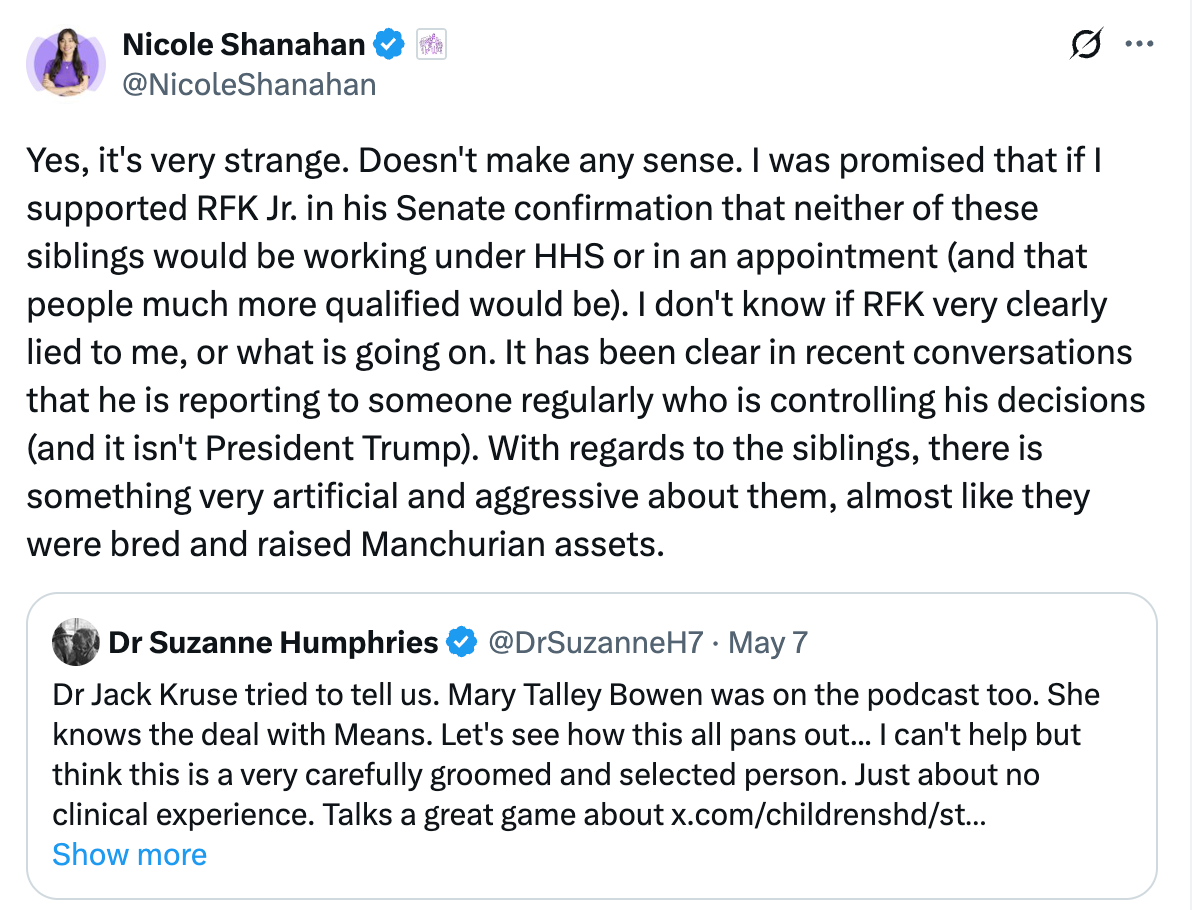
Among those who openly suspect Means of being a con artist in medical drag is Kennedy's former running mate, Nicole Shanahan, who reacted with horror to the news. Shanahan noted that she'd made Kennedy promise that Means, specifically, would never be given an appointment.

Nicole Shanahan criticizes RFK Jr. on Twitter, questioning his independence and suggesting he's influenced by powerful individuals behind the scenes


This is the third day in a row that Trump has said he doesn't really know much about he did something, or let something be done on his authority.

Why does this matter?

  • "Someone told me to" isn't a good enough reason for a president to make appointments, much less one this important.
  • Americans' health is more important than paying off Donald Trump's political debts. 

Friday, March 28, 2025

What did Donald Trump do today?

He forced out the federal government's top remaining vaccine official.

Dr. Peter Marks, who played a substantial role in developing the COVID-19 vaccine, was forced out by the Trump administration today. In his resignation letter, Marks said Trump's secretary of Health and Human Services, Robert Kennedy Jr., was backsliding on his confirmation hearing promises not to destroy what remains of the government's capacity to produce lifesaving vaccines.

Referencing Kennedy's beliefs about health and medicine, which are on the fringe even by the standards of most people who identify as "vaccine skeptics," Marks wrote: "It has become clear that truth and transparency are not desired by the Secretary, but rather he wishes subservient confirmation of his misinformation and lies."

Kennedy was appointed HHS Secretary by Trump as part of a political bargain in which Kennedy—whose few supporters were generally socially liberal—would throw his support behind the notionally conservative Trump.

In addition to his belief in an extreme version of anti-vaccine conspiracy, Kennedy also claims to believe:
  • that the COVID-19 virus was genetically engineered to spare Jews
  • that fluoridation of water is responsible for almost every form of human illness (the same belief that was parodied as an old-fashioned, paranoid delusion in the 1964 film Dr. Strangelove)
  • that pasteurized milk is unhealthy, but "raw" milk is not—in spite of countless outbreaks of salmonella, influenza, and other communicable diseases linked to it
  • that the best way to treat an outbreak of bird flu in livestock chickens—which can be deadly to humans—is to let it rage through the entire American poultry system, in the hopes that the offspring of the few surviving birds will be immune

In addition to other massive cuts to federal health programs, Trump is in the process of firing as many as 20,000 other HHS employees.

Like Trump, Kennedy is vaccinated against all the diseases he now claims to believe that other Americans should not be—as are his children.

Trump himself did not comment on Marks' firing. He continued to remain out of public view today after a series of events earlier in the week in which he appeared confused, forgetful, or ill-informed. As is typical for Trump, he ended his workweek early this morning and will spend a  long weekend at his Florida compound.

Why does this matter?

  • Presidents are responsible for the policies they let their staff implement.
  • The overwhelming majority of Americans support vaccine research and expect the government to actually do things to combat infectious disease.

Tuesday, December 31, 2024

What did Donald Trump do today?

He warned that Senate Democrats would use "all sorts of tricks" against his nominees, like holding confirmation hearings.

Today, Trump posted on his private social media site that

"We just won a Historic Landslide and Mandate from the American People, but Senate Democrats are organizing to improperly stall and delay the confirmation process of many of our Great Nominees. They will try all sorts of tricks starting very soon. Republicans must not allow them to do that."

Trump once called his penchant for making things up and daring anybody to correct him "truthful hyperbole," but even by that standard, he did not win in a landslide. He received less than 50% of the popular vote, and beat Vice-President Kamala Harris by 1.5%.

The "trick" Trump apparently fears is that Senate Democrats will hold confirmation hearings on nominees who must be confirmed by the Senate. That is why he has demanded that his own party, which will control both houses of Congress in the coming year, shut down Congress entirely so that they can be appointed via a Constitutional provision known as a recess appointment. That would enable them to serve for the rest of the Congressional term without anyone asking questions about their fitness.

Even with a Republican majority in the Senate, Trump has good reason to be afraid of public hearings into many of his nominees. Many of them are billionaires, some have no apparent qualifications for the job Trump assigned to them, and some are struggling to receive even token support from within Trump's own party. For example, Trump's choice to lead the Department of Defense, Pete Hegseth, has done little to refute allegations—including those leveled by his own mother—that he is an untreated alcoholic with a history of sexual violence against women.

Trump may also be particularly worried about the embarrassment of seeing his choice for Secretary of Health and Human Services, Robert F. Kennedy Jr., face questions from Americans' representatives in the Senate. Kennedy, who would be in charge of the United States' public health programs, is a conspiracy theorist whose only connection to dealing with disease outbreaks is helping to cause one. Kennedy threw his support to Trump late in the race after supporters started abandoning him after a series of increasingly bizarre or horrifying stories about committing sexual abuse, conducting a sexting-affair with a reporter covering him during the campaign, saying that COVID-19 was a bioweapon that deliberately spared Jews, contracting a parasite that literally ate part of his brain, and rehashing too many discredited "alternative" health theories to list.

Why does this matter?

  • People who can't stand a few minutes' worth of scrutiny by the American public probably shouldn't be put in charge of the American government.
  • No matter how much they believe otherwise, presidents are not kings, and they can't banish their opposition.