Saturday, February 28, 2026

What did Donald Trump do today?

He attacked Iran without a plan, public support, or the legal authority to do so.

Early this morning, Florida time, Trump ordered a series of attacks against Iran and its leadership. Almost a full day later, the situation is unclear, although Iran has confirmed that the strikes killed the de facto leader, Ayatollah Khamenei. Here is some of what is known.

Mar-a-Lago. Trump was photographed monitoring the attacks at his luxury resort in Florida. It's not clear how much of the operation Trump was cognizant of, or how long he stayed awake during the several hours in which the attacks took place. The national security apparatus was split between Mar-a-Lago and the White House Situation Room, but Trump's half was conducted in what was almost certainly an informationally insecure room: images released by the White House show Trump in an area of a large room cordoned off with drapes, not the electronically hardened walls of a SCIF. In what appears to have been an attempt to project confidence, Trump's White House also released images showing monitors with classified information on them that had not been obscured. 

Insider trading. Trump has put his full political weight behind so-called "prediction markets," legalized gambling sites that allow people to place bets on almost anything—including the exact timing of the attacks, which White House insiders would be in a position to know before the general public. Millions of dollars in winning bets now appear to have been insider trades placed by new accounts that were created and funded mere hours before the attacks began. Not only is that illegal, but it raises the possibility that Trump administration officials are making military decisions based on what will yield the most profit. 

This is not the first time that suspicious bets have been placed on actions taken by the Trump administration.

Timing and civilian deaths. Attacks of this nature are normally carried out at night in order to limit civilian casualties: fewer people out and about means fewer people in harm's way. But the attacks began at about 9:45 AM local time, and on a Saturday morning, which in Iran is more like a Monday morning would be for Americans in terms of civilians going to work and school.

That likely contributed to an apparent tragedy in the town of Minab, where local officials say that more than 100 children were killed when a missile hit a girls' school there, and there is independently confirmed video evidence supporting that claim. 

Where it was the middle of the night at the time of the attacks, and at the quietest part of the weekly news cycle, was the United States.

Khamenei already replaced. The government led by the Ayatollah Khameini had been facing substantial internal pressure from Iranian moderates angry at its mismanagement of a number of domestic crises. But, as Trump was warned would be the case, the attacks do not seem to have disrupted his faction's control over the nation. A caretaker government consisting of people loyal to Khameini's regime has already been announced by the Revolutionary Guard, and appears to be exercising power within Iran.

Trump seems to have hoped that the Khamenei regime's internal opponents would somehow seize control of the state apparatus. If Khamenei, who was 86, had died of natural causes, that might very well have happened. But Iran is a very large country—in both population and size, comparable to the entire east coast of the United States—and neither its military nor its bureaucracy are likely to radically shift allegiances, especially with Khamenei already being proclaimed a martyr. Even if they did, the Iranians that had been protesting against Khamenei are not inherently friendly to the West and are particularly unlikely to be sympathetic to any government led by Trump.

"Americans will die." Three independent sources within the Trump administration have confirmed to Zeteo that Trump was told that a likely outcome of this attack is the deaths of Americans, either as collateral damage in retaliatory attacks, or as military casualties in a war that grows beyond a one-sided barrage of missiles. These administration sources made clear that, when and if this happens, they expect Trump to plead ignorance and claim he wasn't told:

The two people familiar with the matter say that the gaming out of different scenarios included so many possibilities of how the regime in Tehran could kill American soldiers, potentially roil the global economy, or inflict other forms of damage, that many US officials did not mince words: It would be “very” likely, both sources say, that Americans would get killed days or weeks in, if Trump went ahead.

“It’s in a lot of [internal] documents, we also wrote it down a lot,” says one of the people briefed. If you are Trump, or Vice President JD Vance, or Secretary of Defense Pete Hegseth, or their colleagues, “you can’t really say you didn’t know,” this source adds. 

For his part, in a taped message to the American people that Trump released on his private microblogging site (rather than through official channels less subject to hacking), Trump made a casual reference to the possibility of American casualties, saying that "the lives of courageous American heroes may be lost." Trump, who dodged the Vietnam draft by getting a fraudulent doctor's note for a medical condition he's never shown any actual symptoms of, did not say under what circumstances he expected Americans to be killed, and his administration has given no indication that it knows what will come next in the conflict.

No legal authority. Presidents do not have any inherent legal authority to launch preemptive attacks on foreign countries. To do so requires either a declaration of war by Congress, or a Congressional resolution authorizing the use of military force. Trump has neither, nor would he have obtained one: there is strong bipartisan opposition in Congress to unprovoked hostilities with Iran. 

The American people are also deeply opposed, with shockingly few people supporting the attacks on the first day. Polling for military action is almost always at its highest at the very beginning, due to a "rally 'round the flag" effect, but Americans have seen Trump look for reasons to stir up conflict with Iran since he first took office, and are firmly hardened against it.

Why does this matter?

  • The lives of Americans in and out of the military are more important than Trump's political ambitions. 
  • The existence of a hostile authoritarian government does not give the President of the United States a free pass to commit atrocities of his own. 
  • Presidents are not kings and the armed forces of the United States are not their personal playthings.  

Friday, February 27, 2026

What did Donald Trump do today?

He asked if he could get the Supreme Court's first ever do-over.

Still fuming over the Supreme Court's decision to strike down the taxes Trump illegally imposed based on a "national emergency" only he could see, Trump posted a legal question to his private microblogging site today: 
 

The recent Decision of the United States Supreme Court concerning TARIFFS could allow for Hundreds of Billions of Dollars to be returned to Countries and Companies that have been “ripping off” the United States of America for many years to come, and now, according to this Decision, could actually continue to do so, at an even increased level. I am sure that the Supreme Court did not have this in mind! It doesn’t make sense that Countries and Companies that took advantage of us for decades, receiving Billions and Billions of Dollars that they should not have been allowed to receive, would now be entitled to an undeserved “windfall,” the likes of which the World has never seen before, as a result of this highly disappointing, to say the least, ruling. Is a Rehearing or Readjudication of this case possible???

No.

Losing parties in court can appeal verdicts to the Supreme Court, but after that they don't get to keep appealing until they get the verdict they want, because there is no higher authority than the Supreme Court on legal questions, including the president. The law and its interpretation change over time, but nobody—ever—gets to demand an immediate do-over just because.

Most Americans learn that much in elementary school, but there is a reason Trump might be confused. As a private citizen, Trump used the literally thousands of civil lawsuits he was a party to (as plaintiff or defendant) as a sort of bludgeoning tool, betting that he could drag out proceedings long enough that less wealthy opponents would be forced to settle on his terms. One judge even called him "the mastermind of strategic abuse of the judicial process."

Trump was notorious for this during his failed real estate career, suing contractors on a pretext to avoid having to pay workers for jobs they'd already completed. That tactic worked almost as well in criminal court: he was only convicted in one of his trials before his return to the presidency saved him from prosecution on other pending matters—at least for the moment. And even the 34 criminal counts that he was found guilty of by a jury yielded no actual sentence, for the same reason.

And, whether or not Trump really didn't know what a third-grader knows about how the Supreme Court works, he's using the same strategy with the tariffs case. Late today, his administration filed a motion with a lower court asking for a delay of at least four months before it had to begin answering requests for refunds of Trump's illegally collected taxes.

Why does this matter?

  • Presidents should have at least a middle-school understanding of how the legal system works. 

Thursday, February 26, 2026

What did Donald Trump do today?

He got manipulated in a way that might actually do some good for once.

Zohran Mamdani is the recently-elected Mayor of New York City. 

Zohran Mamdani - IMDb 

He's a young Ugandan-born naturalized citizen, a Muslim, and a Democratic Socialist. He ran squarely against Trump in the mayoral primary, attacking Trump's immigration policy as racist and inhumane, and holding campaign events with Trump Tower as a backdrop. Then, during the general election, he made his race against former Democrat-turned-independent Andrew Cuomo a referendum on who would be better able to protect New Yorkers from the threat that Trump posed. Mamdani's victory in that election, part of a shockingly strong performance by Democrats nationwide that evening, was understood by everyone as a direct rebuke to Trump by an electorate that was much larger, younger, and more politically diverse than any that the party had fielded against Trump in 2024. In Mamdani's victory speech, he took dead aim at Trump:

After all, if anyone can show a nation betrayed by Donald Trump how to defeat him, it is the city that gave rise to him. And if there is any way to terrify a despot, it is by dismantling the very conditions that allowed him to accumulate power.

This is not only how we stop Trump; it’s how we stop the next one. So, Donald Trump, since I know you’re watching, I have four words for you: Turn the volume up.

We will hold bad landlords to account because the Donald Trumps of our city have grown far too comfortable taking advantage of their tenants. We will put an end to the culture of corruption that has allowed billionaires like Trump to evade taxation and exploit tax breaks. We will stand alongside unions and expand labor protections because we know, just as Donald Trump does, that when working people have ironclad rights, the bosses who seek to extort them become very small indeed.

New York will remain a city of immigrants: a city built by immigrants, powered by immigrants and, as of tonight, led by an immigrant.

So hear me, President Trump, when I say this: to get to any of us, you will have to get through all of us.

Trump, for his part, called Mamdani a communist and made a toothless threat to revoke his citizenship. But a curious thing happened when the two men met in November: Trump was, by his own admission, charmed by Mamdani and left their meeting visibly eager for Mamdani's approval. Since then, Trump has seemed unable to bring himself to attack Mamdani the way he does almost any other politician (including other Republicans) who resist him in any way, or even fail to be sufficiently obsequious. Even in his grievance-laden speech to Congress on Tuesday, Trump couldn't help but admit that the "communist mayor" was a "nice guy."

Of course, Mamdani is hardly the first politician to realize how easy it is to sway Trump on a personal level. The role of chief "Trump whisperer" is something foreign politicians have competed fiercely for, because it amounts to having the President of the United States in your pocket. Last year, for example, Argentina's president Javier Milei used his personal knack with Trump to win a massive $40 billion bailout for Argentina, a lavish gift that made no economic sense for the United States, and which Milei promptly used to undercut Trump's trade war with China by selling them the soybeans that would normally come from American farmers. 

Even world leaders who famously lack that kind of personal charisma can win Trump over by modeling what he sees as "strength." Trump was deeply impressed by stories of North Korean leader Kim Jong-un murdering potential rivals by having them shot with enormous anti-aircraft guns, and quickly "fell in love" with the dictator. (Those are Trump's words.) 

Mamdani and Trump met again today, and where other politicians have brought thinly-disguised bribes with real monetary value, Mamdani brought a fake newspaper headline praising Trump for signing onto Mamdani's plan to build more affordable housing in New York. This is explicitly contrary to Trump's own announced plans to keep housing prices high so that homeowners can make profits on them when they sell. Trump was visibly delighted, and left having effectively endorsed the "communist" mayor's plan. (It's not clear from Trump's remarks today that he remembered his previous intentions.)

Mamdani also prevailed on Trump to order the immediate release of a Columbia University student, Elmina Aghayeva, who was seized in a legally dubious raid by ICE yesterday in which agents lied about a missing child to trick employees into letting them into her residence hall, where they could not legally go otherwise. Trump, who has gone to truly extraordinary lengths to evade any legal oversight of his deportation regime, and who has held other students on legal visas in detention for months at a time, immediately agreed without condition to have Aghayeva released.

Of course, releasing a person from jail who is not accused or suspected of any crime is not a bad thing to do, and neither is adopting a pro-housing policy for an expensive real estate market. Indeed, given how much more widely admired Mamdani is than Trump—even outside of New York City— Trump taking more cues from Mamdani would hardly hurt him. But the story in the political press today is not a sudden liberal turn for Trump, but whether he is really able to act objectively in the presence of other people seeking to manipulate him, foreign and domestic.

Why does this matter?

  • A president who does whatever a sufficiently charming person does is not emotionally stable enough to hold office.

Wednesday, February 25, 2026

What did Donald Trump do today?

He once again threatened to withhold medical care from poor children to punish the Americans he thinks are his enemies.

The day after Trump gave a long speech that left him visibly exhausted, the White House kept him out of public sight today. But the administration did send JD Vance and Mehmet Oz out to reiterate a threat Trump made last night. The two held a press event today promising to withhold $259 million in Medicaid funds to the state of Minnesota. That state's governor, Tim Walz, was Vance's opponent in the 2024 vice-presidential race. 

Minnesota is also home to the largest Somali-American communities in the nation, a group Trump has compared to animals and falsely accused of disloyalty. It's not clear how much of Trump's loathing of Americans of Somali descent comes from his personal racist beliefs and how much of it is political opportunism in the belief that other Americans can be convinced that those racist beliefs are true. Racist broadsides against immigrants were a major theme of his campaign and a sort of acid test for then-candidate Vance, who was given the job of spreading false rumors that Haitian-American immigrants in Ohio were stealing and eating household pets.

The link to Minnesota and Medicaid has its roots in a fraud investigation launched by the Walz administration before the election. Some of the targets were Somali-Americans, although most were not. That ultimately led to Walz suspending one grant program that had been a particular target for fraud, although legitimate claims were filled through other programs.

Medicaid, which is the federal government's main provider of health insurance for children and poor families, has no such alternative at the state level, meaning that Trump's threatened cuts will directly impact the ability of Minnesotans who have not committed fraud to receive necessary health care. 

There's no way to be sure whether Vance and Oz's delivery of Trump's threat will amount to anything in practice. He's made precisely this same threat before, to no real effect, because courts immediately put a stop to it. As a general rule, Trump has no legal power to punish Americans, especially Americans who are not themselves guilty of any crimes, by arbitrarily denying them government services—and certainly not as a means of political revenge against a state that doesn't vote for him.

Oz, who is Trump's Medicaid administrator, said that people who commit fraud against the program are "self-serving scoundrels." That's hard to disagree with. Among the people who have commited fraud against Medicaid and Medicare who have received pardons or commutations from Trump are:

  • Paul Walczak of Florida, who stole employee Medicare payments and used them to buy a yacht, and whose mother later gave Trump's PAC $1 million 
  • Joseph Schwartz of New Jersey, who committed fraud against Medicaid as the CEO of a chain of for-profit nursing homes, who paid lobbyists with Trump's ear $1.1 million to get the pardon 
  • Rickey Ivan Kanter, who defrauded Medicare through his orthopedic shoe business 
  • Paul Behrens, Thaddeus Bereday, Todd S. Farha, William Kale, and Peter Clay of Florida, all executives in a health insurance company that defrauded Medicare 
  • Robert Corkern of Mississippi, a hospital management company owner who bribed a public official to overpay for his services, driving up public reimbursement costs 
  • William "Ed" Henry, a former Republican member of the Alabama state legislature, who stole government property as part of a Medicare fraud scheme 
  • Ted Suhl of Arkansas, who ran a faith-based behavioral therapy clinic, and defrauded Medicaid 
  • Philip Esformes of Florida, whose chain of nursing homes billed Medicare $1.3 billion for care it never provided to patients, and who went on to commit other crimes after Trump's clemency 
  • Saloman E. Melgen of Florida, an opthalmologist who bilked Medicare for $73 million by performing unnecessary (and sometimes painful and dangerous) eye surgeries 


Why does this matter?

  • It's beyond evil to punish poor children by withholding medical care to score political points against Americans who politically oppose you. 
  • Under no circumstances does a president who pardons $1.6 billion in medical fraud, mostly from his own home state, care about medical fraud.

Tuesday, February 24, 2026

What did Donald Trump do today?

He quietly admitted he'd been lying about his recent promises before making dozens more.

Much of the political news tonight dealt with Trump's address to Congress, which was mostly the same litany of grievances and agitation he's been reciting in political speeches since returning to the campaign trail. It would take far longer than the 100-minute speech to unpack why virtually all of it consisted of lies, and for that reason it arguably isn't even worth trying to do, although some instant debunking is available here and here.

Trump came into the speech with abysmally low approval ratings, reflecting voter anger at everything from his terror campaign against American cities to his botched trade war to his tenuous mental health. In an attempt to turn that around, his speechwriters put promises of better times in his mouth. Among other things, he pledged to abolish (or at least "substantially replace") the income tax and to abolish the health insurance by giving Americans a one-time cash payout of a few thousand dollars to buy health care on the open market. (As usual, he neglected to say how this would cover, for example, the $20,000 hospital sticker price of a routine pregnancy.)

The fact that Trump is neither able nor even necessarily willing to do these kinds of things isn't the point. Instead, they're a form of political insurance: Trump and his handlers hope that the promise will make him popular in the short term and be forgotten in the long term. That's also why Trump promoted policies he doesn't actually support, like forcing AI companies to pay premiums on the electricity they use to prevent rate spikes for residences. Trump is heavily indebted to the extremely precarious AI sector, and has been cutting sweetheart deals for it since returning to office, including killing what few regulations governed it in the first place. But by coming out theoretically in favor of a bill that would cost these companies real money, Trump hopes to give himself political cover in the meantime.

It's the same strategy he employed with the bill requiring the release of the DOJ's Epstein documents. When the winds shifted late last year after months of stonewalling calls to release the documents he'd campaigned on releasing, and Congress presented him with a near-unanimous bill requiring him to do that, Trump insisted he'd wanted to all along—and then continued to not do it. Today, news broke that many documents that did implicate Trump in wrongdoing have been silently removed from the public release

That was one of several stories, just from today, of Trump backpedaling on recent flashy promises or threats. His administration also admitted today that the medical ship he'd said was already "on the way!!!" to Greenland, as a result of a tantrum this past weekend over an American sailor getting medical help from Denmark's military, would not be going at all and had never left port.

He even backed down today on the extra five-percent flourish he'd added to his recent attempt to impose a legally valid tax on imported goods: in the wake of last Friday's Supreme Court ruling striking down most of his tariffs, he declared that Americans would have to pay 10% on all foreign goods, and then the next day—without offering any explanation—insisted that he'd decided it should be 15% instead. Today, it went into effect at the original 10%.

Why does this matter?

  • It's still wrong to lie, even if nobody really believes you anymore. 
  • Presidents who have good ideas that anybody likes, and the mental energy to follow through on them, don't need to lie about getting things done.

Monday, February 23, 2026

What did Donald Trump do today?

He got told "no" by women, which he hates.

The United States women's hockey team played perennial favorite Canada in the gold medal game at the Olympics last Thursday. They won in dramatic fashion, with a goal in overtime making the final score 2-1.


Two days later, the US men's team did the same thing, against the same powerhouse opponent, in the same way, with the same score. 

Yesterday, Trump called to congratulate the men's team, inviting them to hear his State of the Union speech tomorrow. In the course of the call, he insulted the women's team, sarcastically apologizing that he would "have" to invite the women as well, laughing and saying he was only doing it because he'd be impeached if he didn't.

Today, the women's team refused Trump's offer as a team, citing schedule conflicts as an excuse—even though any of the individual 23 players could go if they were available.

This isn't the first time Trump has been snubbed by athletes. In fact, American athletes decline Trump's invitations almost as often as they accept them, sometimes because of political differences and sometimes because the camera-hungry Trump has picked fights with them before the games are even won.

Trump offered to send a "military plane" to pick up the men's hockey team, although they're not all in the same place after returning from Italy, and it's not clear whether they'll attend Trump's speech at all. But government planes have already played a role in this story: one of them took Trump's FBI Director, Kash Patel, to and from the games just to see the men's team play. Patel was then escorted to the locker room to join in the celebrations—contradicting earlier Trump administration claims that he hadn't gone at all. (Patel, who criticized his predecessor for using the same plane, had previously been caught using the FBI jet to ferry his girlfriend around.)

A later explanation said that Patel, a former podcaster and political operative with no actual law enforcement experience prior to being installed by Trump, was there to check up on Olympic security. The games ended the following day.
 

Why does this matter?

  • Treating women differently from men who have identical accomplishments is misogyny. 
  • A misogynist who was in mental and emotional control of himself would still have been able to keep from saying this shit out loud and on tape.
  • It's not good if a presidential administration can't go a single week without yet another controversy over the misuse of government jets.

Sunday, February 22, 2026

What did Donald Trump do today?

He tried really hard to act like he still had a tariff plan.

On Friday, the Supreme Court struck down most of the tariffs Trump had imposed since returning to office as illegal, because the law he cited as an authority didn't apply to his actions. By the end of the day, he said he would use other legal authorities to impose a flat 10% import tax on goods from the rest of the world. (These measures are legally dubious themselves, but will probably go into effect at least for a while.)

On Saturday, without explanation, he changed that figure to 15%—almost as though to make sure that domestic and world markets understood there would be no relief from the constant chaos and uncertainty of the past year.

Today, he sent out members of his administration to insist that Trump could and would still do whatever he wanted in terms of forcing American consumers to pay higher prices, and that this would somehow work out for the best. But in practice, this meant two things: sprinting away from any hope that consumers would recover the thousands of dollars they'd paid in higher prices as a result of the illegal taxes Trump imposed, and putting pressure on Congressional Republicans—many of whom want nothing to do with Trump's deeply unpopular trade war—to give him the authority he'd claimed to have all along.

(Trump himself hid away from public sight today.) 

Treasury Secretary Scott Bessent has been given the job of explaining away Trump's now-revoked promises of tariff rebates, which is the closest Trump has ever come to acknowledging that American consumers are the ones who pay the cost of tariffs. For the most part, he tried to shift the blame to the courts, who will now have to address the question of whether businesses can recoup the taxes that Trump illegally collected at customs. (Bessent called this "corporate welfare," although he didn't say why he thought the federal government should keep illegally collected taxes just this one time.)

Meanwhile, Trump has another problem: what little leverage he gained from declaring a trade war on the rest of the world has evaporated, and the handful of "deals" he's been trumpeting are now moot. The European Union is already rattling its saber at Trump, whose new 15% tariff will expire in 150 days without Congressional approval that absolutely will not be forthcoming. Even worse, as was obvious at the time, most of the "deals" Trump made involved vague and unenforceable promises to "invest" in the United States at some point in the future. Even if those countries had intended to honor those pledges, there's no reason to now, except to take advantage of an opportunity to buy in a depressed American market.

Meanwhile, the countries that Trump hit with the highest tariffs last year are seeing their strategy of not negotiating with him pay off, as taxes on their imported goods drop to the same as nations that played ball. It is not a coincidence that the world's largest economies, and the ones who do the most business with the United States, are the ones now celebrating a shutout victory in their standoff with Trump—while many of those who made concessions are seeing their tariffs unilaterally increased to the flat 15%. What's more, each of those countries will now have the option of maintaining their own retaliatory tariffs against the United States, putting Trump and the United States in exactly the bind he had hoped to put the rest of the world.


Faced with questions about all of this today, Trump's chief trade representative, Jamison Greer, simply took a page from Trump's book and insisted, all evidence to the contrary, that "the policy hasn't changed."

Why does this matter?

  • A president who wasn't a complete disaster at running businesses would know that markets hate uncertainty. 
  • It was always a stupid idea to declare a trade war on the literal rest of the world, and it's even stupider to try to do it with less leverage than you had while you were losing before. 
  • The economy of the United States and the well-being of Americans is infinitely more important than Donald Trump's wounded pride.

Saturday, February 21, 2026

What did Donald Trump do today?

He took a routine medical evacuation as a personal insult and made sure everyone knew it.

Denmark's military announced today that its Joint Arctic Command had participated in the medical evacuation of a crew member from a U.S. submarine in the waters near Greenland's capital, Nuuk. According to the statement, the crew member was taken by Danish helicopter a short distance to a hospital in Nuuk.

Both the event and the announcement were unremarkable. Cooperation between allied military forces like this is normal and expected. 

This routine act of humanitarian aid seems to have been taken as a personal insult by Trump, though, who has become obsessed with seizing Greenland from Denmark. His reaction was to declare that he would send one of the US Navy's two hospital ships to Greenland, to "help with the many people who are sick" who—he claimed—were suffering from neglect by Denmark. He has not acknowledged the Danish sea rescue. 

USNS Comfort - Wikipedia
The USNS Comfort


Greenland does face unique health challenges, mostly due to its small population, many of whom live in extremely isolated communities cut off by rugged terrain from regular travel to the capital. (Similar problems exist across the Arctic, for example in Alaska.) There is no chronic or acute health care shortage in Greenland that a ship meant to handle combat medicine or large-scale humanitarian disasters could help with.

Probably the simplest and most damning way to summarize the state of health care in Greenland is that Greenlanders have regular, no-cost access to health care that is not much better than what Americans with health insurance can get—but still much better than what the tens of millions of Americans who can't afford it can get. That number is sharply rising due to Trump's refusal to fund the United States' own healthcare system

About 15 million Americans—or about 272 times the entire population of Greenland—are expected to lose health care in the coming year due to the lapse of those subsidies in Trump's 2025 budget bill. 

Why does this matter?

  • A U.S. sailor receiving emergency medical care from an ally nation isn't an insult and any president who gets mad about that is too emotionally unstable to serve. 
  • Americans need the United States government to look after their health care more than Greenland does.

Friday, February 20, 2026

What did Donald Trump do today?

He threatened the "disloyal" judges who overturned his illegal import tax scheme.

As had been expected for months, the Supreme Court today struck down most of Trump's tariffs as illegal taxes that he had no statutory authority to levy. Certain laws already on the books do give the president a very limited authority to impose tariffs in a bona fide national emergency. But Trump seemed to go out of his way to make the case against himself, declaring in social media rants that he was imposing specific tariffs to punish his political enemies or because foreign governments tried to fight corruption caused by his own political allies.

Trump held a press conference shortly after the ruling was announced, and gave a bitter and sarcastic monologue about what he saw as flaws in the decision. Not for the first time, he treated the votes against him by justices he'd appointed, Neil Gorsuch and Amy Coney Barrett, as personal betrayals. In fact, he paid the Court's three liberal members a backhanded compliment for what he imagined was their partisan "loyalty," although anger at Trump's tariffs is a pretty bipartisan thing these days: the impact of the illegal taxes hit red America the hardest, and staunch Republican groups like the US Chamber of Commerce were among the challengers.

But in a clearly emotional tone, Trump said he was "absolutely ashamed" of Gorsuch and Barrett and, for some reason, added that their families would be too. (Trump has a history of trying to menace judges by talking about their families.) He also said that the justices who voted against him were captives of an unspecified "foreign influence," but refused to provide any details when asked.

(Trump himself is known to be under the direct influence of the Putin regime in Russia, which he directly begged to interfere in the 2016 election. This is a conclusion that was endorsed by a Senate committee led by a majority of Republicans in 2020, even before the election he lost to Joe Biden that year, and before his attempts to illegally install himself in office in spite of that election. He's also sought and received financial gifts from foreign governments while in office, ranging from mere gold bars to luxury jets to scam cryptocurrency profits.) 

Of course, Trump is entitled to his opinion, and this is far from the first time he's lashed out at judges who held him to the law. In fact, usually his outbursts are a lot worse and more overtly threatening

But he's also made it clear that he thinks only he is entitled to an opinion, and that people who criticize judges who have issued rulings he liked are somehow breaking the law. Just before returning to office, Trump called for people who say things like he did today about Supreme Court Justices to be put in jail for trying to influence them. At the time, he was talking about the court's decision overturning Roe v. Wade and women's right to reproductive freedom. Most Americans support those rights and were critical of the ruling, but none of them had the power to force the executive branch to "investigate" justices for ties to supposed foreign puppetmasters.

Perhaps the only clear and consistent message out of the Trump administration on the subject of tariffs today was that everyday Americans will not see any kind of refund for the thousands of dollars in taxes that they indirectly paid. (Importing businesses might be able to recoup those taxes, but unlike a surprise surtax like the ones Trump imposed, windfall profits are never passed along to consumers.) Asked about it today, Treasury Secretary Scott Bessent literally laughed at the notion, saying "I got a feeling the American people won't see it." 

Why does this matter?

  • Donald Trump is not the only American who gets to have an opinion or a say in how the United States is governed.  
  • Puppets installed in glass White Houses shouldn't throw stones.

Thursday, February 19, 2026

What did Donald Trump do today?

He made a (mostly) truthful statement about donating his presidential salary back to the government.

Trump appeared today at a political event to shore up Republicans' chances in a special election to replace former Rep. Marjorie Taylor Greene. (Greene, previously one of Trump's top MAGA lieutenants in Congress, retired abruptly after a falling out with Trump over the Epstein files, accusing him of covering up the crimes of his wealthy friends.) The district is overwhelmingly Republican, and Greene crushed her Democratic opponent by 29 points in 2024, but Trump's deep unpopularity after another year in office is making Republicans—and Trump himself—nervous about even the safest races.

During his speech, Trump made the following claim:

I don't even talk about this much, I get no credit for it. So — as president I make two million dollars over four years, two and a half million. I waived it. And they never, ever talk about it. But every week some of the scum from the New York Times will call, "Did he waive it?" And my secretary will say "Yes, he did." If I ever said "No he didn't" it would be a headline scandal.

It's not true that nobody covers Trump's donation of his salary: Trump himself made sure of that, holding showy White House events on a regular basis to call attention to his "generosity." And it's not true that Trump's salary was $2 or $2.5 million for four years: the salary of the president is $400,000 per year, or $1.6 million per term. But as far as publicly verifiable sources are concerned, it appears to be true that Trump has effectively forgone his presidential salary during his time in office. 

Ignoring the tax benefits that might accrue, this means that Trump has donated about $2 million total.

What else did Donald Trump do today?

He declared that he would be taking $10 billion from the Treasury and depositing it in a fake non-governmental organization that he has lifetime control over.

In an earlier speech at the inaugural meeting of his so-called "Board of Peace," Trump said that he would seize $10 billion in taxpayer dollars and putting it in the organization's accounts. By the "Board's" charters, Trump has essentially unlimited personal authority over the entire organization, and retains it regardless of whether he is president or not. He functionally cannot be removed as the Board's chair, and he can install whoever he likes as his successor. 

In practice, this means the Board is a Trump slush fund. He had attempted, with no verifiable success, to get the dubious collection of member nations to pay $1 billion each as a bribe for membership and access to him. 

Congress has made no such appropriation. It is illegal and unconstitutional for a president to spend money without an appropriation.

The $10 billion in taxpayer money that Trump is threatening to give to the "Board of Peace" is not the same as the $10 billion in taxpayer money that he is demanding from the IRS for "negligence" in allowing his tax returns to be released (during his first term, when he was responsible for it). It's also not the same as the $10 billion he's suing the BBC for because an independent media company edited a single quote in a documentary. Nor is it the same as the taxpayer money he is demanding because the FBI caught him with stolen classified documents after his first term, for which he wants $230 million.

 $10 billion is equivalent to twenty-five thousand years of presidential salary, or the amount of money that a typical American family would accumulate if they'd started making the median annual household income at about the same time that Paleolithic humans made the earliest ceremonial bone etchings ever discovered.

Why does this matter?

  • Corruption doesn't get any more obvious than a president taking tens of billions of taxpayer dollars and putting it in his own pocket.
  • Acting like you're above the law is a good way to show how much contempt you have for people who obey it.

Wednesday, February 18, 2026

What did Donald Trump do today?

He got equal parts confused and mad over a decision the British government made regarding its own territory.

In October 2024, the British government announced it would cede a smattering of tiny islands in the Indian Ocean back to the nation of Mauritius, settling a long-standing controversy about whether Mauritius was unlawfully forced to give it up as a condition of their independence in 1968. Minor transfers of land between nations like this are common, but this one does have some geopolitical significance, because of the presence of a joint US-UK military base. Under the planned cession, the British government will sign a 99-year lease for full control of the island housing the Naval Support Facility Diego Garcia. 

Of course, the lease is simply a legal and diplomatic nicety: Mauritius is a tiny nation with no military capability to force the issue, and its government is geopolitically aligned with the United States and the United Kingdom anyway.

Today, for reasons that remain unclear, Trump decided that now was the time to register his objections to the plan. He, or someone posing as him on his private social media platform, posted a rant warning the British Prime Minister to cancel the deal because the United States might need to use NSF Diego Garcia in a forthcoming attack on Iran.

This is gibberish for several reasons. First, the United States could still use the base, which it will retain complete control over. Second, even if it couldn't, it wouldn't need to: Diego Garcia is 4,000 km from the nearest point in Iran, and there are many airbases much closer or better equipped for a strike against Iran's nuclear facilities.

Third, at least according to Trump's official version of events there is no need for a strike against Iran's nuclear facilities because—again, according to the official position of the Trump administration—its uranium enrichment capacity was "OBLITERATED LIKE NOBODY'S EVER SEEN BEFORE." (In reality, of course, this is not even remotely true, but Trump himself may very well believe that it is.)

What makes the matter even more confusing is that Trump is once again rapidly flip-flopping between extreme opposite positions. Not only did the U.S. State Department announce the Trump administration's support for the deal yesterday, but Trump himself said less than two weeks ago that this was the "best" deal possible.

The White House did not clarify Trump's comments today, other than to have the press secretary promise that this was, really and truly, Trump himself saying this and not anyone else putting words in his mouth (this time). 

Why does this matter?

  • Whoever said this is too confused and careless to be running either military or diplomatic policy for the United States. 
  • The only thing this kind of last-minute tantrum accomplishes is driving a wedge between the United States and its closest military allies, which is something only the United States' military opponents could want.

Tuesday, February 17, 2026

What did Donald Trump do today?

He called attention to a Democratic Senate hopeful he was trying not to call attention to.

James Talarico is a Texas state representative locked in a close contest for the Democratic Senate primary this year. While Texas is overall a red state, both he and his opponent, U.S. Rep. Jasmine Crockett, have a fighting chance to win a U.S. Senate seat in the midterm elections as Trump's deep unpopularity drags his party down with him. That's especially true in Texas, where Trump has alienated both old and new members of his voting coalition with the careless cruelty of his immigration crackdowns.

Jasmine Crockett touts progressive credentials in Dem Senate fight against  James Talarico
Texas state Rep. James Talarico and US Rep. Jasmine Crockett (D-TX)

While their politics are similar, Crockett is a Black woman who has repeatedly clashed with Trump, and Talarico is a soft-spoken white man. Perhaps under the impression that Texans as a whole share his feelings about Black women who talk back to him, Trump believes Talarico poses a bigger threat in the general election.

That is likely why, just after midnight this morning on the east coast, Stephen Colbert announced to viewers of The Late Show that he would not be doing a scheduled interview with Talarico during the telecast. The reason: CBS was under legal threat from the Trump administration if he did so. Colbert reported that CBS lawyers were concerned by comments that Trump's FCC chair Brendan Carr had made, suggesting that it would be a violation of the Equal Time rule governing broadcast television to give Talarico a chance to make his case to the voters.

There are two problems with that claim. The first is that talk shows and news shows are exempt from that policy. The second is that Talarico's competitor in the upcoming primary election, Rep. Crockett, has already appeared on the same program this cycle.

CBS's parent company Skydance, owned by the billionaire Larry Ellison, needed Trump's approval for a merger last year, and Ellison has made no secret of his willingness to pay Trump's price for continued legal protection. He appointed Bari Weiss, a conservative Trump-approved candidate, as head of CBS News, and she promptly began spiking news stories that she felt were damaging to the Trump administration. CBS also terminated Colbert's contract last year, which delighted Trump, who is obsessed with TV coverage of himself.

In this case, though, the plan backfired, and in a fairly predictable way. Colbert—who has nothing to lose now that his run on the show will end in May—disregarded orders from CBS not to explain why Talarico's interview had been spiked. He told the broadcast audience that his interview with Talarico would appear on the show's YouTube channel instead. It has since racked up almost 4,000,000 views in the first 24 hours after it was posted. (A typical video from The Late Show might get a few hundred thousand views in the same period.)


It is important to note that Crockett did not object to Talarico's appearance, and condemned CBS for spiking the interview. In her own interview with MSNOW, she noted wryly that the overall effect was probably to give Talarico a boost, given the extraordinary attention Trump's efforts to silence him had gotten.

Texas' Senate primary election is Tuesday, March 3. 
 

Why does this matter?

  • Presidents who believe in free and fair elections don't try to censor opponents. 
  • Presidents who are either popular or smart don't try to even if they want to.

Monday, February 16, 2026

What did Donald Trump do today?

He pretended he didn't know about a salacious affair two of his closest advisors were having at taxpayer expense.

Kristi Noem is Trump's Secretary of Homeland Security, known for shooting her own dog and using an infamous Salvadoran torture prison as set dressing for a propaganda video. Corey Lewandowski is one of her aides, and also a former Trump campaign operative who was caught selling meetings with Trump. He's also assaulted a reporter from Trump-friendly Breitbart Media and sexually harassed at least two other women in Trump's orbit. 

The two are both married to other people, but have been carrying on an affair as an open secret for years. Last week, the Wall Street Journal ran an exposé on the affair and the luxury plane with separate private cabins that Noem and Lewandowski have been using to travel together. The plane is leased at taxpayer expense, but Noem wants the Treasury to spend $70m to buy it outright. Among other amenities, the 737 Max 8 BBJ is equipped with onboard bidets and a wine chiller in what the seller called the "VVIP cabin configuration."

That article also highlighted bizarre, if faintly chivalrous acts that Noem and Lewandowski have performed for each other. Lewandowski tried to fire the jet's pilot mid-flight after Noem's favorite blanket was left on another aircraft, while Noem has been quietly backing Lewandowski's quest to be issued a badge and gun as a DHS agent. (Lewandowski, a lifelong political operative, has no law enforcement or military experience.)

Today, Trump—who cheated on his first wife with his second, and his second wife with his third, before cheating on his third wife with a porn star, among other infidelities—was asked about whether Noem and Lewandowski's behavior was "a good look." He responded:

I don't know about that. I mean, I haven't heard that. Uhh… I'll find out about it, but, I have not heard that.

But that is a lie, as the WSJ story makes clear. Trump, who at one point in 2024 was considering Noem as his running mate, actively rejected the idea of hiring Lewandowski into an actual staff position at DHS because he knew what was going on between them.

Noem and Lewandowski’s close relationship had already made Trump and his top advisers uncomfortable. Lewandowski had initially wanted to formally serve as Noem’s chief of staff, but Trump rejected the idea due to reports of a romantic relationship between the two—which he has continued to bring up, officials say. 

This isn't even the only time in Trump's second term that cabinet-level officials have been caught using expensive private aircraft to advance their love-lives. FBI Director Kash Patel has been using a similarly luxurious private jet to ferry his girlfriend around the country.

Why does this matter? 

  • For people who don't work for the Trump administration, lying about having an affair with a subordinate and spending other people's money to do it would have consequences. 

  • Luxury jets with private bedrooms for the exclusive use of government officials is wrong even if they're not using it as a love-nest for adultery. 
  • Presidents are responsible for the choices that people in their administration make.

Sunday, February 15, 2026

What did Donald Trump do today?

He claimed to have shaken down $5 billion for a non-governmental slush fund he personally controls.

Trump will hold a meeting of his so-called "Board of Peace" this week. This entity is, in theory, a non-governmental organization comprised of delegates from UN member nations and is tasked with rebuilding and restoring stability to Gaza. 

In practice, it makes Trump personally—independent of whether he remains President of the United States—its chair for as long as he wants to be, and gives him the power to act unilaterally no matter what the member states do. This passage from its charter spells that out—and note that even if Trump is deemed "incapacitated" by every single other member of its board, he can legally dismiss anyone who thinks might act against him before any such vote. He could also make sure that his successor is someone he can trust—for example, a family member.


The "Board of Peace" has generally been regarded as a vanity project for Trump, something that more responsible world leaders are using to distract him from further interference in world affairs. But it's also a moneymaking opportunity for Trump, who—as chairman—would control its budget. And since Trump has demanded that member states put up $1 billion dollars for the privilege of membership, that means he can potentially hide real money from any US governmental scrutiny, and use it for whatever purpose he likes. For example, used as bribes, that kind of money might clear the way for the Trump-branded resort he wants to build on what used to be land owned by Gazans.

That kind of calculation may explain why virtually every nation that has accepted his initial invitation is one flavor or another of a dictatorship or authoritarian regime: these are nations with governments that don't object to Trump's methods and understand the value of bribing him with both money and whatever legitimacy he gets from the endorsement of (say) the Putin-aligned dictator of Belarus.

Today, Trump announced he'd gotten $5 billion out of the 22 nations who have said they'll join. There's no proof of this, and as long as Trump intends to hold the money where future American governments can't control it, there never will be. Quite likely for fear of being contradicted, Trump wouldn't say which governments had paid his price.

This is not the first time even in recent months that Trump has created a slush fund that sits deliberately outside of the legal reach of the government he leads. He's also depositing money from the sale of seized Venezuelan oil in a fund based out of Qatar, the hereditary monarchy that has also joined the "Board of Peace" and openly bribed him with a luxury jet to use as his personal property both during and after his presidency

Why does this matter?

  • Nobody has worked harder to be more easily bribed that Donald Trump.  
  • Nobody has ever taken more obvious pride in being someone you can bribe, either.
  • Presidents shouldn't profit off their offices, or scheme to retain power after they leave office.  

Saturday, February 14, 2026

What did Donald Trump do today?

Very little, even by his standards.

Trump, who likes to call other people "low energy," is famously removed from the actual work of the presidency. Even in his first term he was usually unable or unwilling to put in a full day of work in the Oval Office, and his visibly declining health and ability to control himself has removed him even further from the day-to-day operation of the White House in his second term. He's even disappeared from public view without explanation for a week at a time. The result has been that, even more often than in his first term, Trump appears to have been kept out of the loop on major decisions that "he" has supposedly made, while competing junior aides dictate policies without any real oversight.

In that sense, today was a fairly typical day in the Trump presidency, in that it was the Saturday of a three-day weekend in which he has no public events scheduled. He went to a Trump-branded golf course, although in keeping with the new normal of his second term, there was no way to know if he actually played golf. The press pool and White House photographers, who were often allowed to take pictures during his rounds, were not even allowed to verify that Trump was actually in the motorcade that went to the course today. (Trump has difficulty walking down stairs or even ramps without assistance, and while he's known to rely on a cart when he does play, even the act of getting up and down from it a hundred times or so would probably be challenging given his other symptoms.) 

Trump's afternoon schedule was similarly opaque: he supposedly had "private meetings" with unspecified visitors. It's not known who, if anyone, he met with, and likely never will be if it was anything other than a social call: Trump revoked a longstanding policy of releasing visitor logs to the public when he first took office.

But he's also been oddly silent on social media today, the one area of public life where he's normally very energetic (and sometimes hypermanic). He posted only twice to his private microblogging site the whole day. One of those posts did make headlines, because rather than a love letter to his third wife Melania, it was a Valentine's Day rant about what amounted to a bad dinner date he'd once had with the alt-conservative talk show host Bill Maher. 

Arguably, Trump complaining about not being treated gently enough by comedians wasn't the most newsworthy part of the 500-word essay that he posted: he also tried to walk back a truly deranged side comment about China's plans to cancel the Stanley Cup (that is, the NHL championship) by economically dominating Canada, which contributes seven of the NHL's 28 teams. In this morning's tirade, Trump reversed course and now claimed that he had

jokingly stated in a TRUTH that, “The first thing China will do is terminate ALL Ice Hockey being played in Canada, and permanently eliminate The Stanley Cup.” Well, he went on and on about the Hockey statement, like “What kind of a person would say such a foolish thing as this,” as though I were being serious when I said it
The post that Trump is referring to came this past Monday, and while people did call it "silly" and "deranged" and "manic," nobody—including Trump's White House staff—called it a joke. It wasn't the first time Trump has said it: a few weeks earlier, he said the same thing to reporters, who didn't take it as a joke then either.

Oh, well, if, if they do a deal with China, yeah, we'll do something very substantial, because we can't, look, I have a great relationship with China presidency, but we don't want China to take over Canada. And if they make the deal that he's looking to make, China will take over Canada. And the first thing they're gonna do, end ice hockey. 

Typically, a president caught making a ridiculous statement in writing that embarrassed him might have the option to blame a staffer, but the Trump White House has already played that card once in the past week.

Why does this matter?

  • Trump doing nothing at all might be an improvement, but a president who can't or won't rise to the burdens of the office should resign. 
  • Nothing says a president has to be funny, but it's a huge problem when nobody can tell the difference between his "jokes" and his delusions.

Friday, February 13, 2026

What did Donald Trump do today?

He made soldiers go to a campaign rally and told them to vote in ways he wants to make illegal.

Trump doesn't make much of a secret of his feelings about Americans who serve in the armed forces. He went to extreme lengths to dodge the Vietnam draft and joked that his risk of sexually transmitted diseases was as dangerous as the war he bought a fake doctor's note to skip.

Even as president, he's been openly baffled by the idea that servicemembers would sacrifice their lives for the greater good, asking his then-chief of staff John Kelly, "What was in it for them?" and calling America's honored dead "suckers" and "losers." (Kelly, the source of that quote, is a retired Marine general whose son was killed in action in Afghanistan.) Examples abound of his dismissive or mocking treatment of those who serve in uniform. For example, when he made a condolence call to the widow of an Army sergeant killed in an ill-conceived mission in Niger, he forgot or never bothered to learn key details about the man who died, upsetting her further. When she complained about how he treated her in her moment of grief, he called her a liar in the press.

But there is one thing Trump genuinely appreciates about servicemembers: they're not allowed to boo him or show any kind of disrespect towards him, which is a courtesy other large crowds don't usually show him. That's why he's broken with tradition and taken his political events to captive audiences on military facilities, or events like the Army-Navy game where most of the crowd is obliged to show respect to the office of the presidency regardless of how they feel about Trump himself.

He held another rally today at a North Carolina Army base, playing his campaign music and explicitly urging the soldiers mustered up to attend to vote for him. If Trump were actually a member of the military, he would almost certainly be court-martialed for saying that, which is why no president before him ever has in the presence of a military audience. But Trump's remarks came on the same day that he launched another lie-ridden and legally meaningless attack on mail-in ballots. If Trump was aware that many servicemembers vote by mail while temporarily assigned away from home in the United States—and all of them abroad vote that way—he didn't mention it.

Trump is trying to sow doubt about the legitimacy of the 2026 Congressional elections, in which his party is expected to pay a huge price for his unpopularity, and in which tens of millions of legal votes will be cast by mail. Military ballots, especially from voters overseas, are usually among the very last to arrive and be counted. So by repeating his demands from past elections that the count stop at Election Day and mail ballots be discarded, Trump is calling for the disenfranchisement of the soldiers who sat through his campaign event today.

Of course, that may not be such a bad thing, from Trump's perspective. Republican candidates almost always do well with military voters, but Trump is a big exception. He's routinely underwater in approval polls with them. 

Why does this matter?

  • All Americans, including and especially those who serve in uniform, deserve to be able to cast a valid legal ballot and know that their government will honor it.  
  • Holding campaign events on military bases is a good way of telling troops that you don't respect them or the Constitution they're sworn to uphold.
  • Someone who wasn't willing to lie and bribe to avoid Vietnam was drafted in Donald Trump's place.

Thursday, February 12, 2026

What did Donald Trump do today?

He lost another court battle to punish veterans for exercising their First Amendment rights.

Last November, six Democratic members of Congress released a brief video in which they restated a basic legal fact: military or government agents have both the right and duty to disobey illegal orders. If they don't, they are criminally liable for those illegal acts. Put another way, it is not a valid legal defense in the United States to say "I was just following orders," any more than it was at the Nuremberg trials.

The context of those lawmakers' statements was obvious: Trump has openly talked about using federal agents and National Guard forces to violate Americans civil rights and even interfere in elections. Trump's response at the time was to call for their execution on the grounds that stating the simple fact of the law was "SEDITIOUS BEHAVIOR."

Of course, there is no such legal case to be made, although Trump demanded that the Department of Justice try anyway. Earlier this week, Trump's political appointee and former Fox News commentator Jeanine Pirro failed to get a grand jury to indict the lawmakers. This is a humiliating rebuke: because prosecutors effectively conduct grand juries themselves, and because the standard required for an indictment is so much lower than what is needed for a criminal conviction, it is extremely rare for a grand jury to refuse to indict. In one year, it happened in 11 out of about 162,000 cases, or 0.0068%. 

But with no real hope of accomplishing anything more than creating a nuisance in court, Trump has also been trying a more theatrical approach to punishing elected representatives for speaking out against him. He ordered the Department of Defense to start an administrative proceeding that would retroactively reduce Sen. Mark Kelly's former military rank. Sen. Kelly (D-AZ) is a former astronaut and retired Navy captain. Reduction in rank is a severe and deliberately humiliating punishment, and almost never used against senior officers. (One recent example of a Navy officer whose conduct was so bad that it required a reduction in rank was Ronny Jackson, Trump's official White House physician and political protégé. Jackson, a former rear admiral, was reduced in rank to captain when an investigation revealed that he dispensed drugs, including amphetamines and fentanyl, in the White House without a prescription or keeping accurate records, and without proper examinations.)

Today, a federal judge issued a scathing preliminary injunction against the Department of Defense. In blocking Trump from reducing Kelly's rank, Richard Leon, a George W. Bush appointee, wrote that Trump's attempts to use military discipline to silence Kelly violated not only Kelly's right to freedom of speech, but his constituents' rights to have him able to represent their interests in Congress:


United States Senator Mark Kelly, a retired naval officer, has been censured by Secretary of Defense Pete Hegseth for voicing certain opinions on military actions and policy. In addition, he has been subjected to proceedings to possibly reduce his retirement rank and pay and threatened with criminal prosecution if he continues to speak out on these issues. Secretary Hegseth relies on the well-established doctrine that military servicemembers enjoy less vigorous First Amendment protections given the fundamental obligation for obedience and discipline in the armed forces. Unfortunately for Secretary Hegseth, no court has ever extended those principles to retired servicemembers, much less a retired servicemember serving in Congress and exercising oversight responsibility over the military. This Court will not be the first to do so! 

…This Court has all it needs to conclude that Defendants have trampled on Senator Kelly's First Amendment freedoms and threatened the constitutional liberties of millions of military retirees. After all, as Bob Dylan famously said, "You don't need a weatherman to know which way the wind blows." To say the least, our retired veterans deserve more respect from their Government, and our Constitution demands they receive it!

Rather than trying to shrink the First Amendment liberties of retired servicemembers, Secretary Hegseth and his fellow Defendants might reflect and be grateful for the wisdom and expertise that retired servicemembers have brought to public discussions and debate on military matters in our Nation over the past 250 years. If so, they will more fully appreciate why the Founding Fathers made free speech the first Amendment in the Bill of Rights!  
 

Why does this matter?

  • The law is what the law says, not what Donald Trump wants it to say.   
  • Going outside the law to punish people standing up for the law is about as authoritarian as it gets. 
  • The only reason a president would be mad about someone telling soldiers they don't have to obey illegal orders is if he wanted to give soldiers illegal orders.

Wednesday, February 11, 2026

What did Donald Trump do today?

He forced the military to give long-term contracts to the coal industry.

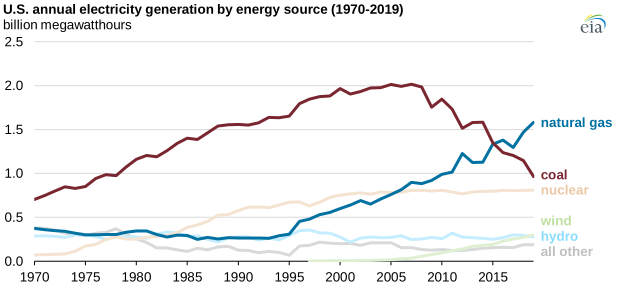
American utility companies have been using less and less coal to generate electricity every year for decades now. The reason is simple economics: coal is more expensive on a per-kilowatt-hour basis than either renewable fuels like solar and wind or its main fossil fuel competitor, natural gas. 

U.S. coal-fired electricity generation in 2019 falls to 42-year low - U.S.  Energy Information Administration (EIA) 

Coal is a uniquely dirty fuel, even setting aside the fact that burning it contributes to climate change. It's also a major environmental source of cancer: burning it in the massive quantities needed to generate electricity puts tons of naturally occurring radioactive elements that would normally be safely underground right into the air. Even when the chemical fallout from coal isn't toxic in and of itself, like sulfur dioxide or fine particulates that clog lung passages, the downwind radioactive plume is a cancer-causing agent.

It also destroys the natural environment in the areas its mined. Toxic chemical agents used in the mining process can permanently foul water tables, and the acidic runoff kills wetland ecosystems. Even when coal companies have complied with government mandates to fix some of the environmental damage they've caused, the health problems for people living in coal-mining communites persist, and range from "traditional" mining diseases like emphysema and black lung to long-term genetic damage.

The nation's heaviest coal-mining areas are also its poorest, which is not a coincidence. The coal industry has a centuries-long reputation for ruthlessness when it comes to its own labor force. Even when prevailing wages for miners are enough to support a family on—and they have not been for quite a while—the work is incredibly dangerous, and grisly and preventable accidents due to mine owner neglect are still common. One example is the 2006 Sago Mine disaster, which killed 12 miners after an explosion in a mine that was operating with more than 200 active safety violations. Trump appointed the owner of that mine, billionaire Wilbur Ross, as his secretary of commerce during his first term.

The result of all this is that coal is a dying industry—and one that Americans from coal country, who know it best, are happy to see die. Virtually every other form of energy that exists is cheaper, cleaner, safer, more reliable, more profitable, easier to scale up, and requires less and cheaper infrastructure. And because coal's main use is in electricity generation, it's also the most easily replaced fuel: electrical grids don't care where the electricity comes from.  

Today, Trump held an event in the White House for coal industry executives—all of whom financially supported his political—where he signed an executive order requiring the United States military to buy coal-generated electricity far into the future. It's hard to think of an organization that needs coal or coal-derived electricity less than the modern military, but it is the largest budget that Trump has control over, and so the easiest to force into the coal subsidy business.

In other words, Trump has ordered a massive, locked-in subsidy of an industry that is failing the test of the free market, and one that benefits his political cronies. This isn't the first time that Trump has dabbled in that particularly corrupt form of socialist central planning, as actual conservatives have noticed

Trump, who is nearly 80, appears to genuinely believe some truly ridiculous things about the superior alternatives like wind power (which he thinks causes cancer somehow) and solar (which he falsely believes can't be stored in batteries after the sun sets) that have been developed since he was a boy. But he also seems to think that coal is a much bigger and more economically important industry than it is. There are only about 45,000 coal miners working in the United States at present, or just under one in every 8,000 Americans. (That's fewer than the number of florists, and about the same number of people as work in the specific job of packaging seafood.)

Why does this matter?

  • Countries that are serious about having energy stability in the future—even other dictatorships, like China—are investing in anything but coal. 
  • Republicans who voted for Trump because they thought he shared their belief in the free market might not like him doing the Putin-style version of socialist welfare supports for oligarchs. 
  • Presidents who can't or can't be bothered to update their understanding of energy from the 1940s aren't mentally competent to serve in the 2020s.