Friday, April 17, 2026

What did Donald Trump do today?

He straight up lied about Iran agreeing to a peace deal.

This afternoon, Trump declared that Iran had "agreed to everything" that he had demanded in peace talks. Specifically, he insisted that Iran had agreed to give up its stockpile of highly enriched uranium, to open the Strait of Hormuz and "never to close" it again. "This will be a great and brilliant day for the world," he told a conservative political conference audience. "Because Iran has just announced that the Strait of Hormuz is fully open and ready for business."

In reality, Iran's government has emphatically rejected Trump's claims, outright accusing him of lying to manipulate the markets and score political points at home. Iran's foreign minister announced on state television that "Iran’s enriched uranium is as sacred to us as the soil of Iran and will under no circumstances be transferred anywhere," and that the matter had not even come up for discussion.

As for the opening of the Strait of Hormuz, which is in Iran's long-term financial interest, there was a brief moment today when Iran once again signaled it was moving towards a limited, toll-based opening of the Persian Gulf to international shipping. But that immediately fell apart when Trump insisted that the United States Navy would maintain its own blockade of the Gulf. Iran's government announced that the Strait would remain open in a limited capacity, far below its normal volume, only for the duration of a 10-day ceasefire that expires at the end of the coming week.

The ships that have been stuck in the Gulf since the conflict began clearly believe Iran. A number of them broke for the Strait today, only to sharply turn back when the Iranian government announced the actual terms.

Two countries that had actually come to an agreement might spin things slightly differently for domestic political purposes—but not to the extent of one declaring peace while the other remained at war. Unfortunately for the United States, Trump has far more reason to lie than the alliance of religious hardliners and military officers that control Iran. Unlike the authoritarians he openly admires, Trump does not yet have complete control of state media, and only limited ability to inflict violence on his internal political enemies. The war has strengthened the Iranian regime's control over its population and helped it suppress internal dissent, while the disastrous and predictable outcome has greatly weakened Trump, and the United States in general.

This was the outcome that internal White House sources were trying to warn Trump of a month ago today when they said that he had blundered into letting Iran control how and if the war ended. It remains unclear to what extent Trump believes what he was saying today.

As has happened frequently during the second Trump administration, there was a sudden and anomalous spike in trading of oil futures immediately before Trump's announcement, which itself came just before markets closed for the weekend. 

Why does this matter?

  • Reality doesn't change just because Donald Trump says so. 
  • It's bad when a hostile foreign country can use the president's ego as a weapon against the United States.

Thursday, April 16, 2026

What did Donald Trump do today?

He ranted about his ballroom at length.

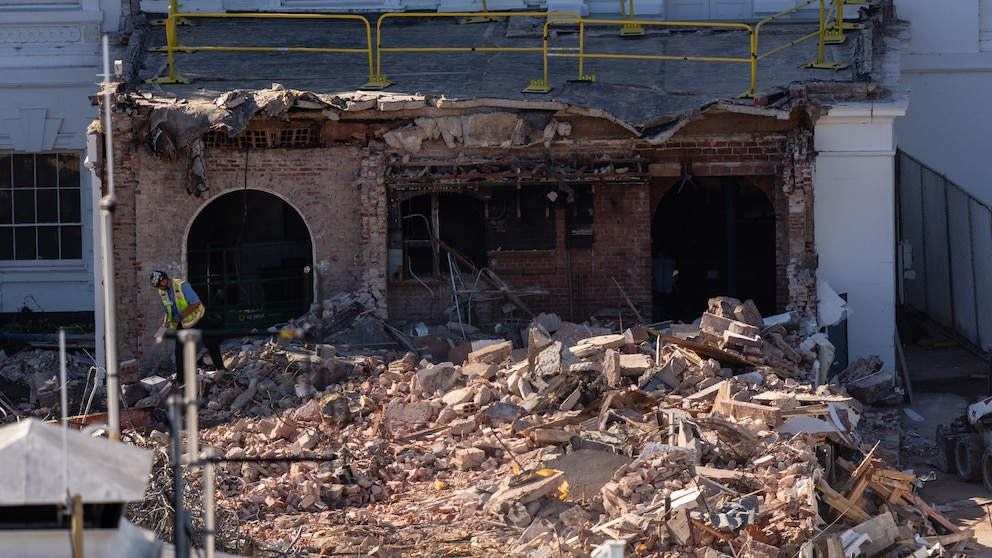
Last year, Trump destroyed the East Wing of the White House, without permission from Congress. He did this with as much secrecy as is possible, hastily knocking it down behind construction barriers after lying to the American public that he was only making minor alterations to it. He had claimed that the ballroom he wanted to build "wouldn't interfere" with the East Wing immediately before having it destroyed.

Since then, despite an obsessive interest in the proposed ballroom's construction, Trump has been held up by legal challenges. A federal judge ruled earlier this month in favor of the National Trust for Historic Preservation, the agency established by law to protect historical buildings, and ordered a halt to construction of the ballroom. Today, the same judge clarified that an exception he had made for the construction of national security facilities under the ballroom was not a blank check to construct the whole thing anyway.

This outraged Trump to the point that he spent the whole afternoon posting four lengthy rants to his boutique social media website, railing against the Republican-appointed Richard Leon as a "Trump Hating Judge" and making absurd claims about the planned ballroom. Some of the most outrageous:

  • Trump asserted, as he often does, that the ballroom is "free" because it is being paid for by corporate sponsors. Even if this weren't a bribe—and Trump has made clear that he regards contributions to the construction fund as the cost of doing business with his White House—it's still not true that taxpayers won't end up paying for it. The "donations" that corporations are making are tax-deductible and secret, so money comes out of the budget either way. Trump also recently gave a Luxembourg steel company a special break on tariff rates in exchange for a "donation" of $34 million worth of steel, reducing revenue and undermining the American steel industry at the same time. 
  • Trump also said, and this is a direct quote, that "The Ballroom is deeply important to our National Security" because it will contain "Top Secret Military Installations." Setting aside the question of how secret they are if Trump is tweeting about them, the judge's order doesn't prevent Trump from building an underground bunker if that's what he wants to do. It simply prevents him from violating the law by building an entire new structure on the grounds of the People's House without authorization from the people's representatives in Congress. 
  • Trump insisted that nobody had legal standing to stop him. In reality, of course, Trump is not the whole government, and doesn't rule by fiat, especially where Congress has given its own agencies jurisdiction. 
  • Finally, Trump claimed that the ballroom was "not a joke to me, or the people of America." It's completely clear that Trump is deadly serious about the ballroom. As for the American people, polls show they overwhelmingly think it's a joke, and a pretty bad one.

The posts appeared at 2:45, 3:47, 4:05, and 6:41. Trump then reposted all of them again about a half an hour after the last one. They come to a grand total of 782 words. 

Why does this matter?

  • A president ranting that "The Ballroom is deeply important to our National Security" is deeply embarrassing. 
  • Even by Trump standards, this is bizarre, and sad.

Wednesday, April 15, 2026

What did Donald Trump do today?

He got extremely confused about a major political event that happened to him.

Trump is serving as a massive anchor dragging down Republicans' chances of keeping control of the House of Representatives in the upcoming elections—and that's coming from Republicans themselves. The situation is so dire that political forecasters now think Democrats have a decent chance of picking up four seats retaking the Senate outright in what, going by the map, should be an awful year for them. 

That has focused attention on the Supreme Court, and whether two of its elderly Republican justices, Samuel Alito and Clarence Thomas, might choose to retire soon rather than risk having Trump's picks to replace them blocked by a Democratic-controlled Senate.  In an interview that aired this morning, Trump had this to say:

Look at — happens to Justice Ginsburg. She was not exactly a young woman. The election was taken. They had a Democrat who could’ve appointed a liberal justice — and the liberals do stick together, that’s one thing about those justices, they stick together like glue, not like the Republicans. But she decided she was going to live forever, and about two minutes after the election, uh, she — went out, and I got to appoint somebody.

Ginsburg died of cancer in September of 2020, almost four years after Trump took office. Trump's over-the-top reaction to "learning" of her death from a reporter, in which he performed shock and insisted "you're telling me now for the first time"—although he clearly was aware—became something of a meme. He then ignored her deathbed plea for him to wait until the election was settled before naming a replacement.

Instead, his administration rushed to appoint Amy Coney Barrett before the November election, doing in barely six weeks what would normally have taken at least four months. That should stick out in Trump's mind for reasons that go beyond the political: the White House ceremony celebrating her nomination was a COVID superspreader event that likely gave Trump the near-fatal case that saw him hospitalized days later.

But Trump's version today has the timeline off by a matter of years, at least. The closest thing to an explanation seems to be that he was conflating her death with the death of Antonin Scalia, who died in 2016, during Barack Obama's last full year in office. Obama nominated Merrick Garland to replace him, but the Republican-controlled Senate refused to vote on him, giving Trump the opportunity to name his replacement after the 2016 election.

Trump clearly wasn't lying. His version of the story isn't embellished to make him look good; it was just wrong on basic facts he lived through as President.
 

Why does this matter?

  • Confusing elements of different stories is called confabulation, and it is not a sign of good cognitive health in the elderly.

Tuesday, April 14, 2026

What did Donald Trump do today?

He tried to erase the history of both his impeachments.

This morning, Trump promoted an article written by his impeachment lawyer and mutual friend of Jeffrey Epstein, Alan Dershowitz, suggesting that his first impeachment could be "expunged" by an act of Congress. The gist of Dershowitz's argument is that one of the witnesses against Trump consulted with Democratic lawmakers before coming forward. (Congress has the Constitutional responsibility for oversight of the executive branch, so contacting lawmakers about criminal behavior in the White House is not exactly out of bounds.)

Not even Trump disputes the basic facts that led to his first impeachment: fearing that he would lose the 2020 election to Joe Biden, Trump pressured Ukraine's president, Volodymyr Zelenskyy, to publicly announce a criminal investigation in to Biden's son Hunter, and to (falsely) claim that it was Ukraine that had tried to interfere in the 2016 election rather than Russia. He conditioned continued American military support for Ukraine on this, and then obstructed Congress when it tried to investigate after whistleblowers brought evidence of Trump's scheme to light.

Coincidentally or not, Trump also tried to legally undo the subject of his second impeachment today. The DOJ, now led by his personal criminal defense lawyer Todd Blanche, asked federal courts to throw out the seditious conspiracy convictions of a number of members of white supremacist and militia organizations related to the January 6th attack on Congress. Trump, who was impeached in the last days of his first term for that attempt to cling to power, had already granted clemency to anyone who committed crimes on his behalf that day. 

Neither action would have any real legal or practical effect. But Trump, for all his legendary outrage at anyone—whistleblowers, voters, courts, or Congress—who would hold him accountable, seems to genuinely believe he can rewrite history by fiat even as he calls attention to it.
 

Why does this matter?

  • Reality doesn't change just because Donald Trump doesn't like what happened in it. 
  • Corruption, obstruction of justice, and attempted coups are still wrong.

Monday, April 13, 2026

What did Donald Trump do today?

He stayed up all night and regretted it in the morning.

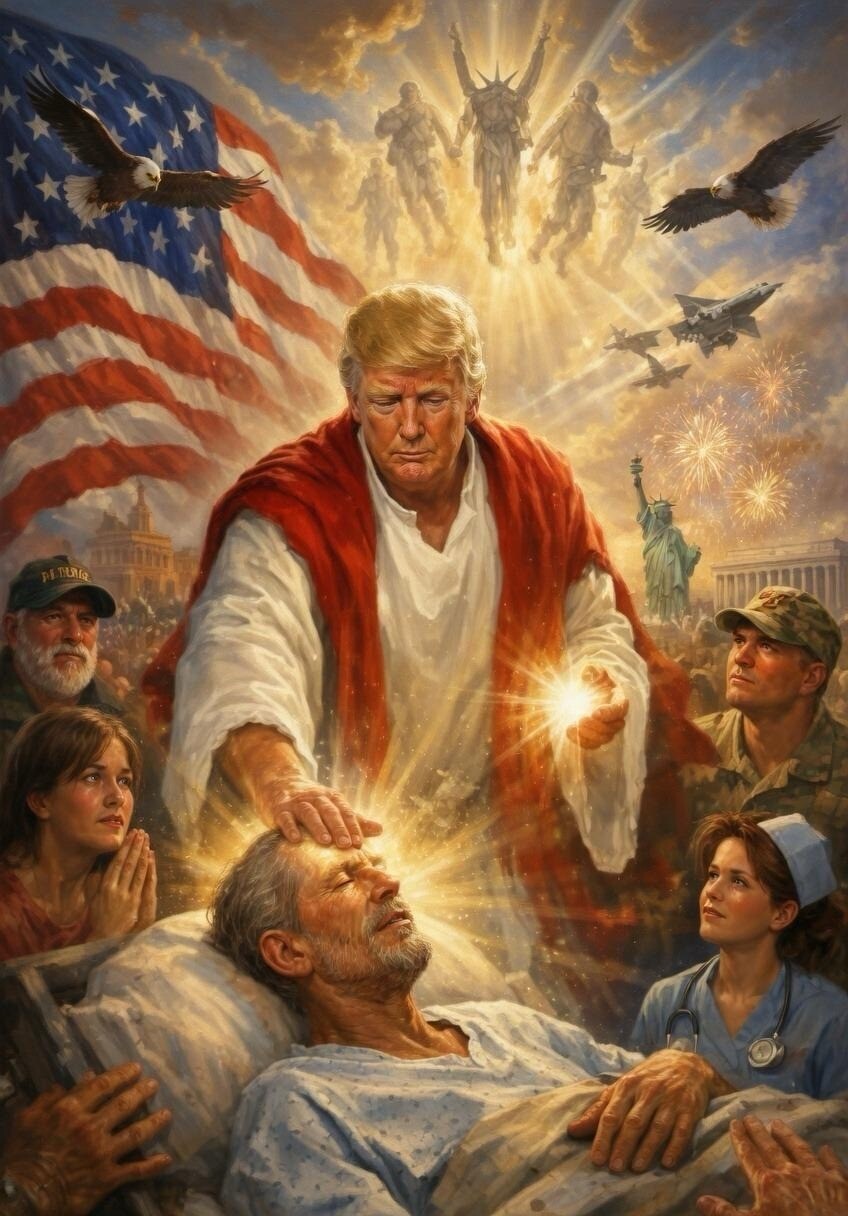
Trump, who is 79 years old and erratic under the best of circumstances, stayed up all night posting to his boutique social media site. At 9:03 PM on Sunday, he posted a lengthy screed against Pope Leo XIV, accusing the head of the Roman Catholic Church of being "WEAK ON CRIME." 46 minutes later, he posted an AI-generated image of himself as Jesus, healing the sick while worshipers looked on adoringly.

A dramatic scene depicts a figure resembling Donald Trump in a red cloak, performing a healing gesture over a hospitalized elderly man, surrounded by symbolic elements like the Statue of Liberty, eagles, soldiers, a nurse, and an American flag. Celestial figures rise above amidst fireworks, creating a patriotic and spiritual atmosphere. 

Trump then posted at 9:50 PM, 10:10 PM, 10:32 PM, 10:34 PM, 10:53 PM, 12:43 AM, 2:35 AM, 2:36 AM, 2:37 AM, a second post at 2:37 AM, 2:38 AM, and 4:10 AM, before, presumably, getting a little sleep. 

If Trump's public schedule is to be believed—and for this sort of thing, it shouldn't be—he might have gotten a little under three hours of sleep before getting up and ready for "executive time" starting at 8:00 AM. (In the Trump White House, that is a euphemism for time spent browsing social media, calling friends, or napping, so Trump may well have just slept through the first part of his "workday.")

When he did finally appear after noon, Trump was asked about why he depicted himself as Jesus. He insisted that he thought the picture of him in the white and red robes, showing him laying hands glowing with holy light on the head of a sick man—which is how Jesus is often depicted in devotional art—was showing him as a "doctor."  


Then, perhaps not wanting to walk back the Jesus comparison too much, he insisted, "I do make people better." He also praised the obviously AI-generated image as having come from a "very beautiful, talented artist," and blamed "the fake news" for the controversy.

Trump comparing himself to Jesus is nothing new: this isn't even the first time this month he's done it. But this time, he outraged some of his strongest Christian supporters—to say nothing of Christians and non-Christians across the political spectrum—and was forced to remove the post

Why does this matter?

  • Dementia is the generous explanation for comparing yourself to Jesus right after you denounce the Pope for forgiving criminals

Sunday, April 12, 2026

What did Donald Trump do today?

He blockaded a blockade. 

This morning, having abandoned "peace" negotiations with Iran after less than a day, Trump announced that he, too, would blockade the Persian Gulf. He also claimed that the US Navy would interdict any vessel that paid Iran's toll, although he didn't say how he'd know which ones those were, or what would happen afterwards. In fact, as is often the case, it's difficult to tell whether Trump knew what he was saying at all. Military seizure of a Russian or Indian or Chinese-flagged ship would instantly change the character of the war.

Unlike most of the war up to this point, there is at least a theoretically valid military justification for blockading Iran. It might make it harder for Iran to resupply weapons or other militarily useful materials, or to raise money by exporting its own products. But Trump's blockade isn't complete, and can't be: Iran has shipping channels via the Caspian Sea with its main trading partner Russia, as well as overland routes through friendly countries bordering it, including Turkmenistan and Afghanistan.

Political Map of Caspian Sea - Nations Online Project 

The result is that Trump is simply adding to the effectiveness of Iran's near-complete closure of the Persian Gulf. Not only will this hurt the rest of the world more than it hurts Iran for the foreseeable future, it also undoes what little relief Trump had won for oil prices by taking the unprecedented (and humiliating) action of dropping sanctions against Iranian oil exports in the middle of a war against it.

Trump, who attended a UFC match in Florida last night while negotiations collapsed, has once again remained hidden from the press today. His only brief comments came as he arrived in DC, insisting that "other nations" were joining the US in trying to prevent the sale of Iranian oil. As is often the case when Trump claims international support for one of his plans, he was unable to say exactly which other nations were involved.

Still, it is possible to see this as a positive development. A blockade is easier to back down from than a ground invasion, both in terms of the level of military commitment and the amount of public scrutiny it would receive. The main obstacle that the United States has been facing in extricating itself from the debacle of the Iran attacks has been Trump's own unwillingness to admit he's made a mistake.

Oil and gas prices were once again up sharply on the news.

Why does this matter?

  • The safety and stability of Americans, and for that matter everyone else, is more important than Donald Trump's ego. 

Saturday, April 11, 2026

What did Donald Trump do today?

He told Americans exactly why gas prices are going to go up again.

Yesterday, Trump seized on a tweet by Canadian oil and gas industry analyst Rory Johnston. It showed a map plot of empty oil tankers rerouting in a continuous line stretching halfway around the world, bound for American oil export terminals on the Gulf of Mexico. This is, obviously, the result of a fifth of the world's oil supply being shut off by Iran's ongoing blockade of the Strait of Hormuz.


Johnston said it was "very cool" to see this, referring to the unusual redeployment of a substantial portion of the world's oil fleet. But Trump apparently misunderstood Johnston's enthusiasm and assumed it was a good thing for United States, and stole Johnston's map for a post to his own boutique social media account. (Johnston took the theft in good humor.)

Today, Trump doubled down on the idea that chaos in the oil markets was a positive development:

Massive numbers of completely empty oil tankers, some of the largest anywhere in the World, are heading, right now, to the United States to load up with the best and "sweetest" oil (and gas!) anywhere in the World. We have more oil than the next two largest oil economies combined - and higher quality. We are waiting for you. Quick turnaround! President DJT 

In reality, what this means is that American consumers will be bidding directly against the rest of the world for oil that otherwise would have mostly remained in the United States.

The oil market is global and complex. Refineries are built to process specific kinds of oil based on specific levels of demand in different places, and they have fixed capacities. Inefficiencies, like having to reroute a tanker fleet 10,000 miles, drive up the price. So does limited supply.

It's true that American oil company profits will go up, although Iran itself and Russia are the real winners, as both are now free from American sanctions on their oil, and both are heavily dependent on petroleum revenue to support their wars against the United States and its ally Ukraine.

But actual Americans pay more for everything when fuel prices soar like they have since the start of Trump's attacks on Iran: more for gasoline, which is now over $5/gallon on the west coast, and more for everything shipped on planes or trucks.


Why does this matter?

  • A president who can't understand the most basic economic concepts like supply and demand isn't fit to hold office. 
  • There's a difference between what's good for a few oil companies and what's good for 340 million Americans.

Friday, April 10, 2026

What did Donald Trump do today?

He said nothing about the dramatically worsening economy.

According to the Consumer Price Index report released today, inflation in March rose at an annualized rate of 11.3%, almost six times faster than the target rate of 2%. This was the fifth-highest monthly increase in this century. 

Worse, for American consumers, there are strong indications that this won't be a momentary spike in prices: the fundamental cause is supply chain disruptions from Trump's trade war and especially the Iran crisis, neither of which can be quickly undone. Fertilizer shortages are going to drive up the price of food everywhere for the rest of the growing season. Key industrial products are also spiking in price, which will have a long-term effect on prices. China today banned exports of sulfuric acid, a basic industrial chemical needed in bulk in sectors ranging from agriculture to electronics. The price of plastics have soared too.

Trump himself mostly hid from the public today, scheduling a half day of "executive time" (the Trump administration euphemism for time he spends watching TV, calling friends, or resting in the residence) before taking his usual Friday trip to Florida. None of the social media posts attributed to him addressed the economic elephant in the room, and White House spokespeople were reduced to cherry-picking specific items that haven't gone up in price in an attempt to project confidence.

That's unlikely to work. Consumer confidence is plummeting, to record-low levels in the benchmark University of Michigan survey, for the obvious reason that most Americans can see with their own eyes what is happening to prices—especially for things like gas, which is now at $4.15/gallon on average and well over $5 in cities. 

When he is willing to talk about the economy, Trump continues to insist that Americans don't really care about the things they need being affordable.

Why does this matter?

  • Problems do not go away just because a president doesn't want to think about them. 

Thursday, April 9, 2026

What did Donald Trump do today?

He played the most powerful card remaining to him on Iran: whining about it on the internet.

Trump posted two complaints to his boutique social media website this evening:

There are reports that Iran is charging fees to tankers going through the Hormuz Strait — They better not be and, if they are, they better stop now! President DONALD J. TRUMP 

Iran is doing a very poor job, dishonorable some would say, of allowing Oil to go through the Strait of Hormuz. That is not the agreement we have! President DONALD J. TRUMP

Trump is correct on two points: Iran is letting very few ships through the strait, and they are targeting some of the ships they do allow through with millions of dollars in fees. That's not just a "report," it's established fact, and has been for weeks.

At least according to Trump's fiery rhetoric on Tuesday, that means the ceasefire should never have started in the first place, since he'd made it the only explicit condition that Iran had to meet. Given how little Iran has been restrained in the two days since Trump backed down from his promise to commit war crimes if Iran didn't come to the bargaining table, it's genuinely unclear what "agreement" Trump thinks is in place.

The problem, which Iran clearly understands, is that Trump is now negotiating from a position of almost unbelievable weakness. Simply by continuing to exert control over the Strait in defiance of Trump's demands, Iran strengthens its hand and funds its own war effort in the process.

Trump could resume hostilities, but short of a full-scale invasion of an extremely large and populous country, more bombing of already destroyed airfields won't do much. It's also unlikely Trump make good on his previous threat to bomb Iran "back to the stone age" by destroying civilian infrastructure. Not only would be the kind of premeditated atrocity that would risk having the United States military push back against its civilian commander, it wouldn't accomplish anything for Trump politically: the war is already deeply unpopular in the United States, and bombing cities wouldn't fix the economic damage.

Nor can he force the issue in the Strait of Hormuz itself. Iran doesn't need to be able to destroy every vessel that goes through in order to completely shut down traffic. It only needs to be plausibly able to destroy a ship once in a while, and cheap drones or shoulder-mounted missiles launched from well inland are more than capable of doing that. Against the slow, literally explosive target presented by an oil tanker, even speedboats or divers carrying explosive satchels can do the job. On this point, at least, Trump seems to have finally grasped the reality of the situation, which may explain why he's also tried to get the United States' allies to do the "easy" task of solving the problem for him.

Trump doesn't even have a good option as to whether to hold the negotiations that are supposed to begin tomorrow in Pakistan. Walking away would simply leave a determinedly anti-American regime more entrenched in its control over Iran, more regionally powerful, and wealthier than at the start of a war in which the United States military succeeded in killing much of its senior leadership. 

But holding the negotiations will only call attention to the comical discrepancy between the US and Iranian proposals. Both sides are essentially calling for the other to surrender, which is absurd on its face. But it's also deeply embarrassing for Trump, as the commander of the most powerful military in the world, to have backed himself into this corner barely six weeks into the conflict.  

Why does this matter?

  • At this point, it's obvious and a little repetitive, but it shouldn't even be possible to fuck up a war this badly, and nobody who managed to do it is remotely fit for office. 

Wednesday, April 8, 2026


What did Donald Trump do today?

He was full of high hopes for the first day of his Iran War ceasefire, for literally one minute.

At one minute after midnight today, Trump posted this to his private microblogging website:

A big day for World Peace! Iran wants it to happen, they’ve had enough! Likewise, so has everyone else! The United States of America will be helping with the traffic buildup in the Strait of Hormuz. There will be lots of positive action! Big money will be made. Iran can start the reconstruction process. We’ll be loading up with supplies of all kinds, and just “hangin’ around” in order to make sure that everything goes well. I feel confident that it will. Just like we are experiencing in the U.S., this could be the Golden Age of the Middle East!!! President DONALD J. TRUMP

Since then: 

  • Trump blustered that he would "punish" NATO allies who didn't join the war he launched without telling them by moving US forces stationed in them to countries that did support it, like Saudi Arabia and Qatar. One of Iran's demands is that the United States remove its forces from the Middle East. 
  • Trump threatened to impose tariffs on any country supplying weapons to Iran. The countries Iran is most likely to buy weapons from—using the money it expects to collect from its new toll revenue scheme—are China and Russia, which were already defying American sanctions before the war.
     
  • Israel carpet-bombed Lebanon, drawing a rare rebuke from the International Committee of the Red Cross. Iran has said that there is no ceasefire if it does not also protect Lebanon.  
  • Secretary of Defense Pete Hegseth answered "I believe so" when asked if the Strait of Hormuz was, in fact, open. 
  • Two hours after Hegseth's comments, Iranian state media announced the Strait of Hormuz was closed again because of Israel's attacks on Lebanon. Opening the strait was a condition that Trump set for the ceasefire.  
  • Trump floated the idea that United States could also be paid by ships seeking protection from being destroyed by Iran. It's not clear why anyone, either Iran or the potential victims of a joint US-Iran extortion scheme, would agree to that. 

Finally, Iran—which Trump has repeatedly insisted was "desperate" for a ceasefire because "they've had enough"—was already threatening to withdraw from the negotiations that are supposedly to begin Friday in Pakistan.

Why does this matter?

  • It's bad that a deteriorating shitshow in a Middle East now dominated by a strengthened Iranian regime is still probably the best outcome of the situation that Trump blundered into. 
  • A more skilled dealmaker would know that bargaining from a position of weakness makes it easy for enemies to call your bluff.

Tuesday, April 7, 2026


What did Donald Trump do today?

He threatened atrocities in the morning and signaled surrender in the afternoon. 

This morning, Trump threatened in a post to his microblogging website to destroy "a whole civilization," presumably meaning Iran's, if they didn't capitulate to his demands by 8 PM EDT, the latest of several deadlines he'd set.

This afternoon, he announced that a ceasefire with Iran had been reached, based on a "ten-point plan" Iran had submitted, and pending the "COMPLETE, IMMEDIATE, and SAFE OPENING of the Strait of Hormuz."

Just a few minutes later, Iran launched missiles at Israel. Most of Iran's attacks in the war have been directed at US-aligned countries in the region rather than American targets directly, so if the ceasefire doesn't apply to those countries, it will be of very limited effect on Iran.

Later in the evening, Trump himself posted a message from Iranian officials which explicitly confirmed that Iran would maintain unchallenged military control of the Strait: "For a period of two weeks, safe passage through the Strait of Hormuz will be possible via coordination with Iran's Armed Forces and with due consideration of technical limitations." 

Iran has been charging vessels $2 million per transit, but has announced it is willing to split that fee with Oman. Under normal circumstances, about 135 ships go through the Strait of Hormuz per day, which would amount to something like a $40 billion annual income stream for Iran's government. That's more than 10% of its current GDP. 

Iran's demands, which Trump called "a workable basis on which to negotiate," are:

  1.  The United States must commit to a non-aggressive stance toward Iran.
  2.  Iran will maintain full control over the Strait of Hormuz (which it did not have before Trump's attacks).
  3.  Iran will be permitted to enrich uranium.
  4.  The United States will lift sanctions on Iran.
  5.  The United States will lift sanctions against other countries doing business with Iran.
  6.  The United Nations will withdraw its resolutions targeting Iran. 
  7.  The International Atomic Energy Agency will lift its restrictions on Iran's nuclear program.
  8.  Iran will be fully compensated for the damage it has sustained during the war.
  9.  The United States will withdraw combat forces from the region.
  10.  All parties will enter into a cease-fire, including in Israel's ongoing invasion of Lebanon.

In other words, after a month of prematurely declaring that he would only accept Iran's "UNCONDITIONAL SURRENDER," Trump is celebrating being offered what by any objective standard is a demand for the United States' surrender. 

Of course, Iran is not likely to get all of these concessions at the bargaining table, assuming any actual talks happen. That may be the best possible outcome for both sides: simply ending things with a new status quo, even one that leaves the Iranian regime objectively stronger. 

But it is a sign of Trump's desperation to undo some of the damage the war has caused—or at least to get himself out of the corner he'd painted himself into by threatening atrocities—by calling any excuse to back down a win.
 

Why does this matter?

  • Any "strategy" that puts your country at the mercy of a vastly weaker opponent is an incredibly bad strategy. 
  • This is both an absolute humiliation for the United States and, for now, the best possible outcome under the circumstances.

Monday, April 6, 2026

What did Donald Trump do today?

He threatened to put a journalist in jail for reporting what his own administration leaked.

Trump held a press conference today in which he continued his pattern of whipsawing between extreme opposite positions on the Iran war. At one point, pressed on whether he could even say whether he wanted to end the war or bomb Iran "back to the stone age," he responded, "Can't tell you. I can't tell you. I don't know."

But he also took the time to threaten unnamed American journalists with jail time if they didn't give up the name of a Trump administration official who told them that an American pilot was missing after Iran shot down two jets on Friday. Trump said he was going to find out who provided reporters with that information "because we’re going to go to the media company that released it, and we’re going to say,  'National security. Give it up or go to jail.'" 

To be clear, the leak came from inside the Trump administration, and there is no way to know that it wasn't authorized. The Trump administration, like all political offices, routinely "leaks" information that it wants publicly known without having to take responsibility for answering questions about it directly.

It is not illegal for American news outlets to publish information they receive confidentially from government employees, and for the most part, journalists can't be forced to disclose their sources. Even in the rare circumstances when the federal government can meet the high threshold of an "overriding and compelling state interest," most administrations have avoided that kind of a confrontation, out of a basic respect for the value of a truly free press. Trump notoriously feels otherwise and has spent a great deal of effort trying to handpick his own press corps and escape the more difficult questions that independent reporters tend to ask.

In other words, Trump can't simply order reporters "to jail" by invoking national security, although that hasn't stopped him from threatening that or worse many, many, many, many, many, many times.
 

Why does this matter?

  • A free and independent press is essential to the functioning of democracy, which is why only dictators or people aspiring to be dictators attack it.

Sunday, April 5, 2026

What did Donald Trump do today?

He tried harder than he ever has to win a war with trolling.

For context regarding what he did this Easter morning, here is one statement Trump has made about his disastrous war with Iran for every day since it began:

February 28: "No president was willing to do what I am willing to do tonight. Now you have a president who is giving you what you want."

March 1: "And sadly, there will likely be more [dead Americans]. Before it ends, that's, uh, the way it is. Likely be more."

March 2: "We're already substantially ahead of our time projections, but whatever the time is, it's okay. Whatever it takes." 

March 3: "The United States is stocked, and ready to WIN, BIG!!!"

March 4: "We’re going to cut off all trade with Spain. We don’t want anything to do with Spain."  

March 5: "I hope you are impressed. How do you like the performance?" 

March 6: "There will be no deal with Iran except UNCONDITIONAL SURRENDER!" 

March 7: "Today Iran will be hit very hard."

March 8: "[Ayatollah Mojtaba Khamenei] is going to have to get approval from us. If he doesn’t get approval from us, he’s not going to last long."

March 9: "I think the war is very complete."

March 10: "If Iran has put out any mines in the Hormuz Strait, and we have no reports of them doing so, we want them removed, IMMEDIATELY!" 

March 11: [in response to two oil tankers being set on fire in the Persian Gulf] "The Straits are in great shape." 

March 12: "You never like to say too early you won. We won. In the first hour it was over."

March 13: "I can’t tell you [how long the war will last.] I mean, I have my own idea. But what good does it do? …When I feel it in my bones."

March 14: "Many Countries, especially those who are affected by Iran’s attempted closure of the Hormuz Strait, will be sending War Ships… to keep the Strait open and safe."

March 15: "Uh, I guess they can have a little bit of fight back, but not much."

March 16: "We’ve never needed [NATO]. We have never really asked anything of them."

March 17: "But we're not ready to leave yet, but we'll be leaving in the near future. We'll be leaving in pretty much the very near future."

March 18: "US allies need to get a grip – step up and help open the Strait of Hormuz" 

March 19: "We are getting very close to meeting our objectives as we consider winding down our great Military efforts in the Middle East." 

March 20: "We don’t use the Strait, the United States, we don’t need it."

March 21: "If Iran doesn’t FULLY OPEN, WITHOUT THREAT, the Strait of Hormuz, within 48 HOURS from this exact point in time, the United States of America will hit and obliterate their various POWER PLANTS, STARTING WITH THE BIGGEST ONE FIRST!"

March 22: "You will soon see what will happen with the ultimatum on the power plants — the result will be very good." 

March 23: Iran has "one more chance at peace."

March 24: "[Iran's government] gave us a present, and the present arrived today… It was a very nice thing they did. But what it showed me is that we're dealing with the right people."

March 25: "I won't use the word 'war' because they say, if you use the word war, that's maybe not a good thing to do. They don't like the word 'war,' because you're supposed to get approval."

March 26: "Please let this statement serve to represent that I am pausing the period of Energy Plant destruction by 10 Days to Monday, April 6. …Talks are ongoing and, despite erroneous statements to the contrary by the Fake News Media, and others, they are going very well."

March 27: "NATO made a terrible mistake when they wouldn't send a small amount of military armament, when they wouldn't just even acknowledge what we were doing for the world and taking on Iran."

March 28: "They are talking. We are talking now. They want to make a deal."

March 29: "To be honest with you, my favorite thing is to take the oil in Iran but some stupid people back in the US say: 'why are you doing that?' But they’re stupid people."

March 30: "We will conclude our lovely 'stay' in Iran by blowing up and completely obliterating all of their Electric Generating Plants, Oil Wells and Kharg Island (and possibly all desalinization plants!)"

March 31: “It should be wrapped up in days, not weeks, because no sane group of people could stand the punishment that's going to rain down on them if it's not."

April 1: "We are going to hit them extremely hard over the next two to three weeks. We’re going to bring them back to the Stone Ages, where they belong. …They have no anti-aircraft equipment. Their radar is 100% annihilated."

April 2: "IT IS TIME FOR IRAN TO MAKE A DEAL BEFORE IT IS TOO LATE, AND THERE IS NOTHING LEFT OF WHAT STILL COULD BECOME A GREAT COUNTRY!"

April 3: "With a little more time, we can easily OPEN THE HORMUZ STRAIT, TAKE THE OIL, & MAKE A FORTUNE. IT WOULD BE A “GUSHER” FOR THE WORLD???" 

April 4: "Remember when I gave Iran ten days to MAKE A DEAL or OPEN UP THE HORMUZ STRAIT. Time is running out - 48 hours before all Hell will reign down on them. Glory be to GOD!"

In other words, Trump has simultaneously and repeatedly claimed that:

  • the war is over
  • the war is just getting started
  • Iran is desperate to make a deal
  • Iran is refusing to negotiate
  • The United States can keep the Strait of Hormuz open
  • The United States needs help from other countries to keep the Strait of Hormuz open
  • The United States doesn't care if the Strait of Hormuz is open
  • his threats against Iran's civilian population is forcing them to bargain
  • Iran is putting its civilian population at risk by ignoring his threats
  • he will "take" Iran's oil
  • Iran is allowed to sell its oil more freely than it could before the war 

That's barely scratching the surface of the confusion out of Trump's administration and Trump's own mouth, but it may help to provide some context for Trump's attempt to garner attention with this Easter morning post to his private microblogging website.

Easter is the holiday celebrating the miraculous resurrection of Jesus Christ, whose death and descent into Hell vicariously atoned for the sins of the world, according to Christian theology.

Why does this matter?

  • This is an open mockery of Christianity as well as Islam. 
  • Trolling and attention-seeking have never won a war and this won't be the first time.

Saturday, April 4, 2026

What did Donald Trump do today?

He self-soothed with some polling data that absolutely does not mean what he thinks it means.

Neither the public nor the White House press corps has seen Trump in the flesh since Wednesday night, leading to some now-routine gallows humor online about his failing health. There were rumors he'd been secretly whisked off to Walter Reed National Military Medical Center, something that has happened at least three times in the past. Enough people were prematurely celebrating his demise that the White House was forced to put out a statement insisting that Trump was alive and well (although, as of the end of the day on Saturday, still unseen). 

It's hard to say what Trump knows about the widespread cultural phenomenon of Americans joking about what they'll do when "It Happens." He's famously kept in a bubble by his own staff to help manage his moods, and fed a diet of "uplifting" stories about his popularity. But even if Trump doesn't know about Americans actively rooting for his demise by preparing celebratory playlists on Spotify, he knows enough about his plummeting popularity to complain bitterly about polls showing it.

That may be why he—or, if he was indisposed, someone with access to his social media accounts—posted graphs showing that he is far and away the most beloved figure in the history of American politics. 96% of those polled approved of his performance in office. 94% agreed with the statement "Donald Trump has been the best President in my lifetime." And 91% approved of his trade war against the rest of the world, or as the poll put it, his "use of tariffs to reduce America's trade deficit and create a level playing field for American workers and businesses."

Bar chart depicting approval ratings for President Trump's use of tariffs. Categories include "Approve" at 91%, "Strongly" at 69%, "Smwt." (Somewhat) at 22%, "Disapprove" at 7%, "Smwt." at 4%, "Strongly" at 3%, and "Unsure" at 2%. The chart is branded with CPAC and McLaughlin & Associates logos. Bar chart showing approval ratings for Donald Trump's presidency, with 96% overall approval. Breakdown includes 84% strongly approve, 12% somewhat approve, 4% disapprove, 3% somewhat disapprove, 1% strongly disapprove, and 1% unsure. CPAC and McLaughlin & Associates logos present.

Bar chart showing survey results on the statement "Donald Trump has been the best President in my lifetime." 94% agree, with 80% strongly and 14% somewhat agreeing. 5% disagree, with 3% somewhat and 2% strongly disagreeing. 1% are unsure. CPAC and McLaughlin & Associates logos included. Bar chart displaying approval ratings for J.D. Vance as Vice President of the United States. Categories include "Approve" at 92%, "Strongly Approve" at 78%, "Somewhat Approve" at 14%, "Disapprove" at 6%, "Somewhat Disapprove" at 4%, "Strongly Disapprove" at 2%, and "Unsure" at 2%. Includes logos for CPAC and McLaughlin & Associates. A table shows approval at 99% on 2/25 and 92% on 3/26, with disapproval at 1% on 2/25 and 6% on 3/26.

Of course, what Trump doesn't seem to have realized is that the graphs also show who responded to the poll: not Americans overall, who now give him approval ratings in the low 30s and who
overwhelmingly say his trade war has hurt the American economy. Instead, it was a poll of people attending CPAC—a political conference attended only by Trump's strongest supporters.

In other words, Trump supporters working in politics support Trump.  

This isn't that hard to understand, but this isn't the only time Trump has gotten confused about that recently. When CNN's poll analyst Harry Enten put up a graphic last month showing 100% support for Trump among "MAGA voters"—in other words, people who self-identified as supporting Trump in the same poll where they were asked about their support—he couldn't stop bragging about it. Enten said this week that a more accurate way of depicting Trump's popularity was "a steady fall into the abyss" that was still happening.

Trump used "emotional support polls" in his first term, too, claiming that his approval rating with Republicans was sky-high: over the course of that term, he reported numbers ranging from 93-96%. But in those cases, he wasn't confused over what polls meant—he was just making the numbers up

Why does this matter?

  • Saying people like you doesn't make it true, which most people figure out by the time they reach elementary school. 
  • It's bad if a president isn't even pretending to care about Americans who don't support him politically, especially when that's about two-thirds of all Americans. 
  • If Trump wasn't profoundly confused about what he was posting, then the only other explanation is that he thinks people who read his social media posts are incredibly stupid.

Friday, April 3, 2026

What did Donald Trump do today?

He retreated deeper into the fantasy that he is winning the Iran war so he didn't have to deal with planes getting shot down.

This morning, news broke that two American jets had been shot down by Iran. One was an A-10 Warthog that crashed in Kuwait, with the sole pilot safely ejecting. The other was an F-15E fighter, carrying two crew members. One was rescued; the other is missing, and is either dead, or stranded inside Iran. Both Iranian forces and U.S. helicopters were searching inside Iran throughout the day.

Trump, who has been insisting for over a month that Iran's military capabilities had already been "annihilated," including its anti-aircraft weapons, ducked the press entirely today except for a few quick phone interviews.

Faced with predictable Iranian retaliation that he was completely unprepared for, and that is by his own staff's account, Trump has employed two coping strategies. One has been to simply pretend it's not happening. That was how he reacted to the news of the downed planes: by diving into a fantasy on social media where Iran was not only already defeated, but its oil resources were being plundered by the United States. The two posts below were the last he made before and the first he made after the news of the downed jets broke:


(In reality, Iran is selling more oil than ever, and more easily, since Trump canceled sanctions against Iranian oil in a desperate and futile attempt to keep gas prices down in the United States.)

The other strategy is to pretend that Iran's counteroffensives against the United States and its regional allies don't really matter. Trump has tried to convince Americans that higher gas and heating oil prices are actually good for them, since "we" (meaning American oil companies) benefit from high prices too. He's also tried to shrug off the inconceivably bad outcome of Iran gaining a stranglehold on the Strait of Hormuz, declaring it a problem for the rest of the world to solve even though it is already causing massive disruption in American industries ranging from agriculture to air travel.

He's even tried to pretend that the loss of American lives is nothing to worry about. He literally shrugged and smirked at the prospect of more American deaths at the outset of the war, and to drive the point home, wore a campaign baseball hat for sale on his website to the solemn ceremony in which the bodies of the first American casualties of the war were received at Dover Air Force Base.

Why does this matter?

  • Nobody this incompetent or out of touch can be trusted with command of the United States military forces. 
  • No matter what Donald Trump thinks, it actually is a big deal if American servicemembers die, especially in a pointless war that will achieve no good purpose for the United States.

Thursday, April 2, 2026

What did Donald Trump do today?

He bragged about war crimes he ordered, again.

This morning, Trump posted photos of a destroyed highway bridge leading into Tehran, threatening to continue to ruin the country's civilian infrastructure "UNTIL THERE IS NOTHING LEFT" if Iran's government didn't "MAKE A DEAL." (Trump declared victory in the war and Iran's imminent "unconditional surrender" almost a month ago.) 


It is a war crime to destroy civilian infrastructure. It is especially a war crime to hit a civilian target a second time, after rescuers have arrived, in order to drive up casualties—and that is exactly what the United States appears to have done. Trump has ordered these "double-tap" strikes on the boats he claimed were smuggling drugs out of Venezuela. The attack on the girls' school that killed 165 students and teachers was also carried out this way.

Before Trump, these kinds of premeditated attacks on rescuers were more closely associated with the atrocities of the Yugoslav wars or the Putin regime. But Trump seems to equate this kind of thing with his idea of manliness that actual military veterans generally react to with disgust. Trump has even begun to echo his Secretary of Defense's mocking language about bombing Iran "BACK TO THE STONE AGE." 

That phrase was originally coined by Gen. Curtis LeMay in 1965, as American military involvement in Vietnam was ramping up, and characterized the now completely discredited belief that wars could be won simply by bombing a population into submission. (Trump dodged the Vietnam draft with a fake doctor's note.) Vietnam is much smaller in area and population than Iran, or for that matter Afghanistan, whose victorious faction resisted U.S. invasion and bombardment for 18 years.  

News about the bridge destruction comes on the same day as still more reporting confirming that the Trump White House was completely unprepared for even the possibility of Iranian counteroffensives or anything more than "performative" responses.

And yet behind the bluster has been a growing recognition within the West Wing that the situation may be slipping out of its control. Key Trump officials, including Defense Secretary Pete Hegseth, were surprised by the barrage of retaliatory attacks Tehran launched against U.S. and Israeli targets across the region, including in countries long assumed to be off-limits: Kuwait, Bahrain, Saudi Arabia, the United Arab Emirates, and Qatar, a state that had both harbored Iran’s terrorist proxies and served as a conduit for backchannel diplomacy between the U.S. and Hamas. The response shattered the assumption that Tehran would confine itself to performative retaliation. In internal deliberations before the war’s launch, Hegseth had pointed to Iran's muted reaction to Trump’s past attacks as evidence that calibrated force could impose costs on Tehran without triggering a broader war. Hegseth “was caught off guard. There’s no question,” says a person familiar with his thinking. 

But there was at least one sign that Trump and Hegseth are starting to realize what an incredible fiasco the Iran campaign has become: they purged several top Army officials, none of whom were involved in the day-to-day conduct of the war. It's not clear exactly why those officials were fired tonight, but Trump and Hegseth's clumsy attempts to demand personal loyalty from professional military personnel have gone over poorly. One of the people fired tonight, Gen. Randy George, had ordered an investigation into a bizarre helicopter fly-by of Trump backer Kid Rock's house that appeared to have been staged for social media. Hegseth immediately ordered the investigation shut down and called the pilots "patriots."

Why does this matter?

  • Nobody as incompetent at "warfighting" as Trump or Hegseth should ever be allowed anywhere near military command.
  • Only dictators try to purge the military of "disloyal" troops because only dictators need to.

Wednesday, April 1, 2026

What did Donald Trump do today?

Literal blasphemy.

Paula White is Trump's "White House Faith Advisor," head of an office he created for her at the start of his second term. White, who abruptly left her position as the head of a megachurch with hundreds of millions of dollars in revenue shortly before it declared bankruptcy, is a political supporter of Trump, and shares with him a fondness for expensive private jets paid for by other people

At a White House event today, notionally celebrating the Christian Holy Week, White compared Trump explicitly to Jesus, telling him that "you were betrayed and arrested and falsely accused" just as Jesus had been. (It's true that Trump was arrested.)

Outside of her affiliation with Trump, White is best known for saying that if Jesus had been a refugee like those who apply for asylum in the United States, he would have been a sinner and therefore not the Messiah. In fact, it doesn't violate the law to ask for shelter in the United States. But more importantly, as the vast majority of Christians understand their faith, the fact that Jesus was born to refugee parents is a central element of the Gospels, as is his repeated emphasis on showing kindness and grace to outsiders.

Normally, presidents discourage comparisons between themselves and Jesus, but this was familiar territory for Trump, who has repeatedly made the connection himself. He's also compared himself to popes, although that appears to have been a deliberate attempt to offend Catholics mourning the late Pope Francis, whom Trump hated. He's even made literal golden idols of himself. He most recently did this Monday, releasing an AI-generated video of his planned presidential library featuring a gallery full of people worshipfully gazing up at giant gold statue of himself.

Computer-generated image of Trump's supposed library plans, with a gallery of people staring at a giant gold Trump statue 

In fact, Trump made the Jesus comparison himself again today too. Reading from a prepared text about Jesus' entry into Jerusalem on Palm Sunday, Trump seemed to have a flash of recognition on the word "king" and began to rif about how he, too, has been mocked as a so-called king, before "joking" about how he'd do "a lot more" with unlimited power if he could. 

Why does this matter?