Wednesday, January 14, 2026

What did Donald Trump do today?

He forced NATO to take up defensive positions against an American invasion of Greenland.

In response to Trump's bizarre and increasingly serious threats to invade Greenland, European countries that are officially allies of the United States have been sending military and diplomatic delegations to the island. France recently announced it was opening a consulate in Greenland's capital city of Nuuk, and today it confirmed it would be sending military forces to participate in joint force exercises with Denmark. The UK is also sending a single officer, and Germany, Norway, and Sweden are also taking part.For their part, Denmark's armed forces have been given strict orders to actively repel any attack on Greenland. 

In military theory, token detachments like this in the path of a potential invasion are called "tripwire forces." They're intended to deter aggression (because of the promise of a full-scale counterattack) without provoking unstable regimes with an escalating force. For example, the United States military presence in South Korea is not large enough to repel an invasion from North Korea, but even the notoriously chaotic North Korean government is unwilling to risk harming American troops for fear of retaliation.

In other words, the rest of NATO is beginning to treat Donald Trump the same way they do Kim Jong-un, and for the same reasons. Support for a military invasion of Greenland is nonexistent among Americans, with a recent poll showing only 4% of Americans in favor

The foreign ministers of Denmark and Greenland were in Washington today, meeting with JD Vance and Secretary of State Marco Rubio. Predictably, nothing was accomplished, if only because Trump preemptively declared today that "anything less than" surrender of Greenland was "unacceptable." He also flatly refused to rule out a direct military invasion of a founding member of NATO.

Trump himself did not attend the meeting. Instead, he held a signing ceremony for a bill promoting 2% milk, during which he nodded off

Why does this matter?

  • Even by Trump standards, this is delusional and dishonorable. 
  • Destroying NATO like this would be a godsend to nations hostile to the United States

Tuesday, January 13, 2026

What did Donald Trump do today?

He told an American auto worker "fuck you" for mentioning his adminstration's ongoing coverup of the Epstein files.

Trump gave a meandering, grievance-fueled speech to the Detroit Economic Club today, but not before he visited a Ford factory where a worker in the crowd below him called him a "pedophile protector," which drew immediate cheers from a few others.

Trump's reaction was caught on video. He stopped, tried to draw focus on who had called him out, then pointed and said "fuck you" twice before giving the middle finger.

A spokesperson for the Trump administration (which has had to make excuses for far worse tantrums) called his reaction "appropriate."

As for the claim that Trump protects pedophiles, the numbers are on the worker's side. For the first ten months of his second term, Trump stonewalled bipartisan calls for him to make good on his campaign promise to release DOJ investigative files on Jeffrey Epstein's child sex trafficking ring. His administration "found" more than a million additional documents after a law was passed requiring him to release them. Trump is now almost month past the deadline set by that law and has released less than one percent of what the DOJ knows about Epstein's sex trafficking ring—and its connections to Trump and his other friends.

In fact, most of what the American people have learned about Epstein recently comes from ultra-conservative ex-Rep. Marjorie Taylor Greene, who had been a staunch defender of Trump's for her entire political career. She told the New York Times that when she pressed Trump on why he wouldn't yield to bipartisan demands for transparency on Epstein, his response was, "My friends would get hurt."

Why does this matter?

  • Someone who didn't want to be called a pedophile protector could simply not protect pedophiles.

Monday, January 12, 2026

What did Donald Trump do today?

He tried to shift the blame for his (probably illegal) tariffs to the Supreme Court.

The Supreme Court is likely, although not certain, to announce on Wednesday that it is allowing a lower court's ruling against most of Trump's tariffs to stand. Legal experts have been saying for months that Trump's case is weak, and even the extremely deferential majority he's appointed to the Court is unlikely to rule in his favor.

That would mean that the federal government would likely be required to refund the bulk of the taxes collected to the importers that paid them in the first place—although it would not help American consumers, who have been repaying those importers in the form of higher prices.

The Constitution gives Congress, not the president, the power to set tariffs. The flaw in Trump's argument is that the laws he has invoked to set the tariffs himself require there to be a "national security" justification in the form of an "unusual and extraordinary threat." But Trump has frequently and openly cited his personal anger or desire for political revenge as a reason for imposing tariffs. 

Even when he hasn't done that, the Court seems unwilling to accept that national security is threatened by American consumers not paying through the nose for groceries. 

Trump has apparently realized that the game is up, and is now trying to shift to blame the Court itself, saying that the country will be "SCREWED" by having to refund illegally collected taxes. He's partially right: it will be an enormous mess, and many small- and medium-sized businesses may find it too burdensome or legally costly to try to recover their losses. And, of course, many businesses didn't survive the initial shock of seeing the imports they relied on to make their own products soar in price. That's been an even bigger problem for America's farms

But even as businesses and consumers are hurting from having to pay those taxes in the first place, the bottom line of the Treasury won't be affected very much. For all Trump's rhetoric, import taxes still account for a very small proportion of overall federal revenue: only about 3.5%, and much of those are in legally imposed tariffs that predate Trump's return to office.

Why does this matter?

  • It's catastrophically stupid and harmful to impose illegal taxes and even a remotely competent administration would never have done this.   
  • Courts are not responsible for the acts of people who break the law. Lawbreakers are. 
  • No matter how angry or surprised it makes him, Trump is not the whole of the government and he is not above its laws.

Sunday, January 11, 2026

What did Donald Trump do today?

He imagined that his word was law.

Last week, Trump "called for" a reduction in credit card interest rates. Today, speaking to reporters as he returned from his usual three-day weekend in Florida, Trump declared that credit card companies that failed to reduce their interest rates by January 20th would be "in violation of the law."

No, they won't be. No such law exists, and Trump can't issue one by decree. 

Unfortunately, that wasn't the real financial news of the day. The New York Times broke the story on Sunday that the Trump administration has launched a criminal investigation into Jerome Powell, the chair of the Federal Reserve. Trump has been demanding that the Fed slash interest rates, something completely contradicted by basic economic principles under the current circumstances. (Trump, who owns billions of dollars in both mortgaged property and bonds, would reap an enormous financial windfall if that were to happen.)

Powell responded tonight, directly accusing Trump of extortion.

Trump claimed tonight that he was unaware of any such investigation. This is also a lie: he publicly called for it, and Trump has made a point of installing DOJ officials who will act on those posts as official orders and then confirm that they did so.

Why does this matter?

  • Trump is not a king and has no power to issue decrees with the force of law. 
  • The health of the American economy is vastly more important than Trump adding a few hundred million dollars to his billions.

Saturday, January 10, 2026

What did Donald Trump do today?

He declared victory in Venezuela, all evidence to the contrary.

Trump posted a cheery message on his private microblogging service today: "I love the Venezuelan people, and am already making Venezuela rich and safe again." 

The U.S. State Department had a message about Venezuela's safety today, too, urging any Americans still there to leave immediately and to take extreme precautions in doing so. Its bulletin urged U.S. citizens to leave while international flights were still a possibility, and warned of

reports of groups of armed militias, known as colectivos, setting up roadblocks and searching vehicles for evidence of U.S. citizenship or support for the United States.  U.S. citizens in Venezuela should remain vigilant and exercise caution when traveling by road. 

It added that there were "severe risks to Americans, including wrongful detention, torture in detention, terrorism, kidnapping, arbitrary enforcement of local laws, crime, civil unrest, and poor health infrastructure." 

As for making Venezuela rich, Trump took pains to make sure that any money derived from the sale of seized Venezuelan oil was kept in an account only he could access—and not Congress, which the Constitution gives power of the purse to. Claiming that the sale of that oil would somehow amount to a national emergency, Trump signed an executive order late Friday night declaring it, for all practical purposes, a private presidential slush fund. The order claims that this makes the proceeds immune from any "attachment, judgment, decree, lien, execution, garnishment, or other judicial process," cutting out the judicial branch too.

Trump's happy gloss on the peace and prosperity of Venezuela comes a day after yet another failed attempt to interest American oil companies in what amounts to free oil. Oil executives called Venezuela "uninvestable" precisely because there is so little guarantee that Trump will ever be able guarantee peace or prosperity while trying to run an extractive industry through an non-complaint puppet government.

Why does this matter?

  • Prematurely declaring victory never works. 

Friday, January 9, 2026

What did Donald Trump do today?

He "called for" still yet another economic rescue he has no power to implement.

Last night, for the first time in the history of the Bureau of Labor Statistics, employment numbers were leaked in advance of this morning's official release. Trump posted a summary to his private microblogging service, apparently in the belief that they were good news. They are not: December's tiny contribution to the 2025 numbers made it the worst year for jobs outside of an outright recession since 2003. 


Asked about his leak today, Trump shrugged and said, “I don’t know if they posted them. They gave me some numbers. When people give me things, I post them.”

Notably, Trump's reaction suggests that he doesn't know what is being posted under his name or who might be doing it. And the fact that the White House is launching an internal investigation into who "gave [Trump] some numbers" to mindlessly post suggests there's more to the story, whether or not Trump is in the loop.

There's a reason that BLS jobs numbers are some of the most closely kept secrets in the economic world: they can move markets, and anyone who knows the data or knows when it might be released by surprise can make a lot of (illegal) profit overnight. That sort of free-for-all trading in government secrets for personal enrichment has been a hallmark of Trump's presidency, and especially the second term. Examples range from Elon Musk crowding out competitors to his private companies from government contracts, to someone with insider knowledge of the surprise attack on Venezuela placing huge bets on an invasion at high odds moments before it happened.

Regardless, Trump is clearly rattled by the utter lack of faith Americans have in his stewardship of the economy, and has been desperate to come up with a quick fix. This has mostly taken the form of vague, unfulfilled promises to put money in pockets at some point in the future. He's promised various bribes to lessen the damage caused by his tariffs to individual consumers. Earlier this week he said he'd direct his "agents" to manipulate the real estate finance markets to lower mortgage rates. (This immediately resulted in a huge financial windfall—for mortgage companies.)  He's even tried to pitch the attack on Venezuela as some kind of financial boon to American consumers, even as he's also promised oil companies untold billions in subsidies to re-enter the Venezuelan market, and said he'll personally keep control of any money extracted from Venezuelan oil. (That is also flagrantly illegal.)

Today, he made yet another pledge in that vein: that he would "call for" a 10% cap on credit card interest rates. To put it mildly, that is not a power he has on his own, legally or otherwise, even in the unlikely event he were to actually try to follow through. Congress could pass a law that would do it, and Democrats have already introduced bills to that effect, that Trump has never supported.

There are, or rather were, ways Trump could have intervened on behalf of bank consumers in a way that would actually have helped. The Consumer Finance Protection Bureau was an Obama-era program enacted by law to help cut down on predatory lending, illegally high rates, improperly imposed fees, and dozens of other types of abuses perpetrated by finance companies. Dismantling the CFPB was one of the highest priorities for DOGE when Trump returned to office, not least because its champion and first director was Sen. Elizabeth Warren (D-MA), whom Trump hates. It was absorbed into DOGE itself and functionally shut down.

In the absence of the CFPB, Trump has been busy undoing its work. For example, he recently sued to overturn a cap it had imposed on credit card late fees. This restores a massive source of real income taken from Americans' pockets for the banks that Trump is now "calling for" interest caps on.
 

Why does this matter?

  • Constantly promising things you never deliver on is another way of saying you think Americans are too stupid to notice. 
  • A competent president wouldn't have to pretend to rescue Americans from the financial hole he'd dug for them.

Thursday, January 8, 2026

What did Donald Trump do today?

He made his dictator fetish about as clear as he possibly could.

In the last few days, Trump has attacked and blockaded Venezuela, renewed threats to annex Greenland, tried to force Ukraine to surrender to Russia, and threatened violence against a laundry list of countries including but not necessarily limited to Cuba, Canada, Mexico, Iran, Syria, Denmark, Nigeria, Nicaragua, Colombia, Panama, and NATO as a whole.

Trump made two more alarming comments in an interview released by the New York Times today. The first came when he was asked if there were any limits on his powers to invade, harass, or overthrow other nations. He responded:

Yeah, there is one thing. My own morality. My own mind. It’s the only thing that can stop me.  

In reality, Trump is above neither domestic nor international law, although he can't be prosecuted while he remains in office—especially since he made a point of appointing his personal defense lawyers to run the Department of Justice. 

The second alarming thing Trump said today is that he thinks that Xi Jinping, the authoritarian ruler-for-life of China, has the same rights where Taiwan is concerned, saying of Xi that "it's up to him" whether China breaks over 70 years of US-imposed stalemate and reconquers the island. This follows concerns that China, Russia, and other authoritarian regimes looking to expand their regional influence might follow Trump's lead in Venezuela. 

Trump's branding for the idea that he can attack, colonize, or extort any country that isn't the special province of another authoritarian ruler is the "Donroe Doctrine." That's meant to be a play on the Monroe Doctrine from the early 1800s. There's a more accurate historical analogy, though: the 1939 Molotov-Ribbentrop pact (also known as the Hitler-Stalin Pact), in which Nazi Germany and the Soviet Union agreed to divide Europe into their respective spheres of influence.

Why does this matter?

  • "I am accountable to nobody on the planet except myself" is what a cartoon supervillain says, not the leader of a democracy. 
  • The "morality" of a convicted felon, tax cheat, rapist, fraudster, and longtime close friend of Jeffrey Epstein isn't going to stop him from doing anything. 

Wednesday, January 7, 2026

What did Donald Trump do today?

He trashed a woman murdered today by an ICE agent and her grieving widow.

Renee Nicole Good, a 37-year-old mother, was shot to death in Minneapolis by an ICE agent this morning as she was attempting to move her car out of the way of the path of an ICE vehicle. The agent, who has not yet been identified, fired several shots at her vehicle as she was moving away. Good's SUV rolled a short distance until it collided with a parked car.

Video of the event (see below) shows her SUV maneuvering slowly away from the scene. There is a clear separation between it and any law enforcement officer near it. At no point as Good tries to drive away is there ever any person in front of her SUV. The closest any person comes to the vehicle is when the agent who shot her comes up from behind the driver-side window and reaches out with his gun. As he does so, at least one other nearby law enforcement officer is recording the scene with a phone, not showing any sign of alarm. 

A detailed description of the whole event, and links to video from several different angles, is available here. A frame-by-frame analysis showing that neither the shooter nor any other person was in the path of the SUV is available here.

As a senior DHS official admitted today, it is extremely dangerous to fire at vehicles, and law enforcement officers who have actually been trained know never to do it except as a last resort, especially when there are crowds of people nearby. Because the Trump administration is concealing the name of the shooter, it's not immediately clear whether he had any training at all. Trump has been trying to massively expand the size of ICE, and has been aggressively deploying it high-profile politically-motivated raids. But even with $50,000 signing bonuses and vastly lowered entry standards—much lower than for entry-level police work or even private prison guards, and with officials turning a blind eye to what background checks are turning up—recruiting has been sluggish. 

The videos and still images in the link above make completely clear what happened. But within hours of Good's death, Trump was on his private social media site lying about what that video showed and saying that Good was a criminal who was killed in self-defense.

In his post, Trump claimed that the ICE agent was "violently, willfully and viciously [run] over" and that it is hard to believe he is alive." In reality, video shows the agent completely unhurt, and the video above shows he was never anywhere near being run over.

Trump also said that Good's partner was "a professional agitator" because she was screaming. In fact, she was screaming because she had witnessed Good being shot at point-blank range and was desperately trying to get her medical attention. ICE agents on the scene blocked an ambulance and turned away a physician who tried to help.

Trump claims that the ultra-aggressive tactics that ICE now uses, including against American citizens carrying valid documents proving their citizenship, is to "fight crime." In reality, immigrants both documented and undocumented commit crimes at much lower rates than American citizens do, and the emphasis has forced federal law enforcement to abandon actual criminal threats like child sex trafficking and drug smuggling

Good's killing at the hands of ICE is the only homicide Minneapolis has seen so far in the new year.

Renee Good's six-year-old daughter, whose father died in 2023, was at school during the shooting. Stuffed animals and children's toys were visible in the car.

murdered woman's glove compartment filled with stuffed animals 

Good's mother, Donna Ganger, said of her daughter that "she was extremely compassionate. She’s taken care of people all her life. She was loving, forgiving and affectionate. She was an amazing human being." Ganger also said that Good was not part of any organized groups protesting ICE.

BREAKING: Renee Good, 37 mother of three, identified as woman shot dead by  ICE agent in Minneapolis today.

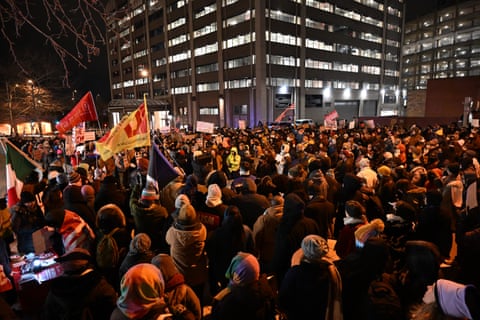
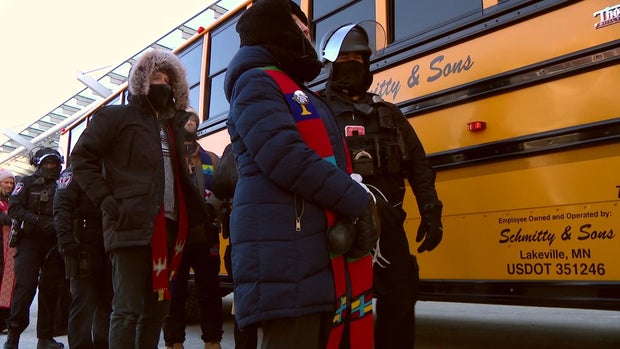
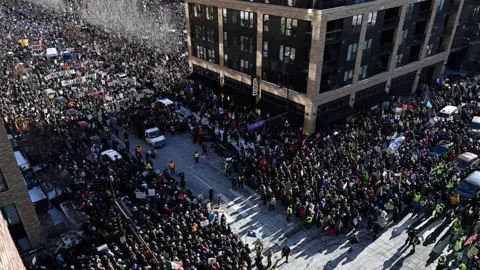
Thousands of people in Minneapolis turned out in freezing weather tonight to hold a vigil for Good.


Why does this matter?

  • This kind of indifference to human life and suffering is completely depraved. 
  • Defaming a dead woman and her grieving family for propaganda purposes is evil.  
  • Deliberately telling obvious lies and demanding that people ignore what they can see with their own eyes is so basic to fascism that it's a plot point in 1984
  • This is what unaccountable secret police deployed to stir up political trouble always do.

Tuesday, January 6, 2026

What did Donald Trump do today?

He stopped making legally required federal aid payments for needy children to states run by Democrats.

Temporary Aid for Needy Families (TANF) is a federal cash assistance program that gives block grants to states to provide for basic welfare for poor families. The Child Care Development Fund (CCDF) underwrites child care programs so that parents in low-income families can work. Social Services Block Grants (SSBG) fund foster care programs, adoption services, and other child welfare services. All three are funded by Congressional appropriation through the Administration for Children and Families (ACF), a division of the Department of Health and Human Services.

Today, and without offering any legal justification, Trump froze all of those funds to five states: Minnesota, California, New York, Illinois, and Colorado, or about 22% of the country by population. This means that about half a million people from TANF alone will be without the food assistance American taxpayers have already funded, and federally subsidized daycares are likely to shut down abruptly.

Trump's administration claims it was because of suspected fraud, although there is no direct evidence of unusual fraud in any of those states, and an active investigation in only one of them. What they do have in common is that they are states with Democratic governors and heavily Democratic-leaning electorates.

To be clear, there is almost certainly fraud in each of these programs in every state. As a rule, it is not difficult to defraud any government. The trick, as Trump knows from extensive and bitter personal experience, is getting away with it. 

Trump has recently made Minnesotan children in particular a political target recently precisely because its government, led by 2024 vice-presidential nominee Gov. Tim Walz, had found fraud and taken action about it. Some of the fraud that Walz's government found was committed by Somali immigrants. Trump has targeted the Somali-American community, many of whom live in Minnesota, with racist attacks on their patriotism. 

Today's freeze seems to have been done in great haste in an attempt to keep Trump's version of that story in the news: identical letters requesting audit documents from Minnesota specifically went out to all five states 

It's been just over seven weeks since Trump last unlawfully stopped payments to help American children in low-income families who rely on federal subsidies for food and care. That came during the record-long shutdown at the end of last year over Trump's refusal to fund health care for 24 million Americans whose insurance comes through the Affordable Care Act.

Why does this matter?

  • Punishing poor children to hurt your political enemies is evil. 
  • No matter how many times he pretends otherwise, Donald Trump is not above the law. 
  • Fraudsters who live in glass White Houses shouldn't throw stones.

Monday, January 5, 2026

What did Donald Trump do today?

He switched from threats to bribes in an attempt to make Venezuela make sense.

Trump's stated rationale for the attack on Venezuela was to force what was left of its government to allow American companies to take over production of its oil resources. This has quickly proven to be a massive miscalculation. He doesn't have the cooperation of the Venezuelan government, which is essential in the absence of an massive occupation by American troops. And he doesn't even have interest from the oil companies, because of the massive infrastructural investment that would be necessary to make those oil fields profitable.

Trump claimed to have met with the three major U.S. oil companies before and after the initial attack, but that is a lie, according to the companies themselves. He also claimed through a spokesperson that they were "ready and willing," which is obviously not the case. But in an apparent attempt to get them there, he floated the idea that the United States itself would reimburse those companies for the investment needed. 

In other words, Trump is saying that his plan is for American taxpayers to pay oil companies to extract and refine otherwise unprofitable oil in what would be—at best—a hostile occupied country, and then pay for the oil again on the open market. 

For the moment, oil production in Venezuela is down sharply following the attack, but at least some is getting out. Four tankers have run the U.S.-imposed naval blockade of Venezuela since the attack, and about a dozen since it was first imposed.

Why does this matter?

  • Launching a destabilizing attack on another country that nobody wanted with no plan for how to deal with the aftermath is criminally stupid.

Sunday, January 4, 2026

What did Donald Trump do today?

He may have figured out how badly he'd played himself in Venezuela.

Yesterday, Trump declared that he was "running" Venezuela through Delcy Rodriguez, Nicolás Maduro's vice-president and now acting president of the country. He appears to have been convinced that this was possible by Secretary of State Marco Rubio, who reportedly tried to negotiate Maduro's ouster with Venezuelan officials. This narrative was immediately demolished by Rodriguez's fiery denunciation of Maduro's abduction and the cost in Venezuelan civilian life.

As of today, Rodriguez appears to be fully in command of the Venezuelan state apparatus, and remains defiant towards Trump. The result is that Trump appears to have blundered into a situation where he's strengthened the genuinely corrupt and illegitimate Maduro regime—and further weakened the legitimate Venezuelan opposition, which also condemned the attacks—in furtherance of a corrupt bargain that existed only in his mind.

Today, as that reality seems to have become clear to him, he threatened Rodriguez's life. "If she doesn’t do what’s right, she is going to pay a very big price, probably bigger than Maduro,” he told The Atlantic. This comes less than a day after he'd bragged that Rodriguez was in effect his puppet, and that she would be "willing to do what we think is necessary to make Venezuela great again."

Rodriguez wasn't the only person Trump has had to threaten to go along with his plan. The real justification for the attack, as he explained it yesterday—seizure of the oil fields that Venezuela nationalized fifty years ago for exploitation by American oil companies—is foundering on the fact that those American companies don't see Venezuelan oil as profitable to exploit. Venezuelan crude is of low quality and requires highly specialized refineries to be turned into useful products. That would mean an enormous up-front investment in new refining capacity, which would only make economic sense on the scale of decades' worth of access to oil that neither the Rodriguez-Maduro government nor its opposition are willing to simply give to the United States as a prize.

Summarizing the last two days: Trump has tried to turn Venezuela into a client state with the explicit goal of getting oil that even American oil companies don't want, by tightening the grip on power of the very same regime he was trying to oust, in the face of massive American public opposition. At least 80 people, mostly civilians, are dead, not counting the people killed on boats when Trump was trying and failing to drum up support on the theory that his problem with the Maduro regime was drugs, not oil.

Trump also threatened to attack MexicoColombia, Cuba, and Greenland today. 

Why does this matter?

  • There's no difference between a president who isn't capable of thinking through the logical consequences of starting a war and a president who simply doesn't think he has to. 
  • There's a difference between having power and saying you have power in the hope that anyone will believe you. 

Saturday, January 3, 2026

What did Donald Trump do today?

He launched an attack on Venezuela in furtherance of a plan he hasn't come up with yet.

In the early hours of Saturday morning, the United States launched an aerial attack on Caracas as an apparent distraction for the apprehension of its president, Nicolás Maduro. At least forty civilians are reported dead so far. Relatively little else is known about the attack almost a full day later.

At a press conference this morning, during which he struggled to stay awake when others were talking, Trump made perfectly clear that this his motivation was not the Maduro's supposed involvement in drug trafficking, or the questions around his legitimacy, but rather Venezuela's oil industry. (Venezuela produces a moderate amount of low-quality crude oil.) Trump claims to believe that the oil in Venezuela belongs to the United States by right, because Venezuela nationalized its oil industry fifty years ago and expelled American companies. He also claimed that those same American oil companies would participate in the takeover of the Venezuelan oil industry, saying that the United States was "in the oil business." He said, "We’re going to have our very large United States oil companies – the biggest anywhere in the world – go in, spend billions of dollars, fix the badly broken infrastructure and start making money for the country." 

Asked for comment, no American oil company was willing to validate Trump's claim. 

Trump also insisted that the United States would "run" Venezuela in the meantime. How this was possible was immediately unclear: there are no American troops on the ground (that Trump has acknowledged, anyway), although he didn't rule out the possibility of American forces being deployed to Venezuela, which is roughly the size of the eastern seaboard of the United States. Trump and his administration seemed to genuinely believe they would have the cooperation of Venezuela's vice-president and now acting president, Delcy Rodriguez. But Rodriguez immediately and passionately denounced the capture of Maduro as a "barbarity," calling him Venezuela's "only true president," and vowing that there would consequences for the United States.

It's not clear why Trump believed Rodriguez would support what amounts to an external coup. She is generally regarded as an integral part of Maduro's administration, and is under personal economic sanction by the United States. Confusing matters even further, Trump specifically rejected the idea that the Venezuelan opposition—widely regarded as having a legitimate moral claim on the Venezuelan presidency after the disputed 2024 elections—could now form a government. 

In other words, based on what is known tonight, Trump launched an attack that killed at least 40 Venezuelans in order to apprehend Maduro, then confidently but wrongly claiming he had the support of the second-in-command of the same regime—the one who was supposed to allow him to "run" Venezuela. 

The official justification for Maduro's apprehension was an indictment in U.S. federal court for his alleged involvement in cocaine trafficking. This is the same offense for which Trump pardoned a different former head of State, Juan Orlando Hernández. 

Trump himself was indicted in two different federal districts and remains liable to prosecution—and presumably capture by the United States military—when and if he leaves office. 

Why does this matter?

  • The skill and capability of the United States military does not make up for this kind of incompetence at the executive level. 
  • Innocent people died today for a plan that Donald Trump hasn't bothered to think through.   

Friday, January 2, 2026

What did Donald Trump do today?

He changed his position on whether it's a good thing to shoot protestors.

Trump was apparently awake at 2:58 a.m. this morning, and took the opportunity to post on social media that he would "come to the rescue" of Iranian protestors if the government of Iran "shots [sic] and violently kills" them.

There are protests happening now in Iran, over the country's dire economic situation. Unlike some previous uprisings in Iran, these don't appear to be aimed at toppling the government. That was more characteristic of the 2019-2020 protests during Trump's first term, which he largely ignored as some 1,500 Iranian citizens died.

Trump didn't say how the United States would "rescue" protestors—and nobody thinks he could. A ground invasion is inconceivable and airstrikes would only endanger protestors. Even Iran's government, which routinely uses Trump's threats and bluster as a foil against its population, didn't rise to the bait.

Trump himself has threatened violence against protestors many times when his regime was the target. He made a running joke of promising to pay the legal bills of supporters who attacked protestors at his campaign rallies, although he immediately broke that promise when someone took him up on it. His own Defense Secretary, Mark Esper, said that Trump's reaction to the George Floyd protests in 2020 was to ask whether the United States military couldn't be deployed to "just shoot them in the legs or something." 

This isn't the first time this week Trump has rattled the saber against Iran. Earlier, it was to warn the Iranian government of unspecified "consequences" if Iran continued to build up its nuclear program—the same nuclear program that Trump claimed six months ago was "OBLITERATED LIKE NOBODY'S EVER SEEN BEFORE" by telegraphed bombings of certain facilities. (As experts pointed out at the time, Iran was obviously capable of refining uranium almost anywhere, making the attacks on hardened underground targets mostly cosmetic.)

Why does this matter?

  • Empty threats like this make the United States look weak. 
  • You either believe shooting protestors is wrong all the time, or you don't believe it at all.

Thursday, January 1, 2026

What did Donald Trump do today?

He did just about everything he could to make people question his health and judgment.

At midnight Thursday morning, Trump was where he's spent most of the last two weeks: his private resort in Florida. As usual, his right hand was pasted over with makeup that doesn't match his skin tone, to cover up a bruise he claims is from shaking hands. That explanation, which the White House continues to gamely offer reporters who ask about it, doesn't explain why Trump has recently been wearing concealer on his left hand, or why he's needed adhesive bandages to cover the spot where an IV for some undisclosed infusion would go.

But today, Trump had more news about his health—none of it good. The Wall Street Journal posted a long article today detailing his various health struggles and his increasingly obvious decline in energy and cognitive fitness, as well as the effort to portray him as healthy and fit. As is typical for such stories, the reporters asked the White House for comment before publishing, and were surprised when Trump made himself available for questions. 

In the course of the impromptu interview that followed, Trump blamed his hand bruising on his aspirin regimen, saying that he takes 325mg per day in order to get "nice, thin blood pouring through my heart — does that make sense?" From a medical standpoint, it doesn't. Daily aspirin is almost never prescribed anymore for people who have not already had a cardiac incident, even people whose heart health is suspect, like Trump admits his is. And when daily aspirin is indicated, the dose is 81mg, not 325. 

In other words, Trump says he is taking aspirin explicitly against doctors' orders, and four times the dose that would be recommended even if that were a good idea.

He also tried to retroactively downgrade the mysterious MRI that reporters learned he'd undergone last fall to a CT scan. When news of the MRI broke, he claimed he didn't know what it was for—something almost impossible to believe, as MRIs are never done unless a physician is trying to confirm or rule out a specific and serious health issue. But some drug regimens, notably Alzheimers drugs like Leqembi, do require an MRI to ensure they're not causing dangerous brain swelling or fluid buildup.

As is often the case, it's not clear whether Trump was confused then or lying now, although it's worth noting that even if Trump didn't know the difference between an MRI and a CT scan, his doctors and staff would, and could have corrected the record earlier.

Trump said the lesson he'd learned from all this was, in so many words, not to tell people about future medical procedures. "In retrospect, it’s too bad I took it because it gave them a little ammunition. I would have been a lot better off if they didn’t, because the fact that I took it said, ‘Oh gee, is something wrong?’ Well, nothing’s wrong.”

Trump, who handed over control of the nation's public health and medical regulatory agencies to a devotee of pseudo-scientific conspiracy theories, is full of unusual ideas about health. When the COVID-19 epidemic broke, he publicly suggested using household cleansers and veterinary deworming agents as a drug therapy. And he unironically believes an 18th-century theory that exercise is bad for the body because it uses up the finite amount of energy a person is born with.

UPDATE, 1/2: Trump followed up early this morning with another social media post claiming that he had "just" passed his "third" dementia screening test. Trump also announced passing his third dementia screening test a month ago. It's not clear whether Trump mistakenly thought the December exam had just happened, or whether his doctors had for some reason ordered a fourth dementia test and he'd lost count, or whether he's simply making things up.

Why does this matter?

  • Presidents who can't be honest about their health (or simply can't remember what it is) aren't healthy enough to serve. 
  • Someone who gets and then ignores the best medical advice in the world on matters that might kill them is also unfit, although more on grounds of stupidity or narcissism.